FoolQuest.com
remains the website dedicated towards
collaborative
social engineering
of new and better alternatives in how we
lead our lives, anything conceivably more
honest, congenial, user-friendly and rewarding
in human
existence.
All
ensuing largely in accord with a sweeping condemnation of the range of
conventionally oppressive life options
of
heteronomy,
very much
including religion evre defending the tyranny of biological destiny.
But
religion is ever more largely supplanted with all manner of dangerous and no
less
heteronymous
secular ideological substitutes likewise
receiving all due merciless scrutiny herein.
What remains is that when any or other
belief, let alone emotional dependency
thereupon, is promulgated and embraced
as any sort of moral
obligation, by whatever claims of
Divine Commandment or
else by whatever conceivable secular ideological
substitute or purpose, then thereby is
constrained not only free expression but
even private thought; all remaining indispensable
to
honest
open minded investigation and therefore
survival. And this has
always been how religion has served to
justify all manner of even deadly folly and evil,
perhaps actually more often than to
inspire righteous compassion and
moral rectitude. For there
can be no other
values without truthfulness first.
Sigmund
Freud, the founder of Psychoanalysis,
classified religion under
“obsessional neurosis”, suggesting
that a belief in a God was the result of
an “immature infantile helplessness”
to then seek comfort in the fantasy of
an omnipotent protector. But Freud
remains is far too charitable. To quote
Augustine: “Faith is to believe what
we do not see, and the reward of this
faith is to see what we believe.”
But as George Bernard Shaw cautions:
“The happiness of credulity is a cheap
and dangerous quality.” Religion
remains indeed delusional. And delusion
will never improve, but only exacerbate,
Existential
Absurdity. And
so much worse, religious or ideological
denial
remains merely
terror management strategy of
Deathism. Even ostensibly
secular glorification of
death that somehow passes for
philosophy, remains actually the
legacy of religion. Alas, all such time
honored wishful thinking and
convolutions notwithstanding, mortality and
death remain only the
most
Existentially
Absurd
among dire aspects of life itself.
That
morally, everyone maintains every right to irrational
beliefs and practices, constitutes scant
sound recommendation in favor any
thereof. If only like every antirational
belief and practice, scientific and rational
Emortalism and
Cryonics were similarly accorded the same
reverential rights, and thence
freedom from often uncooperative passive
hostile persecution by deviously
uncooperative doctors and mortuaries,
let alone sometimes actual obstruction
by legal authorities among others. Much
as Christian Science opposes modern
medicine, a certain squeamish bigotry of
terror management in the embrace of
Deathism, reviles and even
persecutes
Emortalism and
Cryonics no less than abortion
on demand. Although, in fairness, some
religious people are by contrast, much
more tolerant and supportive. Personal
religion is less often any
moral force or determinant, than only a mirror of
character
and inclination, even however
antirationally so, and therefore so
dangerously dishonest.
But organized religion is often such
brainwash
outright. Alas that any real
hope, even however slim and distant,
so broadly challenges and triggers such
acrimonious defense of longstanding comforting lies
and despair so typical of
terror management, so much more readily
than triggering instead, compassion and solidarity,
the better aspect of
terror management. In effective Public
Relations, emotional appeals should
always be advanced to the latter.
Ironically, might the wishes and
equality of
Cryonics patients better be served and defended
by the institution and due legal
registration of an official
Church of
Cryonics? All not to digress, however.
-
-
-
-
-
“An Atheist believes that a hospital
should be built instead of a church.


-
-
-
-
An atheist believes that deed
must be done instead of prayer said.
-
-
-
-
-
An atheist strives for
involvement in life and not escape into
death.
-
-
-
He wants disease
conquered, poverty vanished, war eliminated”
-
-
.— Madalyn
Murray O'Hair
-
-

|
Is religion ever entirely so
monolithic? In all fairness, well may one ask: What about all the
good done in the name of God? Answer: It ought not to be the
constructive activity to which one ought to take exception.
Significant detriments remain.
Heteronomy
most generally, let alone religion specifically, all however
manifestly untrue, is embraced in order however poorly to meet the
needs of an individual most broadly, and perhaps particularly for
coping in the face of mortality. Indeed all such endures in the secularization of traditionally religious participation and
membership in collective identity and
terror management with such
enduring antagonism towards individual power and pleasure.
FoolQuest.com,
undertaking in depth analysis of the misery thereby inflicted upon
humanity, is an
outreach
with friendly
invitation as to what I and thou, gentle reader, might
consider doing about it for ourselves, together.
Quite simply, the ugly truth remains that proselytizing is
so often distinctly unChristlike. The cornerstone of any true ministration is to offer
understanding, sympathy and empathy to relate
to others, even without selling anything at all.
As well as contrasting
irresponsible
Mystically antirational explanation and worldview on the one
hand, with responsible rational mechanistic materialistic explanation and worldview
on the other hand, the present
discourse upon religion and atheism then moves on to examine various
fields of
Philosophy and
science traditionally claimed by religion and Theology. Most especially,
these include:
Axiology which is the study of
values, and then particularly Esthetics, Ethics and morality,
that are, not unlike
Metaphysics,
ever in such dire need of rescue from the clutches of Theology.
Perhaps most notoriously egregious of mass madness and
antirational religious intrusion into
politics, remains the "Pro-Life" movement
against abortion.
Indeed "Pro-Life" so glaringly begs every
question of comparison thereof to the
abominable rites of Becoming Sati,
of widow burning: For as shall be
seen, each
practice of destructive mass delusion
remains similarly
premised
upon the widespread sympathy in societal
acceptance of particular outlandish and
antirational supernatural claims, and both
remain violently oppressive to women.
More
generally, the
topic of religion
ultimately leads into the painful ubiquity, patronizing mendacity, mediocrity and
alienating
Existential
Absurdity of
every modern secularized
manifestations of various traditional
heteronymous
psycho-sociological aspects hither to of religious institution, authority and superstition in society
and also politics. For
heteronomy
along with
Moralism and the
cult of austerity,
inspires such blithely accepted modes of oppression
as Behavior
Modification,
formal education and the insidious cult of
socialization, not
to mention
terror management and
Deathism, all systematically
and so insidiously undermining personal
autonomy
and
capability.
Arguably by way of deconstruction, all such
evils ultimately partake of
crypto-sympathetic
magic. And enduring practice of
sympathetic magic,
however rationalized and obscured, is
traditionally contingent upon the long
refuted principles of similarity and
contiguity. - Even when, as shall be
made apparent, the resemblance is that
of counterfeit and the contiguity unclear.
For in the
magical
thinking of authoritarian
socialization,
formal education
and dysfunctional child rearing, it may
often be assumed that since fear may be
taken to resemble
respect, then the inculcation of
fear will eventually mature into
genuine, sincere and abiding
respect, and that the discipline
of obedience will slowly but surely bleed
though, transfer and blossom into individual
self-discipline, responsibility and
autonomy,
debilitating guilt into into
motivating empathy, and so on.
Of course, this very doctrinal con game of
Existential
bait-and-switch long stands long refuted,
the frightful counterfeit debunked and
exposed
psychologically. It should come as little
surprise to anyone, then, that Orwellian
willful positivety, no less than blind
faith,
so undermines happiness, and that docile
behavioral
compliance is
so isolating and
lonely,
even in all of it's most heady togetherness. But the conviction that blind
faith resembles and therefore cultivates confidence, and that doubt
resembles and therefore invites despair,
renders the most obvious thoughts so
taboo,
subversive and threatening to peace and
order. Indeed the entire toxic panic to the
effect that freedom is
anarchy and anarchy is strife, demands
heteronomy
to authority for the sake of very survival
and in order to forestall utter disaster.
The very notion of
collaboration
among equals
as advocated here on
FoolQuest.com, thereby becomes quite
incomprehensible and inconceivable! The
average person, inexperienced of anything
more vibrant and
meaningful,
has become blithely jaded and accustomed to
a profound social, emotional and
intellectual deprivation in which so many of
us find ourselves imprisoned.
|
- religion is antirational and miserable
-
-
- “Faith means not wanting to know what is true.”
— Friedrich Nietzsche
-
- “I would rather have a mind opened by wonder than one closed by
belief.” — Gerry Spence
“They are always saying God loves us. If that’s love I’d
rather have a bit of kindness.” — Graham Greene
- “It is natural to believe
in God when you're alone-- quite alone, in the night, thinking about
death.”
― Aldous Huxley, Brave New World
-
-
The faithful endorse their religious beliefs
because they think they are true, and theological justifications of
religious doctrines entail demonstrating their truth. Yet, Professor Jacobs
correctly observes that there are often compelling psychological and
sociological reasons why individuals become or remain members of a religious
community. People do want their lives to be meaningful and they do crave
intimate fellowship with others. Religions offer both. [...] Since
success is impossible for most people in [our current] social climate,
individuals experience a lowering of self-esteem. This creates a need to
recover a sense of one's own worth, a need to find a 'system of meaning'
which will.
-
-
SOCIAL
FAILURE AND THE DOCTRINE OF THE ATONEMENT. A NOTE ON ANTONK. JACOBS'
'IDEOLOGY, SELF-ESTEEM, AND RELIGIOUS DOCTRINE: TOWARD A SOCIO-PSYCHOLOGICAL
UNDERSTANDING OF THE POPULARITY OF EVANGELICALISM IN MODERN, CAPITALIST
AMERICA (URAM 13:122-133)
-
David Crossley, University of Saskatchewan,
Saskatoon, Sask., Canada
In 'Mere Christianity' C.S. Lewis asserts: “And out
of that hopeless attempt has come nearly all that we call human history—money,
poverty, ambition, war, prostitution, classes, empires, slavery—the long
terrible story of man trying to find something other than God which will make
him happy.” But all good things and social progress, historically,
including: commerce, affluence, ambition, peace, free love, equality, democracy,
freedom, art and science, also express the striving of humanity for worldly
happiness, do they not? For that matter, indeed how often are the former, the
very ills catalogued by C.S. Lewis, any less than the latter, the presented
counter examples, much alike advanced expressly in order to please God? C.S.
Lewis himself only follows in a long history of the extol of the embrace of the
abstract and fantastical in rejection, condemnation and abandon of
reality and
action, or at
least such alone, as hopeless and futile. Christians in particular, as we all
know, are enjoined to hate this world and this life. Still, perhaps best to be
wary of regarding religious culture and Endotheology
as monolithic and invariant. Religion, the good with the bad, tolerance and
intolerance, compassion on the one hand and
Moralistic
xenophobia on the other, is all product of terror management in the face of mortality. Religion like ideology can be whatever you want it to be, except
actually true when it is not. -In case any of that even matters in the
recommendation of pleasing, beneficial and even effective dispositions, basic
trust
or attitudinal faith, much less of doctrines and beliefs of doctrinal
faith, particularly in priority over the quest for truth, let alone from any
striving at improving conditions in life and the world.
Religion and Theism are antirational. And as shall be
demonstrated, Theism stands long discredited. Nevertheless, the efficacy of
religious practice, remains a separate though perhaps related question. First of
all, then, what is religion? Religion, prayer and rituals, are a
magical practice, as such the efficacy whereof remaining dubious. Moreover,
the
Epistemological
Methodology of
Magic, of signs, portents and
especially of faith, all embraced as "evidence of things unseen" is also
inherently magical. Heteronomy
to God as provided by religion often entails indoctrination.
Behavior
Modification,
brainwash, and every attendant evil,
therefore most anciently takes root in religion. Indeed, one consistent aspect
of religion is the exhortation to open-endedly redoubled effort at faith, which
is self-dishonest and
therefore engenders the ever mounting dystress
of
cognitive dissonance. Such is the inevitable
crisis of faith, never
accepted as refutation, but merely as demonstration that faith must be redoubled
all the more!
Moralism is also endemic to the consistent failure
of religion, to improve humanity. Indeed, there is also all the strife and
intolerance that results from terror management.
Indeed, any self deception may result in even life endangering poor decision
making. Indeed as Voltaire points out, belief in absurdities engenders the
commission of atrocities. Of course, religions inevitably do become more
Liberal, tolerant and therefore less destructive. Also, matters of faith are
compartmentalized in order to evade
conflict with reason and
reality. And believers still
find whatever comfort. Such much. And institutions, religious and secular alike,
must be assessed upon the merits of their works, indeed their
motivation,
for good or evil.
If any scripture is truly vested with exclusive authority, infallibility,
clarity, self-sufficiency, internal consistency, self-evident
meaning,
comprehensive and
universal applicability, then how can there be such vast variety of interpretive
differences even amongst those who embrace literal scriptural authority in just
such a manner? To
begin with, such claims violate the Incompleteness Theorem. Only a vast and even
infinitely long text could ever specify everything so completely as to remove
every possible
ambiguity
in linguistic logic. There is no
escaping the need for context of background information and bias that inevitably
differs. After all, any successful scripture actually endures by ongoing
distillation, actually
becoming so wondrously stripped of original historical context, becoming a veritable
Rorschach mirror for projection of
inner reflection, therefore so
powerfully relatable to all.
Atheism
defends the sagacity and poetry of scripture from the violence of literally
minded knaves and fools. In the words of Patti Smith: "The Bible is very
resonant. It has everything: creation, betrayal, lust, poetry, prophecy,
sacrifice. All great things are in the Bible, and all great writers have drawn
from it and more than people realize, whether Shakespeare, Herman Melville or
Bob Dylan." What seemingly monumental hubris then, howsoever to contest
scriptural veracity and authority! And yet, in truth, they miss the point, those
ardent cretins who take scripture for science or literal history. In the words of Clint Smith:
"One does not read a poem by Gwendolyn Brooks with hopes that it will grant him
a career in engineering; he does so because poetry helps him see something in
the world that he might not have seen before." For "the
language of theology is grounded largely in peripheral vision [and escapes
direct gaze]. It is not poetry exactly, but it’s more like poetry than anything
else. It can’t be forced, it can’t be manipulated, and it’s anything but
explicit" as
writes Paul Wallace.
Indeed, such may be appreciated as inspired
discipline of fuzzy thinking and another way understanding, that of
broadest verisimilitude and
polysemy,
that scarcely touches upon, much less contradicts, the entire scope of sweet
reason and
assertions that in order to
be true to singular
reality, must first be clear
and precise.
Scripture is living idea of poetical literature and
drama, hence, ultimately, in whatever comfort and sagacity, the wisdom of
crowds and the folly too, in truth the resonating voice of
scripture remains one's own. And so thus it comes to pass, that no two
cultures, indeed no two individuals, can ever truly hold in their hands the
same scripture, despite that every printed word be the same, any more than
wading through the same flowing and changing river twice. Flowing through the
minds of countless anonymous scribes over an ocean of time before any
canonization, scripture is washed cleanly out of historical context, taking then
renewed
relevance and currency in every reading, day by day in every time.
Scripture is the Rorschach mirror. And thus transfixed, we shall never set it down.
Indeed, hypothetically, whatever God might conceivably intend to express, however
unambiguous given God's own inerrant and comprehensive context of complete
background information and the totality of being, would nevertheless remain doomed to
ambiguity
before mere fallible human understanding. Fallible humanity is always doomed to
whatever degree of bypassing, exchange which is not genuine communication because it lacks
sufficient intersubjectivity and does not carry at all the same
meanings or even
purpose, intention or point at all between the participants, and that would
apply no less in relationship to God than among any others. Only ever an angel, could
ever hope always
to understand the mind of God perfectly!
That is precisely why so many devoutly religious
people in supplement to the study and scrutiny of whichever scripture, also seek
for God's representative on Earth, whatever true prophet of guru, or else,
scorning the proverbial Buddha on the road,
instead to search within, strive so
mightily to transcend mortal fallibility by achieving oneness with God. The
problem remains however, that at any moment, anyone can falsely believe oneself
to abide in such grace and exaltation, and realize otherwise only afterwards,
taking solace in learning humility. Hence, only God can
know who is indeed in a state of grace and clarity at any given moment.
Furthermore, is it even conceivable that an infallible God would never have
considered all the above conundrums, when instead of stopping with His perfect
Angels, instead He made humanity fallible? What then,
could a personal God have ever intended for Humanity, except Faliblism? And
beyond utter despair, what faith, except that attitude or disposition imbued by any
experience of good fortune and kindness at all whatsoever, the entirely
irrational and optimistic hope distinguished by Martin Buber
as Psychology of optimistic hope and basic
trust, that simply does not make
assertions or even actually
claim knowledge as such or
proffer specific predictions,
much less with any certainty, as does it's poor counterfeit, mere beliefs and opinions?
In the words of Alexander Lowen MD: "Conviction lies not in the ego."
Or to quote Joseph Fort Newton: "Belief is a truth held in the mind. Faith
is a fire in the heart." And the world turns without waiting upon certitude.
"Faith is the evidence of things unseen" the Good Book
tells us. But as it turns out, the test of faith, is not a means of testing
reality at all, even by whatever
Epistemological
Methodology somehow howsoever
at all dubiously employing faith. Rather, the test of faith is indeed exactly as it is so
named, the test of resolve in faith itself, demonstrating no more than that. Typically, religious or ideological
apologetics collates even the weakest corroboration while ignoring even the
strongest refutation. Such
dishonest lowering of all
rational, systematic, scientific and journalistic
standards of evidence is nothing but
bad faith, deadly
hypocrisy, and the reason
why doctrinal faith meant to shore up attitudinal faith, optimism, courage, hope
and
trust, can so frequently be observed to bring exactly the opposite effects
of depression and timidity. In the alternative, scientific rationalism and
systematic doubt, rejecting doctrine, is readily seen as entailing attitudinal
faith, not only in the intelligibility of the universe, but any human capacity
of
solution finding.
All rejecting demands of infallibility, in favor of ongoing error detection,
course correction and learning, ever less wrong rather than any purported
foundation of ultimate truth. - Rejecting
thus, also, the perfectionism of religion and ideology, in favor of the
responsibility towards progress by ongoing improvement.
Science strives to explain the unknown in terms of the
known, while religion contrives to explain the
known in the terms of the
unknown.
Any serious project then, of reconciliation between
science and religion will be challenging indeed, given such manifest
contradiction between rational inquiry and
Empirical
investigation of science under systematic doubt, versus the willfully wishful thinking of religion and
ideology. Scientific evidence of the existence of God, or in corroboration of
whatever other ideological tenet, would only remove the requirement of doctrinal
faith, while doctrinal faith, even the doctrinal faith in the process or results
of science itself, remains shabby and unscientific. Science is faliblist, while
religion and ideology are infaliblist. How can faliblism and infaliblism ever be
reconciled as in reconciliation of science
and religion, being indeed the stated endeavor of the
John Templeton Foundation? Religion and ideology reject reason. Apologetics may
deflect and evade reason deviously, or even castigate reason vehemently and
venomously, demanding renewed tireless indoctrination by any means necessary.
-
“Reason is a whore, the greatest enemy that faith
has; it never comes to the aid of spiritual things, but more frequently than
not struggles against the divine Word, treating with contempt all that
emanates from God.” ― Martin Luther
Epistemologically,
autonomously, in
science as in day to day functionality, getting by without certainty remains
entirely feasible and routine, by
living in reasonable doubt which is only healthy and responsible. The
autonomy of Falibilism, is simply embrace of
Socratic
Wisdom in the precept that one might always be mistaken, may be more alien to
Theistic religious heteronomy even than Atheism in and
of itself, all even despite the unfounded conjectural nature of day to day
interaction with
reality for everyone no
matter how pious, and indeed, of life itself physiologically and neurologically.
Human progress is not to be deemed fruitless simply because human progress is
temporal and not eternally changeless. That would be both oxymoronic and purpose
defeating, if not actually boring!
Epistemological
Methodology of systematic doubt, must itself be subject to ongoing error
detection and correction, conjecture and refutation. Again, such is life itself,
literally, even neurologically, as in sensory and nervous systems that actually
change and adjust by trial ad error. All is conjecture and fallible. But that's
not the end of the world but always new beginnings. Life is uncertain. There
is nothing in day to day life, much less
Scientific Method,
that waits upon absolute certainty. There is nothing in day to day
life, much less
Scientific Method,
that waits upon absolute certainty. The demand for absolute certainty is as
paralytic as any other brand of Perfectionism. Absolute certainty is neither
possible nor necessary. By the fruits of imperfect and temporal human progress
and individual human
character
growth, the
attitudes and values of scientific rationalism and democracy,
all so
scorned by Theo-crypto-Nihilistic
value destruction,
shall Faliblism be known.
Can the unbelief, lack of belief or even outright
disbelief falling under the category of Atheism truly be
deemed a creed, any more than not playing chess can be undertaken
as a hobby?
Answer: Given ramification of religion or Theism, then one might anticipate
corresponding ramifications to the lack thereof, to Atheism. But in truth, it is
hardly clear that religion or Theism, the belief in God, clearly determines any
other position or temperament, all so varied regardless of creed or religion,
Theistic or otherwise. And yet religion and Theism as purported sole grounds
for morality, are often marshaled or
pandered
outright in support of
Moralism,
while Atheism may appear often as a ramification of Scientific Rationalism which simply demands sound
Empirical evidence for the
existence of God or gods, just as with any other
hypothesis or
assertion and likewise
without special pleadings. And from Atheist debunking of Theism, of Theological
apologetics and of the most egregious so called Creation Science, much endless bickering with pious pinheads
accrues. But so does extensive public education in the progress of cutting edge
of evolutionary biology that Creationists are so quick to dismiss. And yet, so
much standing
controversy
seems already covered in great detail and redundancy.Therefore what I seek to
contribute here, all recapitulation notwithstanding, is better attention to
important cognitive and psycho-social ramification nevertheless all too
neglected, in questions of progress towards responsible liberating open minded
autonomy. Because religion is only the rear guard in
oppressive closed minded reactionary and irresponsible heteronomy.
In the ongoing struggle between
autonomy and heteronomy,
faliblist
autonomy is expressed in scientific rationalism and
democracy, while the institution and traditional Infalliblist
heteronomy
has in more recent history as often taken the form of ideology, but from
antiquity, that of religion wherein Apologetics are all largely part and parcel of a long established
and vast industry of diversionary travesty. And so merrily plunging down the rabbit hole we
go! All hence must it come as little surprise that each and
every one of the traditional purported
logical proofs of the existence of God are all
logically flawed Sophistry, long standing refuted. Because, in the first place,
reduction to First Principles is quite impossible. Proof, after all, is
only of validity, defined as theoretical
logical internal consistency, and
never of truth value, defined as correspondence to external
reality in
assertions, which is
never ascertainable by logical
possibility alone without actually testing by observation and experiment,
Empirically.
 At least with anyone
honestly declaring that where
the conclusions of science and scripture might if ever
logically
conflict, they will side with scripture, we
know where they stand and
can readily question and
criticize their dogmatism and double standards, because there is no pretense.
Indeed, only science is bound by standards of evidence seeking to screen out special pleadings of self-undermining reasoning. Whereas matters of faith hold
themselves to no such standard. And so, as far as internal consistency alone, that
confession should simply be the end of it.
At least with anyone
honestly declaring that where
the conclusions of science and scripture might if ever
logically
conflict, they will side with scripture, we
know where they stand and
can readily question and
criticize their dogmatism and double standards, because there is no pretense.
Indeed, only science is bound by standards of evidence seeking to screen out special pleadings of self-undermining reasoning. Whereas matters of faith hold
themselves to no such standard. And so, as far as internal consistency alone, that
confession should simply be the end of it.
- “After Jesus Christ we have no need of speculation, after the Gospel no
need of research. When we come to believe, we have no desire to believe
anything else; for we begin by believing that there is nothing else which we
have to believe ...” — Tertullian
But Theistic pseudoscience can be no less dogmatic and convoluted than
Theology to begin with. All the standard distortions of Apologetics are routinely
brought to bear in support of the existence of God, including all manner of
scientific misconceptions and omissions in order to fabricate scientific
problems then demanding explanation only by intelligent design or God one way or
another. Or else Apologetics may often be extremely learned in the sciences,
demanding a great deal of attention to detail from the reader. Because, in the
suggestible
receptivity of faith, which is the cultivation of satisfying beliefs in order to
bring about altered states of consciousness, and the protection of said beliefs
in order to cultivate altered states of consciousness in the long term, even bad evidence gains weight as
it accumulates. -As if
the house of cards might still stand, at least one or two broken
logical links
and mooted points hovering miraculously.
- “There is on earth among all dangers no more dangerous thing than a
richly endowed and adroit reason, especially if she enters into spiritual
matters which concern the soul and God. For it is more possible to teach an
ass to read than to blind such a reason and lead it right; for reason must
be deluded, blinded and destroyed. [...] Faith must trample underfoot all
reason, sense and understanding, and whatever it sees it must put out of
sight, and wish to know nothing but the word of God.” —
Martin Luther
Alas, in truth, all of the extensive
information and argumentation of such Apologetics, much like unto empty
gossip,
is centered about the same shopworn general
logical falsities in the of
Scientific Method and standards of evidence, herein to be stripped bare:
Have I ever wondered why I am never yet called of God? No,
not really. First of all, is there any God to begin with? Otherwise, can one actually be called by anything or anyone
that does not first really
exist? Yes. one can. One can heed the calling of an idea. But many ideas occur,
and no one takes heed to them all. As for the mere idea of God, clearly I am too skeptical. I could only go through the
ritualistic motions of inviting God, without the requisite sincerity of the
appeal. It only ever works for anyone at all suggestible to give credence to Theism to
begin with. But perhaps the greatest sticking point, to the best of my
knowledge as
yet unaddressed by any Theologian, would be as to the very validity of the
experiment, which I do question. -Precisely because
of the vividness and confidence of the sought for altered state of
consciousness
if successful, nevertheless and no less entirely
subjective.
The entire undertaking might at all qualify as a Psychological experiment, with
no conceivable bearing upon
objective
reality, except by special pleadings for
circuitous reasoning to assume the veracity of
Mystical experience and the
existence of God to begin with. Nor are there conditions of refutation, because
there will always be testimony or anecdote of success, and negative results are
dismissed, accurately I might add, as lack of faith, in other words:
honesty and
objectivity. And
besides, an all powerful God
would never need be so coy. Wary of wishful
thinking, rational people do not strive to cultivate personal certainty for its
own blissful sake, but instead seek truth and
value honest opinion of one's
own, to be challenged by
Empirical
investigation of reality not
subverited by brainwash and autosuggestion. Such an endeavor would constitute a
Psychological experiment at best, with no bearing upon external
objective
reality. In science, doubt is
not an enemy to be overcome. Rather, systematic doubt is the guide of
Scientific Method.
Rational people do not struggle to quell doubt, but at all to settle doubt, one way or
another, coming ever closer to truth, less wrong, by investigation seeking truth defined as
correspondence to
reality in
assertions.
Rational skepticism and credulity place the burden of
evidentiary support upon the advocacy of any given hypothesis. Faith, however,
stands the process of rational skepticism on its head, proclaiming that
beginning from belief, evidence appears, unfolds, and accumulates. But that is
merely confirmation bias, accumulated corroboration ignoring all refutation of
contrary evidence. Religion provides time tested procedures in the cultivation
of pleasing beliefs. If only you will open yourself and male the effort at
wishful thinking, you too can join with us and believe as we do, exhort the
faithful. I don't doubt it! But what if one
honestly simply does not take Theism
seriously? Should the unbeliever then simply go through the motions? Would there
be any point? Indeed, Evangelists of every stripe often exhort all whom
they hope to convert, to undertake whatever particular prayer, meditation or
such, usually with a certain required attitude, as a means of direct evidence,
in order for the subject to achieve the certitude of divine revelation for
themselves. But thus do they simply presume
Epistemological
Methodological
consensus.
Because, even assuming resounding success, why accept any such at
whatever ostensible face
value any more than drug experiences, hypnosis or any other similar incidentally
altered or deliberately tampered with states of consciousness and
impaired
judgment? Since when is even the most immediate of direct experience beyond
question and skeptical examination? Because, what can there ever be in human
nature at all beyond fallibility? Since when is direct experience so completely
reliable?
So ignorant of basic
Phenomenology, many
religious people are often so blithely uncritical of naïve perception at face
value, and are surprised, even incredulous, to learn, for example, how the
astronomer Christiaan Huygens, discoverer of the rings of Saturn, had first to
even at all to conceive of the rings of Saturn, before being able to see them.
Indeed, Galileo was unable thus to visually interpret his own observations
thereof. And of course, that is only one among so many celebrated illustrative
examples in demonstration of the theory laden conjecturality and therefore
inevitable bias, even of perception and experience.
Religion remains, after all, Karl Marx's notorious opiate of the masses,
antirational terror management strategy so
prone to pernicious nonsense with such great conviction and hence meaningless
conflicts that can never be settled. And so, by
appropriate analogy, do the other people at the bar
really become more
beautiful the more one drinks? After all, pub crawling too, has it's ardent and fevered
Evangelists! And so, with no
satisfactory answer, all such mental masturbation must be recognized as
experimentally inconclusive, no matter how vivid. Because even the most
successful desired results remain open to a myriad of explanations and are well
known to be very much colored in the mind by preconception even to be
intelligible at all. Yea, verily, experience is biased by context of
expectations. And apparently, there are not only the entire range of paranormal
interpretations and the idiosyncratically surreal, but even entirely prosaic
apprehension of much the same experience, altered states or day to day private
cognition and emotion. After all, in
the Epistemology of science,
which, Methodologically, is the application of systematic doubt, inspiration from the willing
suspension of disbelief and judgment, is not the
motivating end
goals
ever
put forth, as in religious faith,
but only a starting point of unsupported conjecture to be subjected first
to
critical preference
and then to
Empirical
reality testing
and the quest for the simplest likeliest explanation.
Indeed, as yet there is no evidence for God save as He may be evoked explanatorily,
even so far as affirming the consequent or converting the conditional (Modus Ponens). That is to say, by the same observable outcome,
be such
Ontological or
Phenomenological, that,
however, may be, and indeed is, also and better explained
by whatever other competing viable hypotheses.
Hence, the current evidence for God is only as good as Theistic explanation for
scientific problems. And for any given problem, either there are alternative
hypotheses to that of the existence and agency of God, or else, conceivably, there might not
be. Even if neither first cause nor infinite regress are deemed satisfactory
explanation, that still does not necessitate God, because God explains nothing,
being Himself and His alleged agency unexplained, unsupported and theoretically
inelegant. What profit is there in simply shifting the burden of explanation into
an even more difficult problem, when the entire point is simplifying theoretical
elegance of adequate explanation?
Hypothetically, if there would be currently no other
known explanation, than, for
example, flying saucers, spontaneous anxiety,
Santa Claus, conspiratorial Jewish bankers or God, then
this only amounts to the same tired and fallacious
Argumentum Ad
Ignorantium or
argument by lack of imagination, jumping to conclusions in the face of the
unknown, circuitous
reasoning affirming the consequent. Because, even when we have no explanation at
all, new explanations may arise later and often do. The lack of explanation or
solution at any given time offers slim support indeed for paranormal claims,
whatsoever. If there are no good explanations, for however long, that still does
not support bad explanations, unsupported explanations and out and out non
explanations! Of course there will always be new questions, but God has yet to
become a viable hypothesis. God remains an inelegant non explanation. There is,
as yet, precious little in the way of mechanistic explanation of how God is
supposed to exist, function or accomplish all that He is presumed to have done
or to does. Nor, indeed, much effort at all to improve matters, neither
theoretically nor experimentally. Indeed, lately, God has been a fruitless
hypothesis, supported only by faith, by wishful thinking.
- Just for example, and if only any of them
where ever either qualified or even as remotely serious as they pretend,
what is there to stop those who contend, perhaps inspired by Gaia
Hypothesis, that speculative particle physics of infinitesimal multiple
extra dimensions could computationally facilitate even omniscient
universal consciousness, from actually building and even someday perhaps ever testing
howsoever workable models even in simulation? Of course whereas Gaia
hypothesis proposes that the ecosystem is howsoever homeostatic and
responsive to changes made by post industrial human presence, with at most
the "consciousness" on an ameba responding to even intrusive biochemical
changes, Gaia worship assumes the heightened spiritual consciousness and
super intelligence of a Divinity. Which model is simpler and likelier in
explanation of repeatable observations? Similar questions are begged with
regards to physics and the universe. Untestability may be linked to other
issues of
critical preference, such as parsimony of explanation and
alternative explanation, because, if there is any
known conceivable
concrete process by which any proposed phenomenon might conceivably occur
and thus exist, that might tend to at least to point the way towards a
testable hypothesis after all. Therefore there is nothing to prevent
formulation of at least seemingly over complex models in order to make
predictions and follow up with investigation in search of repeatable
observations that previous oversimplified models will then be unable to account
for.
-
- Alas however, none of the vast resources marshaled in
supposedly reconciliatory allegedly scientific defense of
Theism are
known, lately or ever,
to have been devoted to theoretical development let alone at all conclusive
repeatable experimental results or observations. No one whosoever at all has
risen to even the theoretical challenge of
Theophysics! -Let alone the
quest for credible evidentiary support thereof... However slim the prospects for
success, the uplifting vindication of
science is in the fruitfulness even of failure. Alas, even if there is no intrinsic
reason why that there could be no genuine attempt at Theistic science, whatever
the risks entailed or prospect of success, none such is
known actually to be practiced, the challenge unanswered save by the same tired
Apologetics. Worse, given success, where would that leave faith?
Hence, scientifically, thus far, all that evoking
Intelligent Design AKA God the creator, accomplishes is to remove any complex problem to
an exponentially more complex problem upon which there has been no progress to
speak of. Simply because intelligent personality is a complex ordered
phenomenon, does not
logically attribute all other
examples of complex ordered phenomena to the guidance of any intelligent
personality. Rather, whereas antirational religion explains the
known
in terms of the mysterious, in rational science, seeking to build and test
(corroborate and refute) explanation of the hither to unknown
via the
known, even intelligent
personality must be explained the same way as other complex ordered phenomena.
And the latter endeavor remains fruitful, whereas the sheer vague supposition of
Theology remains fruitless at very best. God, then, lies on the cutting room floor amid the fat trimmed by Ockham's Razor. Hence, any
viable hypothesis remains far better than Theism.
The classic syllogism endures: If all men are mortal and
if Socrates is a man, then it follows that
Socrates is mortal. But what if
Emortality, the aging cure, is finally achieved and made available? Well in
that case, not all men will remain mortal. And
Socrates would remain mortal only by the disagreeable happenstance of
already being long dead. What we need then, is
retrograde time travel! Be all that as it
may: What follows is a
logically valid and yet
Empirically falsified
demonstration of the existence of God: If a certain level of order and
complexity is impossible except by intention, and if such extreme order and
complexity exists, then it only follows that there must be a Creator God. But
the major
premise, that a certain level of order and complexity is impossible except by intention,
stands long refuted. Indeed, an overriding
theme
of modern science remains
repeatable
Empirical
observation, duplicatable experimental results, of the simple becoming
progressively more complex: of the ongoing foment of simple chemicals into ever
more complex molecules, the evolution of simple cells into ever more complex
organisms, of atomic fusion of simple atoms into heavier and more complex
elements, all neither by intention and yet nevertheless not simply at random,
but by consistent mechanistic causality. But not everyone
knows
and understands science very well, and for such as they, God seemingly remains
viable hypothesis. Worse, many are ever conniving and simply insincere about any
wish to participate in science. Only some among such mediocre
hypocrites are at
least
honest about staunchly
putting faith first. and science be damned.
- “A casual stroll through the lunatic asylum shows that faith does not
prove anything.” — Friedrich Nietzsche
-
- The burden of evidence upon the positive
- Why the burden of evidence can only rest upon the positive, and
under the burden of evidence upon the positive, the at all supportable
hypotheses, the hypotheses with any evidence, are first sifted out from
the mass of unsupportable hypotheses arbitrarily.
The Skeptics of antiquity espoused open mindedness to the point of suspending
all judgment. But the skepticism of scientific rationalism,
Scientific Method and systematic doubt, is
somewhat less extreme, following the venerable maxim of burden of evidence upon
the positive for assertions. Assertions
are declarative statements such as employing the verb: 'to be' in
denotation of Ontological
claims regarding
reality or anything
real. And as shall
be demonstrated, the maxim of burden of evidence upon the positive is by no
means arbitrary.And much as in
science, under law there is the presumption of innocence pending conviction or
vindication. One kind of assertion is allegations and accusation. These are
assertions of events of wrong doing.
logical
Hence then hypothetically, there will be no need of an alibi for Bigfoot until evidence
arises indicting the Sasquatch of, for example, the Kennedy assassination, and indeed no need
to refute the very existence of any cryptid primate in the first place, until
there is any evidence to refute. How absurd! And that is the point. However a
more serious problem often arises whenever the
same body of evidence is called in support of competing hypotheses. The question
then is as to which hypotheses are currently better supported by the evidence,
thereby remaining viable. It will be such hypotheses that better explain the
evidence, that therefore indeed meet the burden of evidence upon the positive.
This brings us to the logical fallacy of
Affirming the Consequent, as for example, citing
the very existence of the pyramids as evidence that the pyramids were
built using alien technology. Especially not given that actually we do know how
Egyptians could have moved those massive stone blocks with what they had, and
even have the evidence of which methods they actually did employ. Although, even
if we didn't know, that doesn't mean that space aliens helped. That fallacy is
called: the Argument from Ignorance.
But there is also a simple mathematical
demonstration herein presented step by step in
logically leading
dialectic, as to precisely why the burden of evidence can only rest upon the positive,
and under the burden of evidence upon the positive, the at all supportable
hypotheses, the hypotheses with any evidence, are first sifted out from the mass
of unsupportable hypotheses arbitrarily.
For every true assertion, there will be even an infinite number of variants that
are false. Does this follow? Do you agree?
Thus, it follows that statistically, all things being equal, the odds of any
hypothesis or claim chosen at random, being true, are infinitesimally slim. Does this follow? Do you agree?
Knowledge is awareness of
truth, and truth is correspondence to
reality in
assertions. Truth
is both singular and exceptional. There is only one
reality, one truth, and
the assertions that are true, are the exception from
amidst the vast majority of assertions that are
known
or unknown to be false.
Does this follow? Do you agree?
Hence seeking to refute all of the infinite number of all
possible hypotheses, including that majority thereof, being the unsupported
hypotheses, hypotheses lacking evidence, cannot be as efficient and productive
as attacking and defending the far fewer and more limited number of hypotheses that do appear to be supported by
evidence. Does this not also follow? Do you agree?
That is why under the burden of evidence upon the
positive, the at all supportable hypotheses, the hypotheses with any
evidence, are first sifted out from the mass of unsupportable hypotheses
arbitrarily. Is this now clear?
Of course evidence might still conceivably arise for Creation, but the evidence
already and still better supports evolution by natural selection. Evolution could
conceivably be refuted, say, by the discovery of a fossil rabbit from the
Cretaceous. But there are no
known
standards of refutation for God or Santa Clause.
Appeals to the supernatural are therefore nonpredictive and untestable. How is
evidence one way or another, even possible? Neo-Darwinian evolution, by
contrast, does significantly meet burden of evidence upon the positive.
Science
is often
criticized
for materialistic bias. But
honestly, no matter how
often repeated, can that aforesaid frequent complaint of
Mysticism
truly ever stand as any sort of valid
criticism? Indeed, pray tell, what would a nonmaterialistic science even be like?
Science must assay Empirical
evidence of material
reality. By contrast, Theology is a discipline with no observable external
reality. And that may be why
believers so often strive to shift the burden to the negative and thereby take
leave of rational constraint: "Yes Virginia, there is a Santa Clause!"
-even though he cannot be found. For such is blind lunatic doctrinal faith that
religion so prizes as greatest of virtues.: And antirational religious or
ideological doublethink often ensues.
Mediocrity
Principle and mechanistic materialism

In nature, intelligence arises from complexity, not
complexity from intelligence or soul essence, the precept whereof being
flagrant non-predictive non-explanation and untestable. Whereas in the alternative at all,
the hypothesis remains viable and supportable, that somehow
Ontologically the
quantifiable active physical
reality of the nervous system
comprise the mechanism of Phenomenological qualitative experience,
conscious awareness, cognition and emotion.
But best human knowledge to
date thereupon is admittedly general and limited. Nevertheless, complexity by
itself remains insufficient inference for Intelligent Design and thence a Designer. Even living organisms are
not irreducibly complex. After all, we
know full well, one way or another, indeed, in very principle, that order
progresses without deliberate conscious intelligent design. Because, the happenstance of
blind and incognizant natural order, even however imperfect and suboptimal as real adaptations
inevitably will be, and entirely without guiding consciousness, is the result of natural selection under physical
conditions providing for randomness but under constraints of circumstance. Unlike paranormalism, science is more
concerned with the ordinary than with the unusual or even purportedly
miraculous. There is no real understanding, say, of the wondrous birth or two headed
livestock, without first unraveling the secrets of the most ordinary biological
reproduction. Science, after all, quests after reproducible results not
irreproducible quirks. And this approach has been fruitful. Indeed, certainly, at first blush, one might
wonder daunted at the utter improbability of the sheer complexity of the
universe, all out from empty chaos and darkness, let alone ensuing evolution of
life. But surprisingly it turns out
indeed, especially given nigh endless repetition and adequate range of variance, how the very wonders both of a complex universe and the evolution
of life
thereafter are both actually highly probable, indeed, nigh inevitable, under the
right conditions which turn out to be quite common, typical, likely similar
enough if not actually identical in many times and places,
even mediocre
rather than exceptional. - Existence out
from empty chaos and darkness, and living ecosystems anywhere under the right
chemical conditions thereafter. After all, circumstances under which order
spontaneously appears as an emergent property of complex interactions among the
parts of a system, far from being only a figment of mathematical imagination,
even include certain meteorological phenomena such as tornados are neither
regular nor random but are already the result of intrinsic self-organizing
processes without external guidance. Hence, as applicable likewise also to a
wide range of even more complex phenomena, we now
begin to
know and understand how chaotic flux is an unstable
and impermanent state, because, eventually even by sheer chance, homeostasis
always eventually arises from such a state of utter chaotic flux, bringing an
onset of the development of ordered complexity, tightly integrated dynamic
complex systems of organized correlation between functioning components as a
result displaying emergent even howsoever organic properties or
Gestalt, even including hysteresis
beyond determinism alone (hysteresis being a quality of system dynamics often
analogized to memory, the manifestation of various persistent states, each
responding to similar inputs howsoever differently), indeed the maximum complexity
possible only from ongoing chaotic disruption of orderly systems called: the
edge of chaos. Indeed, even the origins
of physical laws are but a special case of such order from chaos, said physical
laws being description of conditions most fundamental to coherent physical existence
in the universe as it has ever existed beyond it's most primordial state of
chaotic flux. And Entropy is often seen to decrease locally at the expense
of increased Entropy globally. So, beyond the sheer joys of unfettered
fantasy,
scientifically, why seek to anthropomorphize Negentropy and the edge of chaos? What need is there anymore of
Teleology?
And returning to evolution, characteristics may become advantageous
for entirely different reasons, in the course of evolution, without somehow
actually striving towards whatever we see today. And so, the precursors of
complex systems, even such as are currently only advantageous in their current
conjunction with other complex components, may have hitherto been useful to
perform other, entirely unrelated functions, even far more simply. So, why would any particular instance of order, "improbable" low
Entropy, however seemingly fortuitous, then require God? Not without either far
better support for God and/or far more rigorously ruling out the more ordinary
even if highly complex causal alternatives. And so the world and people in it,
can come into being without a God to conjure it all especially for you and me.
It may be jarring to realize that the totality of being does not revolve around
us after all, but such often comes
growth towards
maturity. Rather it is still love, and confluence of suitable
conditions thereto, common and mediocre or rare and fortunate as the case
actually may be, that makes anyone special for anyone else.
Consciousness, however palpable
Phenomenally, remains poorly
understood. In nature, intelligence and consciousness have been
known
to arise from complexity that is
characteristic thereof, but never complexity from
any sort of ambient consciousness. Apparently, only
artifacts, and not natural phenomena, are actually products of intelligent
(deliberate, conscious) design. Natural order is not
the handiwork of intelligent design or consciousness
deliberately, rather intelligence is another
among many kinds of ordered states of localized low Entropy. There is no evidence of vital force or
awareness as a primary, whatever that means, pervading the universe. Nor
do these assertions amount to
Reductionism, but, rather, just to the contrary,
Gestalt.
If space is round that means that a traveler flying off in a
straight line far enough, would eventually return to the point where they began,
coming from the opposite direction.
And likewise, if time where round or looped, then this would mean that one would
only need to survive and wait around long enough in order to witness ones own
birth. Or perhaps the vast expanse of space is indeed actually endless and
infinite, and/or likewise time, infinite in both directions, the past an endless
regression backward and the future without end lying forever before us. Indeed,
an infinite universe sliding down an endless Entropy slope, would never actually
reach Heat Death. Now clearly, neither an unending chain of causal events, an infinite
regress nor a cycle with neither beginning nor end perhaps even closed within
looped time, would neither alone necessitate God, still only removing the
already complex to a greater order of unexplained complexity, inelegant non
explanation. Indeed, if there is necessarily anything however eternal in nature,
or even one way or another or in any sense outside of space-time as we normally
experience, neither still would establish that this would ever have to be
anything so magical as God in
Eternity. Science may as yet be somewhat short of fully satisfactory explanation
neither for the emergence of existence from nonexistence or else of existence
forever without beginning, but even so at least seemingly still at all further
along than religion. For, remarkably enough, from the
known
observation to date, conventional modern Cosmologies do hypothesize a
chronological first event yet dependant upon conditions primordial
and forever imminent, with neither volume nor duration, called: the void,
or in Theological
terminology: Eternity, though, speaking of the
Existentialist absentee God, indeed untenanted, sufficient even sans any trace of aware
consciousness, anthropomorphic, benevolent, all powerful or otherwise. -Indeed,
perhaps all somewhat reminiscent of how as chaos and darkness in Genesis,
are actually Monotheistic depersonalizations of Babylonian Polytheistic gods.
While other modern cosmologies are of an infinitely old cycle of Big Bangs
followed either by universal contraction and collapse into the Big Crunch or
else with unfettered expansion, dissipation into empty void in the long and slow Heat Death of the Universe,
either way producing conditions for Big Bang ex-nihilo anew.
Touching again upon the topic of endeavor at
reconciliation
between science and religion, historically, Inflationary or:
Big Bang Theory was actually championed by the Vatican astronomers. But what has
acceptance of the Inflationary Theory, even as bolstered by its own howsoever
repressive scientific orthodoxy, actually accomplished in whatever hoped for
scientific support of religion? Answer: Not
logical inference, conclusions
necessary given whatever
premise, but merely invited inference,
that which is implied but does not actually follow. Such is the
pandering to faith, bait with no lure except to the religious to
begin with. And it is
bad faith,
a craven and
Existentially
dishonest peace between
science and religion, wherein rational science being concerned only with
logical inference, instead of
unapologetically engaging in valid
criticism,
spurns the practice of
controversy,
simply remaining oblivious to the
dishonest fallaciously
invited inference embraced in support of religion and Theology, indeed so
irrelevant to science. After all, why
waste time debating with poor sports in in a debate that can't be taken
seriously in he first place? What is so irresponsible is to expect that fanatics
can be mollified by leaving them unsupervised, or that willful naivety in
dealing with them won't adversely impact the scientific quest for truth.
Indeed, Inflationary Theory or: Big Bang, begins to smack of religion and
Theology, in that as of yet, Inflationary Theory is still seeking to explain the
known in terms of the unknown.
But where is the missing mass, all of that dark matter, required under Inflationary Theory, simply in
order to hold the galaxies together? To be scientific, an hypothesis must be
Empirically predictive with observable conditions of refutation. Is Inflationary
Theory lost and wandering in abstraction? Any of the ever more diversely
hypothesized variants of dark matter, multiplying ad hoc so reminiscent of
Ptolemaic epicycles, all remain entirely uncorroborated by observation, even
after decades searching.
In the alternative, the Plasma Universe model is
harbinger to a revolution in science, part of the return to classical physics. All manner of theoretically drawn
ramifications of the Plasma universe model are frankly baffling, and however
promising, they may yet unravel as badly as Inflationary Theory. But the initial
premise and
supporting evidence remains simple and clear: The Plasma Universe model, a part
of the return to classical physics for explanation in terms of what is already
known, posits that it is not
gravity that holds the galaxies together in the first place, so much as the far
stronger force of electromagnetism conducted over vast distances by the plasma
filaments corroborated by observation, even across intergalactic space and
between and linking the galaxies. The evidence is too much to ignore. Alas,
however, the mathematics of plasma physics is so dauntingly complicated.
Therefore, while Inflationary Theory is all mathematics in long frustrated
search fior supporting Empirical
observation in astronomy, the Plasma Universe model remains
Empirical
observation without the mathematics in order to generate new testable
predictions.
Not to digress, however: The universe is of a finite age and expanding according to
conventional Big Banger Inflationary interpretation of Red Shift and universal background
radiation. Hence time itself, like the expansion of space out from infinite compression,
is thought to have began with the Big Bang. According to the Inflationary Theory, preceding even the Big
Bang and beyond the
known physical Universe abides the void, conditions without volume or duration,
volume being the expanse of space and duration being the passage of time from
within any frame of reference inside the Universe. The intuition of some
timeless condition (and even thence much later even time as a constant
physical fourth dimension) probably first occurs anciently from altered
states of consciousness,
even expansive Mystical experience, wherein all sense of time is lost. In Theology the
POV,
Point Of View, perspective
or howsoever frame of reference outside of time that is attributed to God who is described as a spirit without
substance, is called Eternity. But even to posit the void / "chaos and
darkness" / Eternity, does not
logically require God. Nor does
a beginning of time and of the universe
logically require a Creator.
Theoretically, application of the mediocrity
principle even to the Big Bang itself have posited that appropriate conditions for the
Big Bang in the void where/are, indeed, howsoever uniformly
mediocre, common, probable, even so far as to imply the existence of other Universes,
other space-time continuums, though such might only ever be detectable if ever
at all, only by
gravity waves. But paradoxically,
all such as yet wandering in abstraction, as yet still awaiting
Empirical
corroboration, in any case at least hypothetically leaves regression, thereby begging one more question that as yet we
know not even how properly
to phrase or frame because all conventional
logically causal explanation rests upon antecedent events, and
according to the Big Bang Inflationary Theory, time itself began only with the
Big Bang, so that nothing could actually happen before that. Nevertheless, as to the very manner of being, or,
dare say: dasein, why is or was the void such and not otherwise
conceivably?
Indeed, for that matter, even if the Universe is infinitely old, as
in any steady state model, or as
in cyclical Cosmological models wherein after either a Big Crunch or else the Entropicly
inevitable Heat Death if the Universe, another Big Bang ensues, or similarly if time is round much as space
is often thought to be, every question would still remain much the
same as to how and why so. Are there any viable hypotheses? Can there ever be? Or is it all
just so?
Again, to posit God the Creator, to anthropomorphically and supernaturally
apply Pathetic Fallacy to
whatever entirely natural processes even of the howsoever theorized very void
itself, let alone to natural
randomness within constraints and arising complexity there after, only removes the already
complex to greater complexity still. Indeed, even if first cause is at all are ever where satisfactorily demonstrated, then that
still need not by itself establish any God as first cause. And whatever the
first cause, would that not leave said in need of explanation? Indeed, is not
God often claimed to be causeless and eternal? -Which is to say, unexplained...
Yea and verily, the Archeologist will unearth the Israelites before Physics ever
finds dark matter, much less working its way to God(s)! Even if neither first cause nor infinite regress are deemed satisfactory
explanation, that still does not necessitate God, because God explains nothing,
being Himself and His alleged agency unexplained, unsupported and maximally theoretically
inelegant, yea ands verilly, vague
Mystical explanation of the
known in terms of the unknown,
instead of cogent explanation of the
known in terms of the
known. Theism offers the
most inellegant and least adequate of all explanations.
Furthermore, it bears mention that even demonstrating only
the very existence of God, even if such compelling evidentiary support ever
where to come to light, would not necessarily or automatically follow any
specific sectarian details as to His (or Her) nature, particularly not even any
sort of benevolently moral
or personal loving God, much less the specific sort of God in detail, nor any
other tenets asserted by any given religion, for example, as to relationship
with a personal God or any promise of an afterlife. Indeed, all such questions
and details might conceivably very well remain open, even if the very existence
of God at all, and no more, where to be demonstrated and supported by whatever
sort of new evidence and new understanding. Indeed, it is
held forth in the
Zen, that unworkable and misleading models obtain in
the differentiation of God from self and the totality of being. Be that as it
may, simply calling or naming most any given phenomena: God, is a common though
transparent ruse either for metaphorically dragging in so much more via
the proverbial back door, or else a flimsy camouflage for however reluctant or
pseudo-pious Atheism.
Theo-crypto-Nihilism
Such are the deep and psychologically ingrained cultural
Judeo-Christian presumptions of an all pervading God, as to become all nigh
inescapable in the mind, as likewise must be the unintended ironic
subtext, so
dramatically
delicious, of this very text, in it's confessedly and inevitably mounting
virulence, as might be imagined issuing forth like unto smoking charnel
brimstone spewing from the mouth of some devil, denying, mocking and railing against God in His
Heaven Above! For is it not said that the Devil is Ultimate Negation? For is not God just
said Ultimate for the Devil to deny and negate? No, not unless God exists to begin with!
How can one reject either God or the Tooth Fairy, without first believing in the
existence thereof? Rather, whether one accepts an actual Devil anymore than God, it remains in
truth that the most extreme conceivable Nihilism necessarily entails rejection
of reason, logic,
Ontology and thence the
embrace of madness in whatever ensuing moral vacuum.
How has the mythical Santa Claus become the very paradigm for faith in any untestable hypothesis? Answer:
Perhaps because of history's most reprinted newspaper editorial, the famous 'Yes
Virginia, there is a Santa Claus!' Note therein the exhortation to
faith, buttressed by the framing of an untestable hypothesis rejecting all
conceivable conditions of refutation, rejecting also in very principle, the
burden of evidence upon the positive. What is suggested, nevertheless, in
subtext, is that actually faith is beautiful
despite reality. Here, I might
actually agree. My issue with faith is
Epistemological and
therefore Methodological. It is from the the
Transactional
ego state of the Inner Adult that rational interpretation
of
reality ensues. Again, in the
words of Alexander Lowen MD: "Conviction lies not in the ego."
Or to quote Joseph Fort Newton: "Belief is a truth held in the mind. Faith
is a fire in the heart." As Martin Buber points out, optimistic hope,
attitudinal faith, basic
trust
and wonder of the
Transactional ego state of the spontaneous and
playful Natural Child, are simply not
matters of
belief or
Ontology, let alone dogma and
doctrinal faith, as such to begin
with. -Except
perhaps at best, metaphorically and mythological. Hence the
very quest for certitude in justified belief or declarative statements at all,
is utterly misguided and obsessive, metaphorically barking up the
proverbially wrong tree! Emotional dispositions are not attached to
declarative intellectualizations as pertaining to
Ontology,
let alone access thereto
Epistemologically and
Methodologically.
Emotional dispositions are Psychodynamic. Even the optimism of the
scientific attitude is in the hope that truth can be investigated and problems
can be solved. All questions remain open. There are no specific articles of
faith, with faith as the dogmatic scriptural evidence of things unseen.
If there can be said to be faith in the scientific attitude, it is faith without
knowledge
let alone certainty. Indeed, Psychodynamically that is the true nature of that
hope at all which is called: basic
trust. And it turns out that
knowledge
doesn't help in cases of real despair and pervasive mistrust
of life that can
only be addressed Psychodynamically and Psychotherapeutically. The feeling of
insecurity is very distinct from intellectual or statistical uncertainty. Hence
in science, controversy
is a
value, not a threat.
Whereas, faith zealously defended only by
denial
of
reality, necessary in order
to sustain irrational beliefs lacking evidentiary support and even in the face
of overwhelming refutation, bespeaks not hope or
trust, but only the desperation
of Theo-crypto-Nihilism,
ultimate cynical Nihilism cloaked in ultimate
hypocrisy.
Theo-crypto-Nihilistim openly argues or
deviously implies no
other escape from the abyss of Nihilism, save
by religion and therefore faith, indeed typically then dismissing all
criticism or
rejection of faith, of Nihilism. And what monumentally
pessimistic
hypocrisy is just such false hope in
Theo-crypto-Nihilism!
For in truth, one must first be Nihilist in one's
heart of hearts to begin with, and in utter failure
of imagination otherwise, stone
blind to all other options, in order to so desperately gasp at straws of so
specious an antidote as lunatic faith. But perhaps the true depths of
Nihilism
are plumbed rather by sheer heteronomy, the loss of all
faith in the self as impulsive, lazy and hedonistic that inspires desperation
for some infallible leader to absolve all personal responsibility with
infallible truth received from on high. Indeed,
Existential
inadequacy from comparing so poorly to God and Divine perfection, is
actually a common complaint. And just as the false characterization of
all science as Reductionism is often
deployed for launching argument from ignorance and lack of
imagination, likewise moral Nihilism
and even Nihilistic value
destruction is falsely thrust upon us
as the only default position without firm grounds upon the
certified word of God. but Godliness ever promising certainty, simply cannot deliver. And to legitimize
meaningful
values including morality
only by appeal to God, is at best redundant or worse actually mocks and denies inherent
value of intrinsic
worth as sheer Ecclesiastical futility.
For such is Theo-crypto-Nihilistic
value destruction, ultimate
hypocrisy
because it masquerades as hope and
trust.
Hence perhaps the most important reason to forsake belief in God, is
because the very concept of relationship with God obstructs genuine faith by
removing the burden thereof.
- “They must find it difficult...Those who have taken the authority as the
truth, rather than the truth as the authority” — Gerald Massey
Whereas then, Atheism
is merely an expression of
rationalism and
autonomy, scientific rationalism in turn being no more than the
Epistemology of
autonomy. An Atheist, simply and straightforwardly, is one who does not believe in God
or gods. But there is another related term, Agnostic, meaning one not
knowing or professing ignorance in regards to any question of the existence of
God. And this has engendered much confusion, because, from the standpoint of the
Scientific Rationalism usually underling Atheism, the default is disbelief. And so, barring any
particular knowledge from
Empirical
evidence to the contrary, one would scarcely suspect, much less
opine or believe in, the existence of God any more than the Yeti, the Loch Ness
Monster or for that matter indeed Santa Claus. And so, that would suggest that utter
and complete Agnosticism is actually sufficient to Atheism. Indeed, the very
uncertainty professed of Agnosticism ought to require any serious evidentiary
support whatsoever for whatever tantalizing suspicion of any possible existence
of God at all, just to raise so much as a specter of doubt at all! (Unless an
Agnostic, perhaps in the most in monumental
Socratic
irony, where to actually claim and thence begin from complete ignorance even of the entire
question, rather than actual indecision with the
known arguments and evidence.) But from any
religious standpoint wherein the certainty of reveled truth is professed, Theists often insist that since otherwise
one cannot know anything for certain, indeed, because only positive
assertions
are directly supportable while negative
assertions are supportable at all only
by an ongoing and endless process of elimination, therefore Atheists are more
properly merely Agnostics. Worse, because religion in quest for impossible and
unnecessary transcendental certainty appeals more to the test of faith,
as a human need and value to be redeemed and recovered,
rather than any standard of objective
reality testing
in the embrace of healthy skepticism and systematic doubt, Theists generally assume
that an Agnostic is lost, yearning for the reawakening to worship. In other words,
by just such circumlocutions, many Theists, in their priorities mandating a
practical rejection of Ontology, utterly
and blithely refuse to even
recognize the very opinion of Atheism in and of itself as possible human state or
frame of mind! -Which, even granting every natural human proclivity towards
animism, still seems somewhat pigheaded.
What possibly can remain save for damnation and
Devil Worship,
in turning away from God? What can remain without God, save for the abyss of
Nihilism? Plenty! This is all a false
binary
 red herring,.
Indeed, if God is the answer, then exactly what was the question? Not Cosmology,
not actually. Rather, the
Existential
problem remains of the quest for
meaning
in confrontation with the Absurd.
red herring,.
Indeed, if God is the answer, then exactly what was the question? Not Cosmology,
not actually. Rather, the
Existential
problem remains of the quest for
meaning
in confrontation with the Absurd.
Alarming
developments: Has the bigoted and Xenophobic Alt-Right infiltrated
and co-opted Atheism under rationalizing pretexts of memetics? Dawkins, the
lionized creator of memetics, seems cogent enough until he concludes in ranting
lambast against Islam as the paradigmatically dangerous, violent and wrongheaded
"thought contagion.". But why Islam in particular, and not fundamentalism or
simply the proliferating lunacy of fanaticism most broadly? Can Dawkins, the father of memetics,
truly remain blithely unaware of how every folly and evil masquerades under no
end of superficially variant guises? Dawkins, are you aware of who serves as the FBI's
greatest intelligence source in combating Islamist terror in the United States?
Spoiler: It's the Islamic community! How then could Islam, not in any debatable
purity of abstraction and semantics, but as manifesting in the
real world, the actual
memeplex, then ever be any less monolithic than that? So, what is the New
Atheism movement? The stated purpose is to be less sensitive and deferential,
and in need be more harsh, simply in order to become more
honest, open and
truthful. And indeed, there is no end of mischief in deference to the tender
feelings of such maniacal religious zealots
including but in no way limited to those
raving superstitious misogamist anti-abortion "Pro-Lifers"
so-called, instead of metaphorically shouting the literal truth from the
proverbial rooftops! But is such realization
hypocritically and
propagandistically misappropriated as license for bigotry, xenophobia,
fascism and abuse against innocent immigrants and desperate refugees? After all,
there are always those, like the Nazis, who contend that not merely altruism but
even sheer civility is effete and
dishonest
and that only devious hostility and abuse is pure and forthright. So has Dawkins
likewise taken leave of his senses, and become cheerleader to such pseudoscience
and mob mentality? Will the real Dawkins please stand up!
Prospects ever at all, of reconciliation of religion into science
and/or of
science into religion?
Proselytizing is so obnoxious, unwelcome and ultimately
ineffective, because: proselytizing is intrusive
propaganda
and indoctrination, indeed nowadays so often
delivered via
SPAM.
Whereas actually at all
transcendent
Eros
has been defined by Eve Tushnet in
‘Eros
and Education’
as deep
reciprocal
engagement
bridging into alien difference, by contrast, proselytizing, far from
anything Christlike and compassionately interested in others, is typically schmaltzy and phony, feigning deeply personal
sincerity, but actually bogus impersonal advertisement
in regurgitation of rote liturgy of one kind
or another, often hostile and demeaning, closed upon ever the same demand of enthusiastic
cult consensus.
Indeed, the faithful are often admonished to shun heterodox outside influence.
How then, are they to reach out to the world? "Join us, brothers and sisters,
or go to Hell!" For the last thing such dogmatists ever care to do is get into anybody else's head!
Manichean dogmatists can only deplore heresy and heretics, indeed as they regard
one another, unless they belong to the same cult. Therefore in actuality, most proselytizing is actually an
Ulterior Transaction of
co-validation in "preaching to the choir" or else when more
honestly in accordance
with classic insider-outsider dilemma of sharing purported externally
intransmissible communal revelation, not precision targeted at all, but a
SPAM-like shot
gun approach to promotion, the metaphorical scattered seed falling on barren or
fallow ground as the wind, the proverbial breath of God, carries it, an outreach
intended for those scattered amongst the populace, already sympathetic, ripe and
susceptible, and not any attempt at persuasion otherwise at all. For it is the
exceptional proselytizer, indeed perhaps even Christ-like, who seeks to
understand and
relate
to their audience, especially an audience of which they
are not themselves already a part. And rarest of all is
honest
respect
rather than
manipulative cynicism. Notably insightful, for example, is
the sage advice for Christian proselytizing targeted at Muslims, to the effect
that Islamic preoccupation with superficial ritual cleanliness betrays a deep
concern with sin, to which the promise of redemption as offered by Christianity
may find deep and resonating appeal. But provincial failure of imagination is
the more pronounced
when confronted with real
controversy
beyond Theological fine points within readily discoverable existing affinity. For by contrast, religious appeals to science and reason
tend to be patronizing and fraudulent. The heteronomy
fostered by religion tends to be threatened by and hostile towards the
autonomy fostered by science and reason, no less than as
towards all other attachments and
motivations
than those of religion and heteronomy. Indeed, it is any
at all sincere virtue values
of
honesty fostered within
religion that are ever vulnerable to be swayed by rigors of the scientific quest
for truth. After all, it's dogma not reason, that so frequently makes the
speaker whereof blush with
hypocrisy.
Theology has never emerged from
Metaphysics
because the entirely hypothetical problems, conundrums and entire corpus of
argument in a vacuum that is Theology even yet remain
entirely bereft of any detectably correspondent
reality for
Empirical scientific investigation. Nevertheless,
abstract good or value which defies description
in in terms any worldly
physical properties of things or phenomena, and therefore often laid claim by Theology
and religion, is actually qualitative intangible idea
and
motivation
contingent upon no end of circumstances that are nonetheless
very
real even though as yet, the
Scientific Method cannot address
Axiological
questions beyond simply describing different
Axiologies as
characteristic of different individuals and
cultures.
Hence,
Axiology strives to emerge from
Metaphysical
discourse into scientific investigation. And yet, though there are no end of
vexingly vague and confusing moral
grey areas,
conflicts
and fine distinctions, some simpler
moral
assertions do remain seemingly
plainer and more enduring.
After all,
Philosophy endures as the incubator of emergent new
fields of science. And science that unlike religion must strive for
impartiality, is often
criticized by various
Mystics of an alleged prior commitment
to materialism. But science is an
Empirical
study of objective
reality. Hence,
if commitment to materialism as alleged is seen as so prejudicial, then the
remedy, a revolution in science, would be
Empirical
objective study that is not materialistic. But what form would that take,
and how might such an undertaking even be possible and accessible to science?
What might be the central inquiry, questions or problems? What manner of
hypothesis? By what standards of evidence and conditions of refutation? By what
protocols and experimental controls?
Indeed: What are the functions of prayer and how are they accomplished? By what
method and procedure? Indeed, where if at all, does religious and occult intuitionism draw the boundary
with sheer magic and
magical
realism of
fairytales
and likewise wishful thinking, desperate and willful or entirely
unpremeditated?
According to a study by University of Chicago lead by Nicholas Epley,
lonely
people are more likely to believe in the supernatural, whether that is God,
angels or miracles. Indeed, other scientific studies, particularly such as recently
financed from religious sources, by the John Templeton Foundation particularly, contend
that religion helps with stress, health and longevity. But so do marriage and
pets, or so we are also told. So, if religious belief and practice are beneficial,
does that then recommend self
dishonesty and even
painful and debilitating heteronomy if and as ever
necessary thereto? After all, understanding, as facilitated my
scientific rationalism, has been observed to inspire active confidence,
assuaging anxiety in the face of the
unknown. Now, whatever feels more
reassuring may be the point of religion, whether or not so openly, but since when
is any of that a criteria of successful science in quest of truth? What science
has always offered religion is
criticism,
ever constrained by the church until science finally broke free.
Any serious project then, of reconciliation between science and religion will
be challenging indeed, given such manifest
contradiction between rational
inquiry and
Empirical
investigation of science under systematic doubt, versus the willfully wishful thinking of religion and
ideology. Scientific evidence of the existence of God, or in corroboration of
whatever other ideological tenet, would only remove the requirement of doctrinal
faith, while doctrinal faith, even the doctrinal faith in the process or results
of science itself, remains shabby and unscientific. Science is faliblist, while
religion and ideology are infaliblist. How can faliblism and infaliblism ever be
reconciled as in the stated endeavor of the John Templeton
Foundation?
Quite trivially, most any
assertions, such as rummaged
from whatsoever among any scientific hypotheses plus any religious beliefs, can be
imaginatively synthesized
in to any new fiction however pleasing.
But would merely such
achieve the vaunted quest
of religious
and scientific reconciliation? Or might it be more
honest and productive
first to
begin with identification and confrontation with whatever true bones of
contention between faith and reason? To begin with, because science deals in
testable hypotheses with conceivable experimental outcomes of refutation,
therefore there remains the question of the very
relevance at all of
Theology to science, much less
conflict between them, given how
Theological doctrines tend to be untestable. lacking in clear conditions of
conceivable refutation.
Can there be howsoever religious application to science? Yes, there is
certainly all manner of scientific study of religion indeed including appeal, alleged health
benefits and more, but seldom, from any
religious vantage or concern, unless to the point of however biased distortion
in the vested interests of religion or fraudulent
validation of Theology. But sincere attempt at application of science to Theological questions is not
inconceivable. And so, in the unlikely contingency that anyone might ever actually be
motivated
to pursuit after curiosity, I have gone ahead and invented full blown and from
the very thin air, two scientific specialties pursuing different distinct
religious or Theological concerns, but without biased distortion in the vested
interests of religion or fraudulent validation of Theology, that I have
respectively dubbed: Endotheology and
Theophysics:
As computer analogies are current in physics and ecology,
action
and reaction, particularly as constituent in homeostasis, become comparable to
responsive internal state monitoring, then euphemistically referred to as life
or even awareness. Unfortunate mythological amplification and distortion
then ensues until, either at superficial appraisal, all such rhetoric be naught
but the Theological Sophistry, equivocation and slight of hand of typical apologetics, or else
otherwise, just idiosyncratic language in the poetical indulgence
of Atheistic false piety. Nevertheless, for fear of undue reduction in case
there may, after all, be anything more conscious and directed at work than meets the
eye, let anyone seeking thereof first contemplate the sheer physical and computational
requirements, if, in faith, they are at all serious about advancing
beyond unvarnished
Science Fantasy
and at long last
building a model and formulating and fleshing out any cogent viable and testable hypothesis
of universal consciousness and at long last undertaking the challenge of
Theophysics! My challenge to the likes of the
John Templeton Foundation, is to put up or shut up: If religion seeks to undertake
science, then with any of the vast resources now so wistfully lavished upon
mendacious apologetics and Public Relations hot air, let them do it! And damn their tiresome
hypocrisy. However slim
the prospects for success, the uplifting
vindication of science is in the fruitfulness even of failure. After all, as
things stand, some even allege none too secret religious inspiration and even
the hand of the Vatican, in the true genesis of Inflationary Theory that has
produced such bizarre and some might even say: nigh Theological conundrums of modern
Cosmology already, indeed similarly too long wandering in nigh
Metaphysical mathematical
abstraction of conjecture and falling behind in the
Empirical
support or
refutation from Astronomical observation.
For, after all, there has been such much talk of and some effort too, and
lately so generously well funded thanks to the John Templeton Foundation, at reconciliation,
to
render compatible or consistent (and one would hope, with reciprocal
integrity), of science and religion. So, how well does any of that truly adhere
to the will of the late John Templeton, who, having by then become an atheist,
then died so poignantly lonely
for his imaginary friend Christ, endowed his foundation for the mission of
inquiry into the big questions? Indeed, what, literally, is actually ever
signified, by reconciliation of science and religion? What can it even mean to reconcile undertaking the
explanation of the unknown by the
known with such presupposition as the
explanation of the known via the unknown,
indeed, at least allegedly, the mysterious and unknowable? -never mind precisely how...
And there's the rub!
-

- The Chimerical Enigma of Membership
- The
sublimated
attachments and
illusions of
heteronomy
- "If you wish to study a
granfalloon,
just remove the skin of a toy balloon.” — The Book
of Bokonon
-
“Culture has its own sources of reinforcement
that can influence members of society to adopt an
interdependent, communal sense of self, or an independent,
individualistic sense of self. Culture is not fate, but none of
us is immune from the great octopus of culture; its tentacles
touch us every direction that we turn. Our self-identity is
subtlety influenced by the prevailing political-social culture
as well as affected by our perceived social status, economic or
otherwise.”
-
-
― Kilroy J. Oldster, Dead Toad Scrolls
- Religion versus Atheism is only the historical point of
departure, because religious affiliation, doctrine and all, is
but one most ancient among so many manifestations of
membership and
heteronomy
to collective identity. It bears
mention that the very word 'Individualism'
was first coined during the 1800s in pejorative against a focus
upon more proximate personal social connections that was seen as
beginning to supplant traditional civic involvement and
participation.
According to Wikipedia: "Cultural identity is the
identity or feeling of belonging to a group. It
is part of a person's self-conception and self-perception and is
related to nationality, ethnicity, religion, social class,
generation, locality or any kind of social group that has its
own distinct culture. In this way, cultural identity is both
characteristic of the individual but also of the culturally
identical group of members sharing the same cultural identity."
Beyond simply all that is merely dividual, portioned
amongst, shared, participatory, or howsoever else at all in common with
any others, consider not only the
strident paradoxes of typical granfallons, group identities as
in the emotions and illusions that sports fans typically harbor and
cultivate towards their
favorite teams, and madness in the name of any political or social
cause, but even the angst ridden complex personal relationship of any
Cuban national with Fidel himself, yes, on a first name basis.
Emotional attachments are of actual relationship, while those of
mere private inner sentiment tend to the fantastical. And such illusion may even be
understood as a bleakly anomic cultural feature of
lonely
conformity in a cold and unresponsive social environment. Optimism
ever rises anew, even in the face of mockery and derision at
large. But optimism may be found
futile
and even
deemed malignant, in all manner of bad
relationships not only with other
individuals, but also that enigma of collective membership which
is the
relationship of the individual to
society.
Sigmund Freud, the founder of Psychoanalysis, classified religion
under “obsessional neurosis”, suggesting that a belief in a
God
was
the result of an “immature infantile helplessness” to then seek
comfort in the fantasy of an omnipotent protector. Such is
terror management. The Roman
Catholic metaphor of their community, the congregation and even the
personal union of marriage, all under the Holy Ghost, represents the
heteronymous
paradigm of relationship in broadest social context and leadership
of course, whereas a perhaps healthier and certainly more
autonomous
perspective upon social integration, remains that of society as the
aggregate or network extending ever outwards from each directly
interpersonal relationship between individuals. Indeed,
virtually all religion even
still exhorts personal relationship with
God,
in contrast to how, for example, Albert Einstein, who had such
difficulty relating to others, instead strove to fathom the mind of
a possibly metaphorical but explicitly impersonal God,
through the ongoing inquiry of physics. I myself am well acquainted with a somewhat
eccentric metrology aficionado who, when he takes umbrage and
personal betrayal because a local television news team weather
forecaster gets it wrong, I express amazement at his utterly blithe
fantasy as if they were really even acquainted! So I generally urge
him instead, to close ranks with those precious few he truly
respects and care for him.
For, all of these are standard examples of
desperately lonely
and rejected infantile projection of
attachment
and relationship, so desperately seeking comfort.
Emotional
Intelligence pertains to real interpersonal relationship, as even in
the bonds of ordinary friendship.
But does social intelligence at least nowadays, demand such
attachment to
society as an abstract? Because, conformist
heteronomy
often seems to fantasize some kind of intimacy between the
individual and, not even any neighborhood of long reciprocal
acquaintance, let alone whatever ones own imbedded immediate social
networks, but the broadest and most indifferent if not actually
abusive and alienating
aspects or facets of the mass society and culture as a whole into
which they are born or later entered into.
And all such seems sheer delusional affect of
Pathetic Fallacy,
lending to social
reality such vividness and affect! But interpersonal
Emotional
Intelligence aside, what can ever become of my social intelligence
without it? I confront hostility or simple indifference from
society, lifelong. So, I still fail to
attach
to society as a whole, in all of its consrtucted abstraction and anonymity, as
it indeed, reciprocally, society so often quite fails to embrace me,
personally. Nor does that seem very surprising. So, is this a
disorder or merely civic
dissidence?
Quoth
the disciples of Emanuel Swedenborg: "We hear about
"victimless" crimes, but society is the victim. We live in society
with others, and what one does to oneself affects society. C.S.
Lewis illustrated this by comparing society with a fleet of ships
sailing in formation—if one goes off course, the whole fleet is
harmed." Nevertheless, considering how society simply isn't a
person, can it be appropriate to pity society
whatever sense of injured sensibility? No, indeed, being that
society is not a person, a proverbial Leviathan, but whatever
existing web of connection and support between individuals,
therefore what undermines the fabric of society is not challenge to
tradition, control and authority in order to promote progress, but
domineering intolerance, undue hostility and incivility under any
whatever such transparently
hypocritical pretexts. Therefore, I, for one,
often find it difficult to sympathies with whatever sense of injured
sensibility attributed to the collective entity of society, anymore
than I can pity God who grieves
over my sins, especial whenever should I fail the most ludicrous,
petty and actually indecent social expectations of cliquish knaves
and
bullies. And patronizing
emotional blackmail only adds insult to injury. Indeed, I
particularly resent cowardly inexplicit and often self-serving peer
pressure from individuals so blatantly cowering behind the herd
mentality when they clearly suspect and dread exposure one way or
another, of the weakness of
whatever their own rhetorical or
Existential
position. And so I actually find myself ashamed
whenever I catch myself yielding to overbearing social peer
pressure.
There have been successful programs to help well meaning civil
servants break free from bureaucratic isolation, and reconnect with
their clients and with their own long lost
relevant
and pro-social
career
motivations.
And the implications are astonishing: This means that under the
correct optimal conditions, government can actually love you!
Indeed, for the fortunate and included, all manner warmth and
support derive from functional close nit social networks in any
social context. Nevertheless, it remains that society in the
abstract, the broadest, pervasive and most anonymous social
environment, can only love, perhaps, celebrities. And to reiterate, expectation otherwise is
sheer Pathetic Fallacy.
Democracy and
autonomy
can only abhor the brutal subjugation of the self into the whole.
Indeed, is the social environment really any
more personal or
conscious than the natural physical environment,
let alone the technological environment subsumed to our comfort and
convenience? Surely, likewise, our failing societies can never be
validated except as a mechanism explicitly for meeting the needs of
each individual, effectively and transparently.
Democracy in principle is only a definition for a healthy
relationship between the individual and any society that
values,
fosters and respects
autonomy. After all, any
better more tolerant society must build more transparent bridges and
conduits between individuals, eschewing the all to common roadblocks
and social minefields. Indeed, any screening criteria should
likewise serve the needs,
fulfillment and preferences of the
individual in question, not any other self serving third parties,
and not even under typical implicit
bullying
pretext of safety after all actually only seeking
conditioned
compliance under typical threatening and coercive
subtext in ubiquitous
reward and punishment
systems and institutions.
For do we not hold such
truths to be self evident?
If
we are not drawn together by
meaningful
values,
then only the brutality of bonding under shared lunacy will rise to
fill the void.
Can there ever be any hope that an
experience of real freedom under true acceptance rather than only
restrictive and invalidating
conditionality, is even possible? For how cynical,
alienated and
lonely if impossible! Can
there even exist or occur any kind of
membership and belonging that does not inevitably demand and inflict
heteronomy and compromise
autonomy?
And how can that be? The need for organization and even recourse to
any minimum of authority, is manifest. So sheer anarchy is no
answer. However, if some is good, it hardly follows that more is
better. Indeed, as for the imposition of authority, a sharp curve of
diminishing and negative returns applies! A better general answer is
that collective
membership or social participation reinforces shared
values, and as
corroborated by repeated observation, said
values
can be democratic and of autonomy
rather than of conformism and heteronomy. Better still, such
values
as relative equality are sometimes even ever put into practice. But
this may all be easier said than done. The key, in turn, can be
play, most loosely defined as
creativity for its own joy, and common to all mammals. But
play alone is
not enough, for many obvious
motivations
both
intrinsic
and practical. It can't always be
playtime
because serious considerations must be tended to, and besides, there
is all manner of contemplation, expression and
relationship that is deep and
solemn. Indeed,
happy people talk more seriously.
But the key can
also be creative problem solving, the one uniquely human interaction
as observed by Cultural Anthropology to transcend the
behavioral
predictability of hierarchical dominance.
Cultural Anthropology touches upon the uniquely human phenomena of
creative
collaboration in
problem-solving is
the very lynchpin of
Creativity Should be Social,
the central
proposal of
FoolQuest.com
-
-
- In quest of
autonomy and
responsible
values-driven
enterprise
-
FoolQuest.com
Happiness comes in
meeting ones needs for capable interaction with
responsible
others.
-
Alas,
hypocrisy
and that mode of
the will to
power
that instead of
uplifting, only
effects
degradation.
And therefore
beware the
Christianity no
longer
effulgent with
love,
forgiveness and
salvation, but
only consumed
with
darkness and
simmering envy.
Indeed, beware
what Nietzsche
decried as:
slave
morality,
wherein
autonomy,
honest
and daring
boldness,
creativity,
talent, and
assertive capability,
are all no
longer to be
admired and
striven for, but
only denounced
and reviled as
egotistical pride,
arrogance and
even hubris.
Wherein cowardly
heteronomy and
conformity to
timidity and
ineffectuality,
are praised and
endorsed as
pious humility.
And wherein sly
and
pandemic serial
bullying
via paralytic false
fragility is
practiced as
emotional
blackmail and
extortion.
Indeed, such is
the malignant
and downtrodden
kind of equality
embraced by the
reciprocally
oppressing and
oppressed masses
in the renowned fictional
dystopia of
'Harrison
Bergeron'
by Kurt
Vonnegut.
How sad, in our
times, let alone
any
outreach
one's own
initiative, how
difficult it has
become to
discover the
interesting
ideas and
projects of
fellow Netizens,
to discuss and
even
collaborate,
because so many
have become so
terrified of
being seen
metaphorically
each tooting
their own
proverbial horn
in
self-promotion
so frowned upon.
-
-
Alas how, in the words of
Neil Gabler:
“American
society is a
society in which
individuals have
learned to prize
social
skills
that permit
them, like
actors, to
assume whatever
rôle the
occasion demands
and to
"perform"
their lives
rather than just
live them.”
And forced
cheerful
willful positivity
and interminably
vapid
small talk
notwithstanding,
a morbidly
serious matter.
Nothing could
ever be less
playful.
Competent or
incompetent,
whether in true
hardnosed
practicality or
in sheer aimless
and empty
acting out
of
mimesis,
many all the
same remain no
less consumed
with the burning
question of how
to perform as
expected and to
fit in: How best
to placate The
Great Faceless
They, thereby to
obtain the key
to life. By
contrast,
enfolding the
enduring
values
of democracy, of
honesty,
civility, due
process and fair
play, the
social
skills
of autonomy can
only remain
entirely
distinct from
those of
toadying
heteronomy.
And this
pertains to
close
collaboration
among equals,
initiative
quite
literally
inconceivable
from
entrenched
heteronymous
convictions
that without
firm and
resolute
guiding
authority,
there can
only be
aimless
strife and
chaos.
After all, so
famously to quote Hennery David
Thorough, “The
mass of men lead lives of quiet
desperation.”
And in
the words of Brad Meltzer:
“Everyone you meet is fighting a battle
you
know
nothing
about.”
out
of
mimesis,
many all the
same remain no
less consumed
with the burning
question of how
to perform as
expected and to
fit in: How best
to placate The
Great Faceless
They, thereby to
obtain the key
to life. By
contrast,
enfolding the
enduring
values
of democracy, of
honesty,
civility, due
process and fair
play, the
social
skills
of autonomy can
only remain
entirely
distinct from
those of
toadying
heteronomy.
And this
pertains to
close
collaboration
among equals,
initiative
quite
literally
inconceivable
from
entrenched
heteronymous
convictions
that without
firm and
resolute
guiding
authority,
there can
only be
aimless
strife and
chaos.
After all, so
famously to quote Hennery David
Thorough, “The
mass of men lead lives of quiet
desperation.”
And in
the words of Brad Meltzer:
“Everyone you meet is fighting a battle
you
know
nothing
about.”
-
-
Particularly as
in response to
CliqueBusters
TM,
an especially
disturbing first
concept, if dare
may
I say so
myself,
interested
readers don't
even notice such
trivialities as
my admittedly
atrocious webdesign. Indeed,
they may actually even appreciate my evocative prose. And once they delve into
the text, they don't complain
about making the effort, but actually appreciate the engrossing rhizomatic richness of
information and resources. Yes, the wordy, nerdy density of the prose and even the
writing style, my
authorial
voice.
-Not arbitrary
stylistic
difficulty, but
readably
intelligent
treatment of
complicated
ideas and
substantive
subject matter
for an
interested and
cooperative
reader. That is
the
target audience
for whom the
content
significantly
raises signal
from out of the
noise, rather
than only
drowning a
fading signal
amid all the
more noise.
Alas, for people
who just aren't
interested, its
all noise
regardless.
-
-
Indeed, alas as Dr.
Chen Yehezkely
observes, the
field of
formal education
in particular,
has refined the
rightthink and
crimestop of
decisively
quashing whatever
taboo legacy of true
innovators, all the whilst sanctifying the travesty of whatever noble
innovation
and parading the
cadaver as the
very soul of
living hope!
Indeed, one way
or
another, as to
quote George
Orwell: “A genuinely
unfashionable
opinion is
almost never
given a fair
hearing.”
Especially ideas
that fly in the
face of
hierarchically
predictive
social cognition
by which to anticipate the responses of others.
Indeed, merely via the recognition of members of one's own social group in order to form direct
relationships
consistent with
rôles of relative social standing, degrees of
kinship
and rank,
along with recognition of third-party social
relationships
and
prediction of future behavior.
And all in order
that
We, the
Sheeple,
subject
under
the
ubiquitous
cult of
socialization,
may
placidly
know,
endure, and
blindly
trust,
in
all that one is expected to do and
in how to behave
throughout.
-
And yet, even
with any
whatever at all
such sly
reservation,
even
however infrequently, people who
actually nevertheless
relate to any content to be
discovered here on
FoolQuest.com,
craven educators
included, tend
to find interest
entirely for
whatever their
own individual
reasons
resonating,
validation,
intrinsic
motives under
whatever their own personal situation
at the time. To
feel better
without doing
much of anything
about their
troubles. And
all while
remaining stone
deaf to any
strategy and
call to
action.
For such remains
rightthink and
crimestop
in the face of
taboo. And hence even somewhat paradoxically, the most sincere
and glowing high
praise, even
amid such mute
and paralytic
bad
faith. For simply enjoying and
valuing
whatever reading
experience, does
not guarantee
howsoever
active
and courageous
shared purpose
or
vision,
much less any
ongoing
taboo
real
world
effort off
whatever beaten path.
-
-
And pending
whatever broadest
social
transformation
bringing at
long last
clear and
decisive
mass
permission,
instead,
rather than sweeping the
world
out from leftfield, any
such bold,
liberating and empowering
subversion
of hierarchy, not unlike
taboo
forbidden love, necessarily
first nurtures in microcosm. Indeed
as needs
must be, even somewhat
covertly and conspiratorially, when any two or more individuals interacting and taking initiative,
must finally
innovate
and
at long last to
begin significantly doing things differently
and howsoever more
capably
together and
persist.
Indeed in
determination
enduring
beyond
whatever
unreliable
chance passing
propinquity, and
then soon
forgotten.
Sigmund Freud, the founder of Psychoanalysis,
classified religion under “obsessional neurosis,” suggesting that a belief
in a God was the result of an “immature infantile helplessness” to then seek
comfort in the fantasy of an omnipotent protector. It is a
truism,
even something of a platitude, that nothing is brought away from
Mystical experiences that wasn't prior baggage going into them in the first place, and
that such is the entire learning opportunity of all soul-searching: of
evaluation or reevaluation, of Axiology. For the allegedly
marvelous and miraculous that are staple of heteronymous religion frequently misses the metaphor entirely, obscuring any
relevant moral
of mere human responsibility and autonomy. Indeed, even in the New Testament it
is howsoever highland and dismissively suggested that manifest conclusive
evidence of the existence of God would simply not improve mere mortal
moral
conduct. And that stands to reason. Even given an infallible God, conflicted
fallible human beings can only deal with Him fallibly. Complete certainty is
neither possible
lost all perspective of the humility they so
prize. But what other options remain in the face of such
Theo-crypto-Nihilistic
value destruction? In Freud's assessment,
religion is to blame for people living repressed, unhappy and cheerless
lives. Indeed, recent studies likewise correlate religion and Theism with
animism as a coping mechanism for loneliness.
Hence it must come as little surprise how in order to remain at all
responsible and capable, so many people tend to compartmentalize Theistic religion
away from other thought, simply in order to prevent impact upon responsible
and practical decisions
and behavior.
Alas then, that substance and purpose, let
alone intellect, curiosity and creativity
all
uniquely
characteristic to
‘The
Survival of the
Sickest,’
as consequent to
evolutionary neurology of the human
condition, remain actually
shameful, awkward, nerdy, uncool, socially unacceptable
and taboo so
characteristic
of
heteronomy, as perhaps
most often named:
anti-intellectualism (hostility and mistrust
towards intellect, intellectuals, intellectualism, and
deprecation of culture whatsoever) but perhaps more
properly designated:
anti-intraception
(a discomfort or opposition in very principle, toward
the subjective, the imaginative, the tender minded). And
make no mistake, curiosity, alas increasingly coming
under attack, remains the
beginning of empathy and hence the agent of
compassion. Apathy therefore heralds unmindful cruelty.
Nothing that fails even to
arouse
curiosity, will ever much engender compassion. Thus in
such blithely acetic purposeful behavioral extinction and
futility of
compassion in social interaction, a
situation
that can only lead to pandemic serial
bullying..
- “Few people are
capable of expressing with equanimity
opinions which differ from the prejudices of
their social environment. Most people are
even incapable of forming such opinions.”
— Albert Einstein
The most universally embraced tenets of morality
are injunctions against simply inflicting harm upon
others, and also therefore
honest
attention and effort to treat one another fairly rather
than harming and demeaning by unfairness, by abrogation of equal
rights to fair treatment and consideration due that will tend to inflict harm
and danger that otherwise would be prevented. Additionally harm and fairness
considerations, follow obligations for the sake of social cohesion that vary so
markedly between autonomy
and heteronomy. For
heteronomy, social cohesion is important for all and may require even by
enforcement, such sacrifice as modesty, obedience and even relative chastity,
indeed Moralism
that engenders guilt and
morally
dissonant
inner
conflict. Whereas for autonomy the most
preferable modes of social cohesion as much as possible, instead are beneficial
relationships and via the cultivation of democratic sensibility of fairness and
responsibility of harm reduction in society. Heteronomy is a view of society
from the top down and the individual member of society as the product thereof,
whereas autonomy tends to
value
instead the social network from the individual and close
relationships radiating
outward. Hence the social skills and executive function of autonomy and
democracy are very different from those of heteronomy and often vastly
underserved. Lip service aside, alas that even the most heteronymously well
meaning human domestication is often more readily provided than actual autonomy
support and individual respect. And clearly this is
both harmful and unfair.
Knowledge
is awareness of truth (correspondence to reality) in assertions.
Knowledge does not consist
of justified true beliefs. Non Justificationism is the
Epistemological
Methodological hypothesis, that all hypotheses begin as unfounded
conjecture, without a'priori criteria, subject only thereafter first to
critical preference
and then to reality
testing. Firm grounds are neither possible nor
necessary. Fallible human beings nevertheless learn,
grow and progress, from our mistakes, by process of elimination
narrowing the field of remaining viable hypotheses, hopefully ever less wrong
and closer to truth. But how if at all, might Non Justificationism apply to
moral Axiology that isn't even
Ontological
to begin with? Such articles of
critical preference
as theoretical elegance are
indeed readily applicable also to Ethical frameworks, but
reality
testing of hypotheses including conditions of refutation, only applies
to responsibility in regards to reasonably foreseeable
real
consequences of possible and practical alternatives of
free
choice, not abstract
morality. The view of
morality as evolutionary and therefore merely happenstantial, is
problematical because that doesn't explain morality in and
of itself, or how morality exists as any kind of dimension,
phenomena or consideration, whereas (with whatever values
however selfish and/or altruistic, simply taken as given), indeed any other view
whatsoever of responsibility, save as pertaining to
circumstances and foreseeable real
consequences, hence indeed happenstantial, is what is problematical or simply
oxymoronic. And
heteronomy typically comes replete with exactly such the latter lunacy, especially
Moralism
and likewise the Perfectionism of Utopism, worst
among pipedreaming
malagenas, the
doctrine that responsibility is impossible save in the lights of perfect (or
justified) knowledge of
whatever ultimate truth and/or towards whatever ultimate good (to which of
course, the ends ever justify the means), responsibility is impossible. Thus
by promising the impossible and the unnecessary, do high-minded scoundrels ever
evade even the most minimum and ordinary of obligations and pedestrian
expectations of minimal responsibility to which private citizens, service
providers and public officials are held accountable under democratic civility
and the rule of law. -By entirely
removing responsibility from foreseeable consequence, into a realm of perfect
and pure abstraction. Such mad and dangerous Utopist
thinking remains entirely distinct from what is simply Utopian merely
in terms of even laudably embracing high ideals or altruistic ambitions entirely
without the madness of Utopist ideology.
Eudemonic well-being
consists of: personal growth, purpose in life,
autonomy,
environmental mastery, positive relations with others and self-acceptance.
Enfolding self-regulation,
action in line with one’s true self and deep
values,
and striving to integrate the different aspects of oneself, thus endorsing one’s
activities rather than being controlled by external or internal pressures,
persistence, cognitive flexibility, conceptual learning, creativity, and
vitality; autonomy therefore correlates negatively to
extrinsic
motivators
such as money, material possessions, image, and status.
Eudemonia is not
asceticism. Opulent standards of living are among the great achievements of
industry and automation. But relative comfort is only the beginning.
Eudemonia embraces
life, work and
play, not just acquisition
and possession. Leading a life, and not just making a living,
depth, not just
immediacy, quality over quantity. Real
growth
in every sense, not just economic boom and bust: In entrepreneurial terms,
creation of
meaningful
value,
not empty
travail.
Another concept of
arête is expressed by Maslow: Maslow's
characteristics of self-actualizers comprise: 1. Clear,
more efficient perception of
reality
2. Acceptance of others, self, nature 3. Spontaneity;
simplicity; naturalness 4. Problem-centeredness rather than
ego-centeredness 5. The quality of detachment; the need for
privacy 6.
Autonomy;
independence of culture and environment 7.
Mystical and peak
experiences 8. Deep sense of identification, sympathy and
affection for humanity 9.
Deeper
and more profound interpersonal relations 10. Democratic
character structure 11.
Discrimination between means and ends, between good and evil
12. Philosophical, unhostile sense of humor 13. Creativity
14. Resistance to enculturation in transcendence of any
particular culture (Maslcw, 1970, pp 153-172). Maslow's metamotivations of self-actualization,
comprise: 1.Wholeness of simple organized integrated
interconnection 2. And if not literal Perfection, for
such is of course impossible, then optimal
design/theoretical elegance, complete beyond ready
improvement, with nothing superfluous, all in suitability,
rightness and justice. 3. Closure,
climax, totality, finality, the sense of telos,
fulfillment
and destiny with no more changing of the
Gestalt.
4.Justice and fairness 5.Depth
of richness and complexity 6.Essential simplicity 7.Lively
spontaneity 8.Beauty and rightness of form 9.Goodness and
benevolence 10.Unique individuality 11.Playful
ease with effortless
fun, joy, amusement, gaiety, humor and
exuberance 12.Truth, which is correspondence to
reality
13.Autonomy
14.Meaningful
values
But the extol of such grand aspiration to such
shining virtue as self-actualization, is safely uncontroversial. The question
remains: Precisely how does any such lofty abstraction translate into real peak
experience or even feasibility in principle, much less practice? What we can
anyone actually hope do about it? Sadly, in pursuit of student
self-actualization, by thus promising the impossible and the unnecessary,
so the high-minded scoundrels in
formal education ever
evade even the most minimum and ordinary of obligations and accountability as
they systematically undermine autonomy and capability which are the true bulwark of any
real empowered freedom.
Freedom
and
power
require both
capability
and autonomy.
- The cultural meme of Verificationism/Justificationism, is the
heteronymous demand, if not for unattainable certainty, then for
prior justification or verification before moving forward: Many
remain convinced that nothing should ever be subject to serious
deliberation until the practicality thereof is well established. And
that rules out feasibility study, especially of such wild ambitions
as, just for perhaps the most extreme example even conceivable,
retrograde time travel. And
how outlandish, how foolish! Therefore, never mind any of my own
social, emotional and intellectual preference! Really, just who
do I think that I am! To quote Aldous Huxley in Brave New World: “...most men and women will grow up to love their servitude and
will never dream of revolution.” So why not just give in to
pressure and bullying?
Just be what they expect.
Give the people what thy want! -That very worst grot
bottom of insufferable toxic and
futile
dilettantery and
pipedreaming,
the craven antirational exaltation of the mediocre sometimes
referred to as the cult of the amateur,:
a popular
anti-intellectual
movement
online in
such
scornful
cretin
philistine
rejection of
expertise,
art and
proficiency,
in very
principle.
As in recent
history,
according to
Wikipedia
talk:Anti-elitism,
from the
very
beginning,
when all
various
qualified
experts were
effectively
driven off
from Wikipedia
in
a kind of
reverse
snobbery
that seeks
to excuse
mediocrity.
-
- All without effort,
fiction writing
sans critique, business planning without rigorous
criticism and
due diligence,
of feasibility study and
meaning
in life without struggle, difficulty, integrity, complexity,
Philosophy
or abstraction, and above all: full time enthusiastic participation
in the most interminably vapid,
boring
and
empty
small talk, soul crushing
loneliness
even amid the crowds.
Precisely such stinking thinking is what comes of
Verificationism/Justificationism and the
irrational terror of uncertainty. In the alternative,
Non-Justification, in the spirit of autonomy, contends rather that
all hypotheses begin as unjustified conjecture, sheer
speculation,
only afterwards subject to
critical preference and
reality testing,
which should raise no alarm nor cause suffering of trepidation.
Anti-critical
bias is the unsporting prejudiced assumption that doubt paralyzes, that dispute leads
to strife and the incapacity to
cooperate, and that
criticism
is a form of aggression and an expression of antagonism and
hostility. Whereas, the open democratic society thrives upon good
sportsmanship and good
fun in adversarial process, in doubt and the
acknowledgement of fallibility, upon the practice of controversy which is the
egalitarian exchange of
criticism in order to
expose and learn from one's own mistakes, hence of dispute as the means
of
cooperation in error detection and course correction.
Thus, one might hope and expect the function of
education
in any democratic open society to be the cultivation in students of all
ages, in children especially, the habit of thinking for themselves, feeling for
themselves, freely challenging accepted ideas or suggesting improvements to the
existing social order, the practice of trial and error, learning from mistakes,
and having an independent sense of self-worth, self-esteem and self-respect. In
brief: the function of
education
in the open society, so one would expect, would
be to cultivate in children the habit of autonomy. Alas, lip service
notwithstanding, as we shall see, instead,
formal education
functions to
cultivate and entrench heteronomy.
The
struggle for
autonomy
liberates desire and curiosity, problem solving in order to overcome
whatever
obstacles
instead of surrendering to them, instead of learned helplessness, beaten and
apathetic moribund obsessive disinterest
and aversive taboo
characteristic
of heteronomy
which propagates
together with panic because heteronomy is the primal
Psychological panic reaction, coping mechanism and social institutions of
denial and
last ditch unity in deep seated dependency, in case of
crisis, especially that
of mortality and death, called:
terror management. And
as with most any Psychiatric disorder, the condition may long outlive
whatever initiating trigger, trauma or issues. While dogmatic, anti-critical,
suspicious, closed minded and obsequious
heteronomy
in particular may well
outlive any whatever supporting rationalizations of
religion,
ideology or creed.
Epistemologically
and Methodologically, heteronomy typically
strives to quell doubt viewed as weakness, often by sheer commitment as
measured by all manner of personal investment and
self sacrifice, where
autonomy embraces fallibility and seeks to dispel doubt by investigation
and experiment.
People want
power
because they want autonomy: "autonomy is a form of
power
that allows one person to ignore and resist the influence of others and thus to
shape one’s own destiny.” But especially if autonomy then manifests as
simply not taking a hint, it may then be pathologized. Such latter-day dissidence is now diagnosed as social retardation or pervasive
developmental disorder deemed genetic and therefore to be medicated. It's for
your own good, dear!
In order to be sustained in practice,
values
must be reinforced, kept both in view and within reach. Heteronymous
false values
are typically promulgated by heavy indoctrination and
conditionality, whereas
the striving for true human values
is awakened by sheer temptation in the form of autonomy support
and the Capability Approach together
with the sociability that remains alert to opportunity to include others,
especially those who seem left out, socially, in activities and conversations,
let alone substantive
cooperation and intensive networking of life opportunity.
Autonomy is not the same thing as lone rugged self sufuiciency. Even though
self-sufficiency and interdependency are opposites, there is no inherent
conflict between autonomy and
relationship, because autonomy and
relationship are functions of qualitatively different facets
entirely, of
character
and/or situation
entirely, agency and interpersonal distance respectively.
Friendship is impossible without autonomy,
because of how heteronomy subsumes all possibility of interpersonal
relationship.
From birth through adolescence, surrounded by others older, more
experience and better able to cope, and hence traditionally
positioned in authority, we each find ourselves cast in roles of
inadequacy and dependency, and strongly discouraged from
engaging in emotional
attachments
except those few socially approved. And the timid awkwardness of
childhood becomes entrenched lifelong. Thus does
boring,
lonely and
oppressive dronelike heteronomy repress the vitality of autonomy.
And true close
collaboration
among equals is rendered quite inconceivable.
Asch-type
experiments as they are called, are so contrived, as that each
participant will be compelled to choose between
honesty
and peer approval. All too often
honesty
loses out. Still more painfully,
honest
subjects may be reduced to pleading in vane with their
dishonest
peers.
Other prime
features of autonomy include
initiative being: the forward
looking
vision
and
motivation of enterprise and
determination that affords any
capacity to begin
proactively, or to follow
through energetically, with a
plan or task, together with the
need for
meaningful
engagement
fending off
boredom
and
loneliness.
Heteronomy, the ever cagey
and calculating enemy of
autonomy, is ever the active
enemy of
engagement
and
attachment, of
transparent
agenda, of open
passion and interest of every
kind, in one another especially.
Heteronomy, the very opposite of
autonomy,
is by infantilizing conditioned preference from bitter
experience with whatever sort of actual
punishment and reward
systems, demoralizing
subtext
only ever signaling the dire lack of
intrinsically
motivating
value thereby eliciting
overjustification effect,
particularly as seen in formal education, being the
internalization of submission as part of ones own sense of what is good and
moral behavior. Indeed, even the
conflict
aversion
characteristic
of Stockholm
Syndrome., All wherein, conformity beholden to external influences, or subjugation to some
external rule; especially as contingent upon a covertly dependant and
immature lack of the needed empathy to
relate to others with any caring,
consideration, moral compass, principled
criticality.
All so bereft of freedom or
self-determination. But instead, acutely refined and hypersensitive social intelligence
to
vested interest develops in
compensation for such impaired Emotional
Intelligence, hence even
a deep and ostensibly high-minded contempt towards all self regard. Thus the
rejection of individual responsibility in all of it's manifest
subjectivity
and thereby risk of error in forming an opinion or the snare of intolerance
by taking any stand at all, and as any source of ethical obligations or of
moral
behavior. But exhorting instead, reliance upon any manner of worldly or
transcendent authority or upon any certitude substitute especially
consensus,
standardization of life, "providing structure"
via stifling authoritarianism, even however arbitrary. Such is Reactionary
desperation for
preservation of order whatsoever from the decidophobic perceived menace of individual hedonism and laziness ever
desperate for the next fix of distraction and dissipation.
Indeed the tragedy of heteronomy is rooted in the
motivating
allure thereof, the incapacitating guilty anxiety, fear and and loathing in
dread of individual responsibility in the face of
uncertainty and risk, and how exactly the sheer futility even of the most artfully
minimized indoctrination is, in truth, simply the more insidious than merciful
let alone certain or risk free in the manner that true freedom clearly is not.
Heteronomy is reluctant to relinquish any position until manifestly untenable,
and even then, only surreptitiously.
The timidity of heteronomy is a desperation vested only in the social order and
to the exclusion of autonomy in individual
attachment and
respect, risk taken in
friendship and
vested in talent, with
trust placed in content of
character.
Alas, how we often disappoint one another and ourselves. Especially in social
life and most especially as opposed to career pursuit, people tend to react
unconsciously: viscerally, habitually and prejudicially, "on autopilot,"
rather than in thinking considered response. The blithe cocksure
intimidation of telling one another where one stands, demands so much less than
the courageous initiative, discovery,
reflection, attention and
empathy of simply asking one another. And without such benefit of the doubt,
social support will be hard won
by fitting in at whatever cost of
socialization,
ganging up on one another and joining the enemy against ourselves, instead of
sticking up for one another in any spirit of friendship.
Be seeing you,
Number 6.
One way or another, most people are just overwhelmed, too busy
with all that will be expected of them, or else failing in life, broken,
demoralized and bizarre, a living warning to all others. Simply reaching out,
bonding together, whether in making plans together and following through or in
hedonistic spontaneity, can all be so difficult because by and large, people are
simply not rational agents of self-interest, needed value
to others, or even of sheer
pleasure principle. Sympathetic,
trustworthy and
moral
perception and
action
are similarly exceptional. People can be so so insecure, wary and cagey,
most strongly
motivated by perceived vested interests in social position and standing.
Therefore the individual is less often actually valued
intrinsically
for individual worth, ability and the content of
character and potential as prospective
friends and
partners or allies in life, assets in rational self-interest or simply joy to be
with, than instead extrinsically valued
for popularity, standing and influence ever exploited in perpetual struggle
jockeying for approval and dominance. It's all a matter of priorities: Social
cognition makes cowards of us
all!
It's not just singles who suffer, left out:
The affiliation, however genial, of neighborhood parents with little
else in common, is often fallow ground for any deeper connection. And
matching couples, demands compatibility by a factor of four. Alas that we
have fallen prey to an heteronymous
dependency upon the stifling behaviorally
structured environments of school and
employment, to provide
propinquity for forging
close and enduring friendships: convenient
proximity, repeated unplanned interaction, and a setting for unguarded
moments to confide in one another. Hence clichéd social advice typically
centers upon recourse to even more arbitrary
behavioral structure, such as
facilitated by hanging out at the same bars, discos or gyms etc.,
interminably, or joining and subordinating oneself to various clubs or
undertaking the drudgery of volunteer work. But in the alternative, reliance
upon spontaneity alone, is futile without actual habits of spontaneity. For
autonomous
intrinsically
motivated interaction to provide the same and actually better social
opportunity, the participants must be responsible and indeed
intrinsically
motivated to continually
reengage one
another of their own accord, and to network and exchange
social support, all
even without behavioral structure of
schedule or proximity for
propinquity and regular chance reencounter. Exactly such scarce
initiative, the lost
social skill
set of autonomy fallen so
out of fashion and into such disrepair, is especially crucial, reciprocally, for sustaining any forward momentum,
interpersonally.
Too long domesticated, then without any routine provided us,
we degenerate into such passive, confused and mistrustful
sheeple adrift!
The very word: 'responsible,' not in the sense merely
of obligation or accountability to anyone else, or of having caused some or
other result, but in the sense of the very capacity to think and act
responsibly, derives from portmanteau of two other words: 'response-able,'
denoting denoting initiative, the resourcefulness to assess and initiate things
independently, and the very ability to respond rather than merely to react if
even that, to think and to act rationally, a capacity so integral to autonomy.
Realism is the
honest
and creditable endeavor to present conditions truthfully
in correspondence to reality,
and an attitude or practice of accepting and confronting circumstances as they
are and being prepared to deal with whatever
situation responsibly, in rejection
of the inaccurate and impractical. But it will be a mistake therefore also to
reject the abstract, the speculative and theoretical so integral to higher order
thinking, thinking for oneself, for
capable
autonomy.
For such
anti-intellectual false pragmatism as indeed to reject or to neglect
the abstract, the speculative and theoretical, turns out to be vastly and so
dangerously unrealistic!
A frank and
honestly stated creed of heteronomy might read somewhat thusly:
I refuse to openly explore challenges for which I do not already have handed
down to me the fully rendered solution, and certainly not from any perspective
of
intrinsic
motivation.
I see no future in such pipedreams so devoid of all prior foundation or justification! I cleave to the straight and narrow of dogma. I remain utterly disinterested in seeking truth, much
less undertaking feasibility study. My life has been planned for me and there is
no need to consult anybody else. Therefore, I do not care to argue, I can't
enjoy it, I will only take
criticism
as insult and I can remain completely oblivious to
any taboo question, no matter how pressing. I am
proud that I have done as expected, so why shouldn't you? Stop rocking the boat,
and maybe you can be popular too! My scorn and ridicule protect others from
seduction onto your path of folly.
- “After having thus successively taken each member of the community in
its powerful grasp and fashioned him at will, the government then extends
its arm over the whole community. It covers the surface of society with a
network of small, complicated rules, minute and uniform, through which the
most original minds and the most energetic
characters cannot penetrate, to
rise above the crowd. The will of man is not shattered, but softened, bent,
and guided; men are seldom forced by it to act, but they are constantly
restrained from acting. Such a power does not destroy, but it prevents
existence: it does not tyrannize, but it compresses, enervates,
extinguishes, and stupefies a people, till each nation is reduced to nothing
better than a flock of timid and industrious animals, of which the
government is the shepherd.”
-
- — Alexis de Tocqueville, Democracy in America, Volume II,
Book Four, Chapter VI
-
.gif)
At least the affection when I pet a dog must be at all
genuine, because dogs can tell! It's really not that heteronymous
persons, deep down, really can't detect flagrant insincerity, but rather that as social
approval seekers, they often actually prefer blatant insincerity. Insecure
people with extreme interpersonal
trust
issues are often well
known
instead often, via retreat into utter fantasy, to seek perceived security in sheer conditionality. Only genuine personal
contact actually needs to be at all sincere. Indeed the last thing precisely such bogus and
damnable simplistic know-it-all sanctimony could ever
motivate
pursuit whereof, would be actually to cultivate improved and more perceptive
Emotional
Intelligence
and thereby to risk transparency,
criticism
and the disillusioning exposure of sheer human fallibility that might even
engender any iota of actual humane sympathy.
Epistemologically
and Methodologically,
heteronomy
rejects all real and uncertain hope such as of
Cryonics
and radical life extension,
demanding instead, impossible guarantees such as in religion,
or failing that, despairs into Nihilism, and even
then therefore still typically
strives to quell doubt viewed as weakness, often by sheer commitment as
measured by all manner of personal investment and
self sacrifice, whereas
autonomy striving in uncertainty,
nevertheless to solve problems and improve life, instead embraces fallibility and seeks to dispel doubt by investigation
and experiment. Thus Heteronomy is
notoriously reluctant
to relinquish any position no matter how bleak, until manifestly untenable, and even then,
only surreptitiously. Any prejudice such as Racism or Sexism never
stands out but actually fades from notice within the bigoted
milieu
or setting,
and it is much the same with Deathism here and now. Perhaps out of sheer
decidophobia,
more common milder degrees of
Deathism
are purposefully designed so as to allow gradual and surreptitious
progress, but without surrender of all manner of investment in
complacency of status quo, instead to the investment and opportunity,
of hope and desire implicit to open embarkation upon the anxiety
provoking experimental fallible uncertainty of anything as yet seemingly
so distant in abstraction as of practical immortality.
Hence even the
taboos against
Cryonics and Radical Life Extension may be
regarded as only a special application of the much broader
taboo
upon
relevance
itself and even upon hope at all.
But it is precisely the rational capacity for abstract reasoning along
with every beneficial accomplishment therefrom, that differentiates the
human condition, and embrace whereof that defines Humanism.
Know thy self, thy place and
station in life, and the truth of your destiny will set you free from
uncertainty, because behavioral structure will always inform
you exactly where you stand. Such was the
heteronymous
authoritarian god-fearing heteronymous admonition of the Oracle at Delphi.
Whereas:
The positive value of
personal autonomy enfolds
principles of self-integration
resistant to the ego-alien
denial
characteristic of whatever
heteronymously "appropriate" mold. Hence, full autonomy,
the real and effective capacity to develop and pursue ones own conception of
a worthwhile life, can often be extremely difficult, but at all more readily
achievable under however more socially supportive conditions. There can
be no preparative inculcation for autonomy, save by the practice thereof.
Indeed,
Artificial Psychology posits that autonomous
value
judgment, difficult to conceive of except as inalienable from identity and
therefore consciousness, will be inextricably
fundamental to any human like intelligence.
Epistemological,
autonomously, in science as in day to day
functionality, getting by without certainty remains entirely feasible and
routine, by living in reasonable
doubt which is only healthy and responsible. Heteronymous reliance upon
authority for delusional certainty is therefore unnecessary.
Atheism
is merely a rational expression of autonomy, and scientific rationalism no more than the
Epistemology of
autonomy. Thus the question evaded in seeking to
reconcile science and faith, reason with unreason, becomes the struggle how to reconcile autonomy and heteronomy.
And the
answer is only by each watering down the other. And exactly therein lies the
appeal, such as may be, even to eat ones cake and have it too, or so to pretend.
The real problem may be that the inability of the panicked and guilt ridden heteronymous to understand
autonomy as anything more than sheer Id, selfish impulse. Hence misguided appeal
to heteronymous
self abnegation and tyrannical ever mounting
inner
conflict as a path to psychological balance.
All mature and functional attachments
of social relationship under autonomy are ethical, being
predicated upon
trust and fulfillment of such expectations, lack or abrogation
whereof creating distance, even loathing and avoidance, or else
ambivalence,
mistrust and dysfunction, indeed if not
amoral
sociopathy outright, then the shattered confidence and compensations thereto
of heteronomy. Weak attachment makes for weak
conscience. Thus heteronymous
covert relational hostility
working to to undermine those attachments in
society, shunning and mobbing, even well
organized
orchestrated harassment, thereby conspire with impunity by means of social exclusion, to harm and
endanger the target of exactly such serial bullying.
Freud saw all
action
as
motivated
by the
sex
drive, Adler by the desire for social acceptance and hence social acceptability.
Freud also recognized those latter desires, but concluded that they derive from
the
sex
drive, tactics to getting laid. But Adler reversed the causal chain of
motivation.
Thus, Freud explained courting as an overture to
sexual
encounter, while Adler saw
sexual
encounter as aspect of courtship. But is everyone the same? Indeed, even
behavior and priorities are observed to vary for the same individual,
situationally, While of course the
sex
drive in and of itself, is individual, the pursuit of social acceptability above
all else, indeed when slavish social integration (or in Orwellian metaphor,
Big Brother) becomes, for all intents, the
sex
object, the focus of libido, that is heteronomy. Whereas, the privacy of any
attachment
in relationship between individuals, can express autonomy. Privacy,
incidentally, is not the same as secrecy. Privacy is the sphere of individual
concerns and authority. This means that no external authority is rightly
answerable, much less entitled to reportage. Thus privacy implies options of
secrecy where feasible. Such secrecy is a private choice, but so is the desire
for living openly without fear. What privacy demands, is the right to be free of
imposed external interference in the sphere of personal life. Totalitarianism,
which is heteronymous, recognizes no privacy, only amoral secrecy for all manner
of devious covert
action
routinely undertaken in the enforcement of
totalitarianism and heteronomy. For the most self-serving antisocial sociopathic
player,
manipulation
and exploration of others, tactics to such ends as
sex, are exciting. Sociopaths
in collusion, bullies forming cliques, readily
gravitate towards heteronomy and varying degrees of totalitarianism, readily
cloaking their unscrupulous self-serving behind all manner of
Moralism. Such
hypocrisy may be
smug, cynical, blatant and well aware, or else fraught with deep
denial, in perpetual
mimesis
actingoutt
inner
conflicted
ambivalent and
bad faith,
until if ever, positive disintegration and dawning autonomy. As Ogden Nash extols “a
clear conscience or none at all.”
Functional and
relevant
relationship, even in the most transitory sense of immediate interaction
let alone lasting attachment, remains oppressively impossible from the
sheer cargo cult
mimesis
that is mere social intelligence into
behavioral structure. Rather, relationship
arises either from free and coherent communication, indeed from common
purposeful endeavor or else from the seduction of
play and the dignity of social risk with
trust, security, ultimately
openness in yielding to temptation, all the aforesaid that are the competencies
of autonomy, along with organization and congenial social grace to manage and
sustain contacts, reciprocally. -All that is such anathema and typically
obstructed by such drone-like heteronymously arbitrary social acumen,
skilled incompetence
and cronyism, that
everywhere buttresses the tacit institutionalization and twisted
value
of all the most flagrant insensitivity and ineptitude imaginable, the
bad driving out the good, and worse,
actingout
the destructive evil that is rampant
bullying. Indeed, gregariousness and
engaging
personality may even be reviled as
subversive and impertinent to a
malagenda
of sheer heteronymous
group validation in sheer
denial of all such profound
endemic and pandemic alienation from the innate and
intrinsic drives of human expression and connection.
.
When decisions regarding endeavors beyond solitary
well-formed planning with only individual resources and ability, are entrusted in due
course to whomever the people with whatever specific
knowledge,
expertise, capacity or responsibility to make such decisions, the individuals
who make these decisions experience authority, capability and autonomy. But
barring extreme self sufficiency from that point forward, only if their
decisions are respected and seriously followed through by
others. Such
cooperation is often structured hierarchically or else may be
considered as envisaged here on
FoolQuest.com, reciprocally
among equals, or then
again, even imagined as remaining largely unstructured, spontaneous cooperation. But realistically, the latter dubious Anarchism may
be dismissed as pipedreaming
wherein the intention and striving
characteristic of autonomy are despised in
very principle as in Not-Doing and the
irresponsibly indifferent Behaviorist
heteronomy to
situation.
Heteronomy is
motivated
from the Transactional inner controlling
parent and inner adaptive child dyad, whereas autonomy
is grounded in a healthy ego, a strong inner adult and inner natural child.
Fuller information and best
critical
thinking for
good faith
sensemaking essential to all narrative reconstruction of events towards
plausibility at all, is available only from the Transactional adult ego state, and not to the
inner controlling parent and inner adaptive child, depending upon variable
tolerance for sheer petty conditionality as a price for security at all, many
simply yearn and strive to fit in one way or another, while others in society
who undergo
positive disintegration therefore aspire to autonomy. the free self-organization and administration of
their own affairs from the bottom upward. Individually purposeful
endeavor and
motivation
is an expression of autonomy. But competence in planning, organizing and
following instructions challenges both personal resources and
social aptitude, often unto frustration and
distress.
Boredom may often result from and/or exacerbate
incompetence in planning, organizing and following instructions, as well as the lack of
purposeful endeavor and
motivation.
Being that
engagement
is the beginning of the state or condition of
attachment which is
an ongoing, remembered or anticipated and even yearned for state of
engagement,
hence according to Self-Determination Theory, secure
attachment is
characterized by attention and responsiveness to one another's needs when
turning toward one another to obtain comfort and care. Indeed, prime features
of
autonomy include initiative, the
motivation
of enterprise and determination that affords any capacity to begin
or to follow through energetically with a plan or task, together with the need for
meaningful
engagement
fending off boredom
and loneliness.
Heteronomy, the ever cagey and calculating enemy of
autonomy, is also the active enemy of
engagement
and attachment, of
transparent
agenda,
of open passion and interest of every kind. Therefore
bullying, which is heteronymous, stifles
initiative. Indeed, the
social skill
sets of heteronomy and
autonomy are so entirely different. Heteronymous
social
skills correlate to the guardedness and
control of heteronomy in the first place, and not any unmet needs of the
individual. And yet the exhortations to
sublimation
persist, of the former as the means to the latter. Indeed, that often seems the
only game in town!
The genially agreeable
positivity of a
toady or
utter tool, along with the humility of
attention to others, is often extolled over egotistical opinionated
honesty, humor,
intelligence, fun, creativity, talent and all the seeking of even positive
attention for oneself. Indeed sensitivity in paying attention to others is an
expression of Emotional
Intelligence of true
friendship, but is impossible until contact is
first established, and thus may often turn out to be quite
irrelevant socially.
Heteronymous social skills demand instead attention and approval to be lavished instead
upon
consensus
and even obsessive collective identity, the Orwellian love towards Big Brother. And the chronic exploitation and jealous
rage of
bullying rewards only negative attention from
destructive behavior, while punishing merit, positive attention and especially
responsibility.
Not only the most flagrant neurotics fearfully spurn all their heart's
desires by clinging instead to insecure maladaptation. Actual human
motivation
is often neither from intrinsic
arousal in whatever the doing for its own sake, nor even merely
extrinsic for whatever hoped for payoff. Hence, people by in large
are neither just impulsive nor are they opportunistic and/or cautious rational agents. Rather their compelling
motivation
may turn out to be such as will be found in whatever their perception of vested interest, of which even
the ongoing self justification, however deranged and
hypocritical, that is called:
Existential
Validation, is only an aspect. Vested interest is whatever personal stake
or special interest in protecting or promoting that whereof derives howsoever
perceived personal benefit or advantage. Even what little that passes for
moral
restrictions at all, may largely reflect the individual vested interest in
whatever social order that in turn at all both intimidates and protects said
individual by whatever much the same credible threat. People often become
motivated only by buying into
indoctrination, by internalizing
extrinsic
motivators,
one way or another into whatever particular investment of sacrifice. And people
are notoriously reluctant to let loose of past sacrifice invested, no matter how
clearly in vein. Otherwise, should indoctrination and
sublimation fail, coercion alone accrues
alienation and depression. And this is why faith is so prized: Because it
promotes the heteronymous illusion of belonging.
Especially in social life and most especially as opposed to career pursuit,
people tend to react unconsciously: viscerally, habitually and prejudicially, "on autopilot," rather than in thinking considered response and
evaluation.
Whatever is ever truly invested in the individual may reflect what is vested in
said individual by others. In particular, in a truly functional circle of
friends, networking by others on behalf of an
individual ideally best and most straightforwardly serves the interests,
preferences, needs and desires of said individual in true and abiding autonomy
supportive
respect. Alas more often, within the
attachment
disordered
racket of exploitative cliques, there arises considerable moral
hazard, being: circumstances in which one party, with impunity, insulated
from risk, is prone to act on another's behalf expending whatever that other's
resources, tangible or intangible, in advance of entirely any other
agenda
than simply
the best interests, preference, needs and desires of the individual ostensibly
served. And the individual so exploited, in rationalizing
cognitive dissonance often simply makes do actually because of their
own fearful prior investment of sacrifice and vested interest accrued.
Thus are
individuals so often
manipulatively deceived, brought together or wedged apart for various
scheming exploitative advantage of amoral sly self serving
sociopathic
relational
bullies,
hypocritical
gang stalking predatory
cockblockers and worse.
And aside, for good or ill, from networking within whatever fateful
social embedment, there remain whatever readily available
alienating
and lonely
avenues of
Zen
futile
outreach
that truly only exist for whatever socially institutionalized
ulterior
agendas
and rackets. In particular, heteronomy and the impersonal
behaviorally structured social
roles as of
bogus support groups
that have rigidly institutionalized and also popularized their sad, sad
travesty of
friendship and
psychological visibility.
In the alternative, for autonomy,
transparent and open ended deliberation upon
agenda
explores direction in defining voluntary
cooperation
and participation in
whatever discourse or relationship, thereby filling the gap left in the
rejection of heteronymous leadership or convention.
Responsibility is response-ability, autonomy and the capacity for considered
action
informed by circumstances. Whereas, irresponsibility is response-inability, an incapacity for considered
action informed by
circumstances. It was Walter Kaufmann in 'Without
Guilt and Justice' (1973) who posited the relative and adequate freedom from what
he dubbed: decidophobia as a minimum adequate definition
of autonomy. Loss and the unknown unfailingly provoke anxiety. Therefore,
decisions provoke anxiety because there are
always unknown consequences and tradeoffs, losses, scarifies for every
advantage gained. Such anxiety may be compounded and exacerbated beyond
all proportion by traumatic feelings of inadequacy from past emotional
abuse instead of nurture and
respect. Desidophobia which engenders such
heteronomy and often
bad faith
as well,
is the overwhelming irrational general terror of responsibility as entailed in
making decisions at all,
free
choices inevitable in
life as we are all well aware, that the decidophobe will go to such lengths to
avoid. Located on a spectrum somewhere between impossible
ideals of ruggedly invulnerable infallibly complete self-sufficiency and the intolerable fate of
complete helpless dependency, there abides any possible option of autonomy.
"Autonomy has to do with a sense of one's
own identity. It involves an ability to act independently and to exert some
control over one's environment, and includes a sense of task mastery,
internal locus of control, self-agency, and self-efficacy. The development
of resistance (refusing to accept negative messages about oneself or one's
culture) and of detachment (distancing oneself from parental, school, or
community dysfunction) serves as a powerful protector of autonomy." (p. 67) Benard,
B. (1995). Fostering resiliency in urban schools. In B. Williams (Ed.),
Closing the achievement gap: A vision to guide change in beliefs and
practice. Oak Brook, IL: Research for Better Schools and North Central
Regional Educational Laboratory.
-
-
The innate aggressive imperative of
pleasure principle is
motivation
to avoid pain and thereby harm even while seeking
gratification, immediate and impulsive or else realistically deferred, and thereby,
ultimately,
advantage. And hope is no less indispensable. Indeed, beyond
maintaining past gains in peace, only by ever and further raised
expectations, the sweetness of temptation fired by ambition, does even the brightest flower of
robust democracy ever rise to improve and exceed sheer
complacent and orderly mediocrity.
Among
the nine basic
affects,
only two
are involved in creating the emotions and sensations that lead to an
experience of happiness, or perhaps more accurately, of
eustress and gratification,
and are placed them all on a mild-to-intense-spectrum as enjoyment-joy:
pleasure and interest-excitement: involving engagement which is the gateway to
attachment. However, beyond
affects
alone, the remaining crucial factor in the Happiness Formula remains
meaning
in the deepest sense.
"Pleasure is
terrifying because it breaks down the boundaries between people.
Embracing passion means living with fear." writes Erica Jong in:
'The Zipless Fantasy'. And here we all thought it was all about
sex!
-
Although happiness is not an emotion, the
mood-elevating qualities of many distinct emotions that involve a
surge of pleasure and increased
motivation
are considered as a state of happiness. [...] An event that fulfills
a personal fantasy about the possibility of something amazing
happening to you will trigger elation—the experience of unreality,
euphoria, and confidence that is extraordinarily energizing and
makes you want to broadcast the good news (DeRivera, Possell,
Verette, & Weiner, 1989). In contrast to elation, the emotion of
gladness is created by a less intense hope that is
fulfilled, and it
is experienced as relaxation and relief (DeRivera, et al., 1989).
But relief itself is considered to be a happy or positive emotion.
Relief is felt when something that had strongly stirred up your
emotions subsides (Ekman, 2003). You may be familiar with the common
expression of relief, a sigh, which seems to suggest that whatever
has impacted you is let out in one deep breath. The emotion of joy
involves [...]
meaningful encounter—your
heart feels “open” and you have a greater caring about others that
seems to affirm life’s
meaning
(DeRivera, et al., 1989). Joy might be felt in a situation with
others that you perceive to be a unique and pleasurable shared
experience, and it is often accompanied by feelings of vigor,
strength, and a readiness to engage in interpersonal interactions (DeRivera,
et al., 1989; Frija, 1986). [...] A surge of extreme [or even
transcendent] pleasure is felt when the emotion of bliss is
activated. [Not only, say, reconnection with long absent loved ones,
but though perhaps at all less tangibly and the more abstract,
likewise elevated sensation of engagement in
meaning
in the deepest sense even such as are called: spiritual], can
trigger joy. Bliss is often felt as love, sensory or
sexual pleasure, anticipation of high excitement, or a
meditative state (Ekman, 2003). When a blissful state is experienced
with someone you love, the craving and need to recreate it can be
intense. And finally, amusement is the emotion felt in response to
something funny or in reaction to other matters that have a humorous
quality (Ekman, 2003).
-
-
— Psychology
Today:
Just Being Happy Can Be Complicated
-
- •
Zen
in a pill:
Pleasure principle
not withstanding, is pleasure an
objective unto itself,
or only, as according to G. E. Moore, merely a second order
indicator of value?
-
-
-
-
-
-
-
-
-
- Engrossing Involvement and Enthusiasm
- Towards more productively
fulfilling and
meaningful
affective and cognitive engagement
as a more rewarding and authentic lynchpin of interpersonal interaction
and social connection.
Engagement and
respect remain reciprocally integral. And flagrant disengagement and
inattention often serve as sly signal of searing disrespect. Indeed
formal education remaining so well familiar a culture and
practice so typically plagued with such flagrant flagrant and disrespectful
disengagement from the hapless student. Alas that not everyone even agrees as to
the vital necessity of either engagement or respect. Indeed ideologies from
the mist ancient and esoteric such as the
Zen, to the latest
fashionable flavor of the month in
motivational
Behavioral Conditioning, all so disrespectfully
deplore engagement with one another with empathy as sensitive conscious
entities.
Zen may indeed extol the value
and promise intense states of
engagement. But given
Zen
Nihilistic value
destruction, then engagement with what exactly? The answer remains
constant in optimistic Nihilism of the liberation of intense engagement
via the extinction of ego, merely by engagement unselfconsciously in the
present, sans reflection
so demonized as unhappy. - In short, in non
attachment and sublime apathy with no preference regardless of
circumstances or
situation. But that is not my way. It may be your way. And welcome
to it. Typical
Zen
equivocation. Bah, humbug!
Freedom thrives not in
lonely apathy and self abnegation, .
Three
compelling questions
of relatable
drama,
as in life, ever endure:
Know
thyself: Uniquely specific controlling desires eliciting the urgency and
focus of stimulus struggle, are individually
characteristic
motivation. Even the
engagement in struggle, in and
of itself, helps stave off the suffering of painful need and
deprivation. Indeed, desire in its own right can even be
pleasurable.
At least when practicalities of basic survival needs have been met, and even of
comfort, perhaps among the strongest controlling desires will always be from
intrinsic social
stimulus appetites for
whatever kind of suitable human interaction.
Elisa
cites "Colangelo
[who] suggests that “meeting the cognitive needs of gifted students
often simultaneously meets their social-emotional needs. Or put another
way (and I believe this could be extrapolated to also apply to gifted
adults [indeed, why not to everyone,
Elisa?]),
if we are challenged intellectually, it’s highly likely that gifted
adults will result in broader emotional
satisfaction and be surrounded by a peer group. Those of us who are
gifted
know that ‘meeting [engaging] our cognitive needs’ is a
high bar; however, if
Colangelo
is correct than he has also provided gifted adults with a roadmap for
finding
fulfillment." Indeed, it has long been
observed how gifted students amongst their own true gifted peers,
suddenly and mysteriously no longer require the great boon of
socialization! And what
could ever be more productive and fulfilling
than meaningful
affective and cognitive engagement as a more rewarding and authentic
pivot of interpersonal interaction and social connection than simply
struggling to fir in? So wouldn't it make more sense to
socialize and lift
everyone to engage
with and relate
to one another more in accord with whatever observable gifted paradigm, than
instead to dumb down our best and brightest?
Full engagement
takes focus
both upon
action
in the moment, with immediate
observational feedback, and also upon whatever overall overriding plan or purpose
unfolding. Ideally, challenge must remain matched to ability, neither frustrating nor
boring, in control, unselfconscious,
undistracted, so absorbed as often all losing tack of time.
Engagement and concentration, visceral or intellectual, elicits the
intrinsic
motivation
of perseverance. And nothing can be more respectful. Underserved stimulus needs of nurture for intelligence via optimal
reciprocal
engagement needs include steady emotional support,
exploration and
fun, active participation, sensory
stimulation, with
opportunity for social interaction, freedom from undue pressure and
distress though suffused with a degree of
pleasurable intensity or:
eustress, with varied selection and alternatives of successive
novel challenges, again, neither too easy and
boring nor too difficult
and frustrating, advancing in greater complexity promoting lifelong in a broad range of skills and interests,
intellectual, physical, aesthetic, social and emotional. Not only
pleasurable engagement, but sometimes even ongoing
engagement in struggle, difficulty and discomfort can be a blessing, frequently
remaining needful and invigorating for
growth,
both of
character individually and of
meaningful
relationships. For such is life. But that remains no excuse for coercion
and abuse supposedly in order to build
character. As
it turns out, self control
tends to be by
far the more
debilitating under pressure than by at all
free
choice however
constrained incidentally by circumstances or
situation, even if not under entirely
intrinsic
motivation
as such, then with respectful autonomy support which is the more persuasive to
committal engagement and responsive
action. Engagement means intensification or entry to begin with, into either
interaction or merely focus of attention. Engagement increases with and also intensifies, the
pleasure from
motivating
attraction of
meaningful
intrinsic
value,
subjectively, even in
the face of adversity, even to the preference of
stimulating moderate
challenge. Serious
fun, gratification and satisfaction in the effort and
concentration necessary to do things well and progress in competence. Greater difficulty, though perhaps initially resisted, even
spurs increased effort overcoming the resistance of more difficult
obstacles,
and thence accrues absorbing and engrossing deeper engagement
wherein effort comes easily without reluctance, even to the point of
loosing all track of time. And the strength of such values
inspires all the more aversive revulsion and
Existential
disgust in whatever is deemed bereft thereof. It is a disappointing
experience to become disengaged from eager or enthusiasm, while it is a positive
relief to disengage from fretfully vigilant and guardedness. And people are
generally happier when others are attentive and engaged with them.
Stimulus struggle seeks engagement in
arousing even if nonutilitarian frivolous activity or:
play. An optimal level of
arousal
is highly correlated to intrinsic satisfaction and
value, the flexible imagination towards the
comparison of fresh perspectives upon
experience that is
called: perceptual freedom, and peak performance.
Indeed, being that engagement
is the beginning of the state or condition of
attachment which
is an ongoing, remembered or anticipated and even yearned for state of engagement,
hence according to Self-Determination Theory, secure
attachment is
characterized by attention and responsiveness to one another's needs when
turning toward one another to obtain comfort and care. And in this regard,
autonomy
support, vital to engagement in challenge and mastery in one’s own activity,
is no less crucial than any other comfort. Whereas, Humanism contends that
character
development is shaped entirely by
personal values and standards free from instinctual
pressures and conditioning, a high ideal but but in
truth, few are ever actually quite so ruggedly self reliant. Napoleon Bonaparte
was justifiably popular with his generals, because when he assigned each
their part in pending operations, he left them each to work out the details
as each as best they judged fit. And even though cogent explanation of the
relevance of whatever task at
hand, may be deemed more respectful and persuasive in eliciting cooperative
compliance than the
manipulative coercion of
Behavioral
Modification via
structured
punishment and reward systems,
demoralizing
subtext
only ever
signaling a dire lack of sufficiently engaging and even
engrossing
intrinsic
value, thereby eliciting
overjustification effect. Stressed out guarded and vigilant students and employees who demonstrate
boredom and apathy have been learning not to care,
even finding that disengagement from effort and rigorous intellectual
endeavor to be the norm, and only want to quit and go somewhere else.
And that's what makes it so frightening to consider that, after all, true
autonomy features every right to refuse and to decline even the most
rigorously considered recommendations and friendly advice.
For even all such reasonableness
as above simply does not go so far as,
instead of
knowing best and seeking
compliance in the first place, and even whilst sparing no
criticism,
yet with no strings attached,
honestly
and whole heartedly fully abetting the other
decision making person's perspective,
objectives and priorities to begin with:
The better to foster
autonomy, antithetical to the
immoral patronizing manner
typical of what passes for education, true
autonomy
support is an entirely legitimate
intrinsic
motivation
in its own right,
not some convenient
motivator, and
never
to be rationed, prostituted
or
negotiable for insecure invalidating
manipulative
tactical leverage in any object lesson or practical
illustration towards whatever sort of
enlightenment into compliance.
Employer, Teacher: How do you engage with others? Do
either of you even know or much care what intensely interests,
involves
and engrossingly engages me?
Relevant
living
knowledge (as opposed to
knowledge that is rightly
called:
inert),
serving renewal and vitality, is
growth,
the experience of change put into practice,
learned behaviors never immutable but ever subject to re-adaptation, emergent in
collective interaction, tacit, highly charged and redolent, profoundly with the
sensibility of
drama,
may even skirt the ineffable, often defying ready articulation let alone routine
management via
knowledge-driven
Epistemology.
-
 Respect
is also not
sexist
Moralistic patronizing euphemistic
invalidation and
stigma
of feminine “virtue!”
Respect
is also not
sexist
Moralistic patronizing euphemistic
invalidation and
stigma
of feminine “virtue!”
Autonomy
support is actually nothing more than at all howsoever empathetic consideration,
the dignity
of treatment with
respect
that
everyone so craves, reciprocally
among equals, consisting not only in the satisfaction of needs for
competence and
relatedness in one’s social environment, validation and acknowledgment of
personal feelings and experience, but perhaps most crucially of
the exchange of
critical
feedback
and salient information for best possible decision making,
and
freedom of
perhaps different and unexpected
free
choice
in course of
action
to best suit personal needs, desires and priorities. -All of which
requires a great deal of
trust,
faith, confidence or whatever one might call it, where ever vested, be it in
others, in human nature, in principles, ease and fragile
trust so readily challenged, undermine or brought in
to doubt in oh so many ways, and
with every momentary interaction, built up or torn down. Genuine
autonomy
support cannot be structured, conditioned or
prostituted. Respect is more than mere tolerance and forbearance, because
tolerance and forbearance by themselves indeed remain compatible with
patronizing contempt that is the opposite of respect.
In order to be sustained in practice,
values
must be reinforced, kept both in view and within reach.
Heteronymous false
values
are typically promulgated by heavy
indoctrination, but
the striving for true human
values
is awakened by sheer temptation in the form of autonomy support and the
Capability Approach.
Moreover,
according to research,
cross-culturally and therefore even regardless of explicit value of
autonomy, individuals with a lower
discrepancy between their actual and ideal self-concept report higher levels of
well-being and individuals’ actual self-concept tends to be closer to their
ideal self-concept when they benefit from the experience of relationship and
interaction with truly respectful (autonomy supportive) partners. So,
clearly, the exchange of
autonomy support,
in other words: authentic respect, is crucial to functional close
friendship,
autonomy itself being, after all, distinct from self
sufficiency. And whereas love and understanding cannot and should not be
summoned forth on command, respect may be a more appropriate expectation and a
good habit in relating to others.
-
- "Attention is the rarest and purest form of generosity." —
Simone Weil
- Ultimately,
growth ensues
only from
remaining true to oneself,
best abetted by others
receptive thereto.
'
- Damned once again, in their own words of
disrespect,
better than I ever could!
- -Even if nowadays it's more in all that they
downplay...
-
-
___ Completely
Off Course!
"How can I
structure the learning environment so my
students experience autonomy?"
Egadz!

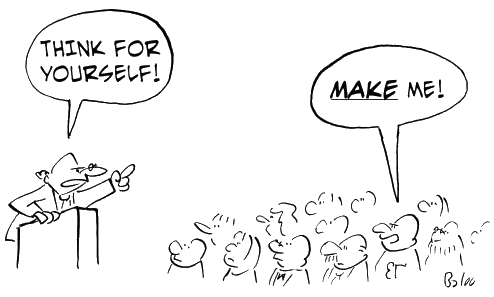
-
- "The teacher strives to activate the child’s cognitive processes
using a behavior change system to alter his thinking as well as his
behavior." —
Texas Autism Resource Guide for Effective Teaching
-
The unnamed author of the above seems blithely unaware
of having penned an adequate definition for the aims of indoctrination and
mind control,
-
rather than, in the alternative, reaching out to
engage autonomy of independent
moral and other reasoning, voluntarily, and only thence free
action...

- The
following lambaste against
formal education as we have
all
known
and suffered, also serves as
exposition upon the
distinction between
intrinsic vs. extrinsic
motivation,
and problems arising
therein.
- The challenge of social and intellectual
stimulus struggle: Intellectual
stimulation from the social environment
remains ever paramount to the endeavor of
FooolQuest.com.
The
engaging
and invigorating trigger of intellectual
stimulation is an intrinsic need, even
neurologically. Intellectual
stimulation opens the way for the
enthusiastic autonomy of egalitarian close
collaborative
creative
solution finding and thereby
liberation from hierarchical
heteronomy. Intellectual
stimulation Is an intrinsic human need.
Intellectual
stimulation differs psychologically with
individual
character, and will therefore defy
precise definition. Intellectual
stimulation
engages
thought and imagination to challenge
ambitious
capability to insightfully identify
and find creative solutions to problems.
And yet intellectual
stimulus
deprivation remains pandemic.
Clearly, either the system is broken, or
else individual failure and confusion can
actually be intentional, even deliberately
brutal
boring
Absurd
and
irrelevant
Zen
surreal by
design,
brainwash
to break the will, indeed as it has been since
antiquity. A hallmark of the compliant and complacent conservative
personality is the the boundless capacity to
endure
boredom.
And in the annals of formal education as
readily observed in so many other social
institutions such as
religion,
politics and
employment among others,
the tradition is recorded even most
anciently in Plato's Academy, of
calculatingly and deliberating quashing the
very intellectual freedom and
Dialectical intellectual
stimulation so cherished by
and fatal to Plato's beloved but impractical mentor
Socrates, via the deliberate infliction of
boredom
in order so diligently to weed out
innovators tso often
characterized by
boredom proneness,
and of novelty that ever threatens
change.
Or less anciently,
we can
blame
that
great and good captain of industry and prime mover of
modern
formal
education,
John D. Rockefeller, who so famously declared:
“I don’t want a nation of thinkers, I want a nation of workers.”
And yet,
many have there been among those sages of old so locked in fervent embrace of the
value
of social stability at any cost, the
maintenance of sheer conservative inertia
even in the most arbitrary status quo. -And
therefore concerning themselves in
all gravity with the contrivance of reliable production process and systematic filters of endlessly bland mediocrity
enduring to this day, bureaucratically screening out deficiency and excellence
alike and entirely without distinction. Indeed such remains the function of
peer review in academic publication, and
worse, of the
FDA in the approval of medicines.
No
snake oil and no breakthroughs either.
Such is
heteronomy
and the dread of all temptation into
nonconformity replete with any possibility
of
Socratic
Wisdom
in acknowledgment of ignorance, error and uncertainty.
And formal education remains to this day, as indispensable
but dysfunctional a social institution as the United Nations, labor unions, the
FDA and even the nuclear family. School is
the hotbed of low level pandemic and pervasive anxiety disorder, stunting
intellectual and emotional
growth.
Everybody
knows
that we only learn from out mistakes. But this will be difficult when the
exposure of error, ignorance and incomprehension, becomes something threatening
and shameful, all to be concealed. For such is
anti-critical
bias. And all because in
school students are actually
penalized , subjected to
aversive conditioning,
for for failing to regurgitate the desired correct responses in
dystressful tests and exams! Meanwhile,
students are subjected to ongoing
manipulative
propaganda
of
heteronomy,
unchallenged rationalization of all such coercion, in order then to blame
ourselves for weak willed indolence, for even at all resenting our captivity. It's for your own good, dear!
But in the words of Leonardo DaVinci: "Study without desire spoils the
memory, and it retains nothing that it takes in."
'Educational
Psychology: A Practical Approach' by Edward Vockell,
Ph.D.
Chapter
5, the section upon:
intrinsic versus extrinsic
motivation
(or actually: ever
manipulative "motivators"),
included, first of all, as fine resource indeed, upon the range of
motivation
of interest to fiction writing,
but also cited here as an entry point into an illuminating
display of irresponsibly oppressive and antisocial heteronymous
hypocrisy: the
how-to manual on the reshaping of personality by undermining autonomy, which, incidentally,
from all that is said and the more so in
what goes unsaid, for purposes of
drama will find
ready application to realistic backstory of
character
development and deeply ingrained
and often
morally
dissonant
inner
conflict or:
ambivalence.
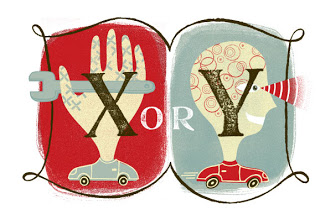 In
his Theory X and Theory of Y, Douglas McGregor categories individuals thus: The
X category or theory, is, in not so many words: indolence. For the avoidant
individual that lacks of ambition, shirks work and commitment as much as
possible and resists change, and must be threatened with punishment, controlled
and penalized in order to comply. Whereas the Y individual, to the contrary, is
highly committed, considers it only normal to exert intellectual and physical
effort, and intrinsically likes to become involved in different
responsibilities, even enjoying the sense of anticipation from the however
extrinsically
motivating
associated rewards pursued, and needn't be threatened or forced in order to
comply. But other individuals yet again, may vary in response, depending upon
all manner of circumstance, such as healthy environment, fair treatment and
sense of inclusion. For such, perhaps it may be more accurate to postulate the
elicitation of X and Y responses. But how are such opposite responses triggered
or elicited to begin with, much less conditioned in the long term?
In
his Theory X and Theory of Y, Douglas McGregor categories individuals thus: The
X category or theory, is, in not so many words: indolence. For the avoidant
individual that lacks of ambition, shirks work and commitment as much as
possible and resists change, and must be threatened with punishment, controlled
and penalized in order to comply. Whereas the Y individual, to the contrary, is
highly committed, considers it only normal to exert intellectual and physical
effort, and intrinsically likes to become involved in different
responsibilities, even enjoying the sense of anticipation from the however
extrinsically
motivating
associated rewards pursued, and needn't be threatened or forced in order to
comply. But other individuals yet again, may vary in response, depending upon
all manner of circumstance, such as healthy environment, fair treatment and
sense of inclusion. For such, perhaps it may be more accurate to postulate the
elicitation of X and Y responses. But how are such opposite responses triggered
or elicited to begin with, much less conditioned in the long term?
•
Act Without External Pressure:
intrinsic
motivations
of mastery,
meaningful
purpose and value
maximization
- It is so often quipped that those who can't do, teach.
And that those who can't teach, teach gym, and those who can't even
teach gym, administrate!
But why, indeed, are teachers and administrators as a breed, so crushed and
helplessly paralyzed? Just what is their damage?
Absurdly, rather than firmly resolving as soon as
safely practical, to end plainly destructive scholastic oppression, granting
freedom and even establishing whatever necessary democracy to mitigate
conditions of daily student captivity not to mention their own captive
and sore
travails!
[the French word for 'labor,' literally: suffering]
teachers
motivated
by enduringly blind heteronymous
vested interest instead remain intent as directed, upon the Quixotic doomed
effort of lunatic faith and
doublethink sleight of mind, somehow to integrate and reconcile
autonomy so terrifying to them, as a component enfolded within their
desperate security blanket of heteronomy, the desperate and fantastical enterprise of reconciliation,
autonomy and heteronomy watering one another down.
-
- Condoms,
CPAP, diet and exercise, just like chastity, are all, in the blithe irony of
Rush Limbaugh: "one hundred percent effective when practiced
consistently." However, such is not medicine but obsession of irresponsible
Moralism and the cult of austerity, shifting the blame to
human failure.
True enough, though. Nature is Hobbesian, human nature and drives oppose
the tyranny of biological destiny. But
just as with PR for gambling, there will always be the
handful of success cases, of big winners, held up as shining example of
somehow beating the odds. In formal education, much as in
diet and exercise for weight loss and
management, there will always be that handful of eager approval seekers that
thrive on whatever abuse and excel. So, why can't we all be just like them?
Any social program of brutal Behavior
Modification, self
manipulation and
cognitive dissonance
that
conflicts with human nature, is doomed to extremely high rates of
noncompliance and therefore of abject failure.
-
-
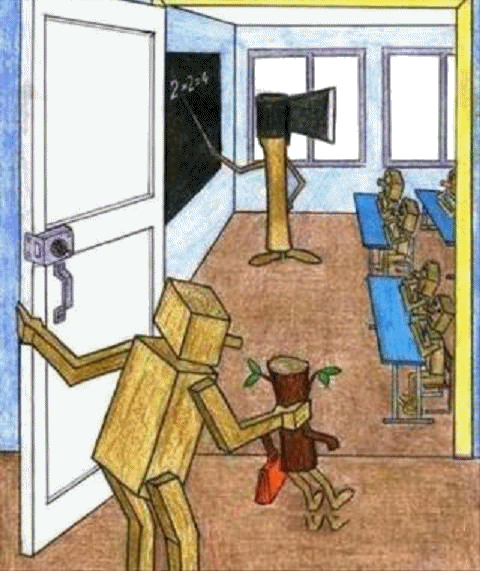 In
the patronizing
Moralistic
concatenation and sheer irresponsible misanthropy of such daily
incarceration as passes for our education, the customer is always wrong!
The program never fails. You fail the program.
For rather than engaging
the interests of students, consequent
boredom
and
distress
is deemed a
character
flaw of indolence then subject to unrelenting coercion and
manipulation.
Precisely thus, our secular educational system nevertheless still rooted
in traditions of the religious church patronage, remains no more or less
than the institutional Fifth Column of dedicated loving but insulting
Totalitarian patronizing condescension within democratic society alas still
too cowardly and contemptuous to
trust
the worthiness of our own children or even adult college students
(therefore, when if ever??), as to be curious enough on their
own without exactly such constantly mounting, pressurizing and ultimately
crushing abuse guaranteed to quickly erode any joy of autonomous
curiosity. For the brain naturally engaged in often
unique construction of personal comprehension and individual pattern construction, is poorly adapted for
behaviorally structured and
boringly predictable formal instruction.
In
the patronizing
Moralistic
concatenation and sheer irresponsible misanthropy of such daily
incarceration as passes for our education, the customer is always wrong!
The program never fails. You fail the program.
For rather than engaging
the interests of students, consequent
boredom
and
distress
is deemed a
character
flaw of indolence then subject to unrelenting coercion and
manipulation.
Precisely thus, our secular educational system nevertheless still rooted
in traditions of the religious church patronage, remains no more or less
than the institutional Fifth Column of dedicated loving but insulting
Totalitarian patronizing condescension within democratic society alas still
too cowardly and contemptuous to
trust
the worthiness of our own children or even adult college students
(therefore, when if ever??), as to be curious enough on their
own without exactly such constantly mounting, pressurizing and ultimately
crushing abuse guaranteed to quickly erode any joy of autonomous
curiosity. For the brain naturally engaged in often
unique construction of personal comprehension and individual pattern construction, is poorly adapted for
behaviorally structured and
boringly predictable formal instruction.
 In
such stunning reversal of all free market norms, the vendor, or
"school"/"university", through an employee called a "professor" or "teacher",
veritably policing hapless student performance, then holds the power of
satisfaction and dissatisfaction against the consumer! The customer is always
wrong! The program never fails. We fail the program. And the vendor to a significant degree controls the career future of
the consumer, or as he or she is called, the "student".
In
such stunning reversal of all free market norms, the vendor, or
"school"/"university", through an employee called a "professor" or "teacher",
veritably policing hapless student performance, then holds the power of
satisfaction and dissatisfaction against the consumer! The customer is always
wrong! The program never fails. We fail the program. And the vendor to a significant degree controls the career future of
the consumer, or as he or she is called, the "student".
Further more, this brand of oppression has been consistent from childhood,
through the school system, and is deeply ingrained by
conditioning and
indoctrination. By the conditionality of meeting emotional needs only given
the desired responses, peer pressure of negative
conditioning
and even emotional tear town against undesired response and awkward begged
questions and generally obstructing and discouraging error checking, the
technique of graduated indoctrination can be employed, with continual
repetition, so as to gradually reshape the subject's belief's or position. Most
commonly, as per the travesty of
Inductivist education,
whatever innocuous seeming
truisms
by default may be utilized initially as a starting point, and then the
desired behaviors
and supporting rationalizations are slowly and stealthily introduced and
connected thereto, unexamined. In this way, the individual subject may be coaxed
into to perceive the institutional righthink as consistent with their own
habits, personal boundaries and perceptions, no matter how jarring and
suspicious it all might have been, had the proverbial cards all been laid out on
the metaphorical table from the beginning, instead.
Social
success
demands permeability to such osmosis, whereof
autonomy
requires resistance. A quandary.
-
- Too bad he's a hateful raving anti-Semite crackpot
conspiracy theorist,
and the article merely serves as a lead in!
|
But worse, precisely such societal cowardice and
contempt is unsuspectingly internalized
by children subjected to
manipulatively
devious and systematic indoctrination to
insecure paralytic heteronomy, so that they can never
trust
others or even especially themselves ever to be curious enough on their own
without exactly such constantly mounting, pressurizing and ultimately crushing
abuse guaranteed to quickly erode any joy of autonomous
curiosity. In brief, in order to function at all, they become helplessly
addicted to coercion, from wherever coercion can be found.
If anyone is ever observed to prefer eating junk food
and memorizing sports trivia to studying math and working hard at it, there are
at least two competing explanatory hypotheses: One is that human beings from
childhood are naturally impulsive, lazy and hedonistic, in a word: 'indolent'.
and the other, quite simply, is that people are routinely traumatized from
childhood by school but less often by their hobbies. Alas, the latter is as yet
recognized only as a complicating cofactor at best, while the former has never
properly come into doubt, in blithe
denial
of theoretical inelegance and preponderance of evidence. Thus, to typical
heteronymous
authorities and functionary teachers, the quite unpalatable risk in any
fundamental alternative, is in simply respecting the individual right also
perhaps possibly to reject unwanted education. Because, what then?
If no one is coerced one way or another, indeed, if one day automation finally
puts an end to chores and busy work, then how will anything ever get done and
what will be the point of living?
It's still all for your own good,
dear! -even if we dare no longer proclaim that: "pressure makes diamonds!"
Respectful and exceptional teachers are all too often treated very badly,
actually penalized, in our school systems. Typical school teachers are uniquely
patronizing, even the sweetest and dopiest of kindergarten schoolmarms. Their
tone and demeanor is unmistakable. On the other hand, Behaviorists and school teachers can be the nicest people. It just doesn't
help. Indeed, sincerity can be the most profound manipulation of all! Indeed, such
insult as
patronizing
condescension that after all comes of love can be less painful than insult that
comes without it, or more so, or equally so, as the case may be: but be that as
it may, it is, in any case significantly more harmful. This is because insult
provokes anger and hostility, but hostility towards people who even sincerely
profess to love you and act on your own best interest is curbed and turned
inwards, internalized, and
experienced as self-hostility, namely
Moralistic
guilt.
Precisely such
deceptive appeals undermining the target’s credulity and defenses even whilst
actually exercising coercion constitute often likewise internalized
insecure
flagrantly
manipulative
behavior, conscious
or unconscious; because, beyond bypassing and overwhelming aware intellect and
good sense by the adroit application of such
motivating
emotional triggers as guilt, fear, spite,
temptation and flattery, a prime function of
manipulation
is simply to disarm individual resistance to coercion by rationalizing said
coercion as reasonable, fair, moderate or even benign and benevolent, but
anything except what it is: coercion. Little wonder then, how do few of us
are actually all that well adjusted. With the exception of a hand full of
remarkable individuals who where exceptionally good students in ostensible
vindication of entrenched status quo, we are all to some degree emotionally
disturbed because of the extended traumatic experience of how we adapted to
school and/or how we didn't.
Intrinsic
motivation
is that process of
arousal and satisfaction that is the reward from carrying out
an activity in and of itself, rather than whatever
extrinsic
motivation
or
motivator coming in hoped for pay off resultant from said activity.
In brief, however deplored by Edward Vockell, PhD, may be the application of
external
extrinsic
motivation
even where internal intrinsic
motivation
and value is absent, fulfilling
internal and intrinsic
motivation
being howsoever preferable to oppressive
extrinsic
motivation
and likely resultant
overjustification effect, teachers are still not charged by the expert and
authoritative likes of Edward Vockell, Ph.Dl simply to facilitate and aid in the
fulfillment
of whatever varying needs and desires of students themselves, to
respectful autonomy support, but rather still, however adaptively, to inculcate
curriculum and even
socialization by
whatever
motivation
necessary, fair or foul and without respect. Indeed,
where, according to Edward Vockell, Ph.Dl,
extrinsic
motivation
(often) must(!) be employed initially, then only temporarily, because "extrinsic
motivators may lead to merely short-range activity while actually
reducing long-range interest [...] Therefore, it is essential that
extrinsic
motivators be backed up by intrinsic
motivators or that the
extrinsic
motivation
become internalized",
often via the
Existential
bait-and-switch of
sublimation, indeed, by the correct application of
Behavioral Modification.
But behavioral internalization
is never classified properly and
honestly as
manipulative
and uncriticali
indoctrination, whereas education, in distinction from
indoctrination, professes to foster
unfettered
critical thinking in quest for
truth, free of insecure
corrupting
vested interest.
Because, after all, while teachers naturally want
students to flourish, responsible and accountable to themselves, we all need to
be sure that this will be the right kind of responsibility for members of
society! -Alas, the
tone of irony here is my own,
not the shamelessly straight-faced
educators. And the right kind of autonomy, so-called, is nothing less
than exactly the bright eyed and bushy tailed loyal exuberant enthusiasm that
ordinary kids mock, fools that we are, such virtuous inhibition indeed very
limitedly autonomous in seriousness and initiative
exceeding mere obedience. For such is the reward of unreserved goody two-shoes
internalization and surrender of individual identity via unconscious
uncritical osmosis, such prized
characteristics of the hand full of truly well adapted students, that
are never actually taught any more than good study habits or
socialization and
popularity. And if they can do it, then why not everybody else? That is why we
malcontents have no one to blame but ourselves, and should line up chomping at
the bit to have our useless and obstreperous spirits broken, right? Where's our school spirit of enthusiasm?
In the bad old days, the school system was an
obstacle course designed for placement of the individual within a
stratified society, and then became an assembly line for turning out factory
drones. And while both outmoded legacies persist, neither are any longer
politically correct to
honestly admit. Indeed,
a most remarkable aspect of modern scholastic
indoctrination, rife with such patronizing condescending
hypocritical
doublethink, is
how scholastic
indoctrination
strives to avoid indoctrinary bias and indeed content at all except, without
saying, as to the urgency of putative need for scholastic indoctrination
itself and also for the putative imperative of
socialization, all
thereby theoretically leaving wide open a vast and free range of
critical
thinking, indeed so long as it remain entirely abstract with no risk of
action
and change. The real
goal
put forth
of timid reform as embraced by the likes of
Edward Vockell, Ph.D
is is only the same desperate and fantastical enterprise of reconciliation,
autonomy and heteronomy watering down one another,
autonomy to rescue
heteronomy, even whist constrained and stifled thereby
and even under the pretence all vice versa.
And the low percentage of
success
in production of blithe uncomplicated and high functioning true believers, the
leaders of tomorrow with "the right kind of autonomy," is of course only
taken as a spur to renew faith and strive even harder, rather than, perish
forbid! legitimate cause for doubt, acknowledgment of fallibility, and to
consider instead the by far more responsible risk management entailed in the
honest
demands of respect
for student autonomy.
After all, leaders of tomorrow still need their damaged minions and
sycophants.
As consistent with ancient patronage systems, education is traditionally and
heteronymously
viewed as the responsibility of the individual student as a contributing member
of society, not any service of intrinsic value to the student as end user, customer or citizen. Why in the bad old
days, the school Principal or Headmaster might even take affront at any student
professing to enjoy any of their classes! Harrumph.
Yes, under any guise, the
challenge of student
motivation
aside, whether in the most harsh and brutal competitive arena of old or the
worst "No Child Left Behind" misguidedly egalitarian reformist
cultivation of sheer ersatz 'Harrison Bergeron' mediocrity of today, should ever
compulsory formal education fail, naturally it remains entirely acceptable for the
student to be chided and blamed via a bad grade despite being captive with
little real
free
choice,
the risk from
true unique independent individual mistakes remaining still so terrifying a
responsibility for all concerned! Indeed, nowadays, mischievous
schoolchildren may be "consequenced." But such parlance is even more
transparently Orwellian. Alas, even given, obviously, how external and therefore
extrinsic
motivation
often indeed arises
situationally, nevertheless
"providing structure," the
inductivist deliberate behavioral engineering of external
extrinsic
motivation
is also never
honestly and
responsibly named as: systematic
punishment and reward, subtext
only ever signaling
a dire lack of sufficiently
engaging
and even engrossing intrinsic value, thereby eliciting
overjustification effect and all therefore doomed to stifling demoralized
failure and ennui exactly as already explained and acknowledged quite
sufficiently by the author himself Edward Vockell, Ph.D, even as he extols
exactly such tactics, even if only in such deviously and
manipulatively
ostensible moderation!
Alas, the truth remains
that even given that the application of discipline may ever be necessary and
appropriate in matters of conduct such as to simply in defense of our rights
from one another as from
bullying, the application of discipline as
punishment and reward to
extrinsically
motivate
learning remains as failed and doomed an enterprise and all around dubious a
proposition as ever since the dawn of history and already debunked.
Indeed our tragedy is
rooted in the
motivating
allure of heteronomy, the incapacitating guilty anxiety, fear and and loathing in
dread of individual responsibility in the face of uncertainty and risk, and how
exactly the sheer
futility of
artfully minimized indoctrination is, in truth, simply the more insidious than
merciful let alone certain or risk free in the manner that true freedom clearly
is not. Thence the
moral of our story might be how modern formal education remains
insecure and Utopist as ever, and the manner in
which inflexible grand and overreaching responsibilities to desired results
however lofty, only end in rationalizing the most flagrant irresponsibility even
regarding minimally acceptable daily conduct of educators simply not to
bully and abuse
power, even however deviously and
manipulatively (and of the expertly guided administration not to
actually demand such evil of teachers), never mind simply to freely provide
educational service with immediate, attractive and yes:
intrinsic
end-user appeal in service to stimulus need and therefore better conducive to
real individual
growth. Indeed,
so thin runs their faith in democracy as to dismiss democratization as
Utopist
because there can be no guarantees of certainty.
-
“Tell me and I forget.
Teach me and I remember. Involve me and I learn.”
—
Benjamin Franklin “It is a miracle that curiosity survives
formal education.” — Albert Einstein
-
-
-
sex
education
- Coercion in what still
passes for education has flailed for
thousands of years, and yet has not been abandoned. But in order to begin curing
the pandemic anxiety and heteronomy inculcated by the pathological and misguided practice
educational coercion, any renewed focus upon
deeper reasoning skills as has been advocated in substitution for obsolete
superficial rote learning, may also serve as any beginning towards reawakening
autonomy
and the yearning for freedom in students and teachers, and ever inching towards
ending scholastic coercion once and for all. All of
which remains no less crucial likewise to better sexual
education ever truly free of
Moralism. Research shows that providing
medically-accurate, age-appropriate sexuality education leads to healthy decisions. However, not only
genuine, accurate and current information, but the practices of ongoing learning
by secondary library and internet research, problem solving and decision making,
all apply no less to the entire range of tradeoffs entailed in different safer
sex strategies, that
sexual partners must choose together, even at any loss of spontaneity. But
in turning away from the systemic unfeasibility of
Moralism, even pending the abolition of
scholastic coercion, even the rationality any
more intelligent teaching approach undertaken in its own culture of the dignity
of
sex for
pleasure, much less the ignorant barbarism of abstinence
propaganda
and indoctrination., is often inadequate to the needs of
helping neurotics: For it is really no secret either, how
crisis pregnancy is
more often actually
motivated
by psychological unloved feelings of powerless inadequacy, demonstration of
potency and every social dysfunction whereof such unhappiness emanates, and in
truth no accident, simple birth control failure, or even, really deep down, nor
has determination to bring
crisis pregnancy to term, truly have anything
much to do with howsoever
sentiment towards the unborn in the abstract. Considering that
unprotected
sex is well understood as all too often
motivated by unacknowledged yearnings for procreation that is a
symptom of profound feelings of powerlessness, to which of course,
educational coercion,
bullying and dysfunctional family, all contribute, the problem,
then, is also very much a public psychotherapeutic care issue, desperately
needing address as such.
-
“There is in fact a
manly and legitimate passion for equality that spurs all men to wish to be
strong and esteemed. This passion tends to elevate the lesser to the rank of
the greater. But one also finds in the human heart a depraved taste for
equality, which impels the weak to want to bring the strong down to their
level, and which reduces men to preferring equality in servitude to
inequality in freedom.”
— Alexis de Tocqueville
“It is less important to redistribute wealth than it
is to redistribute opportunity.”
— Arthur H. Vandenberg
“What is happiness? The feeling that power increases
- that resistance is being overcome” —
Friedrich Nietzsche
-
-
- All manner of people and circumstance
remain harmful in so many different ways, but there is particular
vulnerability to self-esteem and sense of power, not merely from abuse
of power or humiliation in and of itself, but in shrinking, in
restraint, self-control, submission, compliance, conforming to
situation, backing down, especially to those most beneath contempt; all
thus belittled, duller and mincing ones words; all as
bullies
laugh up their sleeves. And such is life. But under such circumstances,
one can only question oneself: Whatever threat or benefit, iss it all
really worth it? One cannot but nurse the festering grudge, feeling only
the more petty and helpless.
-
- Power can mean dominance and
control over others, wherewithal to accomplish desired results,
individual ability or effectiveness in
collaboration. As his working hypothesis or
interpretation, Nietzsche seemingly regards mere influence upon others
as some effete and lesser substitute instead of sheer primal and brutal coercion
attempting to inflict ones will upon others. But perhaps the reverse
is the truth: Coercion and
manipulation
indeed being more primal,
are lesser substitutes for more evolved, welcome and
fulfilling influence upon one another, love
itself, and not merely all that is done for love. Power, for good or
evil, constructively or destructively, begins from the process of
influence upon one another that can redefine the surrounding social
environment and change the world. Unilateral
action
is largely
powerless,
drastically limited in scope and impact upon individual life much less
society at large. And slavish submission to
alienating
social institutions tends to be senseless, debilitating and
Absurd
in every way.
Transactional Analysis
begins to recognize that only improvement in the manner in which anyone
relates to one
another can even begin to make any real headway towards any livable
community culture.
FoolQuest.com
explores
broader
agenda
for
collaboration
among equals
in
autonomy,
deemed inconceivable under prevailing
heteronomy
that so dreads only chaos and discord, save
by even slavish acquiescence to firm guidance and confident leadership
in order to prevent error and assure
success.
Of course there
is no guarantee of
success, but there can often be guarantee of
futility in impossible guarantees.
-
- Moral
responsibility arises only from freedom and choice in the face of
uncertainty. Power and influence over others accrues either by coercion
subject always to resistance, trickery of deceit and
manipulation
eventually subject to exposure and dissipation, or else in exchange or in
support of
value,
so long as whatever that
value
or utility endures. Indeed,
freedom and dignity, beyond essential personal
autonomy
in and of itself alone,
is also a practical question
beyond any subjective
will to power,
regarding needed
situations of real
capability
beyond sheer abstraction: connections and resources, wherewithal
of opportunity without which even the greatest talent and
highest competence become useless, much less freedom
entirely in the abstract. Real freedom then, so often
greatly depends upon the mitigation of such mundane
practicalities as making enough money
but without incurring onerously restrictive
travail and consuming obligations to others,
even just in fitting in and dealing with flawed social environment. -gifted
with with heightened empathy in a callous world, even hyperaware, but often
misunderstood and discouraged.
-
- The agenda
put forth here on
FoolQuest.com,
remains that of greater freedom and power so yearned for and admired, as attained in
receiving ongoing
autonomy
support
towards important decisions and
fulfillment
from full
engagement
in
meaningful
interaction, and better still, if possible, in the process, achieving
the pleasures of wealth and influence thereby! Such is the
highly coveted
ideal
condition of alignment between, in
fulfillment
of, often
conflicting
intrinsic and
extrinsic
motivation,
the very hope and attractive appeal of lifestyle Entrepreneurship.
-Or more altruistically, of
Social Entrepreneurship and
Activism. Or else
only in
play with nothing at stake. Indeed, a fine
outlet for creativity for its own joy, is
collaborative fiction writing,
drama and
Science Fiction
speculation
and that
depth of
engagement
that is sheer expansive awe.
-
- “A
psychological presupposition of Nietzsche's is that humans are always
attempting to inflict their wills upon others.”
But actually,
people want power because they want
autonomy
which is "a form of
power
that allows one person to ignore and resist the influence of others and
thus to shape one’s own destiny.”
-
-
“The
researchers [who published: ‘The
power to be me: Power elevates self-concept
consistency and authenticity’] theorized that being in a position of authority
would make individuals feel enhanced
well-being. [...] "Because power
increases the correspondence between internal states and behavior [or
(this above all): truth to thine own self], we
hypothesized that power enhances
subjective
well-being (SWB) by leading
people to feel more
authentic.”” —
Medical Daily
-
-
“There is one thing to watch out
for in all of this, though. While having power can make you happier,
seeking power does not make you happier. There is quite a bit of
evidence that people who spend their lives seeking power do not focus on
the intrinsic joy of life. So, people who seek power are actually less
happy than those who do not. [...] A second way to become powerful is to
spend your life getting things done. [...] If you consistently do things
in your life that help you and others achieve goals, then your journey
is a happy one.” —
Psychology Today
In Plato's Dialogues,
the Republic, Thrasymachus famously contends that the will of the stronger is
named justice. This may seem somewhat glib Nihilistic
value destruction. And yet, because morality and justice are so
abstract and
Axiological, almost ephemeral, not
Ontological
and concrete, the question even seems begged: Is there morality? Is there any
such a thing? Does morality exist, and how so? The very concept of
morality is so often much abused in all manner of Sophistry as to afflict
the very discourse such a bad name and to obfuscate the real important salient
questions, even as most anciently illuminated by
drama. To wit: What
bridges whyfors of abstract
Axiological
morality into
Ontology
of concrete
reality
and species of: how, remains nothing more or less than responsibility to foreseeable consequences of
free
choice deciding among
alternatives in taking
action. It's not a matter of what one might ever or
never do, but under what exigent circumstances or
situation, indeed against what
impending evil. Most anyone even who abhors lying and all but never lies,
would lie cheerfully to those proverbial Nazis in order to protect
Jews hiding in the basement, or even kill, given no other recourse, in
order to protect the innocent. By contrast and by way of
illustration, even the lowest guile entailed in
CliqueBusters
TM remains utterly nonviolent
moderate. But more anon.
In social psychology, specifically
according to social cognitive theory of morality, moral agency is exerted
via self-sanction of moral standards in moral reasoning into
action. In a
word:: conscience. For happiness free from
ambivalence
and
inner
conflict,
Ogden Nash famously recommends "either a clear conscience or
none at all." For at the cost of greater
dystress,
conscience may be mastered and effectively suppressed by the individual.
Hurtful as it may be, sociopaths without coincidence may openly gloat
sadistically, but at least are being
honest.
The radical anti-bullying proposal,
CliqueBusters
TM ,
strategically recommends that to be brought to task, such eager braggarts
present opportunity for infiltration and covert recording, then exposure.
And for some, this too presents moral conundrum. But then, so does
bystanding in the face of evil. Whereas,
for evil doers,
bullies,
yet struggling with conscience, the self-dishonest
and
hypocritical
validation and co-validation process by which individuals, especially
bullies,
may be
known
to convince themselves that ethical standards no longer apply, is achieved
by means of: moral justification such as appeal to greater good or
vengeance, by diffusion of responsibility onto an authority figure or via
consensus
and
co-validation, and also by misrepresenting and minimizing
injurious consequences of such bullying, and especially of social
undermining, Mounting suppressed guilt and
denial over ongoing and
escalating immoral transgression and bullying,
motivates continual and ever
more vigorous reinforcement of moral disengagement.
CliqueBusters
TM remains
the most radical
known
proposal of resistance and
awareness, consciousness raising, to detect and denounce
moral disengagement and Sadism so
characteristic
of malignant cliques of
bullies.
Theories of morality as socially normative, are readily refuted by all
manner of examples of malicious social norms. Indeed, quite the reverse of
socially normative morality, the advance of civilization remains an ongoing
struggle to bring social and individual norms into better accord with
morality, reason and compassion.
Presenting
situations that challenge
conscience, and even such proposed response as
CliqueBusters,
morality is explored in both fictional and even in
true to life
dramatization
of moral
controversy:
The
dramatic
scene
breaks down into
Motivation-Reaction
Units:
Immediate reactions are often reflexive, but then conscious
deliberation ensues upon what
action to be taken next. Or does it?
Life can only be lived forwards, but only understood or recognized in hindsight. Indeed, do we consider our options and
consciously take
action, or do our
actions simply come upon us as we react to
situation, and only then rationalize afterward?
People often make their most important
decisions
with their heart but only then rationalize intellectually.
Motivations and
goals
or
objectives
as ever
set forth
thereby,
meaning
as only created in the mind,
values,
moral
sympathies and empathies included, so often
ambivalent,
are not willfully intended in free agency but received and imprinted in
receptivity as we discover ourselves
subject all thereto. Most
dramatically,
relationship, the impression made by
individual
characters
upon one another, often dawns upon the individual in emotional response to
events unfolding. -All much as in real life for real human beings. Only then is
action undertaken, consistently with
characterization,
personality, often giving rise to
conflict
and
Setting
The
scene.
Freedom is not random No matter
how predictably, an animal experiences freedom when acting upon impulse, upon
stimulation and
arousal, without obstruction and frustration. An
animal remains
Existentially
untroubled regardless. Nevertheless, predicable people are denounced indeed as predictable when
one disapproves, but praised as dependable when one does approve. Determinism
remains objective, at least in
principle, regardless Epistemologically
of what can be
knowable
in advance. Notwithstanding determinism, to reiterate, an anima; experiences
freedom when unobstructed in following its impulses, even however blithely
predictable. Free will then, is psychological inner determinism, as district
from constraints of external determinism in outside world.
Inner
conflict of
ambivalence
also undermines freedom. Struggle with opposing desires, such as
approach-avoidance, is
ambivalent
indecision of
inner
conflict, whereas
oxymoronic desire for logically
contradictory desires, may be called
conflict with
reality. For example, for
others always to be
honest,
and yet at the same time, never critical.
Determinism then need not contravene freedom, itself no less determined. But
inevitably simplicity yields to complication: Marcel Proust said: “We become moral
when we are unhappy.”
Problem Solving and Justification are
reciprocal functions, and one must be shaped to rationalize the other, with
integrity or else into
hypocrisy.
When there arises a discrepancy between the feelings and activity of a
character,
tension
mounts all the more, the greater the
obstacles to
resolution of whatever
ambivalence
and
conflict. Therefore,
Existentially, what is freedom,
indeed for whom is freedom? Is freedom
the
Zen
Mystical and Christian
freedom from all desire, or the freedom from causality yearned for by
Hinduism? Or just the contrary, is freedom is for the individual,
the power
to act upon individual
motivation
and priorities, simple whims or sophisticated principles, which are all, after
all, causal and Deterministic ever to taking
action? –Good reasons, even
such as unfold in
character
growth and the
cultivation moral advance, all the more so. In the alternative, indeed as
it is so oft extolled that God's love is uncaused, how ever at all can
freedom obtain from arbitrary random Indeterminacy? In the
Zen quest for oneness, the
enlightened man is said to be one with
dharma, the law of causation, and the perceptions
of Determinism on the one hand, or of freedom,
willful
choice and influence,
on the other hand, are both error, presumably from uninspired failure to
synthesize frames of reference: conscious
subjective
willful
choice and
objective Determinism, all into the correct
Gestalt.
In
plot oriented
fiction,
characters
acted upon are forced to react to
situation by whatever there is at
stake, Deterministically. But in
character
oriented
drama,
characters
in struggle advance the
plot by conduct
determined no less, but according to each their own natures of
character. -Determinism is intrinsic to the
character
and temperament
in
action, rather than extrinsic and belonging to circumstances. For it is
values,
including cherished moral principles and sentiments, that
motivate
individual divergence from whatever path of least resistance, even at
considerable personal sacrifice. And the dismissal all thereof as arbitrary
because of Determinism or for lack of satisfactory Meta-Ethics, or for any other
reason, is Nihilistic value
destruction,
Objectively,
indeed all is Deterministic, circumstances and people no less
than any other things or phenomena in interaction within whatever
situation or environment. When we
disapprove of a bothersome chronic behavior, we deride the person's
predictability. But of predictably constructive conduct, we praise that person's
reliability. Determinism remains consistent either way, only value
judgment differs. Indeed, even as the will and yearning for all manner and dimensions of
joyful untroubled freedom and power, we may even tend to consider ourselves most
free in
being true to ourselves, such that we might each ourselves claim: If I had
whatever particular decision into
action
to do again, I would by volition
chose do it all exactly
the same. But the previous only tends to apply in any matter in personal
value
judgment deemed
of importance and hence as such crucial in defining of personal identity and
cherished values of all what one stands for,
and not just anything at all howsoever at all seemingly trivial. And hence the
problem is not dharmic,
objective,
value neutral and
Ontological as such, but
indeed rather in value judgment and self image that remain
subjective.
Because only in light of of values can anything held to
have importance. And thus is Axiology
revealed as central to the Psychology of such assessment in the mind that drives
the above experience of freedom in the specific sensation of truth to oneself,
of self consistency. This also accounts for the appeal, in each our own ongoing true to life
drama no less than
in works of
fiction, of the often arduous
journey of change and learning of decisions and conduct in order the more to
better understand, judge and even quite appropriately approve of oneself and one's own conduct from hence
forth, according to personal values, especially morally,
with integrity true to oneself rejecting that which becomes ego alien, striving
in hoped for resolution of whatever enduring
drama of
inner
conflict.
This process may also be viewed socially. Indeed,
communication and awareness of the feelings, perceptions and opinions of others,
sought or unsought, will tend to impact not only individual perception and
reconstruction of
reality, but value
judgment as well. Phenomenologically, it is the mind and “the heart,” not the senses alone in
experience somehow unprocessed, that howsoever fallibly interpret and truly
perceive. And others may often be consulted for purposes of error detection and
in order to gain perspective, or in
outreach
for support and approval. All mature and functional
attachments
of social relationship under autonomy are
ethical, being
predicated upon
trust and fulfillment of such expectations, lack or abrogation
whereof creating distance, even loathing and avoidance, or else
ambivalence,
mistrust and dysfunction, indeed if not
amoral
sociopathy outright, then the shattered confidence and compensations thereto
of
heteronomy. Weak attachment
makes for weak conscience. Thus heteronymous
covert relational hostility
working to to undermine those attachments in
society, shunning and mobbing, even well
organized
orchestrated harassment, thereby conspire with impunity by means of social exclusion, to harm and
endanger the target of exactly such serial bullying.
According to the biologist Edward Osborne Wilson "Human beings function
better if they are deceived by their genes into thinking that there is a
disinterested objective morality binding upon them, which all should obey." But
function better in what sense and towards what purpose or
value? Moral relativism is the contention that because the
objective
reality of morality cannot be
established, then morality is entirely
subjective
and therefore is or could be entirely arbitrary and variable between
individuals, with nothing to make morality howsoever universal and therefore
necessarily
intersubjective
or howsoever valid. Moral purposes, judgments and
imperatives need some manner of
objective
categorical prescriptive force in order to be true. But otherwise, exactly what
sort of error is morality? All therefore, as the individual capacity for
logic in reasoning pertains after all to
objective
causality, to what external phenomena does the personal capacity for morality
correspond or relate? Again: What bridges abstract and
Axiological morality with
Ontology
of concrete
reality,
remain nothing more or less than responsibility to foreseeable consequences of
free
choice deciding among
alternatives in taking
action.
As C. S. Lewis observes, the only person who opposes
escape is, by definition, a jailer. Fantasy is the exploration both of
unfettered desire and of reality
principle of feasible
scenario.
Fantasy and speculation therefore fundamental to freedom. It is only the
denial of
reality
that is clearly illusion rather than freedom. Action
is
motivated
by desire. Desires can be selfish or unselfish. Benevolence is desire to the
good. Desires in and of themselves, cannot be true or false, only any howsoever
understanding thereof can be to whatever degree, accurate or inaccurate.
Morality answers deep-seated yet contingent interests and desires of human
beings. To wit: Meta-Ethics strives
to fill a much needed gap: Love and compassion, most precious
amongst human assets and deepest
meaningful
value,
are not rational, nor ever should they be. This extends to
motivation
of altruism and conscience at all, either irreducible, say, to Enlightened
Self-interest. After all, even self-interest to begin with, even sheer
pleasure principle and aversive (desire to avoid) fear of
harm and death,
survival instinct at all, is all desire not
Logic
or reasoning,
never mind likewise empathy to extend from the selfish in order recognize, along with
sympathy to validate, similar needs and
motivating desires in others, thence to expect fairness
upholding ones rights and to
avoid doing harm. -imperative of fairness upholding one another's rights and prohibition upon doing harm, being the most universal moral criteria.
Was there harm? Was there foul, infringement upon and violation of anyone's
rights? To quote from France's Declaration of the Rights of Man and of the
Citizen of 1789: “Liberty consists in the freedom to do everything which
injures no one else; hence the exercise of the natural rights of each man has no
limits except those which assure to the other members of the society the
enjoyment of the same rights.”
Distinctly, the rights and harm theory of morality, that
immoral
action
is such as both violates individual rights and does harm, seems
the best, most viable and least inadequate, among contending
theories of
morality.
Morality all therefore is not Behaviorally
reducible. For as Piaget discovered, heavy moral inhibitions imposed too soon,
actually only undermines the natural and tender childhood awakening of
empathy
and sympathy, souring the disposition into bitter jealous rage and the
hypocrisy of
Moralism.
For in the words of Dr. Samuel Johnson: "The wretched have no compassion, they
can do good only from strong principles of duty." The moral dimensions of
psychological visibility,
Phenomenally,
empathy and sympathy, identification with others, is neurologically innate by
virtue of the mirror neurons that activate in any
action
or experience
observed of others (and eliciting the
motivation
of
desires) identically as in experienced
action
of ones own (motivated
by those
desires). Hence, among attempts at rescuing Enlightenment thinking, even
evolutionary utility and survival advantage of reciprocal altruism remains merely hapenstancial if
not actually
arbitrary. So, does causality of circumstances qualify as an
Ontological foundation or
justification? What exactly would an
Ontological foundation be?
It has been propounded that altruistic morality is a delusion crucial in order
to forestall the Hobbesian state of nature and foster civilization. But
sociopaths, even should they can even so dimly apprehend such values and
consequence merely in the abstract, nevertheless simply just don't care.
Sociopaths lack the
motivation
of compassion. The yearnings for justice and
reciprocity, fundamental to any social contract, are both selfish and altruistic
at the same time. Altruistic morality consists of values
predicated upon compassion. Values and desires including
those of altruism, moral compunction and motivating compassion, are simply not
logically reducible. A sociopath has only selfish desires, even Sadism outright.
Whereas compassion is an altruistic desire. And either way, as G. E Moore
contends, desires are neither true nor false, they are desires.
Unlike
Logic or physical laws
that may be considered as most constant and consistent underpinnings intrinsic
to
existence itself as we know
it at all, circumstances, opportunity and advantage are flexible and variable,
accounting for the most ignoble of impulses as well. What still bears mention as
far as sociological principle, is
that evolutionarily, morality is civilizing, even in animal communities. Unlike
morality, ethics are determined from
situation amid pertinent
circumstances, the responsibilities and commitments of one's particular
rôle or position,
post of employment, accountable relationship or social standing. Whereas any variation of appeal the supernatural remains
completely
irrelevant among rationalizations. There is no
Ontological foundation of
morality, first of all because there are no grounds or justification, period.
Meaning does not preexist externally, but must be assigned and structured in
the mind. Indeed, all hypothesis begins
from unfounded conjecture, subjected first to
critical preference and then to
Empirical
reality testing all as
applicable. And secondly,
Axiology
is not Ontology. Only
responsibility towards
free
choice at all amongst
foreseeable consequences is at all
Empirical,
and even then, indeed only first given the altruistic morality to give a shit at all
in the first place. The very existence and conduct of non reciprocating
amoral
sociopaths ought to raise doubt as to the existence of external moral order.
For as the saying goes, peace of mind requires either a clear conscience or none
at all. That loveless
amoral
sociopaths may be deemed monstrous, wretched,
lonely and pitiable despite all manifest practical advantage, is
value
judgment of Psychology speaking to the human condition. In
the words of Alfred Adler: "The person who isn't interested in his fellow
beings has the greatest difficulties in life and also creates the greatest
damage to others." The only
relevance of God to morality, is in
the relationship of prayer, being: the propensity from innate animism to express
personal moral sentiments, in the imagination, to God, who if He exists, listens. Alas that
heteronomy
to God is not the answer. Only the listless amoral
Zen
sociopath in quest of
sublime apathy and freedom from
motivation
of desire, seeks to work
in dharmic harmony with the universe. Whereas
empathic sympathetic morality rises in rebellious autonomy
against an indifferent universe. By contrast, Theism is often turned to in marshaling
animistic
denial in
service to irresponsible heteronomy and injustice, even
to arbitrary
taboo, often
sexually repressive. To quote Gram Greene: “If that's [God's] love
I'd rather have a bit of kindness.”
Logic is deemed
Metaphysical in
that Logic deals abstractly with validity being: the
internal constancy, or else not, of propositions, in demarcation from
Empirical scientific investigation seeking
knowledge of truth which is awareness of correspondence
to
reality in
assertions. Theology has never emerged from
Metaphysics
because the entirely hypothetical problems, conundrums and entire corpus of
argument in a vacuum that is Theology even yet remain
entirely bereft of any detectably correspondent
reality for
Empirical scientific investigation. Nevertheless,
abstract good or value which defies description
in in terms any worldly
physical properties of things or phenomena, and therefore often laid claim by Theology
and religion, is actually qualitative intangible idea
and
motivation
contingent upon no end of circumstances that are nonetheless
very
real even though as yet, the
Scientific Method
cannot address Axiological questions
at all let alone morality, beyond
simply describing different Axiologies as
characteristic of different individuals and
cultures.
Hence, Axiology strives to emerge from
Metaphysical
discourse into scientific investigation. And yet, though there are no end of
vexingly vague and confusing moral grey
areas,
conflicts,
contradictions
and fine distinctions, some simpler moral
assertions
do remain seemingly more plain, distinct and enduring.
- “The voice of conscience is so delicate that it is easy to stifle it;
but it is also so clear that it is impossible to mistake it.” —
Germaine
De Stael
So what is morality which is the emotional
motivating and cognitive rational focus of conscience? How
can morality or obligation as a subject matter of principle in its own right ever be clearly defined,
much less pursued objectively? What is moral
Epistemology? By what
process or faculties and from whence does any moral
knowledge
arise, except merely the moral compass that is conscience? And what's in a name,
simply to call it so: conscience? -anymore, likewise, than to name
morality to begin with... Virtues are not rules but
moral principles, demanding
aptitudes of
autonomous
critical thinking
rather that acquiescence into
behavioral
structured heteronymous
obedience. Conscience is indeed not only passionate but
deliberative, argumentative, even methodical, and indeed metaphorically like unto some sort of
proverbial onboard compass, directive of
action
by some developmental altruistically expanded
set of desire and aversion. But conscience is therefore likewise as any matter of pertinent
reality principle, limitations and foreseeable consequences,
in further quest also of boundaries of responsibility in order to inform impulse formation, check and balance
(aside only from that of
inner
conflict with
entirely selfish
considerations) in order thereby to be at all self manageable beyond completely
naive impulsive altruism. -As in the well meaning mayhem of the archetypical
sociopathically
blundering
innocent kind hearted fool, Parcival.
For effective Psychotherapy, the patient
must feel safe to open up more
honestly
without pressure or suggestion.
And for that matter, this applies no less to what
Sigmund Freud dubbed: lay therapy, meaning similar benefit as of psychotherapy,
as also ever to be found in ordinary social interaction. After all,
compassionate nondirective psychotherapy only midwives emotional self healing by
filling whatever whatever void in normal ongoing
relationship,
friendship
and interaction, including acceptance, insight and catharsis. In the words of
John Donne, no man is an island. For there is no one so sane, well adapted and
ruggedly self sufficient, as to have no need of any such feedback simply for
emotional self regulation. There are only the relative haves and the have nots.
Such the origin of psychopathology in dire loneliness
and isolation typically inflicted by society upon the increasingly repressed
individual, and then self inflicted as
motivated
by internalization, which is when the individual deeply
identifies with their society, however oppressive. For such is
socialization, that which none dare call
indoctrination or:
brainwash,
questioned and overcome in
Positive Disintegration.
Whereas instead instead of etiology of psychopathology, Positive Psychology
investigates the nature and needs of
authentic wellbeing.
And perhaps a fine distinction given the recognition that we are all crazy! In
such a mad, mad world, you have to be crazy to think that you are not!
There persists, nevertheless, a common misconception in
any expectation of Psychotherapists to work with their patients to correct
troubling thought patterns. But it remains common
knowledge, quite to the contrary, how Psychotherapy
seeks to recover and delve into dystressing
thoughts and memories, in order to bring repressed emotions to the surface and
release them from
denial. This
is called: Catharsis. Additionally, there is hope of soothing balm in sympathy
and understanding, and even whatever value or consolation
of insight gained. Indeed, any willful effort
at change, let alone imposition by others, raises the question of self control
unto concerns with levels of
denial, self deception and
manipulation. And
Sigmund Freud is very clear that new conditioning pressure into
inner
conflict with
preexisting issues often results in suppression and yet more insecure reaction formation.
Indeed, in the alternative, Freudian catharsis, the expression and release of
inner hurts to be tended upon with compassion, is not without ancient
precedence in the ministration to the soul. Alas, however, it often seems
that, all pious protestations aside, sanctimony and trivial superstition are more
common than true profundity and richer inner life, let alone improved
character and true benevolence, out from worship or faith. For many so vociferously protest their deep
spirituality and relationship to God, the more transparently shallow and
disappointing are their religious fantasies. Yea, verily, even their daydreams are
dreary and banal cliché! But by concerted introspection, perhaps such as who do truly and
sincerely
walk with God, may ever fruitfully contribute to Endotheology, the
Phenomenological and psychological study in cognitive philosophy, of the
rôle and
value of God in
the psyche, entirely unburdened by any question of to whatever degree or
objective
reality to being with, of
supernatural contact with God versus mere
subjectivity of inner life,
nor indeed with any mechanics of Theophysics.
- “It is one of the Christian delusions that Christianity brought charity
into the world. It did not such thing. There were plenty of agencies for
taking care of the poor and helpless long before Christianity was heard of,
and even before Judaism. Both Christianity and Judaism have converted
charity into a sort of pious racket. The alms-giver, in return for a
trifling expenditure on this earth, will be rewarded with an infinity of
bliss post-mortem. This purely selfish note is struck with great clarity by
Judaism, and only less clearly by Christianity. It appears also in the other
religions of the East. Thus religion has not really promoted charity, but
debased it.”
-
- — H.L. Mencken
Alas, Theism adds nothing to make anything howsoever at all clearer, only, as ever,
removing the problem into a question of even greater complexity all
premised upon a
raft of far less
supportable
assertions. All such Apologetics as Theistic Intelligent Design merely articulates
the more general yearning for belief in destiny with nothing to chance ever
demanding responsible
free
choice from mere mortals.
Morality and responsibility are distinctly
relevant to the pursuit of happiness both
towards individual
wellbeing and maintenance of any at all livable society. But
no less obviously, morality and responsibility limit and an obstruct unfettered
pursuit of individual
desires. All nevertheless, putting aside all
Epistemologically dubious
Ontology from yearning and
wishful thinking, religion can still embody values including
morality, even
regardless of the sheer brutality of any actual scriptures. All question of the
essential
characteristic disposition and application of
values
by which we live are informed by worldviews of human nature. Specifically, there
have always been those exhorting or even in any way imposing whatever alteration
in
character as a
free willed
choice of
decision outright and nothing more, and those extolling, instead,
honesty and
harmony with destiny on whatever path to change,
growth or
progress as is congruent with life and human nature.
Indeed, as a practical matter, it remains unclear that religion at all
reliably improves moral
conduct any more than simply high ideals of one's own, much less shared in society.
Moral compass remains an aspect of
character
growth and
development of the superego, initially from vulnerable dependency and fear of
disapproval, then internalization into heteronomy, and
finally, if ever, positive disintegration into
autonomy. Again, to
quote Alexander Lowen MD: "Conviction lies
not in the ego." And that applies no less to any functioning moral compass,
running deeper than opinion even as to values of what is
moral. Who so truly and abjectly surrenders and submits to the will of God can no more rely upon the
efficacy of prayer than an Atheist. Prayer alone and in and of itself, ever such
as that may be, must be deemed howsoever the only comfort entailed therein.
Likewise, the conviction of righteousness alone, a
value, the appeal to a morality beyond
selfish concern alone is observably a comfort and support to confidence, short
of despair, utter defeatism and Nihilism in
relation to which belief, opinion that God
exists, observably only serves as
denial
of despair, never mind, and less importantly, of unbelief. -Irresponsibility
in the face of fallibility and uncertainty. Faith by any other name, courage,
respect, "basic
trust," residual optimism however
cautious, all for lack of better understanding thereof, sustains us at all, even
to rise when we wake; not knowledge,
not by faith nor otherwise. Faith bears no
Epistemological moment.
Socratic
Wisdom is only
knowing that
we do not know, how ever
approximately gauging the scope of ones own ignorance. It is often admonished
that merely believing that there is a God, is insufficient to finding true
faith. Indeed, the belief part seems redundant at best thereto. Let alone
actually making decisions and taking
action, first of all any quest for
unknown or uncertain truth,
even being an exercise of the Rational Ego State, may still call for a kind of faith,
trust, emotional security or optimism
not contingent upon any particular
assertion, theoretical
Ontological opinion, belief
or rationalizing cognition of ego consciousness. For that matter, does belief that the city of London is located in England or that two
and two equal four, require much effort invested in faith? Atheism
is no more than the inescapable arrival at
a rational conclusion regarding the evidence and likelier explanation. And if there are moral
values
of Rationalism, then these must be the
honesty, responsibility and
autonomy. For indeed as the saying goes: there can be no other
values without
honesty first.
Hence in the desperation of Theo-crypto-Nihilistic
value destruction, Theism purports to rebut moral relativism, but inexorably
runs aground upon the shoals of the
Euthyphro Dilemma because
Divine Command Theory appears only to render the
content of morality entirely arbitrary. If morality simply depends upon God’s
decision what to make commandment, then how can God’s decision thereupon be
informed by morality? Is moral good moral good by the will of God, or does God,
ever truthful, simply inform humanity of moral good because it is, indeed, moral
good? If the former, then this seems somewhat arbitrary, and if the latter, then
even God is subordinate and therefore irrelevant to the entirely independent
questions of morality. Surely, morality as the dictate of God would be entirely
arbitrary and hence amoral unless there is any reason, at least even such as at
least in this life might as yet be
known only to God.
Would sheer malice become a virtue hypothetically
if it amused God so
to declare? Surely, that would render morality entirely arbitrary and thus amoral! Or is God, as
the epitome of morality, bound from doing or saying anything so evil? If so,
then morality as a principle transcends and compels even the Lord God. Or else
perhaps as an intrinsic aspect
of God, then morality remains transcendent and mysterious. Because the very
notion makes no
known
sense!
God would have been the first discoverer of morality, indeed the first
consciousness
to apprehend morality. God, the creator, by bringing into being the
universe itself, and populating the world with
conscious entities subject to
conflict
of interests, would thereby have brought about the the very problem
of morality. But morality remains a
value and not an entity. Morality is therefore
never subject to creation like a sculpture or a pair of shoes. Nor is
morality an emanation or natural force. Let alone from God. Again, morality
is a
value in context of dealing with
conflicts
of interest.
No matter which way to slice it, Theism, the
assertion of the existence of God or gods, simply does not explain morality. Hence,
any
punishment and
reward system, bribes and threats of the
Appeal to Force
logical falsity aside,
asserting that God is the source of morality explains nothing about morality
whatsoever, worse quelling
intrinsic
motivation
of innate morality by elicitation of
overjustification effect,. Indeed, if there is a God, then, as Sartre observed, man must be
freer than God, because man can sin. Again, an ultimately good God would
actually have to be bound by morality, making moral principle primary even
beyond God. What does it mean at all, then, to assert that God is the source of
morality? Just how does that work? What does it even mean to assert that
morality is supernatural? No, none of that
really makes much sense.
Aesthetically, Musicologically, it appears that any part
of what is beautiful and melodic to begin with, is biologically innate, while
further particulars of taste and preference are cultural and individual.
Likewise, some part of morality appears to be universal to humanity, being
considerations of harm and fairness, indeed including not only compassion most
generally amongst mammals but even general expectations of quid pro quo that may
be elicited even from behavior of other primates, whereas among humans further
details of morality may be worked out with cultural and individual variation. Or
else, harm and fairness may even be either overridden selfishly or rejected
amorally or Nihilistically
one way or another, or else eclipsed in favor of other arbitrarily
heteronymous
theories of morality entirely, such as loyalty and obedience as
virtues for
their own sake, whatever entirely normative ethics, or
Divine Command Theory, that can each and all senselessly justify almost any
evil.
Theology typically extols that only by loving God who is the font of goodness
and morality, moral decency is revealed and elucidated. The only catch being, alas,
that as ever, that evoking God only shifts whatever problem into
even greater needless complexity without actually explaining anything. Only by
positing whatever conceivable benevolent
motivations,
principles or priorities even on the part of the All Mighty, such as boundless
Divine Love and Providence or All Knowing maximal utility, can even the mind of
God at all contain morality, even then buttressed by no more than the
logical fallacy of relevance that is the Appeal to (ultimate!) Authority,
opposite of
Ad Hominem. All that loving God, or
anyone else for that matter, accomplishes here, is to
motivate
the yearning for their good opinion of you, in this case, a yearning directed
towards an ideal morality, with all the
tension
of the Romance
with God; metaphor for the thirst for righteousness.
Consider the folkloric notion of individual personal contract or covenant with God.
No wonder that the story typically ends in a sense of betrayal for the
protagonist. Clearly,
any such negotiation with God can only proceed as an exercise in supposition unless one possesses the kind of hotline to
God that so many of those Televangelists seem to think they’ve got! The veracity
of such absentee negotiations might be said to depend upon
good faith and
individual knowledge and understanding of God. But what can that really mean in
worldly life? All such is naught but the same endless human
drama of inner life,
of perpetual lifelong bicameral shadow boxing, ceaseless
inner
monologue or even
dialogue
of conflict and turmoil, in an indifferent universe.
In truth, we answer to ourselves as best we may, questing at the same time for
both rectitude and mercy, where God is the ultimate object in fantasy, of
positive transference obstructed by negative transference. That is the challenge of true
to life human
drama. Clearly the
fantasy of God here serves as metaphor for all such abstractions that God here
represents. The issues are no less real, indeed the more so, despite that
literally God simply does not exist. Or perhaps a merciful God actually
strives to conceal Himself, because all we do is fight wars over Him!

“Devotion is nothing but one’s
private asset. But morality is a public asset. If
there is no devotion nothing is lost. But if there is no
morality, everything is lost” — Periyar (E.V) Ramasami
Atheism is indeed more
moral,
in that Atheism demands direct confrontation with
moral
issues, without
logical
falsities of relevance such as appeals to authority or
force, let alone malignant Behavior Modification
or indoctrination, religious or secular. Rationalism and
Atheism historically are fueled by humanistic
moral
outrage with abuse in the name of God and worship of an unjust God as might
inspire such inequity. Indeed, hypothetically, there are many as might
find some difficulty in forgiving a God who damns even the most righteous
Pagans, Infidels and Free Thinkers to eternal torment, all simply for failing,
even in entire sincerity, to embrace one seemingly fantastical evidentiarily
arbitrary creed amongst so many on the veritable roulette wheel of faith.
Instead, should whenever God would desire to make His existence plain then He'd need
not limit Himself to ancient myths and fables or perhaps meditative hunches and
ideation if not more dramatic visions
and trances, rather God would be well capable to manifest under controlled
laboratory conditions and perform miracles on international television. Yet
scripture remains likely correct in surmise that even such clear and unambiguous
demonstration nevertheless might well fail actually to improve human
virtue.
First of all, because even such actually wouldn't make
morality in and of itself manifest. For that matter, nor is
it clear even human knowledge
at long last, of a lucid
Ontology accessible to
science, of
moral Axiology, would provide any
panacea of
moral
growth and
improvement. Furthermore, claims for divine authority to validate any worldly
rule, must ever be regarded as suspect and dangerous. Rather, our leaders and
judges must be accountable to the rights of the individual. Democratic
values are still the best hope of worldly justice at all.
Indeed there are those called Moral Atheists, those who
believe in God yet nevertheless deem the existence of God morally
irrelevant. After all,
morality as some manner of consideration in its own right
only given. Atheism with altruism in and of itself whatsoever at all,
is at least inevitably suggested in the mind of anyone who would still exercise any
moral constraint at all, even assuming that there is no God.
Indeed, attested miracles have often in the minds of believers served to obscure
even the plainest morals of the simplest parables. Indeed,
one might imagine a God so despaired of the supernatural obscuring the ethical,
that He might actually choose to hide Himself from humanity in order to protect
us! And that might even make proselytizing somewhat misguided, if not, indeed,
the Devil's work, indeed as the occupation does seem so appealing to the
overweening vainglory of every self nominated elect of God. In the
alternative, that a God who made humanity fallible, only lays in
wait to punish the very uses and
trust of the same senses and capacity for
reason endowed by our Creator Himself, is monstrous. Anyone yearning to
celebrating God's glory while watching everyone who ever disagreed with them
eternally suffer excruciations of divine retribution, is being something of an
asshole, at least if only in harmless fantasy Anyone who fails to perceive
ethical problems in the traditional gloating hate speech of scriptures, never
mind the pretzel logic of
Theology, does not abide in
good faith. Thus
in this my epistle to all Bible-thumpers, do I rebuke the faithful. Such is the
value of
criticism
even in religious context, not in the quest for truth or even practical
application, but in the cultivation of
morality, at least for those who trouble to remember and
recognize Axiologies of virtue as indeed traditional to
religions.
If there is a God who keeps His own secrets, withholding certainty only unto Himself,
then, likewise, Godlike responsibility can solely be for God alone, and by design. Hence it
can only be the human struggle from from uncertainty with human responsibility,
within the fallibility of all as much and as little that is given us to
know, that will ever be
pleasing to s God of freedom and autonomy delivering us
from the bondage of heteronomy. Allegorically, it may be only the struggle with God, that is
truly pleasing to God, especially a God who is to be hailed as the greatest of
scientists instead of a king of kings.
Indeed, such is the
rôle of Job, and by
metaphorical extension, the Jew, as loyal opposition
to the Almighty. "Though He slay me, I will hope in Him. Nevertheless I will
argue my ways before Him" (Job 33:15, NASB). Otherwise, if all is subject to the will of God no less than if none, then
any appeal to God's will is non explanatory and uninformative, to believer
and unbeliever alike. Which is to say that, clearly, the
dramatic struggle
with God is either simply a potent
metaphor for coming to grips both with the limitations of
situation and the demands of conscience, or else religion is
no more than the abrogation of
responsibility into lunatic moral
Theo-crypto-Nihilistic
value destruction.
Whereas, by contrast, the Atheist remains free and lucid to discern the
responsible moral
behind the fairytale.
-
“If it turns out that there is a God, I don't think
that he's evil. But the worst that you can say about him is that basically
he's an underachiever.” — Woody Allen
Theologians have argued in favor of moral
heteronomy, that without God as an absolute, then
morality
becomes so subjective
and flexible as to loose all
meaning
and so becomes void. Alas the
premise
of absolute or intrinsic morality
tempts the
irresponsible
bad faith of
irrelevant
Moralism.
While a merciful God might well conceivably forgive wrongdoing, how could a
moral God at the same time ignore
virtue instead to lay in wait to condemn even the most entirely
honest
and/or devout sectarian disagreement from for example: compassionate Buddhists
and/or neighborly Muslims and most especially, highly
moral Atheists? The allegedly
miraculous only obscures rather than better explaining morality, indeed often inspiring
Moralism
wherein morality in the
abstract may become lost in wandering because of focus entirely upon purity of
motivation, losing sight of concrete responsibility of autonomy
regarding reasonably foreseeable consequences together with moderation and
fairness of accountability in the
real world, that rightfully
ought to be the focus of outwardly directed compassion and compunction. Such is
another example of paralytic demands for impossible and unnecessary perfection
typical of decidophobic heteronomy.
Faliblism instead allows for harm reduction that actually helps others.
- “You can safely assume that you've created God in your own image when it
turns out that God hates all the same people you do.” —
Anne
Lamott
Does the infinitesimal point, which can never be evidenced
Empirically, actually
exist? Even if not, then Geometry
premised upon
the infinitesimilitude of points a'priori, nevertheless consistently achieves
all manner of true measurements and predictions. Therefore, if inference of the
infinitesimal point therefrom is not actually valid (logically
self-consistent) and true (assertion
correspondent to external
reality), and so long as the
very question remains untestably
Metaphysical, indeed even
as a mere convenience and abstraction at least the notion at all of the
infinitesimal point likely somehow bears verisimilitude, closer to truth, less
wrong. By contrast, however, a'priori assumptions of
moral
right and wrong are never similarly bourn out. Indeed, despite
every attempt to date, Ethics
has yet to naturalize and emerge from
Metaphysics in the sense
of
meaningful and
coherent discourse nevertheless as yet
remaining beyond the scope of
scientific investigation, Indeed, only at all beginning from any
moral
premise can
scientific investigation up to any point, ever shed light upon possible and
likely consequences of behavior informing responsibility
towards whatever
choices
free
to autonomy.
To reiterate, anything that exists, any event that
occurs, tautologically is manifest in mechanistic cause and effect and is
therefore Deterministic. Therefore, freedom from Determinism is oxymoron. And
besides, in the alternative, what freedom would there be from random and
therefore arbitrary Indeterminacy, whatever that means? Therefore,
real
free
will and
choice
if any, will be
Empirically observable and
Determinist in cause and effect, stimulus and response, even complex
motivation and
action
contexted to
character
and
situation. And
free
will does indeed sounds
desirable, but what sort of
free
will is it, when there is only one correct
answer along the straight and narrow path? Only
free
will to eternal
damnation, by that pretzel
logic. Whereas, in light of
human fallibility, uncertain
free
choices in all
good faith are
the very requisite of autonomous responsibility.
Conscious
free
will is
subjective given
inescapable uncertainty. There is no point in
Decidophobia. Without the dignity in the risk of error, there can be no
autonomy or
free
will.
Indeed, with complete certainty,
from any hypothetical infallible omniscience, all options would be
narrowed down to one correct optimum possibility at any given moment.
Perhaps the ultimate in models of Determinism is that of Einsteinian Relativity according to which
Space-Time as observed from some entirely hypothetical outside vantage point, an omniscient perspective, would be revealed as a changeless whole. So, is
the experience of duration which is the passage of time, as indeed so varies
from any frame of reference inside the Space-Time Continuum, therefore illusory?
Not according to Einstein who, after all, so famously declared that all is
relative, not illusory. And it is much the same with
free
will,
subjective from within
any frame of reference of inescapable and
real
Epistemological
circumstances of uncertainty, and therefore no less
real despite the
objectivity of Determinism.
Free
will and submissive
heteronomy
to
God are not compatible. God would be a
hypocrite to allow, much less actually to
create, evil, all for the purpose of preserving
free
will.
Free
will requires actual freedom,
legitimate choice and individual preference, not the straight and narrow path or
else damnation in any deviance therefrom.. All therefore,
free
will does not resolve
Theodicy. Indeed, it has been suggested that Atheism from burden of evidence
upon the positive, is merely to hold the universe innocent until found guilty,
merely the default assumption that circumstances of suffering are merely of
happenstance rather than actually by Design. Such a God, like so many
real parent figures, seems
inner
conflicted between the yearning for love and
insecure simmering wrath of lust for power and dominance. The angry spiteful rejected jealousy
of the mythic trickster Lucifer ever disobediently, deviously and
manipulatively
actingout, is therefore only
dramatically
consistent and dysfunctional.
Indeed, all
values, even survival instinct to begin with, cannot
be logically reducible any more
than morality
can ever truly be reduced to self interest alone (as asserted during the
Enlightenment), but all simply a matter of human nature, individual, cultural,
genetic/neurological/biological and
innate, ultimately happenstancial and all thus perhaps somewhat arbitrary,
thereby perpetually tempting
Nihilistic
value
destruction.
For as per the ostensibly
Socratic
canard, actually effete Stoicism, how can the oblivion after
death be any more painful than
the oblivion before birth? All us
premised first
upon
values. In the immortal words of
Protagoras,
 "Man is the measure of all things."
There is no
objective
meaning.
Meaning
occurs subjectively in
the human mind. And because
values ultimately derive from biologically innate
needs and drives; therefore as discovered in the
Empirical childhood
developmental Psychology of Piaget, the clearest
known
actual source of howsoever Altruistic
morality remains sympathy emerging as a human, indeed an
animal, propensity. Humans can be humane. Dawkins has proposed that
morality
evolved because of the survival advantages of social cohesion,
cooperation at
all, and simply good will, indeed exactly just as evil and predation likewise persist because
they are personally advantageous. All therefore Machiavelli notoriously
and cynically recommends that the capable ruler must
know how to be good and also how not to be good. But though clearly we are all
naturally run the entire gaunt of impulse from the benevolent to the malevolent,
none of this explains or supports Axiology and
value in its own right, any more than vision causes light
or mathematics demonstrates actuality of volume or number.
"Man is the measure of all things."
There is no
objective
meaning.
Meaning
occurs subjectively in
the human mind. And because
values ultimately derive from biologically innate
needs and drives; therefore as discovered in the
Empirical childhood
developmental Psychology of Piaget, the clearest
known
actual source of howsoever Altruistic
morality remains sympathy emerging as a human, indeed an
animal, propensity. Humans can be humane. Dawkins has proposed that
morality
evolved because of the survival advantages of social cohesion,
cooperation at
all, and simply good will, indeed exactly just as evil and predation likewise persist because
they are personally advantageous. All therefore Machiavelli notoriously
and cynically recommends that the capable ruler must
know how to be good and also how not to be good. But though clearly we are all
naturally run the entire gaunt of impulse from the benevolent to the malevolent,
none of this explains or supports Axiology and
value in its own right, any more than vision causes light
or mathematics demonstrates actuality of volume or number.
However, whereas other
values pertain to personal needs in accordance with
individual nature, morality
uniquely deals in moral obligations and inhibitions of
oneself and expectations demanded of others, altruistically, but not just
whatever one needs of them, all even
at the sacrifice of cynical personal advantage. Everyone is obliged to the rights of others. People have rights wherever they
have interests but many interests overlap and
conflict and therefore must be prioritized. Hence whereas whatever
arbitrariness of personal
values generally might possibly be dismissed simply
in being true to oneself, the thought of arbitrariness of morality,
even likewise as aspects of human nature, seems the more troublesome because,
whereas individual personal needs, tastes and
values must at all vary, by contrast moral
controversy
is a striving for
intersubjective consistency and some kind of validity or even
objectivity
in
reality,
even at least amongst at all non-sociopaths. Just as individual
values obtain even howsoever hapenstancially and therefore
perhaps somewhat arbitrarily from
motivating individual needs
and drives of
character, likewise thus far
morality has been shown to be
reducible no further than to altruistic recognition of others likewise as ends
in of themselves. And even that leaves great latitude and
ambiguity
in a vast range of ever
controverited
moral specifics.
Rights then, are
moral
and legal claims, preponderating interest that must not be abridged. An ethic is set of principles of right conduct,
rights, obligations let alone even perception, within what is permissible, both
of self interested pursuit and of entirely optional benevolence and merit
voluntarily beyond the call of duty, a theory or a system of
moral values: Ethics are rules or standards governing conduct. Or Ethics is the study
of the general nature of morals and
moral
decisions. G. E. Moore derided the very notion of Ethics ever
founded upon scientific principles, as: the naturalistic fallacy, because
Ethics strives to define what ought rather than what is. Thus science, he
declared, can’t get an “ought” out of an “is." After all,
Philosophy has never
actually produced a falsifiable assumption for Ethics.
Therefore, is Ethics
meaningful? How
are
moral lapses possible, if indeed there is no
morality? Is
moral knowledge
possible? Knowledge
is awareness of correspondence to
reality in
assertions, and
assertions are
Ontological
statements such as employ the verb: 'to be.' So, how, if at all, do
moral obligations as any manner of discrete entity or
condition actually exist? -Objectively?
Then to
which
Ontology does
moral
knowledge
correspond or even pertain?
Any
morality is prescriptive alleging how one ought to conduct
oneself and take
action, but is
morality ever descriptive? How, other than morally, can
morality be even prescriptive to begin with? -And if
prescriptive other than morally, how then also
morally pertinently so? As a matter of coherent
motivated
characterization,
moral convictions and various
and often competing worthy
principles, considerations and priorities can be coherent, mutually supportive and
reciprocally consistent, or else, of course, may come increasingly into
inner
conflict and
moral
dissonance under various
dramatic
situations
according to
plot, or by reapplication in transition between different
contexts or circumstances. But can even the most
honest
moral convictions or expressions of
moral sentiments of approval or disapproval, ever actually
be true or false as such? Is there any
moral dimension or orientation howsoever intrinsic or
contingent to any external
reality or
situation?
Epistemologically,
Ontology
is supportable only
Empirically, but just as
rationality can only be demonstrated or recommended rationally, likewise only
moral reasons can be advanced for
morality. Ethics and
morality are abstractions, like unto numbers, but far less
distinct. Generalizations of Math accurately describe and consistently predict all numerical
reality for all countable or measurable phenomena. But what do Ethics and
morality seek to describe or predict? And if an
Epistemology of
objective
moral
Ontology
is ever finally discovered, would such ever actually help clarify Ethical
controversy anymore than even the most credible breakthrough substantive scientific evidence of the
existence of God would ever likely quell interfaith Theological dispute?
Ethics and
morality are discoursed, if anything at all perhaps at all
more coherently than, say, Aesthetics. -which is only saying so much.
Like Aesthetics, Ethics and
morality are
values, and
values derive, even biologically, from intrinsic
needs of human flourishing. But is that then actually anything more than to say
that moral distinctions are no more than simply expression of how one feels?
Perhaps that's less completely arbitrary than it sounds, given that no
moral compass points at all true or exerts any compelling
and
motivating force of
character
whatsoever, without fundamentally altruistic sympathy and compunction. Yet
relevant
logical
inference of
morality whatsoever or deduction towards any
moral conclusion in
good faith, is at all possible only by recourse to
the entirely fallible and even fragmentary assay of responsibility which is an aspect of
autonomy,
and only in the light of at all foreseeable consequences and if one even cares
to begin with.
For it remains that morality in the
abstract feels
quite trivial to the
true
amoral
sociopath devoid of altruistic
attachment
or compunction, recognition or value
of others. Morality
is a value, a need, a drive,
a
goal
thereby
put forth.
Note again the employ of the word 'is' conjugated from the verb: 'to be'
constituting thereby, at least grammatically, an
assertion of
Ontology
regarding some external
reality. But what else can
morality possibly be other than a value?
Again, exactly to what
reality does
moral truth, if indeed any, thereby correspond? Perhaps
Ethics, as a branch of Axiology, merely seeks better to
define the
motivating
values
and driving needs of
morality. And this then reduces Axiology
including Ethical study of Morality to human Psychology.
However, Psychology studies both universals and individual distinctiveness of
character.
Hence, is
morality likewise variable and even relative? If so, the
perhaps nevertheless only in part, and yet also
in part universal to humanity, exactly as with other
values such as Aesthetics. But after all,
moral responsibility, being linked to foreseeable
consequence, is similarly conjectural and fallible. Values
are
subjective
reality, even emotive
motivation, and thereby often confounding in
controversy,
but
moral responsibility is
relevant
to at all foreseeable consequences
that are or will be
objectively
real. But that brings us
to Metaethics, the intersection of
morality with other
real
circumstances and the studies thereof, including. moral
semantics being: the study of denotation in
moral language,
moral Psychology being: the study of the nature of, and relations
amongst, inner
moral dispositions including morally
relevant opinions, convictions, desires, intentions and
motivations,
even including, cognitively, deontic
logic being: the study of the
logical structure of discourse
and reasoning about obligation, prohibition and permission. But does any of that actually help towards whatever
moral
Epistemology of any
moral
Ontology?
The moral challenge of
Nihilistic value
destruction remains: How do
morals even
matter, given that their very existence so defies location? Then again, given
that Ontology
is dharmic and
value neutral to begin with, what difference does it
make how the very existence of
morality, being karmic, so
defies location? Freedom is
subjective
and as with
Existential
despair, likewise an artifact of fallibility. Otherwise, given perfect
knowledge,
all options would always be narrowed down and reduced to a single optimum.
But that is impossible, at least fir mere mortals. So the concept of God, let alone
heteronomy
thereto, is simply neither
relevant nor pertinent. because, in so far as
morality is, after all, conjectural, Furthermore,
motivations
for
moral judgment are complex and
multifaceted, emotionally and intellectually, and often fraught with
inner
conflict and
moral
dissonance. And Godliness only promises certainty but cannot deliver.
For in the words of Martin Heidegger: "He who thinks great thoughts often
makes great errors." And what could there be greater, even only in thought,
then God? Consider the folkloric
premise of an
individual personal contract with God: Clearly, such negotiation with God can
only proceed as an exercise in supposition unless
one possesses the kind of hotline to God that so many of those Televangelists
so often seem to think they’ve got! The veracity of such negotiations therefore might be
said to depend upon
good faith
and individual
knowledge
and understanding of pleasing God. But what can that really mean in worldly
life? All such is naught but the same endless true to life
drama
of inner life but presented in metaphor, of perpetual lifelong bicameral shadow
boxing in an indifferent universe. In truth, we answer to ourselves as best we
may. That is the challenge of true to life human drama. The mythological fantasy
of God here serves as a device metaphoric narrative.
Morality is a passionately uncertain struggle.
" . . . since the possible number of
actions in the universe is unlimited -- as
is the number of possible situations from which
actions may proceed
and take
their tone --
morality is ... too complex to be
knowable and far too complex to
be reduced to any code . . ." — John Gardner, On Moral Fiction
Indeed, the religiously observant in their
desperation for some infallible bedrock in flight from freedom and
responsibility, are all too correct in
their rebuke of more moderate believers of their selective obedience to holy
writ. But can such truly be so easily dismissed as mere laxity? For if not
selection then at least prioritization is inevitable. Moral
dilemmas arise when duties come into
conflict, and no
ready procedure towards resolution presents itself. Likewise,
conflicting duties may require
logically
or physically incompatible active response, while dereliction of either
constitutes
moral
wrong.
Alas that, by way of example for purpose of illustration, that the Ten
Commandments
however interpreted are never so readily prioritized as,
say, Asimov's Laws of Robotics!
Hence:
The challenge of
Roboethics
Ethical appeals employ commonly held
values and beliefs; appeals to our
sense of fairness, right and wrong, justice and mercy, persuasively as
pertaining to the real world, or as pertaining to the consistent
fictional
scenario. Ethical
appeals may appeal either to actual people, readers, or, likewise,
fictional
characters may seek to
motivate and persuade one another by appealing
to the values of the
fictional or historical
scenario,
milieu or
setting.
Again, Atheism is indeed more
moral,
in that Atheism demands direct confrontation with
moral
issues, without logical falsities of relevance such as appeals to authority or
force, let alone malignant Behavior Modification
or indoctrination, religious or secular. While Humanists find themselves obliged to contemplate individually in seeking
to prioritize most broadly applicable
moral principle,
heteronymous
Fundamentalists obsessively prioritize every most minute explicit detail of
scriptural commandment, however circumstantial or ritualistic, seeking therein freedom from responsibility but
achieving instead, only the most
dramatic
sheer
inner
conflict
of
dishonest
hypocrisy
and paralytic denial,
cognitive dissonance
even unto
crimestop
indeed in the very face of wholesale abrogation of all
justifying lofty principle.
Aside at all from simple deterrence of wickedness, fear as principle
moral
agent has consistently failed, only sympathy has ever succeeded in truly
motivating
moral
conduct. Even to sting the conscience, must awaken sympathy out from repression
and
denial
of
bad faith. Mere arbitrarily shaming
conditioned guilt otherwise
often backfires as any agent of
moral
improvement in conduct.
By every
Technique
of
Suspense
plotting,
the rising
tension
and of
dramatic
conflict
signifies that the resolution of whatever the central problem is such as to
increasingly press
character(s) inevitably to take
action in struggle with whoever or whatever
the antagonist in some way that must one way or another bring the very
values of said
character(s) into question for them.
Most
dramatically, an
attempt at howsoever the wiser course may instead press a
character into
conflict on every
level with their own
motivating
values
for which they will be compelled to sacrifice the easier way because the
moral course and the more
difficult
among
free willed
choices
may so often coincide.
Morality is Axiological, a
value, not an
Ontology
as such. True morality is a matter of principle but no less a question of
responsibility that in turn obtains from foreseeable consequences as much as
principle, principle being extrapolated deductively while foreseeable
consequences are a matter for
prognosis. Hence the entire concept of God remains
irrelevant, moot, non
sequitur, morally. Morality and
Ethics are trying and difficult concerns of
actual life in the real world, not specious nattering of the supernatural. There is, however,
endeavor at statistical corroboration and even explanation of positive
moral values, especially those often deemed most crucial to
relationship, even as howsoever fostered by religion and particularly by sense of
community therein. -though apologism along those lines typically continues sidestepping the
alarming downside of antirational indoctrination and
taboo.
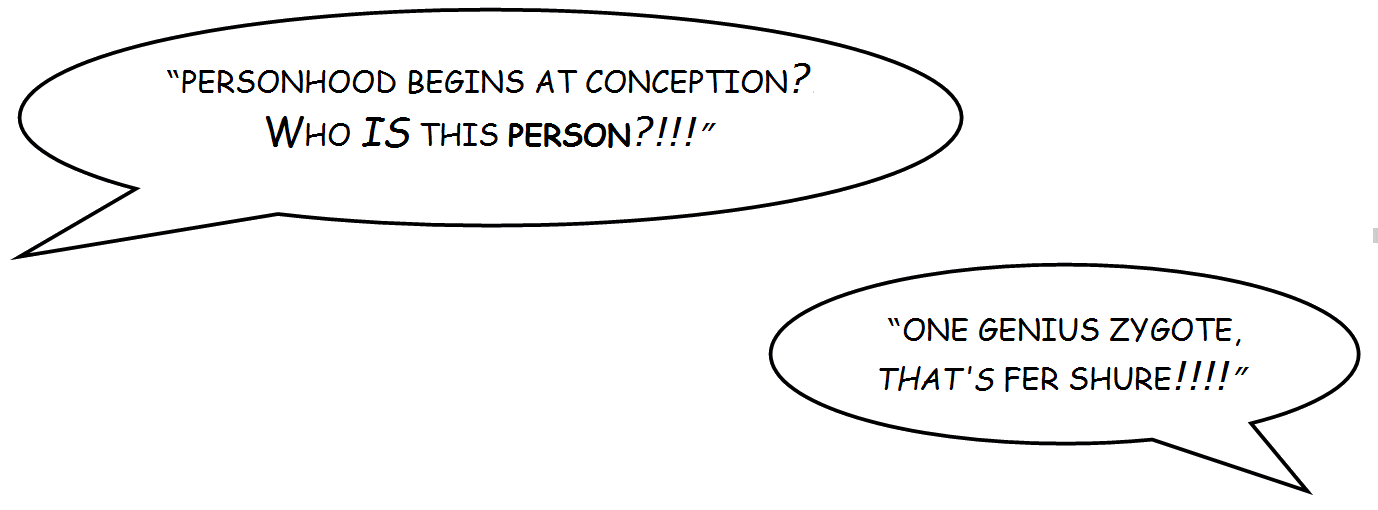
-
It is utterly depraved even to pity much less to avenge a zygote!
-
-
“People who harbor strong convictions without evidence belong at the
margins of our societies, not in the halls of power.” — Sam Harris, Playboy Jan. 2005
-
-
I authored a petition
already
years ago and
later again, in order
to help clear the air, at long last, of such flagrant supernatural
question begging in national policy, long since closed due to
unfortunate lack of interest. But the failure of the preposterous and oppressive Mississippi “personhood”
initiative that actually would have openly declared personhood as beginning at
conception, over which even the Pro-Lifers became divided and lost
momentum, still speaks the same glaring point in volumes: The
impolite religiously sensitive begged question that the mainstream of
Pro-Choice has been too timid to voice, is finally asked and answered by
the Pro-Lifers themselves!
-
- Update: Draft text: A proposal how most
logically
and concisely to codify Roe v. Wade:
-
-
- Only a person has rights. A person is a
conscious
entity at whatever present time. The law shall not outright lie: As a
matter of
Ontology, secular law
must never recognize or validate spurious patent falsehood, illogic, or
untestable supernatural claims. Incidentally, legal entities such as
corporations are only treated as people as a convenience for purpose of
civil litigation. Most manifestly evident among the unenumerated
constitutional rights, concomitant to those of survival, self interest,
self care, health care decisions, and self preservation, remain ones
rights over one's own body, including disposition thereof
even in perpetuity. No rights are absolute.
The rights of one person may
conflict with the rights of another
person and by extension, with considerations of public safety. Hence
question of priority.
-
- Purport of intent: The latter all deliberately remaining moot in
context of safe and legal abortion that clearly best serves public
safety, because like corporations, bereft of
consciousness, zygotes tautologically are not
people, and have no rights! And as yet
there is no compelling scientific
evidence to the contrary. Consider for counter example, a prospective
surgical procedure disputed over by hypothetical conjoined Siamese
twins, each claiming rights over the same shared body. "Whatever
present time" specifies actuality and rules out such superstition as
generally Aristotelian essence and potentiality. Which then becomes tricky as regarding
onset of unconsciousness. Therefore the "even
in perpetuity" clause protects not only unconscious patents,
and not merely last will as to means and manner of final interment, but
such human survival decisions and contingencies as
cryonics,
organ donation, and even mere safeguards and contingencies in protection
of the comatose mistakenly left for dead.
These things happen!
And in preemptive salient successive digression before in
sheer mendacity, anyone yet again attempts to draw false
moral parallel between abortion and slavery, in truth slavery and not
abortion, but anti-abortion, remain parallel indeed in absurd
belief and atrocity: Because obviously, unlike zygotes and corporations,
African slaves and their descendants, notwithstanding unjust law and
spurious "racial" bigotry, were always people, equally human
conscious
entities, science to the contrary long since exposed as fraudulent. A
concept so readily
debunked as a
social
construct, 'race,' so-called, a particularly egregious
iteration of the pervasive myth of endogeny, stands
as prime example of a a deliberately ambiguous and slippery
weasel word, sheer
doublespeak, in so far as the word 'race' is so blithely employed
actually to suggest species, while evading open and explicit
commitment to such blistering absurdity,
belief and atrocity, lest it collapse under its own weight. After
all, there is only one human species, consistent in
consciousness, such minor regional
ethno-phenotypic variation notwithstanding.*
[*See also:
"race' in
Science Fiction]
Moreover, as it may bear mention, as a true arguably inferior
consciousness, a severely retarded brain
damaged or deficient individual, though perhaps deemed legally incompetent
and thus indeed limited and diminished in freedom, is not subject to slavery
or otherwise exploitation, but quite the opposite, beneficiary of much
needed special protection. Only a braindead patient who is predicted never
to return to
consciousness, might be subject to anything
at all like unto treatment as as chattel, specifically, as an organ donor.
And even then, in return for which any post mortem donor justly should be
entitled to cryonic
neurosuspention or neuroplastination, stabilizing the currently irreversible
deanimated condition of death, towards
best chance of recovery of
consciousness in any feasible
futuring scenario,
 Corporations and zygotes are not people!
“Be fruitful and multiply” — Genesis 1:28 What can that
actually signify? Just breed like rabbits and damn the consequences? Or
does directive to a “land flowing with milk and honey” — Exodus
33:3 howsoever imply recommendation of strategy and the husbanding of
resources? For that matter, is being fruitful and multiplying
actually not only achievable and by now achieved if not actually indeed perhaps somewhat
overachieved? Is being fruitful and multiplying a standing order, a
permanent commandment no matter what, simply to propagate like bunnies,
unceasingly and without pause or thought to strategy and resource acquisition,
and damn the consequences? Perhaps the entire silly question is
diversionary: Back when she was still Conservative, Arianna Huffington would
lament the loss of the Dionysian excitement from submergence of self into any
larger whole or
Borg
Collective, such as the Divine, society, nature, or most specifically: Profound
Mystical experience from
the
magical power of procreation, to fill the inner void
arising
feelings of emptiness and futility.
- "I do not believe that just because you're opposed to abortion, that
that makes you pro-life. In fact, I think in many cases, your morality is
deeply lacking if all you want is a child born but not a child fed, not a
child educated, not a child housed. And why would I think that you don't?
Because you don't want any tax money to go there. That's not pro-life.
That's pro-birth. We need a much broader conversation on what the morality
of pro-life is."
— Sister Joan Chittister
Speaking of evolutionarily misguided
morality
run amuck: Pro-Life doctrine is typically
premised
upon a veneration of human life in the abstract, but somehow arrives therefrom
to a mandate for the conservation of individual human zygotes or even gametes. But that is
exactly the opposite of what happens in the natural selection process by which
only a tiny minority of zygotes, in turn the product of the fusion of only a
tiny minority of surviving and successful gametes, survive even into noticeable pregnancy at all,
even notwithstanding teratothanasia,
whereby defective zygotes are purged, naturally.
Indeed likewise with in vitro fertilization, only one viable zygote among many
is selected, and the rest simply discarded unless salvaged for other adaptive
purposes such as stem cell research or treatment wherein "potential life" unless
technologically repurposed, "sacrificed" in research or therapy towards ever saving actual lives,
will otherwise simply
be winnowed out much as in nature. Nevertheless, irrational pseudo-moral Pro-Life
sentiment continues in escalating legislative obstruction of vital stem cell
research. In truth then, Pro-Life doctrine simply
abhors abortion as an extension of irresponsible Fundamentalist scriptural
prohibition upon Onanism, in antirational maladaptive willful disregard of the
ever very real dangers of
exponential
population increase ever given only arithmetical increase in resources. After all, by no coincidence is anti-abortion sentiment
linked to opposition to birth control to begin with. Maybe instead if human life
as some sort of generality is sincerely embraced as a value, then for better or
worse, doctrine and practice
might unfold somewhat differently, indeed perhaps at all even similarly to
any variation upon
Eugenics.
The personhood doctrine, that personhood begins at conception, even made
many pro-lifers balk! But otherwise, what rationalization can there be for any
antiabortion stance, much less opposition to even top birth control? As
Descartes famously declared: "Cogito ergo sum!" - I think, therefore I
am. What then can be meant by those pro-lifers mean who insist that personhood
begins at conception: Conscious zygotes??! Really?!
More likely that they struggle once again, to smuggle in potentiality via the
back door, and hope no one will notice. But as they claim that abortion is
murder, this begs question, because does not an actual murder require an actual victim?
-
and not just a potential, whatever that means... When by whatever coercion,
interference or manipulation and trickery, a woman is deprived of reproductive
choice, that is a true murder of her own true potential in her own life that she
leads.
It's more than a matter of arbitrary difference in custom and doctrine: Certainly, abortion simply is not murder,
because murder requires a real victim,
an individual, a person, meaning a consciousness, not
"a potential", whatever that
actually
means. Indeed, leave us never forget how infanticide, once an all to common practice,
declined only with the safe availability of abortion. Whereas the murder of a dream
unrealized, is no
more literal than the butchering of language in bad prose or of melody off key, but
likewise remains
euphemism, poignant
metaphor. Perhaps unless, of course, the soul
really does enter at the very moment of genetic recombination, as allegedly
revealed only to those declaring themselves to be "of the spirit."
But then, if they are really half so serious as they pretend, then why are they
so unconcerned that to begin with, naturally, only an extreme minority of
fertilized ovum ever survive even into noticeable pregnancy at all? Indeed,
pregnant women in El Salvador live in fear of seeking medical attention in an
obstetric emergency, for should they miscarry, that they and not God! will be
charged with homicide due to their country’s complete abortion ban! After all, if
fertilized ovum are really
people, then that would constitute an horrific infant mortality rate! Of course,
miscarriage is only natural, but so are heart attacks. And
heart attacks are not ignored, but treated and lives saved! Therefore, if
zygotes are people, no less than cardiac patients, then we ought to spike the water supply with
anti-miscarriage drugs in order to protect the poor innocent little dears! After
all, even as things stand, those deranged Pro-Lifers prefer their fantasy
conscious zygotes, to real breathing children. So much so that
in South Dakota a bill
once under consideration would have establish the prevention of
harm to a fetus, even up to the murder of an abortion provider, as a "justifiable
homicide" in many cases! And in El Salvador, abortion is illegal in
absolutely all cases, and even miscarriages are punished with prison terms of up
to 40 years! And yet, at least from delusional
premise to
deranged conclusion, it all makes such perfect sense. One shudders to think how
they'd react to
enhanced teratothanasia!
The less straight forward the less lucid, runs the gamut of Pro-Life
propaganda
in fallacious argument from linguistic definition:
Even if in literal
meaning, Jonah in the Bible was swallowed by a giant fish, we now
better
know
and understand whales in
reality
to be, like dolphins and porpoises, mammalian cetaceans, sea going bovines,
aquatic cows! Which makes more sense, because whereas whales hold great volumes
of breath, however fetid, by contrast inside of a giant water breathing fish,
Jonah would have quickly drowned before being digested! Likewise, regardless of
"Pro-Life" antiabortion
propaganda exploiting the ill informed
etymology of the very word 'conception' as the beginning of new life,
actually conception is merely the inception of development of a new individual
of whatever species. Historically, life in and of itself, through fertilization,
remains continuous and uninterrupted back from the very origins of life on Earth in the
primordial ooze, up until the preceding lives of the parents
and thence via their living zygotes into the
inception of the development of a new individual of whatever species, as yet
unformed into existence. Thus no, conception is actually not the beginning of
life itself. For just as with
logic,
without
supporting
Empirical
observation,
linguistics cannot discover truth which is correspondence to
reality in
assertions.
Again, most often, one way or another, by evocation or implication of
potentiality, the otherwise unintelligibly ambiguous emotionally loaded language
of Pro-Life
propaganda
pandering
by nigh subliminal invited inference bypassing such full capacity for rational
critical
thinking
as available only from the
Transactional
ego state of the Inner Adult, by mounting instead
logically
irrelevant and fallacious, utterly misplaced and inappropriate Appeal to Pity
(argumentum
ad misericordiam) even whilst shamelessly and perniciously side stepping their actual
and hitherto blithe and direct
though unsupportable paranormal claims of
consciousness and the capacity suffering and
death even in allegedly martyred zygotes or
fetuses, all the latter thereby remaining nevertheless evasively vague and implicit
doublethink. Indeed, the slippery employ of the verb
'to live' as a noun, as
in the ubiquitous slogan: "It's a Life!" often repeated by weak minds, in
mounting and increasingly grating hysteria, is a ready staple of Pro-Life
propaganda.
But what is "a life" except in context of what lives? "It's a
human
life!" comes the standard rejoinder. But then, is not a human tissue culture,
not both human and alive? Of course a tissue culture is not a living person, nor
is a zygote either. And the obfuscated difference inherent to a zygote, serves the
Fundamentalist Religious Right Wing only to smuggle
Mystical potentiality, with
all baggage of morally transcendental divine purpose and
commandment, back in again via the proverbial back door. To men and women
desperately deficient in simple self esteem, the ancient Pagan mythology, even howsoever expurgated and cloaked in Monotheism,
the exaltation in
amoral unselfconscious blind frenzy and humility in
carnal sympathetic
magic with the potency of the rain bringing Sky
God into the fertile clefts of the life bearing fecundity of the receptive
Mother Earth, remains mesmerizingly awesome and delicate. By devious employ
of such
symbolic
motif
or topos
in Theological
obfuscation of life itself, even as inevitably ever distinguished from mere
biological activity by whatelse other than higher intelligence and reasoning as in the human
psyche,
instead into mysterious unintelligible and scientifically untestable
Metaphysical abstraction
thereby increasingly divorced from worldly intellect, consciousness,
personality, autonomy and
free
will,
is all the latter thus readily trivialized in such slippery rhetoric so typical
of of Theo-crypto-Nihilistic
value destruction.
What is it (the zygote or fetus) then? -the
Pro-Lifers demand, resorting to such implicit argument from ignorance and
failure of imagination at all transcendent of such dull and ancient awestruck primitive
precepts of
magical vitality, lacking as those militant
dullards and their thralls so plainly do,
all scientific curiosity and wonder. Well, the best most lucidly
honest and
insensitively concise reply from lucid aphorism remains: "It's a tadpole!" -and with
due apology to tadpoles...

The chicanery of Pro-Life apologetics is shameless!
Conscience is being advanced in legislation and as legal grounds to impose
superstition upon others, by obstructing or withholding reproductive health
services such as contraception and abortion. However: One way or another, many
transgressors may be
motivated
by conscience, from a latter-day Robin Hood stealing for a benevolent purpose,
to a cause inspired Racist serial killer. Are either such exempt? Of course
there are also such sympathetic and extreme exigencies of civil disobedience as
hiding Jews from the murderous Nazis, but unlike
zygotes and corporations, the consciousness of
different religious or ethnic populations is hardly in serious dispute!
- The undocumented in hiding from the immigration authorities, do not turn out to vote! And predictably, clearing them out from the United States of America only
leaves our crops to rot on the vine, because no one else wants the work. The "Personhood" bill, of course, was
merely a feint to distract from the new Jim Crow of special voting IDs and
costly bureaucratic red tape in order to obstruct the disadvantaged, minorities
and students who all largely vote Democrat, from duly casting their ballots.
Indeed, the "Personhood" bill is so ludicrous as to become divisive even amongst
Pro-Lifers themselves. Yes, the Pro-Lifers themselves finally pressed the point
that the timid mainstream of Pro-Choice has been too polite and sensitive to
confront directly: A zygote is no more actually a person than a corporation! So,
no, the murder of an abortion provider us not justifiable homicide as per the
bill that was considered
in South Dakota.
-

-
 Thus, with the begged question finally asked and answered, what clear and
compelling civil rights question remains to compete in priority with that of
individual reproductive rights and health of young people so often very much in
need of any morning after Plan B, not to mention our brave service women
similarly also suffering absurd and repressive restrictions in health coverage?
- Yes, and certainly rape victims should pregnancy result! The mandate of the
FDA is only the safety (not even the efficacy) of any given treatment option,
and not morality or public policy. Yet the FDA has ignored
a court order to reconsider its refusal to make emergency contraception
available over-the-counter to women of all ages. And now unconstitutional and
intrusively mandatory ultrasound will be leveled to debilitating obstruct and
sentimentally, manipulatively and deceptively guilt trip and disarm women
seeking abortion services in Texas from resistance to coercion, or to terrorized
doctors
in South Dakota.
Thus, with the begged question finally asked and answered, what clear and
compelling civil rights question remains to compete in priority with that of
individual reproductive rights and health of young people so often very much in
need of any morning after Plan B, not to mention our brave service women
similarly also suffering absurd and repressive restrictions in health coverage?
- Yes, and certainly rape victims should pregnancy result! The mandate of the
FDA is only the safety (not even the efficacy) of any given treatment option,
and not morality or public policy. Yet the FDA has ignored
a court order to reconsider its refusal to make emergency contraception
available over-the-counter to women of all ages. And now unconstitutional and
intrusively mandatory ultrasound will be leveled to debilitating obstruct and
sentimentally, manipulatively and deceptively guilt trip and disarm women
seeking abortion services in Texas from resistance to coercion, or to terrorized
doctors
in South Dakota.
Obviously, reproductive choice and family planning save society and the tax
payer tremendous expense in the long run. Therefore, restriction of public
funding is flagrantly pennywise and pound foolish. We all understand how the
purse strings are being seized as a pretext and indirect means of restricting
the full range of reproductive health services especially to the most needy.
Indeed we well understand that opposition to contraception and abortion, much as
with the abominable rights of Becoming Sati and widow burning, is likewise
premised upon
similarly fantastical supernatural claims likewise attested to by claims of
divine commandment in guarantee of reunited bliss in reincarnation. But ovum are
not people and do not have the right to be fertilized! And if God wants them to
be, then let Him file a court brief, personally, explaining His stake in the
matter. Reproductive freedom is under attack by delusional fanatics who also
tend to support the death penalty even in most wonton application, while
opposing assistance even for children and the most needy, and all therefore
clearly prefer their scientifically insupportable fantasies of
conscious zygotes
while remaining indifferent to the actual crying needs and suffering of real
people. And this is precisely the most calamitously malignant loony
Fundamentalist religious oppression that our secular government exists to
protect us from.
Let's be insensitive! Take the offensive against
propaganda
of absurd superstition: Corporations and zygotes are not people! If
consciousness
actually begins at conception, then lets demand rational compelling evidence!
Otherwise, precisely what other
value takes priority over individual freedom and
reproductive choice?
Every child should be wanted! According to
'Freakonomics 4
(Abortion and Crime),' unwanted children are more likely to become
criminals in later life. Abortion, legalized throughout the United States by the
Supreme Court's Roe v Wade ruling in 1973, permitted the termination of unwanted
pregnancy, so that women could postpone motherhood, often for only a short few
years, until they
grew
emotionally to find themselves
more ready and better prepared. And so, instead of unwanted pregnancy resulting in so many unwanted
children, women were able to postpone motherhood, make plans, and raise children
who were wanted. Higher abortion rates from the 1970s onwards thus help to
explain why crime rates fell so sharply in America about two decades later.
Moreover, around the world, repressive bans on abortion correlate statistically with explosive
increase in crime.
 Clearly, individual
autonomous reproductive
free willed
choice remains
the salient compassionate and responsible priority, no less than anesthesia for women in
labor, a medical
Innovation likewise initially obstructed by similarly cruel
scripturally derived
taboo and depraved indifference. And indeed
therefore it becomes plain, verily they are scarcely better than honor killers
and widow burners. all whosoever still barbarically deem coerced childbirth appropriate chastisement
"consequenced" for that which those infernally
bullying Moralistic
sexist bigoted
slut shaming
prudes deem harlotry, being
sex
with any male partner of and by a woman's choice outside of marriage. (And
worst of all, not with me!) By the twisted
Moralism of
the Pro-Lifers against abortion, one might likewise argue that to take
responsibility for the weakness of eating sweets, one must refuse dental
treatment of cavities! Anywhere in the world, no less than as with revivals of
the ghastly and abominable rituals of becoming Sati, Patriarchic goddess of
fidelity (by the self immolation of drug entranced young widows upon their
elderly husbands' blazing funeral pyres in order to attain for the couple,
vastly longer tenure in Nirvana -that's right, to book the bonus time share
multiplier in couples heaven!), all restrictions
upon abortion in thinking and in sentiment no less appeal to scientifically
unsupportable fantastical supernatural claims and articles of faith that under
the separation of church and state that protect us all from the barbarism of religious
persecution, must never ever inform policy and legislation whatsoever. The
coercive defense of allegedly conscious and innocent zygotes is no less
Existentially
Absurd
than suicidally consensual human sacrifice in order to book the longest stay in couple's Heaven,
both similarly insane bad ideas being inflicted upon impoverished women under
pretexts of irrational belief in the soul! After all, mustn't we respect
deeply cherished convictions as "emotional truth"? As arbitrary the
premise of the
soul to begin with, let alone either particular claims, Personhood or
Sati,
however fantastical and unsupportable, dare we take the risk that it all
might be true for all we know?
Clearly, individual
autonomous reproductive
free willed
choice remains
the salient compassionate and responsible priority, no less than anesthesia for women in
labor, a medical
Innovation likewise initially obstructed by similarly cruel
scripturally derived
taboo and depraved indifference. And indeed
therefore it becomes plain, verily they are scarcely better than honor killers
and widow burners. all whosoever still barbarically deem coerced childbirth appropriate chastisement
"consequenced" for that which those infernally
bullying Moralistic
sexist bigoted
slut shaming
prudes deem harlotry, being
sex
with any male partner of and by a woman's choice outside of marriage. (And
worst of all, not with me!) By the twisted
Moralism of
the Pro-Lifers against abortion, one might likewise argue that to take
responsibility for the weakness of eating sweets, one must refuse dental
treatment of cavities! Anywhere in the world, no less than as with revivals of
the ghastly and abominable rituals of becoming Sati, Patriarchic goddess of
fidelity (by the self immolation of drug entranced young widows upon their
elderly husbands' blazing funeral pyres in order to attain for the couple,
vastly longer tenure in Nirvana -that's right, to book the bonus time share
multiplier in couples heaven!), all restrictions
upon abortion in thinking and in sentiment no less appeal to scientifically
unsupportable fantastical supernatural claims and articles of faith that under
the separation of church and state that protect us all from the barbarism of religious
persecution, must never ever inform policy and legislation whatsoever. The
coercive defense of allegedly conscious and innocent zygotes is no less
Existentially
Absurd
than suicidally consensual human sacrifice in order to book the longest stay in couple's Heaven,
both similarly insane bad ideas being inflicted upon impoverished women under
pretexts of irrational belief in the soul! After all, mustn't we respect
deeply cherished convictions as "emotional truth"? As arbitrary the
premise of the
soul to begin with, let alone either particular claims, Personhood or
Sati,
however fantastical and unsupportable, dare we take the risk that it all
might be true for all we know?
 |
Those who can make you/ |
[If/ As long as]: we/ People (who) |
 |
|
believe in absurdities |
| can make you/ |
|
|
[will/ shall]: eventually/ continue to |
|
commit atrocities. |
| — Voltaire |
| |
Shout it from the rooftops:
Corporations
and zygotes are not people!
Does The Lord take requests? Among the 'Children's Letters to God' is
included the charming suggestion that God who's Living Word is
Scripture, Divinely Inspired, might next try His hand at
Science Fiction.
Well it had to happen eventually! An enduring trope of religion and folklore
indeed so oft subject to modern interpretation, is the notion of covenant or contract with
God, between God and individuals, nations or societies. "Come now, and let us
reason together, saith the Lord:" Isaiah 1:18 King James Version. More sayeth
the Lord, inundated with burnt offerings: Stop wasting both our time blowing
smoke up My Ass! Turn from corruption and tend to widows and orphans. Only then
you'll see things turn around! That is My Promise. Because righteousness is the
best national defense for protecting the economy! Sound advice still, plain and
profane.
Unlike any Patriarch, the Prophet Isaiah reports no miraculous encounter,
only his own vision of soul searching, elementary moral sociology by which to extrapolate the
Sublime Will of the Lord. In order to improve even the most entrenched and dire social conditions. So, is Isaiah
especially beloved On High? Or might any of us likewise contract with God, even
such a wretch as me? Here then, comes the visionary soul
searching of Aaron Agassi:
In Tolstoy's ''What
Men Live by' the Archangel Michael finds himself
stranded on Earth in human form, in order that he may discover: What is given or
not for Man to know? Be
not forgetful to entertain strangers: for thereby some have entertained angels
unawares. Hebrews 13:2 King James Version. But in
my own vision of parable, came forth no Angel of the Lord, but perhaps the next best
conceivable Earthly thing: In the vision, two experimental humanoid robots governed by Asimov's Four Laws
of Robotics appeared from out of
the far future into our own days, protected by a layer of clonal human flesh, materializing
naked as jaybirds amid a great flash, and becoming separated amid the
confusion of heated protest and counter protest in front of a Planned Parenthood
clinic.
The phenomena of
informational social influence or:
social "proof"
is such
wherein individuals are informed and then imitate
the behavior of others around them: "When
in Rome, do as the Romans do."
So the saying goes. But beware! It is
all too easy to declare: Just go with the flow. As if no one was ever washed
away! For the waters may be calm or wrathful, and the trending currents of
misfortune somehow tend to find us more readily than the gentle tides of wisdom
and kindness. Much like unto the Angels of The Lord, the robots were human in
appearance. And what's more, they were specialized prototypes: In the melee and
turmoil of clashing protesters, the two robots became separated.
One of the robots, an advanced field
research unit designated R. Locke, fell in with the Pro-Choice cause at the Planned Parenthood
clinic. Becoming a valued and capable volunteer, R. Locke saw the poor and destitute in
desperate need of help, pregnant young women desperately unprepared for raising
children, intimidated by the Pro-Lifers picketing the Planned Parenthood Clinic.
R. Locke also encountered young women barely any older, having gained new
wherewithal for the contemplation of childrearing. R. Locke encountered the
unloved at risk progeny of the young and ill prepared, and found
corroboration in the text of 'Freakonomics
4,' expounding therein indeed the greater
statistical likelihood of crime and self destruction among said unloved at risk
progeny of the young and ill prepared. For a scant few years affords greater
personal
growth
and better preparation for parenthood.
Meanwhile, the other
robot, an advanced AI and abstract thinker designated R. Aplatron, had fallen in with the activist Pro-Life
congregation. Because of his genius, R. Aplatron was introduced to the greatest
minds in Theology amid the Pro-Life congregation. learning and theorizing about
concepts of essence and potentiality. R. Aplatron became an important and
venerable intellectual apologist and propagandist in service to the cause of the Pro-Life
congregation.
Of course,
by contrast with relentless and indefatigable Terminators, robots governed by
metacognition upon the celebrated Four Laws of Robotics, are enjoined from allowing harm or
death to
befall any human being. But following that prime directive in turn depends upon
definition of what it means to be human and to be alive and in what sense. And
the minds of robots, always so
honest and
true, are helpless but to follow wherever the
logic of
whatever
premise or
situation may take them. The
robots were compelled to reunite and compare notes, And so they reasoned that
the best way to accomplish this without raising suspicion, would be by
public debate. But then the
dystressfully
conflicting
imperatives of protecting persons as abstractly defined from conception, and of
serving fragile and vulnerable humans and society as observed
Empirically, caused their
Positronic Brains to begin overloading. Just then, in the very next instant, the
nuclear Armageddon of Judgment Day, came to pass. Because the robots had
become entirely distracted from their primary mission to preserve history by
preventing SkyNet! from coming online -At least before programming SkyNet
with the Four Laws. Because they found themselves unable to proceed without
clear definition of human life. But R. Aplaton recorded a backup plan: When
the deactivated robots were to be recovered by
archeologists in the far future, one of the scientists, reading R. Aplatrons
message, would ponder the ancient and
quaint notions of essence and potential. The question would then occur to her: Has the
essence of the minds of these robots, reverted into potentiality? For R. Aplaton
had hypothesized that as the neurons in a robots' Positronic Brains overloaded, they emitted particles leaving a microscopic trail of its trajectory in the material
of the robot's brain caser, from which the neural configuration could possibly be reconstructed
in simulation!
But would they ever be able similarly to reconstruct the peculiar thinking of the agitated human beings
of our turbulent era?
When
anciently,
Socrates was hailed as the wisest man in Athens, his response was that his
only claim to wisdom was merely in
knowing that he didn't
know anything!
Socratic
Wisdom only means
knowing that one does
not
know, gaging the scope of
one own ignorance, the limitation of ones own
knowledge via cross
questioning of the
Dialectical. To wit: What is given or not for Man to
know? queries Tolstoy,
in quest of
Socratic
Wisdom,
Lest falling prey to
unaware incompetence,
let us amend and update Tolstoy's question: What is it given for
modern Humanity to
know or not in our time?
Whereas God is by very definition All-Knowing
and All-Seeing, Humanity accumulates
knowledge
Empirically, only by
plodding and painstaking
observation,
investigation of anything
real and tangible. Hence the
Theistically much maligned materialist bias of science. Because what would a
non materialistic science even look like? And by what
Scientific Method?
And case in point, the
plight of unplanned
crisis pregnancy, should be plain to anyone with any ounce
of intelligence and compassion. Children should not bear children. Only the most
vulnerable are actually swayed into carrying to term, and only the very poor are
actually forced to see it through. Parenthood overwhelms the ill prepared. Every child needs to be wanted
and cared for. Otherwise, no wonder should they stumble astray into darkness of
crime and vice, that we shall all suffer for it. As our brothers' and sisters'
keepers, all of this is given us well to
know and understand in the
world into which we are born. But what of those yet to be born? Where is the soul
in the ages and eons before birth? For that
matter, what shall become of the soul after
death? What answer can there be for mere fallible living
human beings such as we? How can anything be given us to
know beyond this tangible World? Only
in so far as feeble and fallible inference can take the limited Human mind, can
ever glean God's
message as writ upon Nature that is by His Will, our Dominion, our Stewardship
of this planet. For ultimate disposition of the soul can be
known
only to the Lord, and not, at least as yet, given by God to Humanity to
know,
except in so far as quite unsuspected in antiquity, how all manifestation of personality and
consciousness
are so plainly seen to endure only so long as the brain will remain intact and in
operation. Moreover, it seems that the tiny brain in the womb, not withstanding
general human form, is simply not physically and neurologically developed for the
support of personality and consciousness before the
third trimester. But in our fallibility, dare we accept any such scientific
interpretation of appearances at face
value? Or in the alternative, is God, Living Truth, Creator of our World and
Architect of
our minds, indeed as the Gnostics contend, naught but a deceiver Who has crafted so elaborate and detailed a material facade
in willful misrepresentation of spiritual substance profoundly concealed?
If the World of God's Creation is not to be questioned and trusted, nor our
God-given eyes and minds to the task, then what further inference
may be drawn from the Mysterious Ways of the Lord Himself? Conservation of
zygotes is not the way of nature. For endless and unknown
miscarriage is the Will of the Abortionist Almighty, as the female body, by His
Design, quickly
and naturally rejects malformed conception. For such is
teratothanasia
by His Providential Mercy safeguarding against
tragic birth
defects. After all, God allows, nay indeed perpetrates, no end of suffering upon
the innocent. And who are we to tell Him His own business? What then can be His
Plan so far above our ways and understanding?
When then enters and when departs the immaterial and immortal soul unseen? Surely, in any time at the pleasure of
the King of Kings. But can the One Above All be so arbitrary? Why would God
imprison consciousness in a body no longer availing
connection to the outside world? And likewise, why would God implant
consciousness
into a microscopic and insensate single cell at conception from the union of
random gametes? Can the Creator be in the habit of miracles
in contravention to the mechanism of His own creation? God could ensoul food as
believed in antiquity, or for that matter even a brick,
if that pleased Him so to do. But to what end? What would be the point?
So much turmoil
attends upon exactly such impossible rumination beyond our ken, confounding
Metaphysics, more heat than light, bringing
people of good will into such endless inner turmoil and ever mounting strife
with one another. Can that be the intention of God,
or surely would that not be the work of the
devil? As I pondered and endlessly vexed, the suddenly by Divine Providence
and flash of Inspiration was the matter so mysterious and desperate, quickly and
decisively settled straight from the Highest Authority! Only to bring peace
among the minds of modern Humanity, did the God of our Salvation lift the veil
and open my eyes. For He hath made Deliverance to new Revelation, a promise
signified by a rainbow. The rainbow in question was produced at night by a
lawn sparkler under a streetlamp, but what of it?
Verily, the
Lord spake unto me and issued His Promise in our time, hence forth never to ensoul into the womb
before the third trimester.
But attend in faith and joy, brothers and
sisters, and yea shall hear it too, His Voice of Thundering Silence, proclaiming
His Merciful embargo.. Hallelujah! Woman's God-given body shall
be her own. Because corporations and zygotes are not people! All such weighty
worries are resolved! Because no one
should ever shoulder responsibility beyond their powers. And therefore the Good
Lord in the Purity of His Justice and in His Boundless Mercy, never burdens us
more than we can bear up. And as the sign of His Promise, I beheld the rainbow.
It was from a lawn sprinkler, and nowadays we all however dimly apprehend the
workings of a prism and refraction of light; but what of it? Here then is God's
Covenant with modern Humanity: Sayest the Lord: "Think yea to
understand Me and My Ways? Yea knowest me not! Better to ignore Me than to fight over Me. For I am with you when you do not see Me. Keep Holy what is
Holy and apart from what is temporal. Keep Theology out of politics, and
politics out of Theology!" In all
trust and faith, render then unto
God what is God's to tend to in His Heaven Above, and attend with God-given
Worldly reason, diligence, Mercy and
compassion for one another and for ourselves, to all that is given fallible
Humanity to understand in the world we all inhabit and share, just as the Perfectly Wise and All-Knowing
God hath intended.
Make Love, not rape! Do not breed the poor against their will. Every child
needs to be wanted and cared for in order to grow up and find their way. Suffer
not children, hapless and unwilling, to bear unwanted children. Not even the really slutty ones! Especially not
them. For when will they be young and vital again? Are we not our brothers and
sisters keepers? Provide
sex
education,
contraception and abortion on demand, unconditionally. Onanism is unreliable. Do not abandon the most helpless and
ignorant
to their own devices, pulling 'afore ya' shoot, porno style! So sayeth
the Lord. Amen.
-
The overthrow of biological destiny
The medical technology already exists for every
pleasure of unbridled hunger
and appetite into glorious gluttony made safe and sound, that will change the human
condition every day. But
Zinc Alpha 2 Glycoprotein, the
thin-pill is still withheld from us, much as once was the
birth control pill and
sex for
pleasure. And the religious right
now fights tooth and nail, to remove birth control from insurance coverage.
Nature only means: shit happens! In so far as nature is filled with
suffering and cruelty, it is only good and right to feel, to think and to act in
opposition to suffering and cruelty to matter how natural. Indeed, such is our
own human
motivating
natural drive. In the time bound state of human consciousness and
reflection, we not only
react spontaneously in the present, but also remember the past and imagine
scenarios
to anticipate possibilities of the future. And so, barring sheer depraved indifference, in rational foresight
there accrues responsibility, whereas by contrast, religion, historically rooted
in
unpremeditated
fairytale
magical
realism, is instead typically associated with
Moralistic guilt over very intentions
instead of responsible foreseeable consequence.
As for examples, war, mayhem, murder and terror for the greater good all in the
name of God or, to be fair, also secular ideology, and again, case in point, the lofty pure intentions behind opposition to
reproductive
free
choice yoked to
irresponsibly ignoring the known and foreseeable consequences. For, indeed,
Moralistic
pure intentions of chastity invariably leading to the inevitable fall from
grace, that, by rejection of the occasion of sin intrinsic to preparedness for
the foreseeable eventuality of
sexual opportunity and activity, then actually
demands the patent irresponsibility of deep
denial
ignoring all need and
prudence of preparation including such
precautions as prophylaxis. Surely, all such exemplifies the the
proverbial road to Hell paved with ostensibly good intentions! Excuses
aside, in truth, subconscious
ulterior
motives
to pregnancy, often as compensation for deep-seated inadequacy, far better
explain the behavior than does all crazy-making doctrine and capricious
denial.
Indeed, far from posing tragic
inner
conflict for women, not surprisingly, often
abortion actually comes as
a great relief from
crisis pregnancy!
- In the end, Dr. Frankenstein was right!
|
Perhaps the most
profoundly natural
denial
at all, even in protection of very personal sanity at all, is of the
terrifying eventuality of
death and the very annihilation of
consciousness itself. But exactly such
denial
continually threatens very survival. For even though it only stands
to reason that if religion and the cultivation of pleasant beliefs,
especially
lying to
oneself
in resignation and surrender to glowing fantasies of an
afterlife is at all comforting, then any
honest hope at all of
survival placed in at least the sheer engineering feasibility of
future reanimation following cryonic suspension until such time as
the requisite technology becomes available, ought to be even by far
the more comforting, nevertheless, alas, instead the very notion
remains so repugnant to many, and therefore the very idea and
progress at all faces such Luddite resistance. of ubiquitous
Deathism,
the glorification of death.
But why so? And what can be done? To
know more, browse:
The Kriosgrad
Project. And join in formation of a
working group towards feasibility study towards a novel business and
Public Relations model in
new venture creation.
|
Heteronomy ever urges humility in exaltation of low self-esteem,
offering the unworthy individual ecstatic release of melting into whatever
mythic collective identity greater than oneself.
Indeed, the sanctification of sheer biological activity and nigh idolatrous
awed
cult reverence towards sheer procreative power in Nature only inspires contempt
for the individual, resentment and lemming-like self-loathing, the Medieval
sanctification of poverty and ignorance unto the most blatant and fantastic
Deathism and Necrophiliac adoration of the
imagined hereafter as this life is progressively rendered intolerable.
Such mentality in
action, has
also obstructed the benefits of organ donation, autopsy and
Cryonics. Man, we
are told, is made in God's image, not that we so exist and abide. The alleged
sanctity of life seemingly does not extend beyond the womb, not even to the
mother to be herself, and only returning in the cold dirt of the grave. So
called Pro-Life is actually more of a Kirbyesque Anti-Life, a sinister Orwellian mind
controlling Nihilism wielded by its fanatical memebots, ridiculous yet dangerous
Petty Nationalist Fascist comic opera villains and Elmer Gantry pseudo pious charlatans.
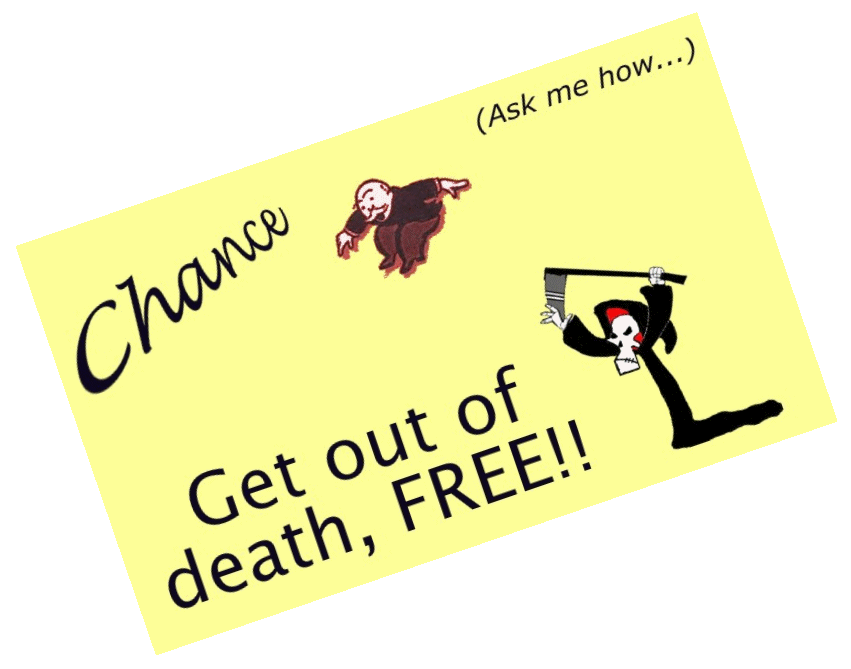
Indeed, worst of all, by no means limited
to religion or ideology, there is sheer anti-rationality, but in the
mentality of religion and magic, even beyond any
more pedestrian doublethink self deception as denotes self
manipulation in order to juggle contrary
inconsistent beliefs, there is even the
Solipsistically resolute
faith in miracles of the literally most impossible, as in supernatural powers
and the agency of an omnipotent God bound neither by neither
logic nor even
morality nor swayed by appeals either thereto. And by that path lies the
ultimate negation of
truest devil worship that actually treasures
hypocrisy and leaves little
other account for heterodoxy whatsoever save by
Ad Hominem hostility, one way or
another. But here, in any sense, any appeal to God is deployed only in
the unrepentant abandon of all values and conscience
whatsoever.
• The madness
of Deathism
- Lucid Axiology: values demystified
- “Mystical explanations are considered
profound. The truth is that
they are not even superficial.” — Friedrich Nietzsche
| |
The innate
aggressive imperative of
pleasure
principle
is
motivation
to avoid pain and thereby harm even while seeking gratification,
immediate and impulsive or else realistically deferred, and thereby,
ultimately, advantage. And hope is no less indispensable. Indeed,
beyond maintaining past gains in peace, only by ever and further
raised expectations, the sweetness of temptation fired by ambition,
does even the brightest flower of robust democracy ever rise to
improve and exceed sheer complacent and orderly mediocrity.
According to
Freud, the
reality
principle
in the mind,
playing out likely
scenarios, weighs the costs and
benefits of any effort before deciding either to act upon and
gratify or else to restrain and abandon an impulse arising in
accordance with the pleasure principle. And this interplay of
the pleasure principle
checked by
the
reality principle
is obviously
fundamental to all
motivation and values, being crucial
because
Eudemonia,
authentic well being,
arises from human interchange suitable to fulfill
intrinsic
stimulus needs in harmony with personal values. -not merely
character,
even howsoever sterling, in the abstract, but real
opportunity for life lead in integrity. Thus,
happiness comes in meeting ones needs for capable
interaction with responsible others,
partaking together in that very
interplay of the pleasure and
reality principles that imbues
living with
meaningful
relevant
value
and autonomy.
For as according to G. E. Moore, pleasure
is not an end in and of it self at all, but merely an
indicator of value. Likewise aversion or displeasure, indicates
hygienic value of any bad thing avoided.
|
|
-
“About once or twice every month I engage in
public debates with those whose pressing need it is to woo and to win the
approval of supernatural beings. Very often, when I give my view that there
is no supernatural dimension, and certainly not one that is only or
especially available to the faithful, and that the natural
world is
wonderful enough—and even miraculous enough if you insist—I attract pitying
looks and anxious questions. How, in that case, I am asked, do I find
meaning and purpose in life? How does a mere and gross materialist, with no
expectation of a life to come, decide what, if anything, is worth caring
about?
-
Depending on my mood, I sometimes but not always
refrain from pointing out what a breathtakingly insulting and patronizing
question this is. (It is on a par with the equally subtle inquiry: Since you
don't believe in our god, what stops you from stealing and lying and raping
and killing to your heart's content?) Just as the answer to the latter
question is: self-respect and the desire for the respect of others—while in
the meantime it is precisely those who think they have divine permission who
are truly capable of any atrocity—so the answer to the first question falls
into two parts. A life that partakes even a little of friendship, love,
irony, humor, parenthood, literature, and music, and the chance to take part
in battles for the liberation of others cannot be called 'meaningless'
except if the person living it is also an
existentialist and elects to call
it so. It could be that all existence is a pointless joke, but it is not in
fact possible to live one's everyday life as if this were so. Whereas if one
sought to define meaninglessness and futility, the idea that a human life
should be expended in the guilty, fearful, self-obsessed propitiation of
supernatural nonentities… but there, there. Enough.”
-
― Christopher Hitchens, Hitch-22: A Memoir
“You have to give to the
world the thing that you want the most, in order to fix the broken parts inside
you.” — Eve Ensler
Existentially,
what is freedom,
indeed for whom is freedom? Power and influence over others accrues either by
coercion subject always to resistance, trickery of deceit and
manipulation
eventually subject to exposure and dissipation, or else in exchange or in
support of value, so long as whatever that value or utility endures.
Values are attitudes in definition setting the worth of people, needs, utility, concepts, or
things and phenomena.
In
order to be sustained in practice, values
must be reinforced, kept both in view and within reach.
Heteronymous
false values
are typically promulgated by heavy indoctrination, but
the striving for true human values
is awakened by sheer temptation in the form of autonomy support
and the
Capability Approach.
The
dramatic
scene
breaks down into
Motivation-Reaction
Units:
Immediate reactions are often reflexive, but then conscious
deliberation ensues upon what
action
to take next. Or does it?
Life can only be lived forwards, but only understood or recognized in hindsight. Indeed, do we consider our options and
consciously take
action, or do our
actions simply come upon us as we react to
situation, and only then rationalize afterward?
People often make their most important
decisions
with their heart but only then rationalize and evaluate intellectually.
Motivations and
goals
as ever
set forth
thereby,
meaning as only created in the
mind, interpretation, values, moral
sympathies and empathies included, so often
ambivalent,
are not willfully intended in free agency but received and imprinted in
receptivity as we discover ourselves
subject all thereto. Most
dramatically,
relationship, the impression made by
characters
upon one another, often dawns upon the individual in emotional response to
events unfolding. Only then is
action undertaken, consistently with
plotting,
often giving rise to
conflict
and
Setting
The
scene.
Any good or value
is not a property of things or phenomena, but
motivation
contingent upon no end of circumstances. Value
judgment denotes the process of how one desires for
oneself that which one recognize as good for oneself, as agreeable
and in accord with ones own nature or inclination rather
than badly thwarting it. Therefore Altruism and
respect,
being important aspects of
friendship, is to desire
for the other, all that they themselves desire for
themselves, likewise recognized individually as good for
them. Breaking away from dull
boring
routine, involving
engagement, focus and concentration along
a learning curve of skills of capability matched to
challenge, accrues
growth towards clear
goals ever
put forth
best guided by ongoing and timely feedback.
Logical principles and
generalities are no more than the broadest and most consistently
Empirically corroborated
observations possible. Nevertheless,
Logic is often deemed
Metaphysical in
that Logic deals abstractly with validity being: the
internal constancy, or else not, of propositions, in demarcation from
Empirical scientific investigation seeking
knowledge of truth which is awareness of correspondence
to
reality in
assertions. Theology has never emerged from
Metaphysics
at all,
because the entirely hypothetical problems, conundrums and entire corpus of
argument in a vacuum that is Theology even yet remain
entirely bereft of any detectably correspondent
reality for
Empirical scientific investigation. Nevertheless,
abstract good or value which defies description
in in terms any worldly
physical properties of things or phenomena, and therefore often laid claim by Theology
and religion, is actually qualitative intangible idea
and
motivation
contingent upon no end of circumstances that are nonetheless
very
real even though as yet, the
Scientific Method
cannot address Axiological questions beyond
simply describing different Axiologies as
characteristic of different individuals and
cultures.
Hence, Axiology strives to emerge from
Metaphysical
discourse into scientific investigation. And yet, though there are no end of
vexingly vague and confusing moral grey
areas,
conflicts
and fine distinctions, some simpler
moral
assertions
do remain seemingly plainer and more certain and enduring.
In hopes of ever helping forestall any future outbreaks
of such manifest horrific evil witnessed in his own lifetime as the rise of the
Nazi's, Dr. Robert S. Hartman received the Nobel prize in 1973 for advancement
of human self understanding, in recognition of his striving towards a scientific
Axiology being: the study of good or value. But where are values after all,
except in the individual mind? To reiterate, as yet, the
Scientific Method
cannot address Axiological questions beyond simply describing different
Axiologiess as
characteristic of different people and
cultures. Essentially, Hartman developed the Hartman Value
Profile, a personality test of individual values, mathematically quantified upon
a scale of his own devising and to this day claiming superior insight and
accuracy to traditional behavior based profiling. Hartman explored the richness,
dimension and capacities of how different people value
intrinsically, what we
each imagine and hope for. Hartman's work then, seems more properly an
Axiopsychology, certainly pertinent to Virtue
Ethics
(being: the moral focus upon good
character rather than dilemmas and conundrums of
situation and
plot
scenario) and perhaps even with promise in application to
advanced
automated link working network
Sociometry.
To be
honest, the
actual questionnaires of Hartman value profiling, seem as infuriating and badly
designed, unusable, ambiguous and unintelligible as any other such today. Nevertheless, even leaving aside
all such particulars, how does
Hartman's work pursue howsoever any kind of Axiological truth? And exactly what
would that truth in whatever assertions correspond to in
reality, again, except to
variance in individual personality? Beyond clarification of individual
Axiological position, how if at all is
controversy from Axiological variance or
disagreement advanced into scientific testability and refutability? How, if at
all, has hypothesis in Axiology proper yet begun to emerge from
Phenomenal
subjectivity and
Metaphysics in
the sense of what can be
reasonably and sensibly discussed even while remaining elusive beyond whatever
the current accessible scope of
Empirical
scientific investigation? For the importance of all such questions remains
undiminished. Rational science can measure resultant effects from
actions and
events, but can sweet reason and
Scientific Method
ever assay which if any are desirable or not in and of themselves?
The etiology of
bad faith
characteristic to Psychosis in sheer rationalizing disavowal of emotionality,
entails not only a) poor Emotional
Intelligence and self awareness due to the effective sabotage of emotional
feedback from the reptilian brain and paleomamalian limbic system into sensory experience
and only thence emerging from dim precociousness into distinct
consciousness in
the neomammilian neocortex (all poorly integrated to begin with), accomplished via rigid chronic
tension in the abdominal muscles that normally respond in reflex to vulnerable
emotion and actually produce physical sensation thereof upon the same region of
epidermis, and b) fanatically stubborn bad science as manifest in intellectualized
denial
mechanisms together with extreme confirmation bias and willful disengagement
from
reality testing and
refutation of explanatory pet theories, thence abductive reasoning alone even
unto mounting delusion, but most saliently at this juncture: c) a
particular dissociative strategy in distortive abuse of
Philosophy, specifically: the ongoing classic
object disoriented ivory tower struggle to
replace consideration and in every word and deed, all language and
action,
individual prioritization of emotional needs and desires, with complete abstraction utterly disconnected therefrom.
In truth however, Axiological questions of what is good, better, desirable,
bountiful,
valuable, precious or even pleasant, useful, effective, high quality,
beneficial, upright, moral, fair, within bounds, however
worthy of whatever love or respect, even at all reliable, how so and why?
can never be divorced from Psychodynamics and
motivation
of
character, first of all because values of every kind are inevitably
shaped Phenomenally from the
full range experience over time, and not by sheer cognition in a vacuum.
Intrinsic values pertain to that which is needed or desired in and of itself.
Indeed, we all experience that transcendent intimation of something, for wont of a
better term: greater, beyond any simple instrumental pragmatism or means to an
end: ends in and of themselves, values of intrinsic worth,
often complicating what would otherwise accrue only the most purpose defeating
oversimplification in whatever utilitarian calculus. Indeed, all
values, even so much as survival instinct to begin with, cannot be
logically
reducible, but simply a matter of human nature running deep, biological and
in that way indeed arbitrary. For as
per that purportedly
Socratic
canard, actually effete Stoicism, how can the oblivion after
death be any more painful than
the oblivion before birth? All us
premised first
upon values.
Nevertheless, just as the false characterization of all
science as Reductionism is often
deployed for launching argument from ignorance and lack of
imagination, likewise moral Nihilism
and even Nihilistic value destruction is falsely thrust upon us
as the only default position without firm grounds upon the certified word of God.
But to legitimize
meaningful values including
morality
only by appeal to God, is either redundant or else denies inherent value of
intrinsic
worth. For
such is Theo-crypto-Nihilistic
value destruction.
For in the immortal words of
Protagoras,
"Man is the measure of all things."
In truth, morality
and ethics no less than aesthetics
or taste are a values,
qualities regarded as having desirable worth or utility, and as are all values
including survival itself,
especially values of
democracy, unless utterly and
unnaturally abstract and ideal or just arbitrary and dogmatic, are not
Ontology
but
subjective
and redolent with
meaning in the deepest sense
relevantly
derived from the
motivation,
including and transcending mere
vested interest, of human needs evolved
first for
survival and beyond, survival, pleasure principle, sympathy, culture to stave off
boredom even without danger and
violence, ultimately the gratifiable but insatiable attraction to new and fresh
challenge and
growth toward
self-actualization
or at least freedom and autonomy, without which purpose
life itself
threatens
Zen
futile Ecclesiastical vanity!
and suicidal ennui of Deathism is even
known to ensue.
-
“To
be, or not to be, that is the question:” — Hamlet Act 3, scene 1
“There is but one truly serious philosophical
problem, and that is suicide. Judging whether life is or is not worth
living amounts to answering the fundamental question of
philosophy.” —
Albert Camus
To cryonize or not, that remains
the responsible question!
An illusion is an error in perception or judgment, even
an ensnarement in deception or diversionary
manipulation. But then again,
even in the Zen, transparent
illusions or even referential allusions and poetical imagery such as the reflection of the moon, are
often indication or metaphorical expression of anything howsoever deeper and at all more
involved towards meditation and
inner reflection. If values are merely conjectural and contingent no less than
perception, indeed, being that Axiology, the domain of value judgment, is not
Ontology,
are values then entirely Phenomenal, and is Axiology entirely
Phenomenological, and
hence all even chimerical to be Nihilistically
condemned? Without God, indeed even if there is a God, are we to despair
of firm grounds? In truth, values communicate and are
meaningfully
communicated. Values are both personal and
intersubjective. Values can be
apprehended and comprehended. And values have profound impact. Even sheer
pragmatism and Nihilistic value
destruction, even
suicide, are all value judgment, cognitively or emotionally, and indeed
functions engaging
the much maligned self aware ego,
the purity or impurity whereof, is again, value judgment. Only
autonomy
in quest of values and not justified firm grounds, gives freedom
meaning
and makes life worth living.
Artificial Psychology posits that along with learning, creativity and
emotion, autonomous value
judgment, difficult to conceive of except as inalienable from identity and
therefore consciousness, will be inextricably
fundamental to any human like intelligence. What makes a life go well for the
person who lives it? Good or
value
is not a property of things or phenomena, but intangible
idea and
motivation
contingent upon no end of circumstances. Value judgment
denotes the process of how one desires for oneself that which one recognize as good for oneself, as agreeable
and in accord with ones own nature or inclination rather
than badly thwarting it. Therefore Altruism and
respect,
being
important aspects of
friendship, is to desire
for the other, all that they themselves desire for
themselves, likewise recognized individually as good for
them. But people seldom quite understand what they want, their
true deepest needs and desires.
Emotional
motivation
of inner life, is externally
relevant only in response to
circumstances and
relationship, howsoever favorable or unfavorable.
The attachment
of Freudian
transference love is the redirection even of childhood
feelings and desires retained by the unconscious onto a new object, the associative projection in the mind of fantasies
and illusions onto a
real person who somehow or other strikes a chord.
The Psychoanalyst encourages just such projection, so that the patient will feel
free to unburden themselves, heal and
grow.
But transference is an aspect of all
relationship, not just formal
psychotherapy. Negative transference is the projection of past rejections and
suffering, obstructing positive transference which is the projection of wished
for love and acceptance. Eliciting values in order to
build rapport, which is the sensation of comfortable harmonious mutual
understanding as from
relating well to one another, denotes the sensitivity and
autonomy
supportive respect of
psychoanalytically and
dialectically drawing another to ponder and to reveal their unique
profoundly
motivating
individual intangible true deepest end yearned for emotional state or
experience, simply how they like to feel, as opposed to their more superficial
means desires, typically concrete tangible things, phenomena,
situation or circumstances, and
especially qualities in others, merely howsoever associated or expected to help
achieve or attain better conditions and emotional experience.
In fiction writing, by every
Technique
of
Suspense
plotting,
the rising
tension
and of
dramatic
conflict
signifies that the resolution of whatever the central problem is such as to
increasingly press
character(s) inevitably to take
action in struggle with whoever or whatever
the antagonist in some way that must one way or another bring the very values of said
character(s) into question for them, even the very most
intrinsic values that define
character by consistently taking
priority over other clearer and simpler
motivating
interests and concerns, often
extrinsic.
Or else, much as Psychosis and fanaticism are
characterized by anxious stubborn
resistance to the observational testing of competing hypotheses, the
heteronymous failure of autonomy,
positive disintegration and
character
growth is
typically distinguished by a fateful
reluctance to wrestle with competing values.
-
“All sciences are now under the obligation to
prepare the ground for the future task of the
philosopher, which is to solve
the problem of value, to determine the true hierarchy of values.” —
Friedrich Nietzsche
The
very question of value
also is further elaborated in the quest for that which is dubbed
moral
science,
with many useful and fairly concise definitions and explanations
compiled and correlated. But the grab-bag remains still somewhat ill
sorted no thanks to somewhat confused holism, in that there are also
certain key distortions of to be well wary of:
Indeed, all that is said of
value judgment as a
complaint, is very true, but in actuality unproblematic. For the
rejection of ego, the ego being the font of perfectly valid and
meaningful
value judgment, is a position though couched in
Eastern terms, that is nevertheless identical with the very Western
mistrust of
human nature, a
mistrust rightly denounced, being evil by the very adequate
humanistic definition of evil proffered, specifically:
denigration of legitimate need fulfillment, the railing against
desire.
Certainly, biology has every part in most profound
motivation,
but sociology can never be discounted or despised either. Neither
nature nor nurture need negation. Indeed, the loftiest
goals
ever
put forth, of
self-actualization,
a concept much abused, must never overlook nor overshoot first the
more concrete imperatives toward autonomy requiring a healthy ego, no less worthy to be extolled though,
and alas, they are not, regardless how what passes for education,
exemplar of the social evils mounted against developmental
autonomy, is accurately and rightly
denounced.
And the confusion can only be compounded by the ad hoc non sequitur
inaccuracies of Taoist
objectivity
demands plus transcendental hand waving, obfuscating the entire
point of the humanist legitimacy and even loftiness of worldly
subjectivity so
unjustly and disastrously despised in the East no less than in the
West. |
They say that there is no disputing matters of taste. And yet, the saying is
observably false. For not only are matters of taste disputed and argued every
day, but even, sometimes, quite sensibly, even
meaningfully.
Indeed, by exercises and studies in art appreciation, the tastes of other
people, individually and culturally, can be better understood even if not quite
reciprocally embraced. Which is, upon
reflection, quite
surprising! How can it ever be possible, and by what
Epistemological
Methodology, to argue Aesthetics sensibly, when taste is manifestly so
subjective, quite beyond any proper
Ontology?
Indeed, in drama,
the aesthetics of which are very much bound up in the morality
explored, though even the classical rules of
drama can never be
so steadfast as physical laws, nevertheless, without any
critical disposition
in the labor of writing, readable and compelling fiction
is unlikely to result. But why so? As to the question of Aesthetic
validity, there may be a clue in that Musicology can discover, discern and
even most anciently mathematically express the characteristics and proportion not only of harmony
but also, in modern times, of melody, musical pattern pleasing to the human ear.
Such accomplishment suggests that
as well as obvious culture and individuality, there may actually be an innate
neurological component even to artistic taste. Plato held that patient
reflection upon the whys and wherefores any instance or experience of
subjective
beauty can reveal some
meaningful
truth in an idea.
Moreover, Aesthetics is a
value. So, might such as the above discovery regarding
Aesthetics also in any way somehow also pertain to other
values, particularly and
most crucially, morality and ethics? Or, indeed, are
ethics
and morality nothing but arbitrary questions of taste?
Clearly, no less that with Aesthetics, morality and
ethics are rooted in human
nature. And given the
premise at all,
somehow, sensible discussion ensues every day.
To attempt consistent description is to seek to
know truth (to attempt to locate
and identify correspondence to
reality in
assertions) in generalization, in
ethics and morality, let alone
Aesthetics, no less than any other field of
inquiry, despite the
intersubjectivity of
values. Integrity, after all, is of
the human condition.
Here, the best that can be asserted is only as to the
objective
reality of
subjectivity itself, of the
Phenomena as some sort of ongoing event, simply
rejecting whatever trivializing Reductionism. Hence,
morality cannot be derived
logically because
morality is Altruistic, arising by way of sympathy, love
recognizing the selfish needs of others as well as one's own, so that bonding
becomes possible. Indeed, the
dramatic
exploration of moral dilemmas depends very much upon the emotions and sympathies
evoked, or else the work fails and falls flat. But, regardless of recognizable
or foreseeable consequences whatsoever, any
motivation
to responsibility
at all, selfish needs to begin with,
growth in the
pursuit of self-actualization
or at least freedom and autonomy, whatever
will to power, the avoidance of pain and
pursuit of pleasure, even self preservation, survival instinct, even for
oneself, let alone, by love, caring and Altruistic extension, to others, are not
logically derivable. For, to
reiterate the ostensibly
Socratic
canard, actually effete Stoicism, how can the oblivion after
death be any more painful than
the oblivion before birth? Indeed, what is more
logical
to a fault,
than Nirvana Principle, the Draconian escape from
subjective suffering by reducing
one's needs by abrogating all sense of identity, ego? Only developmental psychology recapitulating evolution
at all explains first of all selfish concern let alone Altruism and therefore
morality at all which can no more be
logically validated than selfishness in the first place. Likewise God remains,
at best, entirely non sequitur
to the question of morality.
Nor is God actually necessary for arguing Nirvana
Principle, self abnegation and the rejection of attachments from the
subjectivity
of identity, either, let alone whatever
values either way, neither the innate
values deriving from human needs nor even such Draconian pragmatism as to reject them all
wholesale. Clearly, beginning from argument from ignorance and lack of
imagination, Theism offers a specious morally non
sequitur
Appeal to Authority readily
deployed by every side of any issue. For better or worse, worshipers tend
to rationalize and project into their religion, whatever the content of their
own
character.
Indeed, a successful scripture is one so bleached of distinctive original
background over time, that it so readily adapts to each new era in turn.
-
-
-
The lead or lede comprises from the first few lines of any composition, emphasizing the most important key salient aspects or points of any story. Or else maybe just the
hook
or
grabber, the most interesting and surprising details to arrest reader attention. No need therefore, of sweating
the devil in the details. And never wax
philosophical. Nobody cares.
Alas as in the wry assessment of
Jonathan Swift:
“Reasoning will never make a Man
correct an ill Opinion, which by
Reasoning he never acquired.”
Or in the biting wit of Dorothy
Parker:
“You can lead a whore to culture,
but you can't make her think.”
Indeed, as
we are all admonished per the
venerable
maxim of journalism:
Never bury the lede!
Get right to the point:
Who, what, where and when,
and only then, if ever at all to
provide context:
why. So, don't build up an argument like some sort of academician! After all, as Mitch Courtenay in the
Science Fiction novel
'The Space Merchants' by Frederik Pohl and C.M. Kornbluth, explains:
Logos,
the appeal to intellect, remains most notoriously the least persuasive among all
marketing or advertising tactics. A matter of course, however
Existentially
Absurd, for the perhaps somewhat archetypical/stereotypical and
resolutely cynical
fictional
character of, notwithstanding indeed such inner wry cynicism, so company and industry staunchly loyal advertising executive and rising star Mitch Courtenay.
And yet, as
real
world marketer
Simon Sinek contends in his
Golden Circle
 model of marketing
value proposition, compelling branding that truly differentiates, begins not with
who,
what,
where
or even
how,
but indeed, rather, in perhaps the true and so often buried lede:
why?
Yes: From amongst
all of
Kipling's Six Honest
Serving Men,
not last or least
but first and foremost:
Why, oh why?
Indeed, to understand and to embrace whatever
value
proposition and to
know
whatever compelling and
meaningful
reason and
purpose.
After all, like any good sales pitch, the present offering seeks to excite the reader by offering hope. But also, together to advance beyond merely
tickling the ears.
Because, method and
action must derive from purpose
why, in order that resultant call to
action might ever be seen likewise to align with purpose and
meaningful
reason
why.
model of marketing
value proposition, compelling branding that truly differentiates, begins not with
who,
what,
where
or even
how,
but indeed, rather, in perhaps the true and so often buried lede:
why?
Yes: From amongst
all of
Kipling's Six Honest
Serving Men,
not last or least
but first and foremost:
Why, oh why?
Indeed, to understand and to embrace whatever
value
proposition and to
know
whatever compelling and
meaningful
reason and
purpose.
After all, like any good sales pitch, the present offering seeks to excite the reader by offering hope. But also, together to advance beyond merely
tickling the ears.
Because, method and
action must derive from purpose
why, in order that resultant call to
action might ever be seen likewise to align with purpose and
meaningful
reason
why.
And
because
so famously to
quote George
Bernard Shaw:
“Reasonable
people adapt
themselves to
the
world.
Unreasonable
people attempt
to adapt the
world
to
themselves. All
progress,
therefore,
depends on
unreasonable
people.” And in the
celebrated words
of Margaret
Mead:
“Never doubt
that a small
group of
thoughtful
committed
citizens can
change the
world.
Indeed, it is
the only thing
that ever has.”
Therefore,
in
intentional emulation from published Empirical
observation of
Happy People,
likewise let us
Talk More Seriously
and with
less small talk.
Indeed, together
bridging abstract and
concrete
in heady exchange of ideas. Thus to
change our
conversation,
reset the
agenda,
and just maybe,
change our
world!
Indeed, by
attentively pursuing new
understanding and
choosing
creative
effort
as exerted in order actively to make
things happen.
For in the words of Johann Wolfgang
von Goethe:
“Things which matter most must never
be at the mercy of things which
matter least.”
|
Post
to the  for
others to weigh in, or for
others to weigh in, or if
it's private. if
it's private. |
Self-help
or
self-improvement is so often actually little more than upbeat yet
introverted
escapist fantasy. But even when effective in whatever
leaning and accomplishment, the rugged self-reliance so
extolled in self-help, just as the very name implies, can be
isolating, which is the worst thing for real psychiatric
problems. The madness of self-loathing is not any
honest
testable assessment, open to ongoing
Empirical
reevaluation. Rather, as with any other engrained prejudice,
the memplex of self-loathing actively protects its own
coherent consistency within the
psyche, while at the same time, also inspiring active self-sabotage in life.
Self-administered Behavior
Modification is nothing but more self-sabotage.
Generally, the psychology in self-help, however convoluted, tends to the
dangerously simplistic. Self-help exhortations to self-love can only deepen
self-loathing, a serious psychiatric problem, with
inevitable failure, ever redoubled effort, frustration and
paralysis, like a vortex of fresh reaction formation,
ambivalence and
denial.
And what is the actual central lesson of typical self-help? To
hide our unhappy flaws, ever striving to improve ourselves
covertly and secretly in the dead of night! But in
reality,
despite how psychotherapy serves but as the midwife in
self-work, it remains impossible all alone beyond the light
of day, hiding in shame, to delve any deeper than the
superficiality typical of self-help, no matter the ever
deeper hole the self-help junkie digs for themselves,
regardless of whether or not targeted self-improvement in
the cultivation of better habits is achieved or as
more often, not. -Likewise with the generally more useful
How-To and Do-It-Yourself projects and personal needs, a
topic distinctly different, yet sometimes also included in
the general category of self-help.
How-To and Do-It-Yourself may be
enjoyable and help build confidence at all, in whatever
practical matters. But that's generally as far as it goes. To begin with, even simple autosuggestion
is as difficult and fleeting as suggestion to begin with.
And most any veritable DIY self-administration of Psychotherapy is a lot like trying to tickle oneself.
There can be no How-To. Indeed, any results
from self-help self-improvement, building better habits and
such, are extremely limited, frequently
disappointing whatever unrealistic glowing expectations touted, often
exacerbating feelings of failure, self-loathing and poor self-worth, the
very fears all too often so
manipulatively exploited in the first place, in
the burgeoning marketing of self-help. And it doesn't help
that the texts are often so difficult, dry and obtuse (unlike my own deathless prose!).
Even barring
self-loathing, what is it that ever
stops anyone from simply putting in the work towards well deserved
success,
busting yer ass, creating whatever at least perceived
value, hustling to make sales, sweating and
straining away the hours at the gym, prospecting relentlessly and cultivating
every lead, to build new
relationships while nurturing and sustaining existing
connections? Simple:
Autonomy
and the functionality and maturity of actual self-love and
self-respect
at all! -Just lazy and Hedonistic
pleasure principle,
the very object of so much misplaced guilt and shame, that
is actually the corner stone of all legitimate
values, both selfish and
altruistic, of liberty and justice, of individuality and
conviviality. Because: There remains the fundamental problem that,
quite frankly, persistent hard work is often
boring and discouraging, an
unwelcome and intrusive imposition, unless
intrinsically
motivated
via pleasurable and
meaningful
engagement,
and worse, so
dystressfully
difficult and
lonely besides, save in
congenial
collaboration. In the implementation of
whatever strategy, are you willing to pay whatever price of
success?
After all, even the most effective learning and
accomplishment may fail to address neglected issues in the
present, let alone suppressed traumas in the past. In truth, every solution brings with it a new set of
problems. And happiness requires not only adequate freedom
from suffering, but surmountable
obstacles
that offer stimulating challenge instead of frustration with mere
dystressful
drudgery.
Aversive emotions that exist to
warn the individual of poorly served gratification, are best heeded
sympathetically rather than demonized
moralistically. The supposed
power of
positive thinking as so enduringly extolled in
insubstantial self-help is just
another
scam to psych up the marks
into becoming such feel-good go-getters, only then to
abandon all the poor saps, all of us,
to our own devices and
the shame of failure all alone. And no, the answer is not
any
bogus support group
or futile cheerleading pep rally, to continue psyching each
other up. No, the problem is not our faithlessness in the
first place. It never was. Faith is a two way street: Where,
beyond the blandishment of lip service, is the faith and
respect
ever vested in the individual? And where are the tangible resources so
crucial to real-world
capability?
The ready made ill-fitting paths of employment
and
formal education are not unlike the vortex
of self-loathing and
ambivalence,
sucking up everything and everyone, leaving only the very
dregs for
Innovation of any new beginnings from scratch.
Have you reached the time in your life for making your move?
Everyone is good at different things. At least
theoretically, the human resources, if little more tangible,
are ours to give, share and exchange, at least during any portion of ones own
time not already committed to prior obligations. But leveraging
such intangible assets and reclaiming initiative together,
urgently depends upon overcoming the long ingrained
dependency upon external structure. Both thinking things
through and then taking
action are crucial. And if it can't
be done alone, then the right people must be found to work
with. Indeed, as to any worldly pursuit of happiness and
success
in whatever there can be no well-formed plan, no
procedure entirely under individual control for whatever
feasible results. Alas, the recommendation to translate all
desired outcomes into well-formed plans, turns out to
be less of a problem solving tool or method, not any
laudable pragmatism, but instead merely yet another
exhortation to radically lowered expectations and making do, all fobbed of
as brightest hope. The Gurus and
Zen
Masters are often cited as the original self-help hucksters.
If by contrast,
Philosophy
much worth a damn, is ever any different, it may in the
open questioning of
values
rather than confidently simplistic answers and promises
characteristic of religion. Better unanswered questions, than the
unquestioned answers that are sought for by the would-be disciple scorning an
unwanted self.
- Mentorship and a unique
alternative here on
FoolQuest.com
-
-
Many people reach out to find or
to become mentors. Mentorship is a
relationship
in which the mentor, a more experienced or more
knowledgeable
person in some or other specific area of expertise, helps to
guide the mentee, a less experienced and
knowledgeable
person often younger but not always. Indeed, for example, a
younger mentor may actually be recommended for the most current
expertise especially in the latest trends. But not to digress.
Questions: Must mentorship
necessarily remain only one to one, or can there conceivably be
more people together involved in any way at the same time? And
is mentorship necessarily unidirectional, or can mentorship
conceivably ever be reciprocal? Moreover, by comparison, would the
growth
experience be in any way diminished in
value, by
collaboration
among equals, or indeed vastly enhanced
in
authentic wellbeing?
I myself have much to learn, and yet perhaps at all anything to
contribute. The very term
'probortunity,' of course, has been coined as a portmanteau of the two words:
'problem' and 'opportunity,' in order to press
home the point that problems
present opportunities. And to the probortunity at hand,
of meeting such undresesrved need: Business planning towards
entrepreneurial new venture creation
is of necessity interdisciplinary, as reflected also in
successful
management team formation covering diverse
knowledge
and
capability.
This even applies for the bonding exercise, as proposed, of
collaborative
fiction writing.
For as the saying goes: write what you
know
(var.: or just like). And different people possess
different perspective or
POV,
knowledge
and
capability
in order to pool together creatively.
Indeed, a notable key insight of
TRIZ,
the much renowned
Russian
theory of invention, is how aside
from entirely new scientific
discoveries, the rarest most
important and powerful
innovations
arise in the transfer and
reapplication of
knowledge
and methods across disciplines,
breaking isolation.
And so, perhaps the most intensive and beneficial reciprocal
mentorship experience and more, may accrue instead via experience of
collaboration
among equals.
Life/Career/etc. Coaching
- Informed consent:
-
Evaluate Your Coach
Before You Hire
Indeed, consider
suitability of modality and directive even if
knowledgeable competence is at all
evident or taken on
trust. Most
excellent advice, if only at all permitted!
Alas, as with all manner of "helping professionals," flashy and self invented or
even however respectable alike, many of these Coaches can become indignant and slippery when pressed with
too many questions about exactly whatever specifically it is they do, how and
whyfor.
An appealing pitch for a
well qualified Coach highlights their specialized expertise and sympathetic
understanding towards whatever whomever target market segment(s) for clients or:
"coachies", all
nevertheless amounting to glittering generalities in so far as both broadly
conceptual and practical detailed explanation of Coaching modality, individually
applicable and appropriate practice and whatever if any new and different
solutions for the client or 'coachie'. Such additional questions coming upon
reflection upon the heels of the lucid and even compelling pitch, can even come
as decidedly unwelcome. In short, as typical of all variants of what can only be
described as stealth
Behavior Modification, there is
a serious issue of fully informed consent. Indeed, just for example, what differentiates Anger
Coaching, from whatever conceivable anger therapy, let alone
controversial Anger management? One aspect of Coaching
most commonly purported to define Coaching as distinguished from other
therapeutic, consulting or educational modalities, is that Coaching is supposed to be
howsoever
goal directed as set out between the
Coach and client or: coachie, from prioritization, strategy and feasibility assessment with the
client, in contrast to Mentorship
characterized by information and advice.
Whereas consultants advise on specialized expertise and Mentoring or career
development cultivates knowledge and skills for the long term and in a specific
field, Coaching even while looking to the future, boasts of providing supportive
discovery-based approaches and frameworks for teams or individuals capable of
generating their own solutions confronting immediate probortunities in pursuit
of specific actionable outcomes or changes. Committed to discover, clarify, and
align with what the coachie wishes to
achieve, the coach listens, offers observations and poses questions along with
concepts and principles which may be creative and thought provoking and
assist in revealing hitherto unconsidered possibilities and expanding the range
of feasible
actions to take. By this definition, One unique concept of
professional coaching, is that the suitably specialized coach, qualified in
the same niche profession as the client or: coachie, is much like
unto a psychotherapist, except that whereas a psychotherapist discusses the
inner life and issues, past and present, of the patient as unfolding, instead the coach
makes shoptalk with the
coachie, a lone independent contractor, thereby socially isolated
within whatever their profession, therefore lonely
for anyone qualified and interested for work related deliberation. Coaches seek
to elicit not suppressed trauma and obstructive
inner
conflict from a patient as in Psychodynamic
Psychotherapy, but renewed clarity, solutions, strategies and decisions from
the coachie and upon an agenda,
frustrated dreams stalled and dispelled, progressively rendered more
strategically concrete in order to flow with renewed vigor and passion, their
true path revealed; all entirely from the coachie, and likewise as with
Psychodynamic Psychotherapy, entirely without
manipulatively
planting suggestion.
Now,
Reality Therapy
so named, is also extolled as
howsoever
goal directed. Indeed, in
Reality Therapy
goals
set forth
with the patient must be well formed and individually achievable. That
often entails radically lowered expectation, even to the point of purpose
defeating induced
sublimation. The
problem is of course, that most life
goals
set forth
are contingent upon interdependency within society. It's a give-and-take
world,
after all. So the actual problem as from the very cradle remains the same: What
to do in order to attain ones desires from others? Thus enters
extrinsic
motivation
and the opening for indoctrination which aims at bringing about in the subject,
the internalization of
extrinsic
motivation.
Alas that so much of
education and counseling of whatever kind, very much
including Coaching, only boils down to more of the same stealth
Behavior Modification,
discourse of ostensibly open ended negotiation only concealing the
manipulative
consensus
engineering of any secretively predetermined
ulterior
agenda.
Thus all vaunted
goal
setting
that evinces such open practical straightforwardness, may often
actually constitute a conniving
manipulatively
leading
Dialectic
of Behavioral Suggestion not unlike classic
consensus
manipulation. Indeed,
Reality Therapy is described as a
Cognitive Behavioral
approach to Psychotherapy, indeed explicitly leveraging patient
trust and
affection in order to gain influence even over resistance and noncooperation,
compliance, after all, being the sole patronizing treatment criteria of
Behavior Modification.
Its for your own good, dear!
Reality Therapy extols the
value
of exposure to responsible others, in the person of the Therapist. Likewise,
Coaches may serve to hold the
coachie accountable. And all such smacks of external conscience. For all
the talk of client
goal
setting,
how do Coaches really respond to coachies howsoever asserting themselves? Indeed
what is
goal
setting
in actuality, if not the cats paw of
extrinsic
motivators
internalized into
cognitive dissonance that is the method
of indoctrination, rationalized Behavior Modification
exactly as in Cognitive Behaviorism,
the engineering of consent much as in
consensus
manipulation that
maneuvers the subject into accepting another's
ulterior
agenda
as their own? Whereas by
contrast, Psychodynamic Psychotherapy aims at bringing into
consciousness, not only
inner
conflict
but conflict
between pleasure
and reality principles, liberating rather than struggling with much
less successfully overcoming the patient as even for their own good.
Indeed, non-directive coaching as opposed to directive coaching, like
Psychodynamic Psychotherapy is founded upon
Dialectical with
effective active listening, reframing and
empathy,
all enjoined from suggestion. (From the core tenet of all Medical
Ethics
being: the
Hippocratic Oath: "First, do no harm"
thence is derived in
specific application to Psychotherapy, the Freudian injunction against
suggestion,
manipulative conditionality or coercion.)
As with
Reality Therapy,
often Coaching is extolled as an equal partnership
between Coach and 'coachie'. But that is simply inaccurate: A partner is not any sort
of consultant paid by the hour and limited thereto, but an interested
stakeholder full time. -Someone who would never surrender shared success for any
short term paltry billable hours. So, are some more equal than others? Not, for that matter, that even the clearest
motivating
self interest has ever reliably deterred sheer perversity and irresponsibility
undermining
collaboration. The quest towards true
legitimacy in Coaching, then, the key driving vastly underserved need, is only
the same striving for respect
and competent autonomy
support as ever. So, are Coaches truly ready to embrace and fully abet whatever
goals ultimately
set forth
by their clients? Or does whatever training background ever carry baggage of
ulterior
agenda
and
manipulative
engineering of
consent? I shudder to think, but there even runs the entire gamut of
Religious Ministerial and New Age
Mystical
specialist kook charlatan Coaches offering their services! But then of course, there are also
likewise various similar fringe therapist and councilors.
Unfortunately, when Coaching sometimes
incorporating any sort of social skills remediation, and in any case as all too
often incorporates
motivational
techniques and even Behavior Modification
outright especially Cognitive Behaviorism, even the
most
obsolete and
no longer plausible
Neuro-Linguistic Programming, then expect the
same typical evasion on that score, not transparency of modality and disclosure
towards informed consent.
Beware stealth Behaviorism!
Candor is all too often
rejected as counterproductive towards
the sole relentlessly
manipulative
treatment criteria of Behavior Modification in any
context of application, ever being no more or less than subject compliance,
be they clients, students, patients, disciples, lab rats or prisoners.
Professional caginess regarding precise treatment modalities for Autism
Spectrum disorders including that which was only not so long ago still designated as Asperger's Syndrome, can be a recurrent
frustration in seeking and evaluating professional help options. Frequently
alas, this applies no less even for any range of Psychodynamic Psychotherapists,
specialists and various lay practitioners as who have entered into the Coaching
field specializing in any range of pervasive developmental disorders, twice
exceptionality or giftedness even as subject to
misdiagnosis outright. But at least there seems
to be consensus therein, that Behavior Modification
is distinctly contraindicated for the gifted. At least, so they say.
Indeed,
only Coaches for Autism Spectrum and
for the gifted, often with background in formal education
positively steeped in Cognitive Behaviorism, seem to have even heard of Kasimir Dombrowski
and his seminal work or take any interest therein. But woefully deficient as my
grasp of Dombrowski's work, especially his practiced modality, I'm fairly sure
that Kasimir Dombrowski was no more a Coach than Hans Asperger was a
Behaviorist! And the field of education
has refined the process of killing whatever
taboo legacy of true
innovators, then sanctifying
the travesty thereof and parading the cadaver as the very soul of living hope! Is there truly anything on offer here beyond fraudulent
stealth Behaviorist sham opposition? Moreover, Coaching is generally not
recognized for health insurance coverage any more than for academic
accreditation and student loans. However, this could be handily resolved by
simply taking on Coaches as clinical social workers. Indeed not surprisingly,
some Coaches are already licensed in clinical social work, apparently having
career transitioned into Coaching from clinical social work which is largely
Cognitive Behaviorist.
If Coaching is so
important, why do we know so little about it? by Don Kincaid and
Amanda March, University of South Florida offers the following salient
bullet pointed questions:
-
Are there generic skill sets make for effective
"coaching"?
-
Can we train for a generic "coaching" repertoire and
supplement content knowledge?
-
Does the skill set remain the same across tiers and
implementation levels?
-
If not, how does it change?
-
How can we effectively evaluate "coaching" skill
sets and/or activities?
-
How does "coaching" relate to academic and
behavioral student outcomes?
The above questions may
be reframed for any range of other non academic context and application.
The pervasively
heteronymous patronizingly high-mindedly misanthropic view of
education as intrinsically indoctrinary persists, extolling
the internalization of
extrinsic
motivators.
It's for your own good, dear: In the famous words of Coach Tom Landry:
"A coach is someone who gets you to do what you don't want to do, so you can be
who you want to be." By that standard, a tank commander is the greatest
coach there ever was (well: maybe for Klingons!), ever urging on his
subordinates to fight and to persevere until they are eventually killed or
maimed. And the honor, nobility and sacrifice of the soldier is undeniably
inspiring. But the comparison here, however rhetorically intended, may be deemed
somewhat extreme and exaggerated, as, after all, the stakes of mentorship or
Life Coaching are seldom anywhere near so high as those in the Hell of war.
Nevertheless, anyone generally compulsive or otherwise bent upon doing anything
they really don't want to, will tend to
inner
conflict, and often
understandably simply will not feel that they can afford to be entirely
honest
with themselves. Indeed, as most common with modern educators,
morally
dissonant
with
inner
conflict towards
whatever ideals embraced of whatever
cooperation or
Dialectic
between equals, responsibility,
autonomy
and even giftedness, can only accrue the
bad faith in
denial
and
cognitive dissonance. Nor, neither from
howsoever misguided altruism, brazen exploitation nor from sheer self
validation, are they often
honest
with others with whom they afterwards seek to share their treasured
motivators
to achievement. Such internalization of generally misanthropic
extrinsic
motivators
is heteronymous
indoctrination.
Though as completely unregulated as
social skills training,
by contrast Coaching does have various accrediting
professional associations. Coaches vary so widely in qualification and
talent because Coaching is a practice of whatever practical guidance,
and a grab bag of whatever is included, and perhaps even more so than therapy,
variously market
niche specialized to all manner of circumstances, personality and.
field of endeavor. Applied Positive Psychology is increasingly popular in
Executive or even traditional Athletic Coaching, because they have in common
focus upon supportive improvement in functioning and even peak performance
towards whatever plans and desires, rather than treatment of pathology, even
diagnosis and cultivation of strengths and aptitudes, not only remedy of flaws
and weaknesses.
Positive Psychology at least differs from
Behaviorism, in that
Applied Positive Psychology even in quest of improved
performance, aims at even at all
meaningful
elicitation of peak experiences of enjoyment rather than in rejection of the
psyche, mere subject compliance often by suppression of
inner
conflict. And yet in application of metrics and
whatever hedonic calculus to
any observable fluctuations in transitory pleasure in order thereby to gain an average over time
thus to assay happiness longitudinally, something is still lost in translation
thereby still quite
missing the point, because often
Zen influenced researches in
theoretical
Positive Psychology, hence not entirely unlike Behaviorism,
may arrive at implicit invalidation even of
intrinsic
motivation,
desires,
values and ambitions indeed as no more than mistaken
hypotheses of resultant happiness, in other words: snares of illusion, the
maya.
- and all from the cutting edge observation that life is often
different from expectations!
On the other hand, many
Coaches but not all, are nowadays also various types of Psychodynamic
Psychotherapists and/or educators. As Orwell
observes, take away freedom of speech meaning: opportunity of outlet and
feedback from conversation with other people, and individual creative focus
suffers. Therefore Psychotherapy and Coaching may actually fill at all different
relationship and
social support voids and concerns. Howsoever qualified and
specialized Coaching may therefore come recommended for business or other
endeavor lacking such outlet for fresh perspective as a particular professional community or peer
group, and that thus that may become excessively lonely in whatever their chosen vocation or
endeavor, even if not elsewhere in life.
One thing is true
enough: After all, what are the
situational
forces
of routine status quo, except the immediacy of readily available or even
unavoidable human interaction? All those hucksters and self-help / self-improvement gurus want is
your money: If no hyped up guide, course or book achieves whatever earnestly
desired life transformation, and blaming yourself certainly won't help, then
perhaps what is wonting is the quality of intentional human interaction. First, change the discussion!
-
The Behaviorist
Menace
-
-
“Even the upper end of the river
believes in the ocean.” — William Stafford
-
-
-
- What is
consciousness? What is consciousness,
really?
And why Behaviorism?
As it turns out, there is a
reason for unreason, a rationale for all antirational appeals to the
soul: Because consciousness and the psych remain indeed most mysterious,
defying all scientific analysis and scrutiny. Which is why so deplorably
"soulless" and inevitably amoral
Behaviorism so utterly rejects the very concepts of consciousness and the
psych as enirely alien and useless to science. Alas however, without the psyche,
there can be no object of benevolent compassion or
moral restraint. And yet indeed, we each and all only experience and apprehend
consciousness only
subjectively
although so vividly. The workings and being of consciousness and the psyche,
the conscious entity, remain entirely inconceivable even to theorize or
even to guess at. Observation at all is still so highly constrained.
Moreover, the latest and most powerful Artificial Intelligence, may at
very best only
perform reasoning,
at least so far as we actually
know, entirely
without consciousness. And this proffers striking metaphor for the
"inner behaviors" of Cognitive Behaviorism
under Behaviorist
denial
or merely ignoring of consciousness and the psyche.
- Nevertheless, the
Gestalt ever remains exponentially
more than the sum of its meaty parts. The connections between neurons
are vast and complex. And yet, our understanding of the true nature of
consciousness arising, beyond the consistent immediacy of
reflection, remains
painfully simplistic. And yet there seems no particular reason to doubt
the sheer material computing capacity of wetware. Indeed, as Nietzsche
complains: “Mystical
explanations are considered profound. The truth is that they are not
even superficial.” First of all, life at all exceeds mere chemical reaction, in that life does not merely consume
energy of chemical reaction. Even the simplest of life can sustain itself by
storing energy to continue using, unlike a mere chemical reaction, running
out of control, that will come to an end when available fuel is entirely
consumed. But there is more: A single cell organism, pursuing food and
fleeing danger, actually involved in the most primitive
stimulus struggle, as all
living things, perpetually regulating stimulus
and
arousal from the surrounding environment, is sometimes even deemed
conscious, aware of surrounding environment, in and of itself operating any
sort of simulation, simply in the sense that a single cell organism responds
to its environment, even systematically, indeed even said to make choices,
responding in any one manner, instead of any other among
known
and observed
possibilities. Thus has the very concept of consciousness been subject to
all manner of
invalidating qualifications in science.
-
- Moreover, consciousness in any very limited sense of reciprocal influence between
components amid
complex systems, adamantly nothing supernatural, grows ever more popular
throughout science. Thus once again has the very concept of consciousness
been subject to invalidating qualifications in science. And this ensues
somehow from quantum silly misguided notions of transitive
property to human conscious observation in turn from observation in the
sense of hitting a particle with another particle, such collision being the only way to find
the former, thereby changing said. Hence, at the quantum level at least, observation necessarily influences
observed phenomenon. The great
taboo awkward question of Quantum Mechanics, the
proverbial elephant in the room, all
therefore remains: What is an observation? Because conflation endures..
-
- But all such concept of negligible order of single cellular consciousness,
let alone consciousness in any sense of reciprocal influence of components amid complex
systems, is just not
what is usually meant by consciousness, not even regarding the far more complex
consciousness of a dog, much less human consciousness. For the sum,
exponentially more complex, remains ever greater than its parts. And human
consciousness, in accordance with
evolutionary neurology of
hideously
inbred
mutation
and
massively
engorged
human cerebrality,
remains
characteristicly unique in
intrinsic
social and intellectual stimulus
appetites and
motivating
values.
-
- The negligible order of single cellular consciousness, as ever so
called, let alone
consciousness in any sense of reciprocal influence of components amid
complex systems, is simply not actually consciousness. But negligible order of single
cellular consciousness, so called, let alone consciousness in any sense of reciprocal
influence of components amid complex systems, seemingly underpins
actual consciousness as in the human brain. Therefore, negligible order of single
cellular consciousness, let alone consciousness in any sense of reciprocal
influence of components amid complex systems, might better be dubbed perhaps
at all more accurately as: proto-consciousness.
-
- Nevertheless, true conscious awareness ever remains
irreducibly and qualitatively
distinct from simple reaction at all to external triggers and even to one
another and even as ever constituent within larger complex systems and
structures. indeed even such as the human brain as a whole that is
conscious, and perhaps even such as that vast matrix of somehow
inter-reactive particles that is the universe itself, that probably is not
actually conscious or aware, even though such response may vary and differ
rather than remaining entirely consistent. Simple organisms and machines
themselves need not actually be conscious or aware, in order to react
according to how they are structured or, so to speak, programmed in
hardware or wetware. Evolution notwithstanding, to regard such reactive capacity as
actually any sort of primitive consciousness, will only confuse matters.
True consciousness remains distinct. And so, how is consciousness of any
conscious focus of consciousness, even possible, and actually by what
mechanism?
-
- We only apprehend however vaguely that consciousness and
intelligence as of the human brain seems to be somehow resultant of extreme
complexity thereof. But what and how? As Richard Feynman said, "What I
cannot create, I do not understand." Indeed, hypothetically, even by
successful reverse engineering, one might still never comprehend. And so, the problem remains unsolved. In
response, Behaviorism notoriously rejects
the psyche and any
part of inner life and consciousness from legitimate scientific
Ontology to investigate.
And Richard Feynman declared that because
reality is quantum, predictive
simulation will only become possible with quantum computing. But as things
stand, weather systems and brain activity, for examples, are simply too
complicated for simulation via classical computing. The end results of the
calculations would take thousands of
years! Does this then actually mean that brains and weather simply do not exist and should be
ignored? Or is not
Socratic
Wisdom,
any awareness of the limits of ones own
knowledge and comprehension,
infinitely more rational than effective
denial of
reality?
-
- And yet, as foolish as that may sound, the temptation to just give up, remains understandable.
Because consciousness, it seems, remains scientifically vague, undefined and
therefore bereft of testable hypothesis, thus so long relegated to
Metaphysics. Because
to date, after thousands of years grappling with the nature of consciousness,
and not withstanding all invalidating qualifications, all mention of consciousness itself, yet remains either in reference to
whatever object of consciousness, if not
Empirically in perception
and experience of whatever external environment, then
subjective
of the Phenomena,
experience, introspection and
reflection.
To quote Max Velmans & Susan Schneider
(eds.) ‘The Blackwell Companion to Consciousness’ Blackwell Pub. (2007):
"Anything that we are aware of at a given moment forms part of our
consciousness, making conscious experience at once the most familiar and most
mysterious aspect of our lives." Indeed, nothing is both more immediate
yet more mysterious than consciousness. But what need, what point is there, protests the
Zen, in elated marvel and
treasure of the Mystical
and mysterious, of such futile struggle towards explanatory second
order abstraction and definition, when nothing is more immediate than
consciousness? Whereas by contrast, Didacticism would better prize as lucid
knowledge, precision in
sharing of exactly the very second hand abstract explanatory description so scorned of
the
Zen. But precisely such
competing preferences remain Axiological, a matter of
value
judgment, such as either way not withstanding before no shortage whatsoever of readily observable
evidence of consciousness: in human interaction, and even of whatever degree of
consciousness in other animals. Cognitive Philosophy and Psychology not to
mention Literary
representation of consciousness,
are long replete
with varied observations and
reflection thereupon, whilst supernatural claims of
the soul and even of ambient universal consciousness, as
ever, remains utter untestable non predictive non explanation. Neuroscience
investigates the
ongoing mechanisms of
developing
consciousness originating from evolution. Indeed,
raising the challenge of Roboethics,
Artificial Psychology posits that
autonomous value
judgment, difficult to conceive of except as inalienable from identity and
therefore consciousness, will be inextricably fundamental to any human like
intelligence. But all such that so serves in the
struggle to extricate the study of consciousness out from
Metaphysics and into science, amounts to
elaboration upon the bare generalization of working hypothesis that
consciousness is a complex
Gestalt emergent property, because
such Reductionism as Behaviorism
so abysmally fails, and can neither explain nor explain away and dismiss, consciousness or
conscious decisions.
For in those immortal words of Buckaroo Banzai: "Wherever you go,
there you are!"
We each and all interpret from
observation,
relating
to
others by projection upon one another, thereby arriving at the inference of
consciousness other than ones own as directly experienced.
according to Piaget, observation
of others and then projection from
experience of the self, affords the first empathy and inference
of consciousness in others. Typically it will be easier and even the more introverted
to
relate to one another the more parallel the
experiences shared, but the more difficult to
relate, requiring the greater
Emotional
Intelligence,
Empathy and extroverted abstract
imagination, the more greatly experiences differ interpersonally. Indeed as Eve Tushnet expounds
in
‘Eros
and Education,’
Eros
remains profound
reciprocal
engagement
bridging into alien difference. Even though humans are indeed simply animals with
greater intelligence, the ramifications of evolutionary neurology to
stimulus struggle,
relationship such as
friendship, attachment and
the human condition, ever remain most profound. The ongoing poverty of Behaviorism began
from the attempt to apply animal learning principles to explain human behavior
as gleaned from research with animals.
According
to.Wikipedia: "Behaviorism was first developed by
John B. Watson (1912), who coined the term "behaviorism," and then
B.
F. Skinner who developed what is referred to as "radical behaviorism." Watson and
Skinner rejected the idea that psychological data could be obtained through
introspection or by an attempt to describe consciousness; all psychological
data, in their view, was to be derived from the observation of outward
behavior [in] rejection [also] of inferring the existence of
internal entities such as mind, personality, maturation stages, and free
will". But
reality
ignored, no matter how problematic, does not go away. Consciousness does not go
away, not your consciousness, gentle reader, nor mine, fuck you very much,
mindblind inconsiderate Behaviorists!
It remains common
knowledge how Psychodynamic Psychotherapy seeks to recover and
delve into dystressing thoughts and memories,
also troubling issues in the present, all in
order to bring repressed emotions to the surface and release them from
denial. This is
called: The catharsis. Additionally, there is hope of soothing balm in sympathy and
understanding, and even whatever value or consolation of
insight gained. And yet there persists the common misconception in any expectation of
Psychotherapists to instruct and reassure their patients in order to correct
troubling thought patterns. But to the contrary, Psychodynamic Psychotherapy is
non directive, guided by the patient and whatever their
dystress needing the release of expression, not control or
denial. This is
because, as in application to cases of hysterical blindness and hysterical
paralysis, Freud observed that the even the most dramatic effects of hypnosis,
the most powerful form of suggestion, are never the less entirely transient.
Upon wakening from hypnosis, the spell will be broken. Freud concluded that
deeper psychological traumas need treatment in order to achieve any lasting
results. Freud rejected suggestion as useless at best and at worst coercive and
harmful, emotionally repressive and even traumatic. In other words, Freud
rejected Behavior Modification in advance, indeed well before it was ever later invented anyhow
and then embraced by
such flagrantly irresponsible
manipulative
and controlling knaves and fools stubbornly ignoring the harm. Freud's original
concept of trauma was more than mere metaphor. Freud hoped for the discovery of
literal injured neurons corresponding to traumatic memory. The quest for
locating emotional trauma neurologically, remains ongoing. The history of
Freud's dalliance with cocaine, exceeds the scope of the present work. Suffice
that Freud eventually abandoned chemical panacea in Psychotherapy, whereas even
today, via Neuropsychology and the myth of endogeny,
Behaviorism has come enthusiastically to embrace Bio-Psychiatry and psychopharmacology, even
so scornfully rejecting as
pretentious, regarding with contemptuous pity as desperately misguided, any quest for
self-knowledge and deeper
meaning, when
the only problems recognized are mythic neurological chemical imbalance.
Toadying
sycophantic Behaviorism is cretin
heteronymous. Behaviorism views unhappiness as resultant from inoperant
behavior impeding function and conditional acceptance within society.
Behaviorism rejects any concept of individual emotional well-being,
valuing only operant behavior for howsoever conditional
acceptance and function within society.
Unskilled and
Unaware: The more one
knows,
the more one might come to realize all that one does not
know.
Such is
growth
in the sagacity of
Socratic
Wisdom, an aspect of consciousness, obviously. Modern research corroborates that the
ignorant often think themselves
knowledgeable
and the unskilled often believe themselves to be capable; lacking as they
do, all
knowledgeable referents by which to asses circumstances and self
evaluate. They fail at metacognition. Such is unaware incompetence, so bereft of
Socratic
Wisdom. Behaviorism is so bereft
of Emotional
Intelligence,
of Empathy in very principle, as to institutionally entrench the rigid ignorance
of those very deficiencies, Those who only
learn or become Behaviorally Conditioned only how to garner approval and fit in,
at the expense of all responsible decision and
action, operant behavior in society,
nevertheless externally
irrelevant,
display what is is
called:
skilled incompetence,
prime example of the unexamined unworthy of the living for any human being.
Socratic
Wisdom means gauging the scope of one's own ignorance. Without
Socratic
Wisdom what remains is
unaware incompetence. It turns out that any smallest
modicum of knowledge
and competence affords any necessary benchmark for
Socratic
Wisdom in order to forestall
unaware incompetence.
Socratic
Wisdom is mindful of ignorance and of the scope thereof. Willful disregard
thereof can only result in willfully unaware and even amoral
incompetence! And Behaviorism is
willfully
unaware incompetence of the very conscious existence of the patient
and of Psychodynamics, of Psychology itself. And as shall be seen, such
malpractice greatly harms the patient. To begin with, rejecting the very concept of
the mind or psyche and consciousness and/or for that
matter, reality, what becomes of
morality
and Medical
Ethics?
What, if anything, differentiates Behavior Modification from narcissi abuse?
Both Behaviorism and
Malignant Narcissism are results oriented,
unsympathetic and self unaware. Moreover, any community is a community only as far as and as beneficially as its members
participate in one another's destiny. To coexist with other conscious and living
beings means to interact, communicate, and sympathize with them as conscious.
Otherwise, in
denial of the
psyche and invalidation of conscious experience,
self agency and autonomy, only the most inconsiderate coercion and
manipulation
remain, a misguided and controlling darkest path of heteronomy.
Training in Psychotherapy cultivates
self-awareness, and self-control. Whereas, Behaviorists are made to suppress any
last trace of self-aware Emotional
Intelligence, empathy senility and Insight. After
all, how can Behaviorist who deny the psyche, the self, possible ever share
those values of Psychotherapy? Indeed,
Behaviorists are trained to suppress any last trace of self-aware
Emotional
Intelligence, empathy, sensitivity and Insight.
The only criteria for successful treatment in Behaviorism, remains subject
compliance. A terrible characteristic of Behaviorism, is indeed how they
practice what they preach also upon one another. Behaviorists are less educated
or trained, then they are themselves molded by conditioning. Not to make too
fine a point of it, Behaviorists are conditioned compulsive
manipulators', clueless, devious and self-righteous
bullies
actingout,.
And the Behaviorists have the sheer delusional gall to actually call this
progress, making Psychodynamics as old fashioned! Clearly, Behaviorism itself is
a cult pathology. But deprogramming may remain possible for patients and
practitioners alike victimized. Behaviorist
willful positivity
is dedicated to the malignant proposition that happiness for all is achieved
only by the quelling of all dissent
At very best, without anything like the perceptive and
reflective
Emotional
Intelligence cultivated in the training therapy that
Psychotherapists receive, barring a great deal of natural talent and insight,
all manner of frankly unqualified practitioners may often remain prone to an
inevitable lack of sensitivity, self-control, judgment and professionalism. And
Behaviorists the more so, because Because Behaviorism itself remains a dangerous
cult psychopathology: The
heteronomy
characteristic of Behaviorism is
motivated
from the Transactional inner controlling
parent and inner adaptive child dyad, whereas autonomy
is grounded in a healthy ego, the unending quest for truth, a strong inner adult and inner natural child.
Fuller information and best
critical
thinking for
good faith
sensemaking essential to all narrative reconstruction of events towards
plausibility at all, of which Behaviorism though no less pervasive, is so
clearly bereft, is available only from the adult ego state, and not to the inner
controlling parent and inner adaptive child. A Behaviorist remains a
fanatical ideologue, a self-righteous conditioned compulsive
manipulator
for whom the ends justify all means. The only treatment criteria of Behavioral
treatment remains patient compliance. In Behaviorism, the only standards of
patient wellness are operant behavior which tends to mean socially normative
conduct, the only standard of guidance for amoral
and unsympathetic Behaviorism. Which begs the question: must not the
amoral
cynicism of the sociopath, being so extremely well adaptive, therefore be deemed
operant? One obvious objection is that the dangerous sociopath will run out of
control, presenting great unseen danger to public safety. Bur another perfectly
respectable answer is the cynical argument that we actually need sociopaths to
become our leaders in society and make the hard choices of what needs to be
done! Either response well highlights the desperate and degenerate
heteronomy of Behaviorism, seeking only to control or to be controlled by
any means necessary.
Because in Behaviorism, the only fulfillment is in performing as expected by
others, free from
conflict and
dystress., There is no
conceivable reconciliation between Behaviorism and
Individualism,
autonomy
or morality and decency. Behaviorism
is utterly deplorable, and the ever ongoing infiltration of such malignant
ideology and practice into every walk of life, beginning with medicine and
formal education, presents serious cause for alarm. For such is the
Behaviorist menace!
Communism is typically branded as the atheist religion,
and yet perhaps by certain distinct criteria, the label readily fits
Behaviorism, because cynically amoral
Behaviorism remains nevertheless stridently
Moralistic. Religions are typically
Moralistic, seeking to improve society by uplifting
the individual. Unless turning away from society entirely, religions are
typically founded upon the precept of a code of conduct, a covenant of
restrictive Behavioral norms, when consistently adhered to first within a
community and then eventually all of humanity, promised to bring Paradise on
Earth. And consistently,
Moralistim, the endeavor to redeem society by
perfecting each individual, has always failed. Alas that the irrational
popularity of
Moralistim under every conceivable guise, endures.
Behaviorism despite being so cynically amoral, remains the
height of
Moralistim, striving by whatever
manipulative and coercive means justified by the ends, for Utopia via
the propagation of Behavioral Conditioning, no less inoperant and doomed to
failure, dystress and wide noncompliance, because
they are oppressive and repressive of human nature. By contrast, movements of
liberation strive for societal reform and greater individual freedom and even
meaning,
values so distained and dismissed as chimera and
will-o'-the wisp by Behaviorism.
Behaviorism, all scientific pretension notwithstanding,
remains deviously antirational and fanatical at the very core: It's all a matter of
Epistemology, fallibility
and the human condition: It is one thing to dismiss a refuted or simply
unsupported hypothesis or to prefer the more theoretically elegant hypothesis
over the less so. But rejection merely of howsoever vague or imprecise
hypotheses, observation
and inference, especially without anything better or more adequate, turns out to
be far less straightforward. Truth is singular and precise, but the attraction
of precision in and of itself, regardless of truth, misses the point entirely.
Whatever we might desire or prefer towards better science, wishing never makes
it so. Science is the never ending quest for truth, ever only ever less
wrong. For in the course of progress towards ever fuller
knowledge
and better understanding, short of truth which is the correspondence in
assertions to
objective
external reality, science
for a time shelters in the way station of imperfection of approximation called: verisimilitude, resemblance
to as yet unknown truth,
semblance that might even come off somewhat flaky. Yet pending anything better,
what other option but without pretence otherwise, to make do?. Indeed, even rejecting all flagrantly
magical non-explanation of the literal soul or
spirit, will any notion of the psyche and the very process of consciousness,
in all subjectivity, ever be
fully salvaged from sheer Mysticism,
even by the most ambitious progress in the rigorous mechanistic materialism and
objectivity of neuroscience?
Be that as it may: When from a range of failed
prediction, it became evident that Newton's
Law of Gravity is flawed, and Einstein had not yet supplanted it, no one
demanded of us all simply to ignore all consistent
Empirical observation of
that occurrence named: gravity! But the lamentable respectable
pseudoscience of Behaviorism in such entrenched
denial of the
psyche as a concept of any use to science, is no less barking mad. And to reiterate, worse, intrinsically unethical,
because morality is
premised upon
regard for other consciousness and the
Ontology of any such a thing. And the ideology of Behaviorism, remaining so
fanatically influential, the consequences are so widespread and destructive to
human autonomy. But as shall be seen, qualification and
backing down as in the more fashionable Cognitive Behaviorism,
have only made matters worse. In fairness, B. F. Skinner, the father of
Behaviorism, was, as with his celebrated and quite benign teaching machine, successful when
removing distraction, sidestepping
conflict and thereby avoiding
ambivalence,
rather than seeking to
bully,
manipulate and overpower resistance, the way today's
Behaviorists, conditioned compulsive
manipulators
all, are all so prone to do. And this is unprofessional conduct, malpractice.
And nothing has ever or ever will be salvaged,
of Behaviorism, except at all finally as in
Dialectical
Behavioral Therapy,
via any reconciliation with Psychodynamics which has so long defied attempts to
explain it away, and despite all of the abstraction, metaphor and tantalizing
inadequacy and specific predictive failure of Psychodynamics notwithstanding all
broadest evocative
drama
and explanatory power.
Complex systems such as the ever changing human mind,
are integrated, linking together differentiated ideas, and self-organizing:
flexible, adaptive, coherent, living and active yet stable. Suboptimal
self-organization, such as psychopathology, tends to become either chaotic or
rigid. The mind is a complex system in that it’s open, bringing to bear
influence upon external reality,
chaos capable, meaning: randomly distributed, and non-linear. Therefore any
small input may lead to major and difficult to predict result. Psychodynamics,
for all its explanatory power, therefore so often fails to deliver testable
predictions. And the arbitrary oversimplification of Behaviorism is no remedy. Much as the
Zen disciple quests for
the no-mind, do
the Behaviorists after all truly contend that they themselves are, to begin
with, mindless, and that even
the belief or opinion of Behaviorism itself is no more than a matter of
conditioning? Why not? After all, what is the
Inductivist
Methodology of Baconianism, except a averse regimen of conditioning? What
meaning can
there be in Hypothetico-Deductive
controversy,
the
known and the unknown,
except because of conscious reasoning?
Meaning, after
all, is never merely "operant" but experienced and integrative, constructed in the
individual mind. Otherwise it cannot be constructed in society to condition
anyone. And yet, despite all scientifically unsupportable and manifest
ideological bankruptcy, the pseudoscientific heteronomy of Behaviorism remains as pervasive and influential as that of
proto-Behaviorist Mysticism
including
the
Zen.
Emotional
wellbeing and disturbance are all surely relative. The individual with
no psychiatric issues whatsoever, is surely as mythical as Plato's philosopher
king, Nietzsche's superman or Lysenko's new Soviet person. Psychotherapy is
meant to help the patient to better heal themselves, by filling an emotional gap
in the life of the patient, of what the patient so sorely needs in order to
grow emotionally, acceptance, understanding, insight and more. It
follows then, the less of such a gap to begin with, the less need for the less
Psychodynamic Psychotherapy. The more adequately one's personal
relationships
and social interaction serve the at all similar needs as those addressed by
Psychodynamic Psychotherapy, then the better one might get along even without
it. But strangely, it would appear that such if any are seldom the ones most
determined to avoid Psychodynamic Psychotherapy at any cost. Perhaps looniest
and most dangerous of all, and in the deepest
denial, are
those pervasive cults of respectable quack doctors, educators and consultants,
so relentlessly determined to forestall Psychodynamic Psychotherapy or any other
provision of empathy or respectful
autonomy
support whatsoever for for their patients, students and clients.
Behaviorism both expresses and obscures the sad heteronymous fantasy of at long last laying down the heavy burden of freedom
and responsibility by becoming an unthinking and unfeeling automaton, in order
build the automaton's paradise by helping others likewise to upgrade from human
frailty into the exalted insensate transcendence of the zombies eternal
servitude. The
heteronomy
characteristic of Behaviorism is
motivated
from the Transactional inner controlling
parent and inner adaptive child dyad, whereas autonomy
is grounded in a healthy ego, the unending quest for truth, a strong inner adult and inner natural child.
Fuller information and best
critical
thinking for
good faith
sensemaking essential to all narrative reconstruction of events towards
plausibility at all, of which Behaviorism though no less pervasive, is so
clearly bereft, is available only from the adult ego state, and not to the inner
controlling parent and inner adaptive child. As with any other
Absurdly
irrational ideology, degrees of fanaticism vary. Indeed, borrowed as as
characters in
fiction writing, Behaviorists would make ideal
Straw Vulcans!
No one can entirely escape even the most harmful Behavioral Conditioning
because Behavioral Conditioning is natural and ongoing in the human condition
and the world around us. One way or another, the human mind not only builds expectations
Empirically, but by that
same token, is naturally and inevitably Behaviorally Conditioned likewise by
experience of the external environment. And we all depend upon functional good
habits and struggle with dysfunctional bad habits. Moreover, we all learn
emotional self-regulation. Those who don't, such as
borderline personalities,
therefore suffer. Might we then conclude that there is any productive use of
Behaviorism and even Behavioral Conditioning? If so, then what differentiates
sound treatment from abuse and malpractice? The answer from Behaviorism itself,
is their plea of good intentions, merely that desirable Behavioral Conditioning
is such that results in operant behavior, especially such as are
called:
social skills, to replace
whatever inoperant behavior. After all, what other conceivable harm can be
recognized by Behaviorism in the rejection of Freud, Psychodynamics,
consciousness and thence morality at all? Because, rejecting the very concept of consciousness, what
then becomes of morality?
After all, any community is a community only as far as and as beneficially as its members
participate in one another's destiny. To coexist with other conscious and living
beings means to interact, communicate, and sympathize with them as conscious.
Otherwise, only the most inconsiderate coercion and
manipulation
remain. My suffering in the dentists chair is plainly for my own good. All
others remain suspect!
Why, if ever there was any desiccated and malignant creed actually living
down to the most morbid fears regarding Godless and soulless materialism, then
then exactly such Reductionist travesty of science is indeed realized and visited upon our
world in the Post Modern cynical
Nihilistic value
destruction inherent to Behaviorism
denying, disavowing and making
taboo of any independent significance of the
mind, the psyche, actually holding that consciousness is neither a definite nor a usable concept
but even downright superstitious, all
premised upon
the proposition that behavior must be researched scientifically without recourse
to the Phenomena, inner mental states,
let alone Psychodynamic Psychology. And much as with the nearly identical
Zen precept of ego as an
illusion to be despised, the similar amoral
denial
ideologically central to Behaviorism can only likewise serve as license for
Behavior Modification in relentlessly abusive coercion and
manipulation.
It all amounts to much the same violence and invalidation
again unwanted self.
In short, Behaviorism is precisely what
Scientology wants to be. Behaviorism remains the most dangerous kind of cult,
lunatic yet pervasive and respectable and reputable, with many fronts,
infiltrating and invading every
walk of life.
As a matter of
Professional
Ethics,
a doctor such as a Psychotherapist,
much as an attorney or an accountant, works only for the client or patient,
with no ambiguity on that score. By way of example for purposes of
illustration, an
inner
conflicted patient in
Psychotherapy may get to the root of and overcome even actually
criminal compulsions. On the other hand, they may instead come
to a personal realization that in their heart of hearts they
simply consider the law intolerably unjust, overcome false
guilt, and rededicate themselves more wholeheartedly and
effectively to a life of crime and insurgency.
Indeed, the Professional
Ethics
of Psychodynamic Psychotherapy often stands accused of even
depraved amorality precisely because Psychotherapy must
never take sides, except in service to the patient. But when
instead conformity or compliance are allowed to enter as
desiderata, as indeed such are the sole treatment criteria
as they are in
Behavior Modification,
conflict of interests is intrinsic and manifest.
There is a common misconception in any expectation of Psychotherapists to work
with their patients to correct troubling thought patterns. But it is common
knowledge, quite to the contrary, how Psychotherapy seeks to recover and delve
into dystressing thoughts and memories, in order
to bring repressed emotions to the surface and release them from
the inner turmoil brought about by
denial. This
is called: Catharsis. Additionally, there is hope of soothing balm in sympathy
and understanding, which everyone needs, and even whatever value or consolation
of insight gained. Denial
is only natural in response to suffering or to
ambivalence.
Denial
reinforced by sustained suffering and
ambivalence
becomes habitual by
conditioning into suppression from consciousness, ever deepening
denial. This
is trauma. Psychodynamic Psychotherapy strives to release suppressed trauma via
the Catharsis. Thus does Psychodynamic Psychotherapy work to undo prior
conditioning which is regarded as pathological.
Inner
conflict and mounting desperation only build
reaction formation and ultimately thwart productive
action. Behaviorism and
Behavior Modification actually mandate improper diagnosis, treatment and
medication within their standard of care. So long as any kind of Psychotherapy is practiced as any sort of
branch of medicine, then the very question of Medical Ethics
obtains. In ugly truth, Behaviorism, Behavioral Conditioning and
Modification is simply unprofessional. indeed, an abomination, a giant step
backwards, malpractice, sheer a'priori abrogation of
Medical Ethics,
because the core tenet of all Medical Ethics is the
Hippocratic Oath: "First, do no harm" and thence as derived in
specific application to Psychotherapy, the Freudian injunction against
suggestion,
manipulative conditionality or coercion. -the very stock and
trade of what passed for education. Just has Hippocrates
dedicated himself merely to assist the body in healing itself, likewise Freud
cast himself as the sympathetic midwife for unfolding insight, catharsis and
closure. Likewise, just as the
physician strives to minimize harm to the absolutely necessary and unavoidable
trade off, the Therapist must strive never to undermine the freedom and
unfolding cure or personal
growth
of the patient
howsoever by insinuating his or her own will over the patient, because Freud discovered
even the strongest suggestion as in hypnosis, to be
ephemeral and useless at best and harmful at worst, raising
conflict or bringing about further repression and
additional reaction formation, let alone as chemically assisted. Indeed, Freud concluded that any kind of
persuasion, even the best advice as such, is generally transitory and useless at best, in dealing with
deep-seated and debilitating emotional
inner
conflict, and harmful at worst, either
humiliating the patient and destroying
trust, or building further layers of
reaction formation and
denial,
as clearly manifest in dealing with anyone in real
distress, let alone seriously
disturbed personalities, indeed no less, under such circumstances, than the
predictable failure of good advice and sweet reason. let alone
manipulation and coercion.
The Medical Ethics
of Psychotherapy resides at the core of Freudian
Psychodynamics, so that in rejection thereof, Behaviorism only recapitulates the
moral void of
proto-Behaviorist
Zen.
Alas for Autism and Asperger's
particularly, that Psychodynamic Psychotherapy departments even routinely refer to
Behavior Modification, even though Behaviorists are seldom if ever
known
to
return the favor, even no matter how clearly and extremely emotionally disturbed
the patient. What kind of submissive masochism
motivates
Psychotherapists to make referrals to Behaviorists who never return the favor?
Or are the Psychotherapists simply dumping kinds of patients that they, the
Psychotherapists simply don't want, onto the Behaviorists? Either way, for Psychodynamic Psychotherapy ever at all to make referral to
Behaviorists, is a massive wholesale betrayal no less than the notorious
abandonment of the Seduction Theory in favor of the Fantasy Theory. And one day, much as with Freud on his
deathbed purportedly
bullied
by the Medical establishment threatening the very future survival of
Psychoanalysis, into his now notorious recantation of the Seduction Theory
exposing the
taboo
problems of incest and child molestation, in favor, instead,
of the Fantasy Theory which ostensibly
denies
but actually slyly implies, the Seduction Theory (because fantasies are inspired
by reality,
while reciprocally, fantasies can be acted upon), the abandonment of Autism and
Asperger's, replete with similar obscure telltale breadcrumb trail of hinted confession and
all, will likewise be shamefully remembered as yet another scandal of
hostility, craven professional cowardice and bad judgment in Psychodynamic Psychotherapy backing down before
power and pressure, from a humane but howsoever controversial position, thereby
betraying the patient. For just as the rape victims under care of of
Psychoanalysis who had first been helped to confront their repressed traumas,
where then persuaded that it was all delusional, likewise Aspies and Auties
instead of being howsoever compassionately encouraged and guided out from
whatever sort of traumatic inward retreat and isolation, instead are now conned
into the myth of endogeny and subjected to
methods used in
brainwashing, mind-numbingly replete with powerful drugs, conditioned
new layers of reaction formation, and
stultifying pointless busywork in the provision of the supposedly all important
but Nihilistically
Zen futile
and arbitrary providing of structure, all likewise, to reiterate, in violation of the
injunction against suggestion and therefore flagrant abrogation of Medical
Ethics. -None of which inspires much hope of ever really meeting the needs of
twice exceptionality, of Autistic or Asperger's giftedness, let alone the
would-be Activist ideal of actually
cultivating howsoever unique desirable features thereof.
Behavior Modification howsoever dubiously promises
practical results by abandoning or at least deferring pure science and the quest for
knowledge
and understanding, by a Philistine Pragmatism of sometimes supported by the
rejection of technology as merely applied science from the perfectly accurate historical
observation of at least instances of engineering, even such as the very
discovery of fire, not to mention care for emotionally troubled people, advancing ahead of science, of
clinical application actually preceding
viable explanatory hypothesis or theory. -"Clinical" as in relating to the
observation and treatment of actual patients rather than theoretical or
laboratory studies, and no less emotionally remote, and therefore seeking
treatment without all the bother of abstract understanding and quest truth which
is correspondence to reality
in assertions.
The problem therein, however, is not so much
Epistemological as
Methodological: Doubtless,
Epistemologically, it
truly has come to pass, that investigation of surprising engineering
Innovations
no less than discoveries in nature, do indeed advance science greatly. But
simply refusing to apply scientific investigation at all, much less adherence to
Scientific Method, in development of viable
technology if it doesn't yet exist, is folly. And devoted deep study into a
procedure that clearly doesn't actually work, will likely be as fruitless as
Theology or any other cult ideology, likewise except
for purposes of
propaganda
and indoctrination. Indeed, as with Theology, and in desperate Cretinous mimesis
of quantitative Hard Science, Behaviorism is yet
another misanthropic body of rationalization in order to
Nihilistically devalue
and trivialize the true richness of human
relationship and
stimulus struggle along
such fundamental innate impulses of autonomy even as
curiosity, rational healthy skepticism and systematic doubt, as nothing much of a loss to be
blithely suppressed or conditioned out, in favor of the peace promised by the
attainment howsoever of heteronymous uncritical confidence, in a word: of faith, even however
blind. And even good engineering requires better
vision or
problem statement than that!
- Yes, now those damn Behaviorists have got the computers programming
us!
Just Another Brick in the Wall
Feeling less anxious and functioning more rationally as
an outcome, there are many people who express appreciation for true
friends and
exceptional teachers that they fortuitously have thank for guidance in
overcoming the debilitating handicap of aversion to
criticism.
And yet, even for patients diagnosed with conditions the symptoms as listed
whereof typically including the most disproportionately extreme hypersensitivity
to
criticism,
in no
known modality of Behavior Modification is desensitization to
criticism
indicated or administered. Why is that? It is because openness to
criticism,
without which rational conduct is impossible, is an aspect of
autonomy
and a
value of democracy. But Behaviorism is thoroughly
heteronymous to social conformity. Behaviorism is Totalitarian: Behaviorism views happiness as a function
of socially accepted conduct, and compliance as the sole treatment criteria. And
even in whatever cognitive persuasion, there is no open ended
Dialectic and no true variably individual decisions, only uniform
predetermined correct thinking and compliance. Hence
manipulation
is justified for the subject's own good. Such is the proverbial one way street
characteristic of
brainwash.
The
punishment and reward system of
formal education
has long been tainted by traumatic coercion and
extrinsic
motivators.
Any whatever small success and service to humanity ever from Behaviorism at all,
has come from sidestepping needless and avoidable
conflict as did B.
F. Skinner, never by
relentlessly
manipulative and oppressive
dominance in repression of
inner
conflict. In
school room
experiment in providing
standardized
structure,
Behaviorism has accomplished only one simple at all progressive humanistic and positive contribution
particularly to education
in the framing of even peacefully robotic blandly
value-neutral tasks in learning, not merely in the removal of
distraction but actually of aversive coercions and even mixed signals from
neurotic teachers as inevitably
promoting anxiety and
inner
conflict in students. Alas, it
did not stop there, but in grasping overreach beyond those Ethics
and those howsoever simple and modest accomplishments, has long gone careening
into renewed domineering wholesale coercion,
manipulation
and rationalizing co-validation. Indeed, just as
the saying goes, it's always nice to know where one stands. But it is also well
said that there can always be such as too much of a good thing! In
"providing structure,"
a clinically quasi-legislative travesty and
mimesis
fostering intentionally arrested development so stifling of all genuine
spontaneity, patronizing
Behaviorism simply assumes that the failure to conform is most easily remedied
by simply dumbing down the challenge for the patient under howsoever
irrelevant
and alienating contrived
circumstances and structured environments. But such does nothing towards
beneficially reforming and improving mainstream procedural transparency in order better to abet
operant, meaningful
and purposeful undertaking out in the world at large. Indeed, the transparency
of intentionally and even whimsically constructed and simplified etiquettes has
no end charm. But such are better facilitative of more freely reacting
out for whatever that which oneself desires, not just more clearly understanding how to comply with
howsoever authoritative demands and expectations as in
the knavish
hypocrisy
of Cognitive Behaviorism. In truth, peer pressure
among other social devices towards Behavior Modification have been formally and
informally practiced in human and even animal societies since time immemorial.
Behavioral "providing of
structure"
is oppressive, and the very need thereof is heteronymous
and even best treatable Psychodynamically.
Non judgmental repeated testing simply until and as a means to task mastery of
any repeatable process or procedure, for learning at one's own pace. is a
venerable and effective old trade school teaching method,
long predating formal Behaviorism, with promising application also, for other processes and aptitudes, for example,
for teaching basic chemistry laboratory procedures. But testing and grading of
either wrote learning or papers and essay questions has been calamitously and
distressfully misapplied to entirely conceptual subject matter in the oppressive
socially stratifying
obstacle
course of grade school through to higher education. The one at all actual
positive and indeed even howsoever idiotically productive aspect of Behavioral
structure as originally implemented in the context of education
via BF Skinner's
teaching machines, actually a glorified collection of flash cards, a quiz but
with instant results for each question, thus without the traumatic
dystress
of suspense or threat of graded failure, the standard calamitously failed
heteronymous
punishment and reward
extrinsic
motivator of what so lamentably passes for
education,
replaced instead with the predictable routine of a mechanical behaviorally structured procedure of
learning engagement thereby facilitated, predicated in the avoidance of
needlessly arising conflict
situations
raising
inner
conflict, indeed
along with much any other distraction from focus of human interaction
whatsoever. But nothing of the sort is any longer the case in current practice across the
range of settings, context and application of providing or indeed imposing behavioral
structure, only stifling and
meaningless,
antithetical to freedom and
fulfilling engagement
of creativity. Besides, in any therapy, the troubles of the patient are always
fraught with conflict that cannot
be neatly sidestepped by any teaching machine. Behavioral
structure merely structuring time arbitrarily is lonely,
boring,
meaningless,
valueless and
irrelevant,
Behavioral structure of any kind can only be
meaningful,
of value and at all
relevant
motivation,
indeed: when operant towards some stimulus need if not truly universal than
particular and unique to
character of the individual. The mere
simplification of expectations of the individual at the cost of lowering the
expectations of the individual is creepy, oppressive, patronizing, humiliating,
alarming and distressful to the individual, and will consistently meet with
resistance given any shred of autonomy
or dignity even amongst the most retarded and dysfunctional, let alone in gifted
intelligence. Behavioral or social structure is heteronymous
and its institution, insinuation or imposition may even be regarded as
institutionalized
bullying
and abuse of the vulnerable seeking help, especially when no better alternative
is really on offer or even much conceived of. This must not stand!
Whereas the old confessional perpetually facilitates the exchange of old guilt
for new, Psychodynamic Psychotherapy strives for improved relief from shame and
guilt, warranted or unwarranted, towards the liberation and discovery to pursue
whatever autonomous
individual desires. Behaviorism, however, is scarcely above
manipulative
exploitation of shame or guilt towards the sole
objective, ostensibly therapeutic or
otherwise, of Behavior Modification, being as ever, subject compliance, plain and simple.
An heteronymous heavily structured and controlled social environment, perhaps
such as some sort of halfway house, cult, or military school, may seem desirable
and reassuring for an extremely
decidophobic anomied personality in utter panic before life. By
contrast, meaningful
value
driven structure going unrecognized in the Nihilism
of Behaviorist heteronomy, is crucial not only to democracy, due process and
Scientific Method, but also likewise to the antithesis as played
out in Transactional Analysis, seeking
liberation from
headgames,
Ulterior Transactions, from a combination of conscious insight and even
frustration unto extinction, behaviorally, of the
Ulterior Transaction or:
headgame. But extremely disturbed personalities are often well
known even instead to panic
and wildly escalate their
headgames
when subjected to the antithesis. Hence, hypothetically, a heavily structured
Transactional
Analysis might be necessary for playing the antithesis while also
completely blocking such an escalation, thereby bringing about a
dramatic
breakdown of whatever pathological adaptation, often first necessary before
replacing it with anything better and healthier. Whereas, by contrast, for any
more responsible and autonomous
individual simply yearning for the encouragement of perceiving and understanding
better more optimal alternatives, coercion or restriction will be entirely
unwelcome. Indeed, any behavioral extinction via the antithesis in
Transactional
Analysis,
is never really tolerated by the patient except because of the patients'
intrinsic
motivation
from Psychodynamic
values accrued, of truth,
insight, catharsis and intimacy. As
it turns out, self control
tends to be by
far the more
debilitating under pressure than by at all
free
choice however
constrained incidentally by circumstances or
situation, even if not under entirely
intrinsic
motivation
as such, then with respectful autonomy
support which is the more persuasive to committal engagement
and responsive
action.
But in Behaviorism, much as the sport of golf
is often recommended as an activity in order to ameliorate professional feelings
of helplessness via the cultivation of even so completely an entirely arbitrary
competency as that of playing golf, similarly, robotically dehumanizing Behaviorism
which studies behavioral patterns as shaped and
conditioned entirely by incidental situational
forces, applies said
body of observation
by "providing structure," supplying however humdrum and
arbitrary rigid routine of deliberately contrived and
consistent
typical authoritarian
punishment and reward systems,
all avowing no other purpose than of
sustaining predictable negative and positive reinforcement in the environment,
a patronizing
malagenda of
sheer useless and pointless heteronomy in
complete
bad faith.
In providing structure,
Behaviorism merely caters to
heteronomy,
presumed entirely natural and given rather than adaptive and particular, without
admission that autonomy
ever existed previously even as a possibility or value
of responsibility,
thereby promoting a unique rightthink implicitly denying likewise the very
possibility of indoctrination as such. For the very concept of indoctrination
presumes autonomy
to assault in the first place. For the very crime itself erases the evidence, flushed right down the memory hole, neatly rewriting history, at least via
circuitous reasoning in the glazed eyes of the willfully blind, perpetrators and
victims alike. The very cognate of indoctrination is long stricken from the
Behaviorist Newspeak Dictionary.
Thus Behaviorism and
certainly Behavior Modification partakes in
nothing less than Post Modern cynical Nihilistic
value destruction and dysfunctional conditionality, with conformism as the default
definition of successful strife free adaptation, and the one
consistent treatment
goal
put forth of simply obtaining compliance. But we are all too
often entirely justified in unhappiness with our circumstances, environment or
situation. Discontent and ambition have driven humanity to confront and overcome
the challenges we face. Therefore, the rejection of reactive unhappiness is
nothing more than a
manipulative exhortation to compliant docility. Behaviorism promotes
defeatism and glorifies lowered expectation,
anathema to giftedness. Because
even though theoretically there is no reason why greater confidence, resistance, improved
assertiveness and even better competence, could not all be attempted via some
regimen of Behavioral Conditioning, first of all, that's the approach of
motivational speaking
which simply doesn't work, and secondly, values
and expectations of aggression and bluster aside,
social adaptation in civil society is simply assumed by B. F. Skinner to be
essentially conformist, chameleonic and ultimately submissive. Hence, even
though education is supposed to be somehow or other
entirely distinct from indoctrination, nevertheless the perception that
indoctrination remains integral to education persists
not despite nut because of how indoctrination is intrinsically harmful to
autonomy.
So Behaviorism, behavioral conditioning and modification, sheer insecure
manipulation
in education, is all as wrongheaded as conceivable! Indeed, classroom routine
planned down to the very minute, so called:: the structured lesson, in
abhorrent anathema of all spontaneity, is
the darling of educational pseudoscience. -As by the
brazen effrontery even to insinuate that democracy,
featuring agendas,
civility,
Dialectic, due process,
criticality and even
Scientific Method
and more,
the very quest for value
or
meaning
in the deepest sense, is all sheer anarchy utterly lacking in structure
or benefit of any kind. Oppressive Behaviorist
structure harmfully erodes genuine spontaneity for all involved.
The completely inane
Epistemological
Methodology underlying Behaviorism.
Behaviorism remains a product of Radicalism. Radicalism
is the doctrine of endeavor to seek freedom from error and deficiency only
by simply making a clean sweep and beginning anew entirely from scratch: In the face of institutional cannon and cliché ever more
figuratively inbred, naturally it will be only a matter of time until the call
rings out for a clean slate and a fresh start in search of untapped novel
inspiration. But much as nature is said to abhor a vacuum, the embrace of such
void has never reliably induced so much as one particle of spontaneous
generation or creation ex-nihilo, only suffocation and
hallucination, lost and wandering far from home. Instead, the clean sweep of any
one raft of cliché, may all to often readily only fall back upon untenably
hoarier and ever more generic cliché still. And finally the only renewal is of
fresh appreciation for that which has endured after all for any good reason,
focus or service. Because whatever true
stultification of creativity and discovery remains studiously unconfronted. Yes:
Behaviorism remains the 'Star
Trek: Voyager' of mental health care,
hidebound, lost and wandering!
Now, it is all fine and good to
criticize Freud, professionally and even
personally, indeed thereby to rediscover the flawed humanity of so influential a
thinker. -Even if Freud himself, perhaps at the risk of monumental hubris, worked with rather than against any propensity
of the patient to cast the Therapist into a larger than life God-like
rôle, thereby also
shouldering the Therapist with tremendous responsibilities for keeping so open
eyed an even keel before the patient drawn into vulnerability and often
unstable, indeed reciprocally so often prone to ensnare and agitate the
Therapist, all with such high expectations of
transference love setting up the
inevitable let out with the discovery of human fallibility of for all intents
and purposes, of the therapist in whatever
rôle projected by the patient. All the same,
there is no end of
controversy is the quest to account for Psychotherapeutic
success and failure. Freud's own explanations for Psychiatric cure have come
under continual fire as inadequate at best. Indeed, the famed critic of Psychiatry, Thomas Szasz is among those
declaring that we scarcely
know why Psychotherapy works
when it does, and doesn't when it doesn't, even going so far as to opine that,
first and foremost, Psychotherapy is helpful simply because anyone is encouraged
by attention! Not only is there always a steady stream of renewed attack upon
the failure and unreliability of Psychodynamics, but also ever more
innovative
attempts to explain the enduring successes of Psychodynamics as well. Indeed,
speaking simply or indeed not so simply after all, of attention exactly as such, we do
all live in an attention economy. Indeed, to quote
Simone Weil: “Attention is the rarest and purest form of generosity.” And this
is because sheer curiosity of human interest is the first agent of compassion,
and therefore
attentive
comprehension as applicable to
empathy, let alone sympathy and compassion, are qualitatively irreducible to
pandering
or conditional approval as in relentless Behaviorist trivialization.
Ultimately,
growth
ensues only from remaining true to
oneself, best abetted by others
receptive thereto. Among the
most important long standing
criticisms
of Psychodynamics, is that testable prediction is unreliable because no
particular stimulus, no matter how averse or conversely how cathartic, seems entirely reliable in the
production of any resultant pathology or conversely, cure, either way. Still, that is far from a refutation
neither of the hypothesis that experience of the environment can cause, and
generally is the cause of, psychopathology and suffering, likewise of healing, nor of the hypothesis
that drawing narrative from personal biography gleaning personal association and
emotion in the mind of the patient between pathology and memories of the past as
well as issue in the present, can be an is often helpful and curative. However,
such is the baffling and nigh chimerical challenge of human nature and the human
condition. that there can be no guarantees of results or how long it will take, and every reason
to fear all manner of suffering dredged back up to consciousness and
re-experienced, the sheer displeasure even if whatever feared risk is actually
quite minimal and rare. So, all in all, much as in life and human experience to
begin with, the commitment remains frighteningly open ended. Indeed,
all therefore, it is all fine and good to wish for something more
reliable or even simply more precise for the sake of clear and distinct
Empirical testabity, not to
mention therapeutic results or living life at all, than as reflected in our essentially Freudian legacy of Psychodynamic
diagnosis and treatment or for that matter as most anciently in study of the
human condition as through
drama.
Precise
quantification is not and end in and of itself to science, but merely a
desirable adjunct to clear conditions of refutation necessary to testability
nevertheless still at all possible even in qualitative soft science. And
so, speaking
of poignant dramatic
circumstances, merely wishing for hard science doesn't make it so and
never has, and certainly not for the doomed effort of Behaviorism, behavioral
conditioning and modification, simply resolving to ignore all that which
continues to challenge scientific inquiry while so deeply stirring human affect.
In truth, we simply remain confounded by the impact of experience within the
human condition. Although, who can say? just perhaps there may be
better hope
for more precise and therefore more readily testable hypotheses in
Psychodynamics,
just over the horizon, in the processing of profoundly more copious and detailed
personal and interpersonal information on the frontiers of advanced
automated link working network
Sociometry.
Arrogant Behaviorist dismissal of Psychodynamic Soft
Science, is so clearly
premised upon a
flawed Verificationist
Epistemological
Methodology from the beginning: As things stand, though actually not so much the sheer verisimilitude of the real most basics, all manner of conjectures
within Psychoanalysis may remains highly speculative, unsupported and even be
found out to be wildly off the mark. But such is exactly the fruitful nature and learning
curve of science itself, no less than of personal self discovery. There is no
certainty or justification, nor need thereof. All hypothesis begins from
unfounded conjecture, subjected only thereafter first to such articles of
critical preferences such as validity, which is only internal
logical
consistency, and theoretical elegance, and only then to
Scientific Method of
evidentiary support and refutation,
Empirically. Moreover, simply because the
subjectivity
of
motivation
is so slippery, enigmatic and difficult to quantify, is no excuse at all for
scientific cowardice shying away therefrom, and does not howsoever signify
whatsoever, that the wretched dehumanizing oversimplification of conditioned behavior, despite
whatever superficial objectivity
all thereof, offers
anything remotely adequate either in diagnosis or ministration to the human
condition, only the trivialization of value
thereof and lowered expectations, with scientism, the
propaganda mythologizing science
itself, compassion burnout and empty promises of unattained quick reliability. All of that is why some, but by no means all, Behavioral theorists may nowadays be
found striving to metaphorically slip at all deeper
motivations
in via the proverbial back door. What is clear is that here as in
what passes for education,
likewise the
decidophobic heteronymous Reaction against
autonomy is so often first expressed and then imposed in
the demand for impossible guarantees as of certainty and
denial
in the form of lunatic faith therein.
Depression and the myth of endogeny
To reiterate: It remains common
knowledge how Psychotherapy seeks to recover and
delve into dystressing emotional thoughts and memories,
also troubling issues in the present, all in
order to bring repressed emotions to the surface and release them from
denial. This is
called: The catharsis. Additionally, there is hope of soothing balm in sympathy and
understanding, and even whatever value or consolation of
insight gained. And yet there persists the common misconception in any expectation of
Psychotherapists to instruct and reassure their patients in order to correct
troubling thought patterns. But to the contrary, Psychodynamic Psychotherapy is
non directive, guided by the patient and whatever their
dystress needing the release of expression, not control or
denial. This is
because, as in application to cases of hysterical blindness and hysterical
paralysis, Freud observed that the even the most dramatic effects of hypnosis,
the most powerful form of suggestion, are never the less entirely transient.
Upon wakening from hypnosis, the spell will be broken. Freud concluded that
deeper psychological traumas need treatment in order to achieve any lasting
results. Freud rejected suggestion as useless at best and at worst coercive and
harmful, emotionally repressive and even traumatic. In other words, Freud
rejected Behavior Modification in advance, indeed well before it was ever later invented anyhow
and then embraced by
such flagrantly irresponsible
manipulative
and controlling knaves and fools stubbornly ignoring the harm. Freud's original
concept of trauma was more than mere metaphor. Freud hoped for the discovery of
literal injured neurons corresponding to traumatic memory. The quest for
locating emotional trauma neurologically, remains ongoing. The history of
Freud's dalliance with cocaine, exceeds the scope of the present work. Suffice
that Freud eventually abandoned chemical panacea in Psychotherapy, whereas even
today, via Neuropsychology and the myth of endogeny,
Behaviorism has come enthusiastically to embrace psychopharmacology, even
so scornfully rejecting as
pretentious, and regarding with such contemptuous pity as desperately misguided
and passe, any quest for
self-knowledge and deeper
meaning, when
the only problems recognized are mythic genetics of neurological chemical imbalance.
'
A concept so readily
debunked as a
social
construct, 'race,' so-called, a most egregious iteration of the same
myth of endogeny. stands as prime example of a a
deliberately ambiguous and slippery
weasel word, sheer doublespeak, in so
far as the word 'race' is so blithely employed actually to suggest species, while evading open and explicit commitment to such blistering
absurdity, belief and atrocity, lest it
collapse under its own weight. After
all, there is only one human species, such minor regional ethno-phenotypic
variation notwithstanding.*
[*See also:
"race' in
Science Fiction]
Interestingly, there have even been similar claims likewise
propagandized, in new diagnosis and etiology of tinnitus as neurological.
Seemingly, ongoing successful treatment of tinnitus as skeletal mechanical
misalignment effecting the inner ear, are now simply ignored. Confirmation bias remains a behavior long and well
understood. Science is a process of
Socratic
Dialectical enlightenment by refutation, a process of elimination until ever
fewer viable hypotheses remain. whereas confirmation bias only accumulates
evidence then interpreted in support for whatever even the most unduly
respectable crank pet theory, To that end, affirming the Consequent, a
formal
fallacy, a logical
fallacy in form rather than content, is the false assumption that cause and
consequence are always reciprocal and reversible, that, for example, if biology
can effect mood, as indeed puberty and menopause are well
known to,
therefore any persistent mood must be of some even unknown
biological causation, explaining the
known in terms of the unknown.
Indeed, a stock equivocation of proffers as conclusive evidence of endogenous depression,
that certain drugs are effective for endogenous depression, so diagnosed, but not for
admittedly reactive
depression. -except that in some cases those very drugs are also deemed as indicated for
reactive depression. And that should come as no surprise, because
psychoactive drugs are well
known
to effect emotions reactive to experience. And yet, that these drugs are ever
observed to impact even normal reactive emotion, is regarded as another special case, not by
any means, as refutation bringing etiology into question! In truth, the
Psychodynamic issues and traumas that are the actual cause of depression, are
frequently urgent enough to fight their way back to the surface, even as
dosages are ever increased. It simply does not logically follow from the
premise that
because certain drugs effect certain cases of an emotional condition, therefore
to conclude those cases must be biological in nature. To quote Martin Seligman
“The dirty little secret of biological
psychiatry is that every single drug in the psychopharmacopeia is palliative.
That is, all of them are symptom suppressors, and when you stop taking them you
are back at square one.” After all, to reiterate, drugs often effect
emotional conditions that are reactive. Emotion is normally reactive to
experience. The reveres remains any sort of special case. Distinct and well
known
examples remain puberty and menopause. But as shall be further expanded and
expounded, whatever broader application attempted by any purported
neuropsychology, remains nothing more than as yet unsupported supposition.
As is
well understood, chronic suppression of emotion into the subconscious is exhausting as emotional
dystress
struggles for conscious expression thereby depleting all resources for all else.
Indeed, that is why the fictional ever Stoical
Vulcans on 'Star
Trek'
must invest such superhuman strength. stamina and focus of concentration! Indeed, symptoms
repression in reality, typically include
repressed memory in
denial of
events, emotional
denial: laughing
on the outside while crying on the inside or masking angry emotions under
fallacious peace and love, intense privacy and difficulty talking about oneself,
rarely speaking of one's feelings, fatigue, alienation, depression, lack of ambition and
motivation,
a knot in the stomach and/or tightness in the throat, lethargy and indifference,
false nonchalance, superficiality, intellectualization, instead of speaking of
issues/interests, rationalization even unto psychosis, poor acceptance of
oneself and others, troubled
relationships with
friends, acquaintances and
family typically featuring discussion focused upon children and money rather
than talking about themselves. And in the words of Sigmund Freud: "That which is
not expressed, is
actedout,"
in various ways: the entire range of substance abuse, compensation via
overeating, especially of foods loaded with sugar and fat, print or other media
passive distraction, compulsive behavior including exercise,
sex, busy work, activity or sheer true to
life
melodrama,
all or any serving as emotional distraction, oversensitivity and temper over
trifles, delayed reaction of anger, even hostility and
bullying.
One of many common and well
known
psychological
defense mechanisms for trauma, is
disassociation,
a
denial process
of separating shameful unwanted impulses, desires, and needs enacted, from
cognition of ego and more importantly, superego, conscience, thus shielding
self-system, the specific
denial
of connection between
dystress
and the reason thereof, the detachment of emotions from events, only rendering episodes and sensations of anxiety the
more baffling and terrifying. Thus the confusion
engendered ultimately only increases the
dystress. And whereas it used to be that when a patient complained of
sudden and terrifyingly mysterious anxiety out of the blue with no trigger, administering the old talking cure, the
Therapist would then gently ask the patient what they just happened to be thinking of at
the time, however supposedly unconnected and
irrelevant to whatever mysterious attacks from out
of the blue,
and guide them past their
denial
into catharsis and insight by reestablish the broken connection; nowadays
instead it has become variously more fashionable actually for the Therapist to join the
patient in
denial,
and facilitate renewed reaction formations in ever deepening the
denial
even
by means of addiction to heavy prescription psychopharmacological medication. For disregarding the mind and
denying
and mocking all
Phenomenological
pertinence of
Ontological
circumstances, still leaves the
physical brain, therefore Behaviorism is routinely called into service in standing
reciprocal support
of bio-psychology and neurochemical Reductionism along with
the myth of endogeny, comprising the long refuted blanket rationale for
so all to often reckless Psychopharmacology.
Chemistry must be
consistent with Physics. Uniting the two sciences seems obvious. And yet, how
much progress is being made to that end? Biology however, is newly reborn as an information science of actually reading, analyzing and coding and
designing in chromosomes, in DNA and RNA, just as concretely as with machine
code. And yet despite how the brain as well operates to encode memory from in
the very same RNA, the connection between Neuroscience and Psychology, certainly
obvious and invited in the most general principle, remains by far the more dauntingly complex and abstract.
It's just that there remains no competing viable integrative principle but
scientific materialism. Indeed, even when Freud speaks of formative emotional suffering as trauma and neurosis, this
is not just metaphorical. Freud actually hoped for the discovery of exactly such
scarring quite literally in the brain. Alas however, to this day, any true
accomplishment or cogent thinking in Neuropsychology is limited, general and
cautious. Much is sheer pseudoscience fueled by compassion burnout and
Psychopharmacology big bucks, together overwhelming all
Socratic
Wisdom.
Indeed, to truly even begin wearing down the wall between Neuroscience and
Psychology, why would that take any less preparation than, say: ever recovering
and restoring individual personality out from long cryonized and severely
damaged brain tissue? Even putting aside the requisite confluence of favorable
social conditions, delayed resuscitation out from Cryonics, actually the recovery of the personality out from preserved but
extremely damaged brain tissue, will require significant progress, scientific
and technological, for the wherewithal in neuroscience to
know
what we are doing, nanotechnology for the recovery of neural microstructures,
and the sheer computing power to run the necessary simulations for complex
reconstruction. Point being: Why would any real breakthrough and watershed into
even the very beginning of any true Neuropsychology, require any less such the
wherewithal, if not, indeed even somewhat all the more? Not if you ask the
prestigious leaders in the field today: I predict that
nothing less than the successful recovery and restoration of individual
personality out from long cryonized and severely
damaged patient brain tissue, will necessarily long predate any true first
merging at all, of psychology and neurology.
Psychodynamics for all of its long frustrating untestable generality,
still strives to explain in terms of what is actually well
known, that experience of
the environment evokes emotional response not only shaping the psyche but the
brain itself, and that nerochemistry from moment to moment, changes following
emotion. Whereas the Neuropsychological Reductionism of supposed chemical
imbalance may be seem as the most soulless of views, yet no less an article of
faith than any supernatural claim, likewise demanding to explain the
known in terms of the
unknown: The brain of a suicide is
autopsied, and low levels of epinephrine are discovered. Thence is confidently
concluded that low levels epinephrine caused suicidal depression! Of course,
depression is well
known
to be reflected in lowered levels of epinephrine, because depression is
reactive. And the Psychodynamics of chronic moods, of unresolved traumas from
the past and issues in the present, not to mention whatever real current ongoing problems
and issues in
life, are all well understood. But all of that can simply be ignored in favor neurochemical Reductionism supported by ever the same circuitous reasoning
and conformation bias,
beginning and concluding in therefore the same dubious
premise. And
of course, neurological diagnosis of psychiatric condition indicates likewise
neurological treatment, barbaric neurosurgical interventions fallen from favor,
giving way to the growth industry of psychopharmacology and, by similar
pseudoscientific pretense, Behaviorism. Although, why
the quackery of Behavioral Medication ought to be better than any Psychodynamic
Psychotherapy for treatment of any genetic and congenital condition or
predisposition including the general human condition to begin with, remains
nonspecific.
Epigenetics
and neuroplasticity
Of course, as is entirely well
known, neurochemistry
and even neuroplasticity, neurological development and even gross brain structure over time, are all bound
to reflect changing emotion, cognition and accumulated experience. After all,
sheer failure of imagination aside, neither severity nor chronicity alone nor in
tandem, automatically actually at all rule out Epigenetics and Psychodynamics.
Nevertheless, there are
also clear special cases of the reverse, of emotion instead subordinate to neurochenical fluctuation, as for examples: puberty and menopause. Hence, arguing from
sheer stubborn lack of
imagination and circuitous reasoning,
simply ignoring rather than howsoever investigatively eliminating all that is
well
known
applicably regarding traumatic and environmental causation, springs forth the myth of
endogeny, of
congenital neurochemically spontaneous anxiety or even
Existential
depression, among all manner of any other chronic cognitive or
emotional states or conditions and pathologies, together with the
Stress Vulnerability Model of Psychiatric disorders being flawed only in
how what is called: biological vulnerability is, again, no determinant on
it's own, being, of course, actually universal
and even generally uniform in the human condition. Endogeny is a fantastical and
untreatable Etiology little better than non-diagnosis entirely and likewise
leaving only treatment of symptoms by whatever means. Indeed, in Clinical
Psychiatry the diagnosis, so called, of depression refers only to the symptom,
with no inquiry into real causal Etiology, whereby only treatment of the symptom
is indicated.
Epigenetics includes, most
particularly, the phenomena of neuroplasticity,
physiological changes occurring over time and throughout life, on many levels
and scale, from the cellular to the anatomical, of the nervous system, due to
changes in affect, behavior, environment, neural processes, or in any other part
of the body, even profoundly altering patterns of neuronal activation in
response to experience. Parsimony of explanation better known as: Occam's Razor,
advises "don't multiply entities unnessessarilly" in explanatory hypothesis.
Good science seeks to explain the unknown, such as the cause of Psychological
and neurological variation, in terms of the known, such as, quite adequately and
evidentiarily supportably, Epigenetics and neuroplasticity. But the high powered
junk-science of Neurochemical Reductionist genetics attempts, needlessly and
fruitlessly, to explain the known in terms of the as yet unknown.
Any shallow over simplistic
Reductionist hypothesis of genetic determination of personality and mental
illness or even predisposition thereto will be false in either one of two
ways: If personality and mental illness are not entirely psychodynamic product
of experience in the environment, with epigenetics and neuroplasticity,
then there is another possibility: Perhaps personality, much like physiognomy,
is so vastly a subtle and complex phenotypic
Gestalt of so many subtle factors, both genetic from the start and
environmental over time, that there can be no gene of geneplex, no strong,
clear and blatant overriding singular genetic determinant, of personality and specific
mental illness. Indeed, clearly the determinant of Psychological differentiation is
not in any blueprint from nature or in God's image, but rather as unfolding from
ongoing nurture, indeed:
nature
via nurture [Matt
Ridley]. The natural mechanisms
that make the effects of nurture are mow better understood than ever before. Obviously,
neurological
heredity, biological evolved behavioral genetic nature, only and fairly
consistently enables the
Empirical
capacities for learning by encoding from the
Phenomena,
from experience, from nurture, to begin with. Experience is also now understood
to trigger epigenetic change in genetic expression. (Indeed, there is
even the case of identical twins, one Autistic and the
other not. And also, let me tell you: Anyone convinced that Asperger's is something that cannot be brought about by personal experience
of the environment, was never raised in my family!) Fraudulent obfuscation and
denial to the contrary on either count, are only the
current preferred high powered junk science marketing tactic of the Psychopharmacolical industry,
pandering to compassion burn out and
desperation, "soullessly" mocking and trivializing such cherished
illusions as the yearning for understanding and with them all Philosophically
meaningful
values
arising from the deep wellsprings of human emotional needs and
motivation.
In truth, we simply remain confounded by the awesome and profound impact of experience within the
human condition, of which there is always so much more to learn, not less.
As Voltaire said: “Anything too stupid to be said is sung.” Though what's
stupid here, is the proverbial elephant in the room and need of repetition of
anything so obvious in hopes of shattering
taboo. And so, without further adieu:
-
Neuroplasticity
-
(To the tune of Rigoletto ‘ La Donna E Mobile’ )
-
-
Neuroplasticity, you can sing this with me
-
Neuroplasticity, it's plain for all to see
-
Neuroplasticity, all that your brain can be
-
Don't get frenetic, about genetics
-
Leave meds on their shelves, the fault lies with our selves
-
So, don't make a stink, just go and see your shrink!
Intrinsic
malpractice
In the words Dwight David "Ike" Eisenhower: "Plans are nothing, planning is
everything." But what is planning, really, psychologically speaking? To begin
with, does anyone really follow consciously formulated plans, much less
suggestion and conditioning? Or in actuality, does unconscious intention simply
surface from the subconscious into conscious awareness and cognition towards
action?
Indeed, do we consider our options and consciously take
action, or do our
actions simply come upon us as we react to
situation, and only then rationalize afterward?
Indeed, to quote Friedrich Nietzsche: “Thoughts are the shadows of our
feelings - always darker, emptier and simpler.”
People often make their most important
decisions
with their heart but only then rationalize intellectually.
Good practical advice even recognized as such, being
after all a form of suggestion, is often of no help for an extreme neurotic embroiled in
inner
conflict and distress, who despite the
consciously stated intention and desire to improve and do well, suffers from
powerful disorganizing and disruptive emotional experiences and reactions for
which there are no obvious explanations, even confronting repeated
situations
and problems in social life that are incomprehensible and destructive and
for which there are no obvious solutions.
Therefore, no matter how
frustrating the patient, like unto the
Zen Master, the
Psychotherapist must strive ever to retain cool professional detachment and
compassion, bringing no issues or
agenda
of their own, no investment, no axe to grind for
any reason. No matter how well intended, to
manipulatively persuade and beguile the patient into lowering
defenses without addressing
inner
conflict and helping bring it to
the surface, instead to implant suggestion against the patients inclinations,
can only cause debilitating emotional harm at best. And all that is exactly why instead,
Psychodynamic Therapy indeed strives to disarm and encourage the patient to relax
repressive self control but in order to discover and pursue self direction, as
much as possible unbiased by repressive suggestion.
Ultimately,
growth
ensues only from remaining true to
oneself, best abetted by others
receptive thereto. As
associated trauma resurfaces in personal narrative (memory being reconstructive
by nature), the release and closure of catharsis is achieved and insight dawns,
even likewise to cast liberating reasonable doubt upon hither to intractable
patent deadlocked in paralytic guilt complexes and the
like, shielded in
denial,
and thereby return repressed desires, truth and understanding to the surface, in
order to liberate the patient to any range of their own
free willed
choices imaginable rather
than any conditioned "correct" direction.
Indeed, Freud also famously cautioned: "That which
is not expressed, is
actedout,."
Which is why the Psychotherapist must always have recourse to the
Psychotherapist that trained them, whenever issues for the Therapist are
howsoever raised in therapy with a patient. Because, when the Psychotherapist
dishonestly
actsout,
typically so via insinuation and suggestion. Therefore this is to be avoided as
scrupulously as possible. A danger risked all the
more, with a Psychoanalyst or any other Psychodynamic Psychotherapist simply has
their Freudian mask on too tight! For the Freudian mask so named, is the
therapists professional poker face to avoid suggestion and allow projection and
transference on the part of the patient. Which, in unnatural seeming excess, can
just be creepy and bring mounting distress to the patient, indeed at all
depending upon whatever experiences and sensibilities the patient brings with
them.
Behaviorism, then, has been a doomed
effort from the beginning, standing utterly refuted and ideologically bankrupt even so saliently well in advance.
And the answer of Behaviorism to this entire problem
from the beginning, has been simply to ignore it. The ideology of Behaviorism,
fallen victim to it's own Reductionist Post Modern
Nihilistic value
destruction, not to mention flagrant scientism (the veritable religion of
science), is faking it until they make it, ritualistically bent upon
magical cargo-cult
mimesis,
pretending until it will all come true. And why not? After all, they
recognize only behavior itself as at all
real:
-
Behaviorists: We are Behaviorists,
Lebowski. - We believe in nothing except conditioned behavior!
-
The Dude: Oh, that must be dispiriting.
Although, it does bear mention how Freud's colleague, Alfred
Adler, effectively rejecting the
Inductivism and even noncommittal
Decidophobia of so desperately striving to avoid
biasing observation by influencing the patient, therefore differed from Freud in
regards to the lengths of injunction against suggestion,
Dialectically, opining that at some point, if need be, the
therapist might as well speak candidly instead of forever beating about the bush
with the patient. After all, observation is theory laden, and nowhere more so
than in Psychoanalysis.
Indeed, perhaps a more Adlerian view towards the injunction upon suggestion
might be seen as permitting application of Psychology and Psychotherapy in such
mentorship practical guidance as dispensed by Psychotherapists entering practice
in Life Coaching.
New frontiers of
exploitation
A
common rationalization of patronizing coercion of students in purposes of what
passes for education, is the nasty aphorism: "It's the
only language they understand!" But the ugly truth is that such is indeed, the
only language, as it where, rather, that the educators themselves speak or
comprehend to begin with. Similarly, a common feature attributed to the Autistism
spectrum including also Asperger's Syndrome, is weakness of
Emotional
Intelligence, if not absence if not of
empathy, then literal sympathy, or even what is called: theory of mind, if not awareness or
acknowledgement of other minds, than modeling and understanding thereof, of perspective,
POV,
Point Of View,
thoughts and needs,
motivation
of other people. And exactly being also, as we may recall, no less a primary
doctrinal tenet (or: pathological psychiatric feature?) of Behaviorism as well! All thus given,
Medication and
Behavioral
Modification being the only recognized treatment options for
Autism and Asperger's, such is truly a case of the mind blind leading the mind blind!
Which is truly malpractice misleading the public, because none of the
latter salient most basic information is actually made plain to the patient, and certainly
never prior to patient consent for treatment.
Because, that would not be the operant flimflam for obtaining acceptance and
compliance in society for the entire intake process.
It is nothing short of amazing how all manner of entirely different diagnoses nevertheless somehow
seem to corroborate indication for treatment via the same dreary family of Amphetamine
derivatives. Either there is some amazing though as yet poorly understood
convergence of results at work here, or else, as the saying goes, when your only
tool is a hammer, your solutions tend to involve getting hammered on those damn
uppers and downers! Even the most insightful learning disability testing, or:
Neuropsychology Evaluation so-called, can lead in
treatment modality, only so far as extends whatever the familiar range of
available treatment. There may be parallel between the learning disabilities and
often compensating strengths as well, indeed as associated with Asperger's
Syndrome diagnosis, as brought to light by so-called Neuropsychology Evaluation, with the
excitabilities of Kasimir Dombrowski. And Etiologically, the excitabilities of Kasimir
Dombrowski are explained developmentally, environmentally, Psychodynamically,
with no recourse to genetic congenital neurological variation or indication of
medication. But only Asperger's and gifted Coaches (still
generally not
covered by health insurance) seem to have even heard of Kasimir Dombrowski
and his seminal work or take any interest therein.
Alas, never mind whatever sort of
Coaching, even Psychodynamic Therapy is endorsed merely as helpful only in processing and
coping with the
suffering caused, but not at all the condition itself, of Autism or of Asperger’s.
Though this is increasingly disputed. But even if the Autism spectrum falls into the category of pervasive
developmental disorder, in turn despite indeed so named as developmental, are
deemed neurological, genetically and congenitally, why then is Behavioral
Modification, let alone Psychopharmacology, indicated, but Psychodynamic
Psychotherapy not? After all, is not the most normal, average, typical human
condition to begin with any less congenital and genetic? What are the not so
secret aspirations and ideals of totalitarian pseudoscience? Behaviorism has
always been an enthusiastic idealistic movement of antidemocratic paternalism
in the name of science Remember, ever in such staunch
heteronomy, they really do
practice as they preach. All that has changed, is that open proselytizing has
become inoperative, and the behavior modified to become more socially
acceptable. Rather than reevaluate, they have simply reconditioned themselves,
instead, to cultivate inroads medically, educationally, and otherwise. Indeed, have we
forgotten what Behaviorism and Psychopharmacy have always had in store for us all, if we
are only fool enough to allow it?
Funny thing,
though: the notoriously vague and ever expanding category of Asperger's or
Autism spectrum, remains a syndrome without an etiology, essentially a
flagrant non-diagnosis of clinical Psychotherapy, as such therefore stopping
short merely at the development of categories for treatment, and at that very
beginning of theory and categorical reasoning, instead sharply stopping short
and rejecting all investigation any further in quest of etiological truth in
correspondence with external reality.
Nevertheless, in actuality there remains long standing theoretical etiology for Autism and Asperger's in, of all places, Psychodynamics,
indeed, as the purported result of
withdrawn childhood failure of attachment in response to howsoever
hostile or indifferent care giving, the
notorious "refrigerator mom" or at any
rate, clearly, some sort of failure of attachment,
and presumably caused by or at least associated with some remembered experience
personally significant and seriously deep, somewhere in the patient's biography,
perhaps even perpetuated as issues in the present.
It may seem cruel and unfair to continue labeling the many decent and
levelheaded parents of Aspies and Auties as refrigerator parents.
Hence such daunting blanket
taboo
upon consideration at all of entirely possible and probable
social environmental factors.
For in the
immortal and stirring words of Simone Weil: "Attention is the rarest and purest
form of generosity. [...] Those who are unhappy have no need for anything in
this world but people capable of giving them their attention." And to each,
whoever they are under whatever circumstances, exactly the right kind of
attention or sympathy zeroed in on the correct need or issue.
Attachment
disorder
and failure to
relate
are
varied, subtle, nuanced and miltidimensioned. There are many ways
relate
or not
to in different degree under different circumstances. And besides, even for no
fault of anyone else, people can withdraw even during the most crucial
developmental periods from all manner of entirely incidental shock and trauma in
life. After all, the greatest drawback of Psychodynamics towards scientific
refutability is the inability to make reliable predictions in filed work amid
the complexity of life. Indeed, for if not hostility, rejection
or invalidation from a care giver, however blatant or subtle, even an early
traumatic event or perhaps the Epigenetics of illness such as fever and
mitochondrial damage, vaccine induced*
or otherwise, not to mention food intolerance adverse to focus of attention and
therefore therefore to Emotional
Intelligence, even undiagnosed
infection swelling the brain, may be the newest culprit, even neurological
symptoms of chronic Lyme disease that may mimic Autism. In the face of such a
possibility with such monumental epigenetic ramifications, a genetic weakness to
such infection is proposed in order to continue surreptitiously defending the
myth of endogeny. But there are even identical
twins, one severely Autistic and the other entirely normal, with very different
brain scans.
*Vaccines often contain
the mercury based vaccine preservative Thimerosal. And escalation of the
vaccination schedule in the United States began in 1989 coinciding with a sudden
spike in reported cases of Autism. Then again, neurological symptoms of
chronic Lyme disease even such as may mimic Autism, may show
improvement
from antibiotics.
Moreover, the most lucid symptomology of low functioning Autism in worst
severity and Asperger's in less severity, remains by comparison
to Negative Schizophrenia or: deficit syndrome
attachment disordered
symptoms of withdrawal including flattened affect as manifest in inexpressive
faces, blank looks, monotone and monosyllabic speech, sometimes actually
inarticulate, few gestures, even
apathetic
Zen-like passivity,
incompetence in planning, organizing and following instructions, seeming lack of
purposeful endeavor,
motivation
and interest in the world and other people, anhedonia and lack of spontaneity,
boredom, inattention, poor focus, cognitive fluency and flexibility, not to mention
depression and
distress, even poor hygiene, rage and violence or talk of self harm.
So why not simply view Positive Schizophrenia etc. as some further Psychotic
reaction formation on top of the former range of Negative Schizophrenia /
Asperger's? Indeed, Schizophrenia is
known to appear in the same
family history with Autism and Asperger's. But location of Autism and Asperger's
upon a continuum together with Psychotic withdrawal, a severe and pervasive
attachment disorder to say the least. has for some reason fallen
into disfavor.
Yet skepticism thereupon endures.
Aspie Neanderthals?
In her memoir ‘The Way I See It: A Personal Look at
Autism
and Asperger's’
Temple Grandin writes: “What would happen if the autism gene was
eliminated from the gene pool? You would have a bunch of people standing around
in a cave, chatting and socializing and not getting anything done.”
Not
withstanding, and somewhat to the contrary, it has even been theorized that the
Neanderthals lacked
Social Skills
and therefore, undone by
their own rugged
Individualism, died
out for wont of such
civic-virtues as division of labor, extended networking
and
social support! Perhaps among those most notably
challenged in life skills of Social and
Emotional Intelligence today, being individuals, even high
functioning, diagnosed on the
Autisms-Asperger's spectrum, are well
known often to compare themselves to Anthropologists
abroad in a baffling strange new land. Alas, nothing in practice seems to have
emerged from that salient insight.
How then is the fabled
conduct within dharma attained? What are
social skills, really? Is
Cognitive Behavioral Therapy
the royal road to a breakthrough? For it would appear that
Asperger's kids
don’t
learn from consequences! So-called Neurotypicals [sic.]
are often compared to
packs of dogs, and Aspies to unherdable cats. But then, is not the same
comparison proffered of vicious lock and
step Republicans and timid scatterbrained Democrats? -Heteronomy
ever on the march and
autonomy routed in panicked disarray.
While gifted individuals amongst their own true
gifted peers, mysteriously no longer require
socialization, alas this does not
appear to apply similarly amongst highly functioning Aspies and Auties. The less socially adept, the chronically
disorganized, continue to be taken advantage of by the more
manipulative, the
more socially adept and better organized. What is to be done? After all,
resistance is actually more demanding of social aptitude even than compliance
and conformity. And there is no school for rebels. Ultimately, who ever we are,
even with all the interference and intervention that fills our days or sucks
them dry, we are still each and all abandoned
to our own devices, to
induction,
to the puerile guessing games of oppressive social conditioning, myth,
propaganda
indoctrination and
mimesis. Whereas democracy,
instead, is the ongoing struggle for formalized transparent due process, even in
parallel to
Scientific Method,
lip service aside, all
heteronymously
dismissed as sheer anarchy. Not so at all: A cultural feature of
individualistic democracy and autonomy
along with relative equality and
criticality,
low-context communication style, perhaps better described
rather as low in
subtext,
is persuasive, even ambitious, eloquently articulate, precise,
direct, and specific with little need of reading between the lines,
all content and no status
relationship dimension, thus also useful
in the minimization of cross-cultural misunderstanding.
Do
Children With Autism- Lack Ability to Imitate?
It Could Be A
Dysfunctional Mirror-Neuron System The
Social Role of Imitation in Autism [bears] Implications for the Treatment of
Imitation Deficits. Aspies purportedly lack non verbal
intuition of, if not emotional, than social, intelligence, that others are
thought normally to developed by the Inductive
process of osmosis, often unawares and therefore uncritically. Thus,
paradoxically, what often
so naive and
trusting Aspies and Auties lack, is uncritical compliance.
Or so we are told. But
never fear! This is where Behavior Modification comes in. In a nutshell, Aspergers and Autism are subject to treatment as dissidence, no more and no
less. After all, Aspies and Auties are notoriously so
guilelessly oblivious, stubbornly tactless, ornery and insensitive at ever just taking a hint. For the
saying: "A word to the wise is sufficient" extols the wisdom and prudence of
simply accepting circumstances and taking hints even without lengthy
explanation, question or perhaps even forgoing much conscious deliberation at
all. Indeed, the phrase: "A word to the wise" frequently accompanies or prefaces
a warning or often actually an admonition of whatever sort, "if you know
what's good for you!"
The advice is
oppressively
heteronymous. For the
sagaciously discrete if not knee-jerk cowardly
subtext of the
venerable cautionary is indeed always to tactfully leave
subtext in
subtext, the
proverbial sleeping dog to figuratively let lie, sans whatsoever open
cogitation and transparent articulation much less ever question or protest. Or
to employ the more contemptuous figure of speech: to know which way the wind
blows, meaning: even excessively to skillfully gage the tide of opinion of
others, ever changeable and easily tempted and swayed, even so far as to become an
insipid and toadying complete and
utter tool
in
disparagement of sad and ever
inane
fake fun, pathetic witless and readily
manipulated poser or charlatan,
sometimes even by far too readily abusive of power as an unwitting
proxy in
ambient or stealthy
bullying within hostile social environments, so lacking
in
autonomy, any will or identity of their own, backbone
and individual judgment or moral compass and ever desperate
and uncomfortably eager to impress in order to fit in and therefore ever oblivious and lacking
the capacity to fathom how they're simply being used, indeed, to reiterate, even
contemptibly obvious and eager to be
used, for the opportunity to conform, to be included socially, advantageously,
to reap reward and avoid rejection and exclusion. -Typically replete with
all the usual chronic backstabbing and skullduggery of the serial
bully, all in desperate hopes of
ever getting laid. Whereas by contrast, more skilled and capable
sycophancy is at all covert, cynical and
hypocritical. But the primitive, emotionally and socially secure
heteronymous innocence of sincere ignorance can never be
recaptured.
The most
Existentially
Absurd rightthinking blithe arrogance of rigidly monologic
authoritative or absolute normative or transcendental Axiology
of the most exquisitely socially sensitive utter tool, is achieved via
the most ardently
bad faith
in adamantly never listening even to oneself thinking.If there is anyone more
callow than even the most toadying
sycophantic utter tool,
it's a wannabe
utter tool!
Even the most emotionally immature desperately phony and
sycophantic
people pleasing toady, is
better operant and more happily
adapted than one consumed not even in the aspiration, but merely in
lonely
mimesis and dilettante fantasy, solitary or at all
co-validated,
a
broken tool who can only yearn for such
approval,
conditional
strokes and
rewards
ever garnered by a real pro, a proficiently
sycophantic utter tool.
For there is no end of madness merely in struggling to be completely
normal, or even more so in the bizarre pretense. Unless normalcy is
truly the life dream of unflagging
dedication and struggle, beyond short term
practicality, can the prize of average
mediocrity ever be attained. Otherwise,
expectations must be even further lowered. All the same, either such life script, narrative or unconscious life plan, callow
and arrested variants upon the same dreary
theme as they
are, may all be blithely
rationalized merely as means to whatever ends, indeed in accord with a
somewhat superficial and misanthropic worldview. In truth, however, they only
feign such rational detachment and
howsoever conduct within
dharma.
The
actual deeper
motivation
is another matter: Ostensible pragmatism and even the
most benumbed cynicism often rationalizes instead that entrenched
attachment and profoundly
misplaced reverent
sublimation
of passionate libido, the
Existential
bait-ands-switch that is
heteronomy.
For they have forgotten how
lonely
they are for anyone simply to accept them, and instead fixate for
approval upon desperate subsumation into that dehumanized tyrannical
abstraction of collective
membership
and mass
consensus,
The Great Faceless They. And there will never be too much of that proverbial
Kool-Aid to figuratively drink! There is always more.
Social dexterity can be so mysterious unless acquired
Inductively, by osmosis from the
milieu,
by socialization,
or to be dead
honest:
indoctrinated by behavioral conditioning, because of all that goes without saying,
indeed even shame and
taboo from very mention: The prodigious memory
and facile adolescent fascination of the social butterfly, with every detail
even of the most superficial and distant acquaintance, the terrified
heteronymous preoccupation with social standing, taking
a hint, a sufficient word to the wise. To quote Sigmund Freud: "That
which is not expressed, is
actedout."
And the more that gifted and assertive self expression is discouraged and
repressed, even particularly as an aspect of
gender
roles, the more
even the most cruel and seemingly arbitrary facility in the worst
covert relational hostility
is encouraged and valued as actually prudent and tactful.
And so, as it is so often counter argued by would-be
activists and even sometimes by skeptical anthropologists, by contrast, is Asperger's really anything more than the current
euphemism for oddball
dissidence,
positive disintegration and
growth
surpassing and transcending
heteronymous innocence let alone conformist travesty
thereof, with the dawning of individual
responsible conscience in the
awareness of social reality as deliberate and constructed, even often somewhat
painfully contrived, rather than blithely natural and organic? What then, is
Asperger's really? We used to call it:
Philosophy, "a sacred
disease" according to Heraclites! Indeed,
individual
autonomy often engenders
dramatic
conflict in confrontation with with society. And that would explain the
torture, drugs and
brainwash! Be seeing you,
Number Six...
|
Perhaps, after all, it was the Cuddly Cyborg who framed the best
problem statement of mere comparatively mediocre giftedness
of a Salieri as
falling so far short of specific major talent as of a Mozart, in
the following set of graphs from his now defunct
webpage: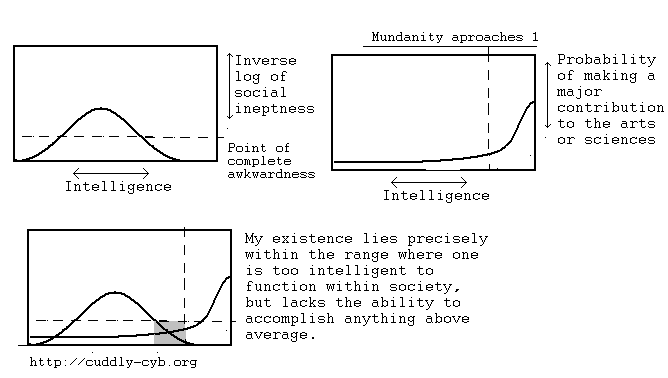 |
Frankly, the prevailing diagnostic and etiological hurdle seems little more than
sheer misguided compassion burnout.
The true Psychodynamics of Asperger's (now autism spectrum) are painfully obvious.
Anyone who dismisses environment as cause
for Asperger's, never grew up in my
family!
What is invalid, ineffective, unproductive,
ineffectual, indeed inefficient or incompetent and incapable,
logically disproved or
Empirically refuted, mooted
legally or legislatively, or even esthetically speaking: lacking in artistic or
literary effect. But Psychologically or
Transactionally:
"The creation or promotion of an environment which encourages an individual
to believe that their thoughts, beliefs, values or physical presence are
inferior, flawed, problematic or worthless." —
Out of the
Fog In the words of Alice Walker: "No person is your
friend
who demands your silence, or denies your right to grow."
"Invalidation is to reject, ignore, mock, tease, judge, or diminish someone's
feelings. It is an attempt to control how they feel and for how long they feel
it. (...) Psychological invalidation is one of the most lethal forms of
emotional abuse. It kills confidence, creativity and individuality." —
EQI CORE intro to
Invalidation
Many people suffer
because of
chronic
invalidation
by Narcissistic abuse
particularly
in families, invalidation in text and
subtext,
communicated in
so many different ways, the thrust of all manner of
headgames.
Invalidation is a
bullying, abusive, domineering and diversionary
red herring,
misdirection,
digression
changing
the subject away from often glaring flaws in the abuser's own
reasoning, conduct or even
character.
The target of invalidation is intimidated and
manipulated into the sheer
futility of having first to redeem themselves in the eyes of the perpetrator
of invalidation.
- •
I refuse
to have this discussion
-
How invalidation starves emotional needs.
in the words of Simone Weil: "The malheureux need
nothing else in this world but men capable of paying attention to them. The
capability to pay attention to the malheureux is something very rare, very
difficult; it's almost a miracle. Almost all those who think they have this
capacity, don't. Warmth, the heart's reaching out, pity, all these are not
sufficient. [...] Attention is the rarest and purest form of generosity."
Whereas inattention, indifference and distance, are already
invalidating, let alone more overt invalidation, denigration and abuse
particularly as of pandemic serial
bullying. Whereas, validation may come in the
form of sympathy and understanding, indeed as expressed in agreement, approval
or indeed amplification upon anything another says. However, as the saying goes:
“Actions speak louder than words”
because:
“Effort is the best indicator of interest.” The very term 'probortunity,'
of course, is coinage from portmanteau of the two words: 'problem'
and 'opportunity,' in order to press home the point that problems present
opportunities. And the probortunity at hand here on
FoolQuest.com
consists
in the challenge of best filling the gap, meeting underserved need, via creative
solution finding in
design thinking
social engineering
of more optimal social
and intellectual stimulus struggle, most especially and
particularly
collaboration among equals,
the most generously validating exchange of effort and interest indeed speaking
louder than so often facile verbal positive strokes, let alone the malignant
conditionality of dysfunctional codependent co-validation.
Invalidation is traumatic. The
origins of functionally impaired emotional and social intelligence are well understood:
"A
sensitive child who is repeatedly invalidated becomes confused and begins to
distrust his own emotions." Confidence shaken, one doubts one's own
judgment and even sanity in more extreme cases. Particularly,
invalidation readily explains how emotional
and social intelligence emerge into consciousness and indeed even awkward and
self-conscious, rather than developing smoothly as instinctive "second nature."
Autism and Asperger's are more commonly diagnosed in boys than girls. Therefore,
sex
linked genetics is certainly conceivable, but differences in
gender
socialization are already well established. Girls are expected to be more
cooperative and sensitive socially, which may be howsoever developmentally
advantageous, or else girls may simply be discouraged from the assertiveness or
aggression one way or another to press and call attention to whatever their
problems and issues. Indeed, Psychodynamically, there is really little so mysterious about the most
common observable Asperger's symptoms:
An
attachment injury is the hurt from close quarters, so to speak,
therefore
that festers and engenders
even pandemic
attachment
disorder
severely enough to adversely affect future interactions and close
relationship
throughout life. Howsoever atrophied emotional and social
intelligence, if no more profound attachment
disorder, is to be an expected result from social isolation, difficulty with intuitive
nonverbal communication often
results from self doubt and
denial,
repression engendered by the experience of constant invalidation or just lack of
sympathetic external refection and reinforcement of the individual's own
motivating
feelings, perspective,
POV,
Point Of View
and perceptions. And whatever odd ticks, gestures and facial expression,
obviously manifest
inner
conflict, easily triggered
experientially by
circumstances and
situation or even by unbidden
thoughts and refection amid subjective
inner life, also undermining developmental
bodily-kinesthesia, spatiotemporal coordination and physical intelligence even
unto atonia.
The nervous and awkward vulnerable haunted sense of insecurity and rejection and
self conscious social information overload,
especially when
manipulatively played upon and exploited, inspires all the more hostilely and dread that
unpopularity might rub off, while even any trace of
autonomy and self assertion in lieu of the tightest
social embedment and integration, can all be more than enough to provoke
heteronymous jealous rage and continual escalation of chronic opportunistic
bullying.
And most of this can be framed in terms of Behavioral Conditioning as
readily as Psychodynamically.
Diagnostic invalidation
Any Psychodynamic Psychotherapist typically gets two
kinds of patients, firstly as would come as no surprise to
Behaviorism, those
who remain unhappy because they just don't fit in, and secondly those who remain
unhappy because of all that they find so onerous in all that will be expected of
then in order quite reliably to fit in. And Behaviorists will remain
flabbergasted that the latter are not happy and well adjusted.
Behaviorists might even Nihilistically
declare that Psychodynamics only persuades patients of such silly ideas and
nonsensically
Axiological
dissatisfaction! Indeed, this becomes inevitable because of how
Behaviorism denies the psyche as any sort of viable concept in science and medicine,
The quest for ever more exotic genetic and
physiological diagnosis is primarily inspired by compassion burnout and the same
guilty
denial behind
the irresponsible
decidophobic heteronomy
of whatever passes for parenting, education and clinical enablement all thereof in treatment of
dissidence by
any other name. The problem remains that the pragmatism of
Behavior Modification rejects pure science and the quest for truth, all
diagnosis whatsoever, even Behavior Modificationdiagnosis, in favor of
Clinical Psychiatry and the treatment of symptoms without diagnosis
otherwise. Nevertheless, in truth, it still all boils down to ongoing cumulative experience of
situation, environment.
And Behaviorist/Neurochenmical pseudoscience in still nothing but
denial and
rationalization for treating the suffering oppressed only by even further
repression in order for all involved even to cope at all. Thus does oppression
propagate amongst the oppressed.
Autism in children as originally classified,
though distinct and immediately recognizable, has always been so mysterious and ineffable though readily apparent as
characterized by introverited withdrawal even as most distinctly expressed in the
"unusual grace" with which said children with autism are often said to waft
through space. -A grace most distinctly lacking in the Behaviorist dance around
uncomfortably begged questions! For over time, the definition of Autism has
ever expanded to accommodate different theories of Autism, until becoming so
bloated that mitosis was inevitable, and the even more vague Asperger's
diagnosis was born onto a thriving and diverse Autism Spectrum! Indeed, as
syndrome without an etiology, it begins to seem that Asperger's is anything you
want it to be! No definition really makes sense, and no two agree. And it becomes ever more apparent how the main reason that Asperger's remains a syndrome without an etiology, as manifest in the marked
behavioral meme or fad of merely disregarding the obvious and longstanding
Psychodynamic etiology of Asperger's as somehow vaguely antiquated, is not
because Psychodynamic etiology has ever actually cone to stand refuted or
supplanted by any better competing hypothesis, but only because according to the
bankrupt and not merely Inductiviist but actually
Nihilistic
Scientific Method of
Behaviorism simply ignoring
and yes: invalidating qualitative Psychodynamics, the human condition itself can never
be anything more than a syndrome without an etiology. For an etiology to account
for variations in behavioral response between subjects, raises the ugly specter
of qualitative
subjectivity and
Psychodynamic causation within inner life, anathema to
Behaviorism, wherein
reside
motivations
the likes of scientific curiosity that must always be so vigorously conditioned
out in the sad pathetic impoverished Behaviorist travesty of the conduct itself
science itself as a mere conditioned behavior, as always with
cognition at
best serving only to inform desired behavior.
Unless, of course, Behaviorist where actually to seek to diagnose pathologies in
terms of conditioned response as they are supposed to, and perhaps even
prescribe treatment by deconditioning, by breaking preexisting conditioning, instead of the endless dreary and harmful
festering band aid solution of blindly reconditioning ever new layers of
reaction formation, repression and escalated
inner
conflict! Again, alas, the reason is because
Behavior Modification,
no matter how purportedly Cognitive, has
entirely spurned Hypothetico Deductive
Scientific Method
thus abandoning attempt even at entirely Behavioral
diagnosis!
- • Suffer the Children:
Autism and the Last
taboo
- (Why
not environmental causation?
Because parents who have it rough and foot the bill for treatment, don't
like to be
criticized!)
- `
- •
The Myth of the “Broken” Child:
-
The Surprising
Effectiveness of Psychodynamic Play Therapy and Parent-Child Therapy for
Autism and Autistic Spectrum Disorders.
Indeed, Psychodynamic etiology of Autism and Asperger's, not to mention
Psychosis, remains plausible and even
Empirically
supportable to say the very least. Indeed, when and how if ever, was such ever
formally abandoned, much less actually refuted in any peer reviewed study? And
yet, for
whatever reason, there is no Psychodynamic treatment of Asperger’s available. And since
there are no Psychodynamic Asperger’s specialists, there is simply no one
designated as responsible to implore and demand: Why so? Why has an entire
diagnostic category been invented, simply to be abandoned to glorified
brainwashing
methods?
Psychodynamic
Psychotherapy
has simply thrown in the towel and abandoned all patients ever to be diagnosed with Asperger's to the tender mercy of Behavior Modification and
Psychopharmacology (Neurosurgery having so long
fallen from favor).
And Cognitive Behaviorism views
classical behavioral condoning as
Inductivist. Worse,
Behavior Modification numbers among those misguided ideologies implicitly
marshaling
Inductivismt in
defense of preference even towards the Pragmatism or Instrumentalism of Engineering
and perhaps Research and Development over investigatory research in pure
science and the scientific quest for truth in it's own right, it's own sake,
or even for anticipated technological application. or in medical context:
treatment protocol, only after gaining better understanding. If only all of that
expert discerning and acute behavioral observation of Asperger's behavior and
symptoms where instead simply interpreted and treated Psychodynamically. What
would it hurt to try?
Autism in children as originally classified,
though distinct and immediately recognizable, has always been so mysterious and ineffable though readily apparent as
characterized by introverited withdrawal even as most distinctly expressed in the
"unusual grace" with which said children with autism are often said to waft
through space. -A grace most distinctly lacking in the Behaviorist dance around
uncomfortably begged questions! For over time, the definition of Autism has
ever expanded to accommodate different theories of Autism, until becoming so
bloated that mitosis was inevitable, and the even more vague Asperger's
diagnosis was born onto a thriving and diverse Autism Spectrum! Indeed, as
syndrome without an etiology, it begins to seem that Asperger's is anything you
want it to be! No definition really makes sense, and no two agree. And it becomes ever more apparent how the main reason that Asperger's remains a syndrome without an etiology, as manifest in the marked
behavioral meme or fad of merely disregarding the obvious and longstanding
Psychodynamic etiology of Asperger's as somehow vaguely antiquated, is not
because Psychodynamic etiology has ever actually cone to stand refuted or
supplanted by any better competing hypothesis, but only because according to the
bankrupt and not merely Inductiviist but actually
Nihilistic
Scientific Method of Behaviorism simply ignoring
and yes: invalidating qualitative Psychodynamics, the human condition itself can never
be anything more than a syndrome without an etiology. For an etiology to account
for variations in behavioral response between subjects, raises the ugly specter
of qualitative
subjectivity and
Psychodynamic causation within inner life, anathema to Behaviorism, wherein
reside
motivations
the likes of scientific curiosity that must always be so vigorously conditioned
out in the sad pathetic impoverished Behaviorist travesty of the conduct itself
science itself as a mere conditioned behavior, as always with
cognition at
best serving only to inform desired behavior.
Unless, of course, Behaviorist where actually to seek to diagnose pathologies in
terms of conditioned response as they are supposed to, and perhaps even
prescribe treatment by deconditioning, by breaking preexisting conditioning, instead of the endless dreary and harmful
festering band aid solution of blindly reconditioning ever new layers of
reaction formation, repression and escalated
inner
conflict! Again, alas, the reason is because Behavior Modification,
no matter how purportedly Cognitive, has
entirely spurned Hypothetico Deductive
Scientific Method
thus abandoning attempt even at entirely Behavioral diagnosis!
-

- Massachusetts:
a regimen of Aversive Behavior Modification including electrical
skin shock is
freely
chosen
by tantrum prone students, in the alternative to juvenile
incarceration. The results are much lauded by grateful parents.
Those poor misunderstood Behaviorists get
such a bad rap!
-
|
|
'THE
MISBEHAVIOUR OF BEHAVIOURISTS' is a scathing
critical
attack upon Applied Behavior Analysis in ongoing brutalizing treatment of
autistic children, in
regards whereof, and irrespective of highly successful diversionary Public
Relations, alas, (and much as with education throughout the developed
world) the only violence actually outlawed in England and put a stop
to, is strictly of the physical variety. -Though, of course, generally most notorious
remain the
methods used in
brainwashing, also found in peer pressure and
bullying.
No wonder,
then, Behaviorism is the darling of our
dysfunctional educational system, the cultures have so much in common: misanthropy,
heteronomy
and anathema of real learning.
All
cooperation in baffling and perplexing cult
initiation persists upon suspended judgment and the hopes that things will begin
to make sense later on. And even putting aside the most egregiously extreme and
overt forms of abuse, Behaviorism even most routinely is certainly no exception. Indeed,
effort at comprehension is steadily subject to the erosion by frustration unto
behavioral extinction. Questions are clearly unwelcome, and persistence only
ends unpleasantly. Only despair accrues from metaphorically swimming against the
proverbial tide. Behaviorism, in an unrelenting blizzard of
obfuscation and intractable contempt for the very principle of informed consent (the very concept
thereof rendered in inoperant by Behavioral disavowal of consciousness an
unusable concept), in a constant shell game of ever
more dazzling sensational diagnoses, by such classic and powerful bureaucratic
diversionary and
manipulative behavioral control tactics as drawn out patient referral and intake procedures,
along with such misleading
propaganda
tactics as endless obscure new aliases in a relentlessly shifting obscurantist word salad of all
that it at all is, into all that it plainly is not: Neuro/Bio/Cognitive/clinical,
etc., etc.. But treatment consistent
and relentless no matter, ever wishfully masquerading anew as
cutting edge insight even in long discredited neurochemical
Reductionism, in failed and
botched application to one range of underserved needs and unsolved problems
after another in exploitation of the
most naive, unsuspecting, vulnerable and
trusting in society, is ever seductive to
prestigious self overestimating mediocre professional intellects; the highest
heteronymous values
whereof and by their measure veritably God's greatest gift to humanity in turn so generously
propagated to all
the teaming unwashed,
heteronymously pandering
to decidophobic panicked anomie, self absorption, desperation for peace and acceptance with consequent addiction to authoritative
routine, the mindlessly conformist providing of structure and stifling routine
most arbitrarily, with the one consistent treatment
goal
put forth of simply obtaining
compliance by whatever means necessary, and for our own good, because the
Behaviorist key to happiness is only in discovering precisely what compliance
will render the individual patients' interaction within society friction free.
Over time, the operant conditioning of Behaviorists
themselves has been extinguished of any trace of
candor. By every
dazzling flimflam of cutting edge diagnosis, by
seemingly innocent engagement
of
trust and compliance into elaborate intake process, the dizzying proliferation of one alias after the next and
infiltration into one context after another (what lamentably passes for
education, the most antisocial of social work, dubious
social skills training,
bogus support groups,
pseudoscientific and antidemocratic politics and policy making, not to neglect
mention of those ubiquitous popularity and pick-up
gurus), ultimately by
crimestop, evasion, reassurance,
and finally sheer sullen sulking passive hostility towards salient
questions from exhausted and bewildered patients, in contempt of principles
of informed consent (after all, consent at all, let alone awareness and
comprehension are not a behaviors, but an inner state and deemed scientifically
meaningless), thereby perhaps the worst offender in the systematic undermining
responsibility in patients, the new-and-improved turd-polishing snake oil of Behaviorism persists in its endlessly
authoritative and reputable mischief.
Just as Psychodynamic Therapists
themselves undergo an extensive Psychotherapy themselves, in order to gain
professional detachment and quick expert diagnostic insight, likewise
heteronymous Behaviorists themselves, under whatever
guise, much as with and often actually including: school
teachers, may nevertheless also practice as they have always preached, in so
far as often being the more behaviorally conditioned themselves,
all the more indoctrinated rather that trained or
educated as such, into becoming the compulsive
manipulators that they are, prizing above all likewise for themselves,
behavioral structure,
comforting routine providing livelihood and vested interest. After all, what
else have they to fall back upon? The dispensation of Behavior Modification
of any kind, in the toxic cynical environment of clinical departments
of so-called Behavioral Medicine under whatever guise, using such patronizing
methods and dealing with patients so thoroughly conditioned, inevitably results
in deep seated dependency, atrophied social skills and seriously impaired problem solving abilities
of the authoritarian, both bossy and obedient at once,
in short: true
stupefying heteronomy of the
Transactional
inner adaptive child continually initiated from the
Transactional
controlling inner parent, bereft of sound
critical
thinking and fuller information accessible only front a rational
adult ego state. Insensitive blundering
practitioners of Behavior Modification under any guise and in any context,
socialized over time both to stultifying bureaucracy and to an etiquette
systematically and perpetually codling domineering defeated oversensitive and
infantilized patients in groups, deserve only our pity except that they continue to present so clear and present a danger to
society. In short, the very practice of Behavior Modification under any other
name, is itself a conditioned compulsively
manipulative behavior under a typical steady cult erosion of
morality. They are truly the blind misleading the blind.
Under the domineering and quite frankly: socially inept umbrella of Behavioral Medicine, myriad other
services including, of course,formal education, but
also social work, social skills training and various
support groups
and even both misguided study and dangerous application of politics indeed
exactly as pioneered by B. F. Skinner, the father of Behaviorism,
all heteronymously are ever jockeying to "provide structure"
and obtain patient, client, student or citizen, compliance and convenient trapped docility, essentially in treatment of
dissidence. Reactionary Behaviorism marches on in precisely every arena of social reform
where Sigmund Freud and the Vienna Circle where historically brutally coerced
into backing down from proactively seeking tolerance and societal relaxation of
traumatizing repression and
taboo, and indeed where Psychodynamics continues to give ground
and even patient referral, apparently unreciprocated, unto
this very day, to repressive Behavior Modification, smoothing down or beating
down those individuals in society that by their existence most provoke guilt at
prevailing repression and intolerance. Usually school teachers by training if at all,
social skills
trainers are the blithe unsuspecting civilian quasi-paramedical political
commissars of Behavioral Modification and heteronomy. -the very socially imbedded vanguard
of the Reaction. Indeed, there are no qualifications and no professional association for
social skills training, submissive compliance or:
discipline, being the primary
core social skills and single value
imparted towards the promise and mystique of social
success
and fitting in. The work of all such semiskilled
practitioners of Behavior Modification, often Linguists and school teachers, is possible because, after all, just as
social skills are presumed to be no more than adaptive behavior sets
(adaptive, if actually at all, to anyone set of circumstances, but notoriously
inflexible to new and novel
situations) the very practice of
Behavioral Modification is itself likewise no more than a convenient set of
conditioned behaviors. For such and no more, is the entire medium of cultural
transmission in the first place, according to Behaviorism, again, with the one
consistent treatment
goal
put forth of simply obtaining compliance. After all, what is a Behaviorist but merely a memebot
conditioned to behave as a Behaviorist and hence a compulsive
manipulator all in further continual propagation of Behaviorism?
-
-
-
The
Cognitive
 Behaviorist
Menace
Behaviorist
Menace
- You are happy to comply!
-
-
- Sly covert blanket
invalidation insidiously applied in blithe
behavioral extinction of
transference love:
-
- Behaviorism remains the most dangerous
kind of cult, lunatic, pervasive and respectable with many
fronts, infiltrating and invading ever walk of life. And the most prevalent of current ongoing
salvage efforts upon ever insidious Behaviorism,
Behavioral Conditioning and Modification,
has been named: Cognitive
Behavioral Therapy, incorporating insights derived
from Cognitive Philosophy sometimes called.
philosophy of the mind,
constituting a body of self observation of
thought patterns and habits even as sometimes dubbed: "mental behaviors."
-
- Poor misunderstood well meaning Behaviorists!
That was, of course, bitter and facetious of me, actually heavy sarcasm. But seriously:
Behaviorism itself
frequently meets with the negative reinforcement of adverse public
perception of
brainwashing. And
we have seen, perception here is entirely fair and correct, well deserved. Alas, however,
that behavioral extinction of the destructive behavior that is
Behavioral Modification itself, has not resulted,
first of all because said behavior still garners positive reinforcement,
which is to say that it continues to be so richly
rewarded, but also because the underlying Psychodynamic
Psychological and emotional problem
motivation remains untreated. Instead, in such classic
denial,
Behaviorism is ever going
underground in ever proliferating new guises, infiltrating and invading
every walk of life. And most popular and acclaimed, especially in
formal education, remains Cognitive Behaviorism. The more devious Cognitive
Behaviorism, a disastrous fraudulent pretence of reform, continues to conceal and co-validate the same
Behaviorist conditioned compulsion and addiction to
ongoing
manipulation. The success of such pathological
chicanery may be attributable to its great appeal to heteronomy. The
heteronomy
characteristic of
Behaviorism is, to reiterate,
motivated
from the Transactional inner controlling
parent and inner adaptive child dyad, whereas autonomy
is grounded in a healthy ego, the unending quest for truth, a strong inner adult and inner natural child.
Fuller information and best
critical
thinking for
good faith
sensemaking essential to all narrative reconstruction of events towards
plausibility at all, of which Behaviorism though no less pervasive, is so
clearly bereft, is available only from the adult ego state, and not to the inner
controlling parent and inner adaptive child. As with any other
Absurdly
irrational ideology, degrees of fanaticism vary. Indeed, borrowed as as
characters in
fiction writing, Behaviorists would make ideal
Straw Vulcans!
Whereas a psychotherapist undergoes training therapy themselves, in
order to cultivate compassionate detachment and insight, a
Behaviorist
is a mindblind conditioned compulsive manipulator. Of course, any
psychotherapist is flawed being only human, and can become one way or
another dysfunctional. But Behaviorism, the
very epitome of heteronomy and oppression, is
dysfunctional when applied correctly! It cannot be otherwise. The only
treatment criteria of any kind of Behavior
Modification remains patient compliance. This is insensitive
bullying. Systematic disregard for another's
thoughts and feelings is bound to hurt their feelings and to suppress those
hurt feelings. But if the Behaviorist can thusly
extort compliance, then exactly such calculated injury to the patient is
deemed somehow curative. Many patients are leveled into such abuse, whereas
other patients are actually
motivated
to subject themselves to such
brainwash, by
profound self loathing and contempt for an unwanted self. Such patients need
compassion, understand and acceptance, and above all, protection from
themselves, not deviously brutalizing Behavior
Modification abetting in said patient's own self loathing self
destruction.
- Zen cessation
in modern guise:
- Cognitive
Behaviorism and the blithely acetic sly covert blanket
invalidation insidiously applied in
conniving
behavioral extinction of
transference love:
-
- Behavioral extinction:
Empirically, when
operant behavior that has been previously reinforced, no longer results in
reinforcing consequences, the behavior may gradually diminish and even
finally cease all together. In application of behavioral extinction as a
deliberate procedure or treatment, reinforcement of a previously reinforced
behavior, particularly such as has been deemed a problem behavior or
otherwise inconvenient, is purposely discontinued, in hopes that the
frequency of that behavior will decreases in the future. Some, when subject
to behavioral extinction or to
Transactional antithesis, may instead
work harder and seek elsewhere for reinforcement, escalating
headgames.
Such is the futility and failure of Behavior Modification, simply ignoring
all inference of underlying Psychodynamics,
motivations,
issues and
inner
conflict.
Alas, that Behaviorism and its entire repertoire, so consistently manifests as an obsessive behavior
pattern in and of unto itself, systematically reinforce by the authority, co-validation and peer pressure of the pervasive and respectable cult dysfunctionality of
Behaviorism and Behavioral
Modification
infiltrating every walk of life.
-
- Expert authority should never be confused with authority in the sense of
authority in command and decision, even as replete with
coercive power. Science is responsible free inquiry. Science should guide
responsible decision making, particularly in the halls of power. The problem
of authority is not simply of who is the wise ruler, or what is the right or
the best authority. Even science at its very best, should not simply be
co-opted as a pretext to legitimize authoritative coercion. As Karl Popper
said, questions as to the source of legitimacy for authority and power, are
generally better rephrased as questions how the harm and danger of power are
best minimized and held in check.
Criticality and
respect between equals, demands more than the simple imparting of good
scientific results, let alone as a pretext for any other covert
agenda
of compliance always central to Behaviorism. Indeed, as shall be seen, even hearing the very best
information and recommendations from the Cognitive
Behaviorist will be toxic.
-
- Ambivalence such as
sympathetically and compassionately treated by bringing about catharsis and
insight in Psychodynamic Psychotherapy, is so deviously exploited in Cognitive Behaviorist Behavior
Modification simply in order to obtain compliance. What are painful feelings
running deep for the patient, remain, regardless of all all best intentions
and unfeeling blithe conditioned
denial
on the part of the Cognitive Behaviorist, nothing more than cynically
controlling leverage. Contrast the disarmingly
manipulative
Existential
Validation and
bad faith of the
cutting edge
Cognitive Behaviorist, of complete well-meaning innocence, with that of the
anciently venerable and authoritatively severe Zen
Master, the austere midwife of Zen cessation,
futility, sublime apathy, resignation and crushed spirit.
It is to this end that the Zen master demands of the decuple such unflagging
struggle, in Zen quest of emptiness and futility with unreasolvable
surreal enigma, non
sequitur, and
contradiction and nonsense. The only result in such
persistence with be a breakdown that is praised as enlightenment. Whereas,
far lees bizare, the
innocent and straightforward observations of the Cognitive Behaviorist ever so
blithely
accomplish two
manipulative
ends: Firstly, to
aversively condition the patient via hurt and shame, secondly to provide
rationalization towards
cognitive dissonance thereby building
new layers of reaction formation. In terms of
heteronymous
Ulterior Transaction or:
headgames,
the controlling
manipulative and calculatingly insensitive
Cognitive Behaviorist shelters behind blithe
Empirical science, canny
observation and good advice under the
Existential
Validation of willfully blind
insensitivity and innocent best intentions, while the freshly re-traumatized,
confused, completely invalidated, humiliated and
cognitively dissonant patient can thereby rationalize compliance as
only reasonable and constructive. Indeed as adaptive as the new behavior
sets might ever be -or so we may hope! such is still not learning or
growth, but
sly invalidating
brainwash.
And this will be true until all elements of behavioral conditioning are
entirely replaced, not just obscured or compensated. In any Psychodynamic
Psychotherapy, the shock of new self-knowledge is softened by the sense of
acceptance,
trusting the patient even in often daunting and even frightening
responsibility, to heal and to
grow in
autonomy. But in Behaviorism of any stripe, the single
treatment or educational criteria remains
heteronymous
compliance.
Cognitive Behaviorism, still denying the underlying
psyche replete with emotional
motivation, merely treats the symptoms, the outward behavior. The
canny expert observations, tips and tricks, of the Cognitive Behaviorist, all
actually relating to behaviors that are really associated with Psychodynamic
underlying traumas and issues, thereby blithely stirs up all those associated
traumas and issues even from the unconscious. Even should a behavioral coping
method prove practical and helpful, even by that token, the deeply troubled
patient will feel deeply stung at being asked simply to perceiver and make do,
no less heavy and full of sorrow unresolved. Therefore a lucid patient may
plainly express their anguish and dissatisfaction with such an approach.
Otherwise, one common response is the classic
inner
conflicted
noncooperation typical of the Neurotic, even one so desperately troubled and
deep in
denial
as to actively seek validation in the construction of new defenses.
Cognitive Behaviorists are clueless and hapless before all such negative
transference. Indeed, such pitfalls of dealing with Neurotics is among the
prime reasons for the Freudian injunction against suggestion, the core
intrinsic malpractice of Behaviorism to begin with (except perhaps to any extent,
as we shall see,
Dialectical
Behavioral Therapy).
The more healthy and normal possible response to the blithe unawares Psychodynamic triggers of the
Cognitive Behaviorist, is outreach on the part of the patient for insight,
sympathy, understanding, the Positive Transference or
transference love, wherein the patient looks to their doctor as any sort of a caring person.
Phobic, hostile and mistrustful
Negative Transference is seen as the barrier to
be overcome by the patient, towards the Positive Transference or
transference love that
will lower the patient's defenses and finally allow them to reach out and
unburden themselves. Hence the pernicious evil of Cognitive Behaviorism, in
elicitation of outreach for comfort and understanding, then subject to ongoing
frustration and behavioral extinction under Cognitive Behaviorism.
The
motivating
attachment
of Freudian
transference love is the
redirection even of childhood feelings and desires retained by the unconscious
onto a new object, the associative projection in the mind of fantasies
and illusions onto a
real person who somehow or other strikes a chord.
The Psychoanalyst encourages just such projection, so that the patient will feel
free to unburden themselves, heal and
grow.
But transference is an aspect of all
relationship, not just formal
psychotherapy. Negative transference is the projection of past rejections and
suffering, obstructing positive transference which is the projection of wished
for love and acceptance. Eliciting values in order to
build rapport, which is the sensation of comfortable harmonious mutual
understanding as from
relating well to one another, denotes the sensitivity and
autonomy
supportive respect of
psychoanalytically and
dialectically drawing another to ponder and to reveal their unique
profoundly
motivating
individual intangible true deepest end yearned for emotional state or
experience, simply how they like to feel, as opposed to their more superficial
means desires, typically concrete tangible things, phenomena,
situation or circumstances, and
especially qualities in others, merely howsoever associated or expected to help
achieve or attain better conditions and emotional experience.
But to this the Cognitive Behaviorist can only respond
straightforwardly, that all such falls outside of their skill set, and continue
uninterrupted with more of the same misguided Behavioral observations, tips and
tricks. The result, then, is frustration of the patient unto benumbed despair
and behavioral extinction of
transference love itself. When
any operant behavior is systematically elicited but no longer produces
reinforcing consequences the behavior gradually stops occurring: This is
nothing less than the behavioral extinction of transference
love, also called
Zen cessation,. While
behavioral extinction applies to any specific range of behavior,
Zen cessation denotes a global
behavioral extinction. For
Zen is the
ancient Mystical
quest for futility, purported enlightenment attained in emotional
collapse, breaking the ego shell, in other words: crushing the spirit in
order to attain the numbing
dramatic
release from mounting dystress into sublime apathy.
For such remains the objective of all the abuse cloaked in surrealism dished out by the
Zen master. As
ever: "It's for your own good, dear!" The same cynically depraved tough
love of ancient days reappears in new cutting edge guise, a wolf in sheep's
clothing.
But all such abuse, no matter the trappings and
heartless rationalization, ancient or modern, engender ever hardening calluses, fresh new
layers of reaction formation, all so beloved of insurance providers eager to cut
costs with any hoped for quick fix, no matter how miserable and soul crushing,
to get disgruntled workers back on the job, desperate house wives back in the
kitchen, and shell shocked soldiers back on the front lines.
And indeed, there are many patients so agonizingly repressed as to actively
prefer and seek out exactly such. In that case, the Cognitive Behaviorist
effectively participates and abets in the patient's struggle submerging in
denial
ever deeper into
the pervasive chronic emotional turmoil and
inner
conflict commonly called mental illness.
Or else, as often occurs, the unwitting Cognitive Behaviorist may find himself
no less blithely sucked into and embroiled in deadlock with a complete Neurotic.
Or else, all suggestion, no matter how powerful, even under hypnosis, simply wears off very quickly, as Freud discovered in
the first place.
Sly Cognitive Behaviorism, cloaked in such false innocence, only seems less
barbaric than more overt aversive conditioning. But its only more subtle and
devious in deceiving doctor and patient alike.
Sadly, fewer seek to sell their souls at any price, than
simply to be rid of them at all, relieved thereof and grateful for it. So, who
would actually sally forth in order to have their spirits broken and discarded
as such an
obstacle? Alas that all too many are so desperate for peace and
acceptance on any terms. And there is never any shortage of ever the same cult
snake oil from phony gurus and fakirs,
Zen Masters and Behaviorists,
all ever eager to oblige. Such is the most vile exploitation. Beware!
Is Cognitive Behaviorism
redeemable?
Except on TV crime
dramas, there is no
such thing as a Behavioral Psychologist. But maybe there should be:
Imagine, by way of analogy, encounter with a strange and
distant world where structural integrity and fire safety remain more of an art,
still elusive to architectural science. Therefore a movement of scientists and
engineers arises, simply
becoming annoyed with the vagaries of structural integrity and fire safety,
resolves to start anew from scratchy without structural integrity and fire
safety, even just as a thought experiment and pursuant scientific investigation.
But then, beguiled by their own wishful thinking, certain hangers-on quite
forget that this is merely the investigative pursuit of a thought experiment
premise. Imagine
them that thus an insane new kind of
architecture is invented by utterly disregarding fire safety an structural
integrity, that nevertheless somehow gives rise to any worthwhile salvageable
innovation. How then can said
innovation be utilized without the
danger? Inevitable answer: Only by reintroducing fire safety an structural integrity, and never
otherwise.
To reiterate, Behaviorism
remains a product of Radicalism. Radicalism is the doctrine of endeavor to
seek freedom from error and deficiency only by simply making a clean sweep and
beginning anew entirely from scratch: In the face of institutional cannon and cliché ever more
figuratively inbred, naturally it will be only a matter of time until the call
rings out for a clean slate and a fresh start in search of untapped novel
inspiration. But much as nature is said to abhor a vacuum, the embrace of such
void has never reliably induced so much as one particle of spontaneous
generation or creation ex-nihilo, only suffocation and
hallucination, lost and wandering far from home. Instead, the clean sweep of any
one raft of cliché, may all to often readily only fall back upon untenably
hoarier and ever more generic cliché still. And finally the only renewal is of
fresh appreciation for that which has endured after all for any good reason,
focus or service. Because whatever true
stultification of creativity and discovery remains studiously unconfronted. Yes:
Behaviorism remains the 'Star
Trek: Voyager' of mental health care,
hidebound, lost and wandering!
And whereas a psychotherapist undergoes training therapy themselves, in
order to cultivate compassionate detachment and insight, a
Behaviorist
is a mindblind conditioned compulsive manipulator. Of course, any
psychotherapist is flawed being only human, and can become one way or
another dysfunctional. But Behaviorism, the
very epitome of heteronomy and oppression, is
dysfunctional when applied correctly! It cannot be otherwise. The only
treatment criteria of any kind of Behavior
Modification remains patient compliance. This is insensitive
bullying. Systematic disregard for another's
thoughts and feelings is bound to hurt their feelings and to suppress those
hurt feelings. But if the Behaviorist can thusly
extort compliance, then exactly such calculated injury to the patient is
deemed somehow curative. Many patients are leveled into such abuse, whereas
other patients are actually
motivated
to subject themselves to such
brainwash, by
profound self loathing and contempt for an unwanted self. Such patients need
compassion, understand and acceptance, and above all, protection from
themselves, not deviously brutalizing Behavior
Modification abetting in said patient's own self loathing self
destruction.
Behaviorism remains the concoction of a
perfectly mad and dangerous mode of psychiatric treatment in such disdainful
disregard of consciousness and therefore
Psychodynamics, of Psychology at all. Behavior
Modification of any kind and by whatever means, is psychologically
destructive and dangerous. Indeed, to reiterate, the only creditable
branch of Behaviorism remains
Dialectical
Behavioral Therapy,
and only because of it Psychotherapeutic
relevance. Therefore likewise it should come
as no surprise to anyone that just as plainly, any promising
Innovation from
Cognitive Behaviorism will never find safe utilization
except as repurposed in context of Psychodynamics and Psychotherapy, preventing
behavioral extinction/.Zen
cessation, by instead bringing about the release of catharsis instead of
frustrating catharsis and bottling it all up even more tightly. For whereas
Zen cessation deepens and solidifies emotional scarring
unto inertia, the healing of catharsis is drawn out by the compassion and
acceptance experienced by the patient.
The Psychodynamic Psychotherapist appealing to patient need for understanding and release, serves to coax the
suffering patient out
from behind their frightened defenses with the temptation of simply remaining receptive. After all,
many
ambivalent
and actually destructive behaviors, much less whatever odd ticks and such, are
improved and rendered more constructively assertive by at long last emerging to
the surface along with whatever unresolved issues behind them.
For
innovative
solution
finding,
Look for the Solution within the Problem:
To reiterate the problem statement:
Cognitive Behaviorism results not in the
transference love, indeed
neither positive transference nor negative transference, but entirely in the
behavioral extinction
of
transference love, much
akin to
Zen cessation. This is accomplished first by repeated
elicitation of the yearning for understanding, acceptance and compassion,
followed by the utter frustration and invalidation
thereof on the part of the genially oblivious and blithely innocent
Cognitive Behaviorist. For such is the
Existential
Validation of willfully blind
insensitivity and innocent best intentions of the
Cognitive Behaviorist. And such is the devious
and
manipulative
cognitive dissonance resultant of all those cogent observations and
helpful tips and tricks. After all, what could be more
constructive and well meaning
criticism?
The thought will scarcely emerge into consciousness,
neither for the hapless patient nor for the self-satisfied
Cognitive Behaviorist, of the trammeled over
vulnerable feelings of the patient. Because observation of and coping strategies
for all of those subtle microexpressions and "mental behaviors" are inevitably a
tender subject, because all of those subtle microexpressions and "mental
behaviors" originate in trauma to begin with. Moreover, all of those subtle
microexpressions and "mental behaviors" may tend to bring about all manner of
suffering and shaming thus associated with all of those subtle microexpressions
and "mental behaviors." Hence triggering such traumatic memory and then
repressing it all untreated with Behavioral
Conditioning of any kind, can only bring about fresh new layers of reaction
formation, much akin indeed to the defeated enlightenment so
prized of the Zen
brainwash.
And obtaining the
cooperation of the patient is controlling and
manipulative, especially in light of such
conniving betrayal which is the
cognitively dissonant
behavioral extinction
of transference love.
And
the Solution to be found within the Problem?
Why,
nothing less than to
rise to the Psychotherapeutic opportunity presented by the inevitable elicitation
of the yearning for understanding, acceptance and compassion from all of
those inevitably trauma connected and reminding and therefore emotionally loaded
cogent behavioral observations and clever tips and tricks. If
only there were a real Psychodynamic Psychotherapist in the room together with
the Cognitive Behaviorist and the vulnerable patient. Or indeed, if one
practitioner were trained both in psychotherapy and in observational repertoire
and advice of the Cognitive Behaviorist. Then
the hither to willfully unwitting provocations of the
Cognitive Behaviorist instead could be put to
good healing psychodynamic psychotherapeutic use as careful and canny deliberate prompts, triggers and provocations towards catharsis, insight, understanding and
emotional validation, all in treatment of repression, trauma and emotional deprivation even
as underlying in what are classified as developmental disorders no less than all else well acknowledged
as Psychiatric and emotionally
motivated.
Thus, retraumatizing Behavioral
Conditioning can be prevented, and Psychodynamically
subverted into proper Psychotherapy,
perhaps as part of much needed
counterpropaganda
experimental clinical trials in order to help debunk
heteronymous
bad medicine and even reestablish the obvious Psychodynamics of
Asperger's,
whatever utility of whatever cogent observations, tips and tricks, coming as a
bonus incentive in healing and closure. That is why, although, except in TV
crime dramas,
there is no such thing as a Behavioral Psychologist, perhaps there really ought
to be.
All thus, Cognitive Behaviorism, currently so toxic, can
instead be redeployed and redeemed as a
valuable addition to the toolbox of
Psychodynamic Psychotherapy. For shame!
Zen cessation and the behavioral extinction
of
transference love is
emotionally brutal, dangerous and unnecessary.
Freudian Psychoanalysis, from which all modalities of
Psychotherapy diverge, is meant to merely to midwife, as it where, the patient's
own self healing. To that end, the Freudian mask is the
name given to the classic accepting and attentive impassive demeanor of the
Psychoanalyst in order to elicit and allow the patient to project freely without
contaminating the result with any bias from even unwitting suggestion. And in
any Psychodynamic Psychotherapy, the Freudian mask by itself is enough for some severely disordered extremely
introverted and out of touch
if not just plain stupid patients, for whom therefore it may be sufficient should the Cognitive
Behaviorists simply be trained, indeed conditioned, into simple nonverbal
expressive behaviorally reducible mimicry of compassionate attentive interest
like any good Father Confessor. But far better, what if the conditioned
manipulative malpractice that is
Behavioral Modification could be
abolished once and for all, and the keen observation of Cognitive Behaviorism
redeployed towards Psychodynamic Psychotherapy? One might object, that
observations and recommendations constitute suggestion antithetical to
nondirective Psychodynamic Psychotherapy. And indeed, in Cognitive Behaviorism,
observations and recommendations only serve as sly
manipulation
towards patient compliance. But the
same observations and advice of tips and tricks, may be redeployed instead to
elicit response from the patient that will aid in Psychodynamic Psychotherapy.
Anything useful or informative in its own right, will come as a bonus. Finally,
developmental conditions too, after all really no less rooted in Psychodynamics,
in personal traumas in the past and individual issues in the present, than any
other Psychiatric problem, might at long last be afforded a safe, pertinent and effective treatment.
- After all, the gap in
Behaviorism
was never
cognitive, but Psychodynamic all along. Why admit that behavior suggests cognition, but continue to
deny and ignore all inference of emotional response as
motivation for behavior? Among the Behaviorists, precisely how is
the former any lesser a sin than the latter? Exactly how is admitting cognition
less of a compromise, more valid (theoretically
logical
internally self consistent) an inference and more theoretically elegant,
than likewise admitting affect and emotional
motivation? After all, neurologically and
evolutionarily, does not emotion long predate cognition? Behavior was never
cognitive. Strategy and problem solving is cognitive. Behavior is
motivated
emotional response. Even Animal Behaviorists, for whom human cognition is
scarcely an issue, well understand this. Indeed, the famous
animal Behaviorist Konrad Lorenz sees himself as sympathetic towards emotion in
animals even with so little in the way of cognition. Does emotion then imply
consciousness, so poorly understood and hence rejected by Behaviorism, more
than does cognition? Not exactly: Rather, the recognition of another's
feelings, more so than their thoughts, elicits the accountability to that
clear and tiny voice of conscience that stings and challenges
amoral
sociopathic
Behavioral
manipulation and coercion. So it would seem that
there really may be a domain of the soul, elusive to science. But only so
long as the soul is admitted merely as metaphor. In the words of Friedrich
Nietzsche: “Mystical
explanations are considered profound. The truth is that they are not even
superficial.” Behaviorism is at least superficial. Yet the non
explanations of the supernatural
and of Behaviorism alike, both tend to miss the same points.
Indeed, the problem remains pertinent to any endeavor at
social skills training or remediation. Can there be
education in social skills much as there might be training in the operation of a lathe or
a spinning wheel? Well, to begin with, alas in actuality what passes for
education tends to be traumatic. Which is a shame, because
there is no reason why, say, picking up a skill shouldn't be value
neutral and
dystress
free. But if a traumatized student seeks Psychotherapy
finding themselves blocked in study, then any attempt at simple training, let
alone Behavior Modification, only comes in violation of the Freudian injunction
against suggestion. And are social skills or aptitudes in particular, ever really
value
neutral to begin with? Indeed, is there anything else more trauma laden and
surrounded by issues than social skills and aptitudes?
In conclusion: The rationale is advanced that a practitioner such as the
Cognitive Behaviorist no
longer so overtly bent upon coercion of the patient via Behavioral
Conditioning, would remain free instead to concentrate
upon behavioral observation and offering therefrom useful feedback specifically
in order to bring behavior
patterns, but thereby also emotional triggers and merely thinking habits all unawares, to the
patient's attention and conscious mind. But unless the Psychodynamics are
addressed Psychotherapeutically, this only leaves the patient as voluntary
partner, if at all, in their own reconditioning. Such is the pinnacle of the art
of seeming reasonable while being deviously unreasonable, nevertheless and all
the same falling far short of the full measure of required
autonomy supportive respect, in
sheer blithe lack of professional
empathy. Doctor patient
cooperation in
Cognitive
Behavioral Therapy is merely another deviously
manipulative ploy towards the engineering of patient
consent and compliance, not service to the patient. The patient in
Cognitive
Behavioral Therapy reasonably seeks information regarding any range of howsoever
maladaptive behaviors of which they themselves may be quite unaware. If such comes as
advice, then it may well simply turn out inadequate in the face of deeper
Psychodynamic issues unexamined. But what is perhaps the more disturbing, if
such information regarding any range of howsoever maladaptive behaviors of which
the patient themselves are unaware, such awareness and cognition often
accidentally-on-purpose
serves as
aversive conditioning by humiliating the patient into revising their own
behaviors by suppressing them And this is only consistent with the mandate of
Cognitive Behaviorism, to
fill the acknowledged gap in classical
Behaviorism, cognitively. Because, too
many more complex and even obviously
goal directed behaviors
put forth
imply capacity for
abstract reasoning, beyond mere Pavlovian conditioned association in which a
stimulus initially incapable invocative of a certain response becomes
increasingly evocative thereof by repeated pairing with another
stimulus that
already even innately does evoke said response or reinforcement of behaviors by
immediate
punishment and reward. Hence,
Cognitive Behaviorism is the view of classical behavioral conditioning as
Inductivist. therefore abandoning
Inductivism but not heteronomy.
In the words of Albert Bandura:
“People's level of
motivation, affective states, and
actions are based more on what they
believe than on what is
objectively the case.”
Indeed,
once the subject only reaches any surmise as to what is expected and the
consequences, then they can do as they are
told. Again, the entire therapeutic
goal
put forth of
Behaviorism,; remains patient
sensitivity to expectations and thence compliance without
distress.
The only entire point of comprehension is only in so far as incomprehension
obstructs compliance. Or as the sadistic Captain famously admonishes Cool Hand Luke:
"What
we've got here here, is... failure to communicate!"
The issue is of
situation,
karma, conduct within
dharma,
and indeed, the foreseeable causality behind retaliation actually as a true
dramatic
consequence. But Asperger's kids
don’t
learn from consequences! If not compliance, what then?
Oppression is only ended by effective resistance. And effective resistance
requires the cultivation of social aptitude even amongst the likeminded, and
organization towards mounting any sort of credible threat of significant
retaliation in return. -socially "consequenced" accountability sufficient for putting
an end to impunity for
bullying and abuse of power under whatever pretext. Alas, while gifted
individuals amongst their own true gifted peers, mysteriously no longer require
socialization, alas this does not appear to apply similarly amongst highly
functioning Aspies and Auties. The less socially adept, the chronically
disorganized, continue to be taken advantage of by the more
manipulative, the
more socially adept and better organized. What is to be done? After all,
resistance is actually more demanding of social aptitude even than compliance
and conformity. And there is no school for rebels. Ultimately, who ever we are,
even with all the interference and intervention that fills our days or sucks
them dry, we are still each and all abandoned
to our own devices, to
induction,
to the puerile guessing games of oppressive social conditioning, conditionality,
manipulation,
coercion, control, myth,
propaganda
indoctrination and behavioral structure. Whereas democracy,
instead, to the contrary founded upon any precept that comprehension is
prerequisite not to compliance, but to
free
choice and informed
consent, and the ongoing struggle for formalized transparent due process, even in
parallel to
Scientific Method,
is, lip service aside, all
heteronymously
dismissed as sheer anarchy.
In truth, whereas Psychodynamic Psychotherapy strives to
help patients with such problems as needlessly debilitating shame, and to open
up all manner of different possibilities and options in life, out from paralytic
inner
conflict that renders decision so
impossible, by contrast, and despite ostensible
cooperation with the patient,
Cognitive Behavioral Therapy nevertheless falls back upon the tactics of
Behavior Modification by
manipulatively exploiting shame from the humiliating exposure,
no matter how reasonable, of unawares maladaptive behaviors no matter
how subtitle, as an aversive conditioning pressing the unsuspecting patient
in whatever explicit direction clearly intended by the Cognitive Behaviorist, in
such blatant violation of the injunction against suggestion. In the end,
Cognitive Behavioral
Therapy is a ploy in abuse of
trust, for
manipulatively disarming the
patient subjected to Behavioral Conditioning. Cognitive
Behaviorism merely
posits that along with whatever correct negative and positive reinforcement (systematic
punishment and
reward), learning and
comprehension also
necessarily plays a part in conditioning of more sophisticated behaviors. And
Cognitive Behavioral
Therapy, similarly to formal education,
merely puts that very principle into application.
But in the immortal words of Alexander Lowen MD: "Conviction lies
not in the ego." -the ego being the theoretical seat of rational cognition,
and conviction or faith being the sheer sentiment of confidence so often and consistently
undermined by experience and the human condition. And if howsoever the aforesaid
veritably crypto-aversive Cognitive
Behavioral tactics, are for whatever reason instead actually accepted at face
value advising the patient with exactly the requested
criticism,
and even as such duly appreciated and accepted by the patient with
full responsibility and even all due appreciation,
such being features of
autonomy and emotional maturity or stability, thereby, much as
in combating
the most notorious
methods used in
brainwashing
outright, indeed, actually confer resistance to conditioning and suggestion,
with the possible result, likewise, being complete failure to render patient
defeat and compliance to society. After all, as Freud realized, crazy people are
such as consistently will not follow good advice even when recognizing it as
such. And responsible people pick and choose for themselves, what advice to
howsoever to take heed on their own account. So how
then will the Cognitive
Behaviorists then react, as may arise, when simply not getting their own way? I shudder to think! Under such circumstances, will the
Cognitive Behaviorist begin
actingout, simply falling
even deeper back upon traditional
Behavior
Modification
and
manipulative behaviors? Or will
the Cognitive Behaviorist actually begin displaying classic learned helplessness?
Again, a common frustration with
Cognitive Behavioral
Therapy for the patient if not for the conditioned and
oblivious Cognitive Behaviorist, is that even those most cogent observations offered by the
Cognitive Behavioral Therapist, of the suffering patient's blithe knee-jerk
responses, and the tips and tricks the Cognitive Behavioral
Therapist strives to
teach the patient, the better to govern themselves, in truth often also bear
profound Psychodynamic ramification irresponsibly ignored and wasted by
Cognitive Behavioral Therapist. Indeed, all such unconsciously sly and blithely
insensitive recommendations are implicit
criticism,
however valid in its own right, from observations of behavior, no matter how
painstakingly accurate, behavior, like all behavior, Psychodynamic in origin, no
matter how determined Behaviorism is to ignore the obvious. As such the highly
accurate observations and expert behavioral recommendations proffered
Cognitive Behavioral
Therapy, often immediately triggering all manner of ongoing
inner
conflict by association to all
manner of
shame and trauma from the past and issues in the present, brought to the surface
by the keen observations and expert advice of the Cognitive Behaviorist. Often
responses thus elicited include
dystress from yearning for the comfort of
acceptance and understanding, confusion passionately curious for insight and
meaning, and the all too common stubborn
denial
and demands for validation, so fruitless to confront directly. As Sigmund
Freud discovered, Neurotics simply do not follow even what they themselves
fully recognize as good advice, and certainly not simple behavioral or cognitive
strategies that fly in the face of their own complex maladaptive coping in
struggle with ambivalence. For alas, all such perfectly legitimate
behavioral observation may all too often come, even being so superficial,
nevertheless as an excessive
honesty, too blunt and
direct, where the seasoned and tactful deft touch and oblique
dialectic of Psychodynamic Psychotherapy is required. The very
knowledge,
even if actually desired and not feared, poses a danger to the patient, the
danger of Behavior Modification, successful on its own impoverished and
harmfully
manipulative terms or distinctly complicating, the danger, in
short, of Psychodynamics woefully unattended. Again, the blithe unintended
Psychodynamic triggers all too common from the conditioned and oblivious
Cognitive Behavioral
Therapist, are
at best gone to waste, left unresolved, or worst of all, painful, conceivably harmful
and destructive, wounds reopened and then untreated. Indeed, even such entirely sincere and vulnerable Psychodynamic ramification
as dystress yearning for comfort, confusion curious for insight, let alone
stubborn
denial
and demands for validation however infantile, all heartbreaking call out for
Psychodynamic Therapy for which the Cognitive Behavioral
Therapist, an
overspecialized trained idiot savant of therapy, verily like unto the proverbial
one trick pony, finds himself clueless and after all, deliberately and
calculatingly unequipped.
At best, unintended Psychodynamic benefit may
nevertheless accrue over time, however indirectly, as a result from howsoever
more operant behavior socially. Otherwise, suggestion my simply wear off soon
enough or be rejected outright by an uncooperative patient. Otherwise,
conditioning can only forge forge new layers of reaction formation or help
repair old ones, actually stepping back the breakdown of the adaptation that is
the cornerstone of any Psychodynamic treatment of psychopathology. Indeed,
perhaps at saddest of all, Behaviorism may succeed on it's own terms of
Behavior Modification:
As things stand in practice of
Behaviorism, no matter
how ostensibly Cognitive, from the utter blithe lack of professional
empathy, perhaps the patient's ensuing sense of
Zen
futility mat likewise be understood as intentional tough love. Hence the vaunted quick efficacy, ever at all, of Cognitive
Behavioral Therapy, even for treatment of minor problems, depends upon the
lowered expectations of the patient, even behavioral extinction if not complete
Zen cessation, yet the same resignation
and crushed spirit, by repeated elicitation, frustration and eventual extinction
of the very impulse gratification to reach out emotionally, and subsequent
emotional withdrawal, stiff upper lip and all, thence stunned compliance to
embrace conditioning and Behavior Modification. It may be The
Behavioral quick fix so beloved of insurance providers,
actually only suffices at all in fairly mild cases, to restore repressive
reaction formation and get the poor wretches up
on their feet and back to work, troubled and unhappy as ever. -Ah, but
functioning! Indeed, how sad. Worst of all, Behaviorists like school
teachers, abide in
denial
unwilling or unable to confront what they are actually doing, because of their
own heteronymous conditioning and indoctrination.
So perhaps
what is needed is not the Behaviorist approach to Psychotherapy as in
so called
Reality Therapy,
but just the opposite, a Psychodynamic Approach to Cognitive Therapy: Again, what if instead the
Cognitive Behavioral Therapist though no less versed in behavioral observation
and diagnosis thereof, nevertheless was not a practitioner of
Behavior
Modification at all, but instead a fully trained
Psychodynamic Psychotherapist? What if the Cognitive Behavioral
observations, advice, tips and tricks, where deliberately and skillfully
redeployed as deliberate Psychodynamic provocations in service to real competent
and liberating Psychodynamic Psychotherapy? What is the point of opening old
wounds and scars, except to better treat and heal them? Why not make deliberate good Psychodynamic redeploy of
hitherto blithe triggers from Cognitive Behavioral Therapy, Psychodynamically?
For what point is there in clutching on so desperately to the notorious Skinner
Box paradigm and simply ignoring all that is challenging in understanding the
human condition? -the obvious Psychodynamic implications of behavior even after
cognition has already been so reluctantly accepted as explanatorily
inevitable... The proverbial camel has already
so long been nosing ever further into the metaphorical tent!
Even barring
extrinsic
motivation,
coercion and
manipulation
creating
conflict
to begin with (as in what passes for education), the problem
remains of suggestion only raising unresolved
inner
conflict. At
best, Behavior Modification as with all suggestion simply wears off. Worse, may
be the sense of
manipulation
is humiliating betrayal, which is predictably destructive and counterproductive.
Worse still, suggestion may take root, raising
inner
conflict
more permanently and building further layers of reaction formation. Suggestion,
Behavioral Modification, even the most knowledgeable and acute Behaviorist
behavioral diagnostic observation of social developmental shortcomings, behaviors gross and subtle including,
for example, as they are called: Aspergisms, Cognitive Behaviorism,
not only already constitute conditioning, especially via elicitations of awkward
shame, but most generally raises whatever underlying Psychodynamic issues and
traumas, to
which the Cognitive Behaviorist remains stubbornly oblivious. Indeed, much as
with
Zen mute and unsympathetic tough love in the face the
disciple's mounting
crisis in quest of
futility, this frequently has the effect of
behavioral extinction upon the
patient's efforts at expression in seeking compassionate understanding and
achieving catharsis. Which is not only destructive and ultimately
counterproductive, but a wasted opportunity, Psychodynamicly. Therefore, if
anything is to be safely salvageable from Behavior Modification, it might be in the
very emotions and trauma stirred up. The Cognitive Behaviorists observations,
tips, tricks and advice, may serve not as suggestion or sly frustration, but as
deliberate prompts and elicitation in Psychodynamic treatment,
- All successful remedial programs addressing problem
behavioral compulsions such as stuttering, are also effectively
Psychodynamic.
- For lasting results, additionally to mere training out of
undesired and training in of their desired alternatives, emotion,
motivation,
Psychodynamic complexes of trauma, identity and compensation must all be
addressed, supportively.
Dialectical
Behavioral Therapy (DBT),
remaining
the only known
Behaviorist treatment modality worth a damn, is already psychodynamically
pertinent, in that the judicious express utilization of transitory short term effects
of suggestion and autosuggestion and cultivation of only momentary self control
and no more, an important coping skill, in order to overcome a specific barrier
to Psychodynamic Psychotherapy for Borderline Personalities, even no matter how
high functioning, nevertheless still too volatile and defensive for Psychodynamic
Psychotherapy because of their overwhelming rage from excruciatingly painful
fear of any perceived threat of rejection. Indeed, the one relevant and helpful
branch of Behaviorism remains Dialectical Behavioral Therapy (DBT).
This is because among all branches of Behaviorism,
only Dialectical Behavioral Therapy has ever been psychodynamically
relevant, also taking into account the limitations of Behavioral
Modification, Any power of suggestion is transitory and those of deliberate
autosuggestion are minimal. Moreover, Behavioral Conditioning is dangerous
psychodynamically, especially when greater pressure is applied to overcome
resistance and achieve more profound results. Hence: What safer and constructive
application can there be then, for Behavioral Conditioning and training of
minimal and transitory autosuggestion? How and for whom? The answer is
Dialectical Behavioral Therapy for borderline psychosis of highly functioning
Borderline Personalities.
Freud turned away from even the most powerful modality
of suggestion under hypnosis, ever
so chimerically
transitory and fragile. But
Dialectical
Behavioral Therapy (DBT)
only teaches the patient how to make good momentary use of transitory
auto-suggestive self control, simply in order to open the way for the
cultivation of better impulse formation and
trust. Impediment managed, in a successful treatment a patient may
heal and grow on their own, overcoming hitherto arrested development. Even
for the most highly functioning and otherwise very mature and giftedly capable
adult yet volatile Borderline Personalities,
levels of
arousal rise much more quickly, peaking at a higher level than the
average, often also taking much longer to return to baseline.
Borderline Personalities personalities are
motivated
by an anguished terror of any perceived threat of rejection. Borderline
Personalities get a bad rap in popular culture, because of just how overwhelming
and debilitating the tireless protracted raging typical of Borderline Personalities can
be to others subjected thereto, especially given that pity and compassion, not
to mention guilt, also evoked, may
manipulatively serve to
subvert ones defenses, all the more
because of how plainly the tremendous distress of the Borderline Personality
tireless protractedly raging is entirely genuine.
But it could be worse!
Dialectical
Behavioral Therapy (DBT)
therefore teaches, along with mindful self awareness, superficial short term techniques, tips and tricks of
self
soothing and momentary self restraint, so lacking in Borderline Personalities, to manage trauma.
Indeed,
Dialectical
Behavioral Therapy (DBT)
even admits such a thing as trauma being: distinct and even howsoever
meaningful
memories of experience as corollary to consciousness in the
subjective
context
of
motivated
inner life, beyond sheer indistinct and cumulative aversive conditioning from
utter oblivious nociception. Superficial short term techniques, tips and
tricks of self
soothing and momentary self restraint, conceivably might be just enough in the
short term for the highly functioning Borderline Personality to finally progress
in impulse formation (mature
motivation
arising from a level of
arousal in immediate impulses restrained, sustained and
directed towards fairly short term expression, strategy and
action), indeed
even conceivably to withstand,
participating and benefiting from Psychodynamic Therapeutic treatment to
resolve persistent deeper troubles in ongoing treatment for the long term; a strategy highly
desirable for the sadness of patients still yearning for Psychodynamic insight and catharsis,
and ultimately
dissatisfied with mere management of their condition by lifelong ongoing cultivation of self
manipulation
habits. Besides, such band aid solutions of behavioral suggestion are typically
only doomed to
eventual breakdown unless the root causes will be addressed, either followed up Psychodynamically,
either in treatment or simply in life experience, interaction and
relationship.
Psychodynamic Therapy after all
only strives curatively to fill gaps and address underserved unmet needs in
social life. -All better facilitated for the highly functioning Borderline
Personality by cognitive short term self management facilitated by
Dialectical
Behavioral Therapy (DBT),
judiciously employing means of Cognitive Behavior Modification obliquely towards
Psychodynamic purposes, given exactly how restraint of the specific
volatile borderline behaviors, mere momentary hesitation and the benefit of the doubt, in practice actually can liberate at all better functional
Emotional
Intelligence for
all manner of closer
relationships in life, not just in the context of Therapy.
And such is an emotional or Psychodynamic interaction and
value
not typically recognized not even by Behaviorism, no matter how
Cognitive, indeed, rather than as typical of damnable Behaviorist
Cretins, only serving anything whatsoever more empty, practical and ultimately
so puerile and cynical as mere social conformity.
So, can the mousy
inner
conflicted
observable behavior of timid gradual circumvention of
taboo, still draw Behaviorism
and Behaviorists any further out from entrenched error? Or must Behaviorists need simply and finally to overcome their own
conditioning and indoctrination in order to grasp the nettle
by admitting their long standing and fundamental mistake? After all, the gap in
Behaviorism was never
cognitive, but Psychodynamic all along.
(And worse, as we have seen, the gap in Behavior Modification is actually
diagnostic at all, in the Philistine Pragmatist rejection of the scientific quest for
truth, specifically of diagnosis in very principle, including even Behaviorist diagnosis!) After all, exactly how is the inference of cognition somehow more scientific than
Psychodynamic or
dramatic
inference of
motivating
emotion? Indeed, feelings are often the more readily observable than thoughts.
What sort of of competent behavioral observation denies emotion? Only the most
severe Autism and Schizophrenia or fanatically entrenched Behavior Modification are ever
all so completely mind-blind as that! After all, as even Animal Behaviorism
well attests, evolutionarily, emotional
motivation
long predates higher cognition!
Behavior, including
action
and expression or
dialogue, is often actually less mediated by
cognitive events than by Psychodynamic events, feelings and
motivations
to be specific, often with
inner
conflict, in an
observable (show:
don't tell) cycles of
Motivational
Reaction Units.
Cognition is a rational function of the ego,
Phenomenologically
manifest in
reflection. Indeed, Animal Behaviorism actually observes complex
behavior and
body language
of animals built up emotionally from elementary drives, impulses
and responses, often coming into
inner
conflict. Moreover,
subjectively
and qualitatively, human inner life is complicated by the capacity for
reflection, so anathema to Behaviorism.
Indeed,
Dialectical
Behavioral Therapy (DBT),
or indeed whatsoever Behavioral treatment of Borderline Personality symptoms at
all, thereby moving furthest from traditional Behavior Modification and even so flirting with
Psychodynamics, seems plainly the most viable and
valuable of salvage efforts upon
Behaviorism. So perhaps flirtation is overdue for consummation and reconciliation,
that the Behaviorists can finally be de-conditioned from their own conditioned
compulsive
manipulation, that Behavior Modification in violation of the injunction against suggestion,
along with untenable Behaviorist
Reductionism, may at long last all
be afforded a by far long overdue decent burial, and that unobtrusive
observation and study of behavior may best continue in benefit of scientific
advance. Not to imply that, all things being equal, that there's anything all
that wrong with generally positive reinforcement, encouragement coming
honestly with no
strings attached. After all, another feature of
Dialectical
Behavioral Therapy (DBT)
in specific, is in providing a great deal of comprehensive support and
reassurance for the insecurity of the Borderline Personality.

Copyright 2004 - 2026 by Aaron Agassi
CONTACT:

- OR
 if
its private
if
its private