- A
(therefore
purpose defeating?) possibly adequate concise definition of
Zen
- This page is no striving at a work
or expression of, or arrival at, the Zen, only a writing upon a
specific topic, merely a writing about the Zen
-
-
-
 To the Zen, practice is more
important than Philosophy and theoretical discourse, the proverbial proof in the
metaphorical pudding. Indeed, the stock defense to
all reasoned
criticism
of the Zen, is that clearly the critic has not practiced, and thus
remains bereft of direct
Empirical
knowledge thereupom.
Guilty as
charged! But is this not the proverbial cart before the metaphorical
horse? Does not reasonable question precede the undertaking of any one
lifelong rigorous
practice among all myriad possibilities? First of all, how well can one actually rely upon the promised outcomes of Zen practice?
And more to the point, why would one even want them? That remains the
central question of the present work.
To the Zen, practice is more
important than Philosophy and theoretical discourse, the proverbial proof in the
metaphorical pudding. Indeed, the stock defense to
all reasoned
criticism
of the Zen, is that clearly the critic has not practiced, and thus
remains bereft of direct
Empirical
knowledge thereupom.
Guilty as
charged! But is this not the proverbial cart before the metaphorical
horse? Does not reasonable question precede the undertaking of any one
lifelong rigorous
practice among all myriad possibilities? First of all, how well can one actually rely upon the promised outcomes of Zen practice?
And more to the point, why would one even want them? That remains the
central question of the present work.
-
- A prime distinction of rational falibilism, is the
rejection of despair over the admitted impossibility of perfect certainty or the
recovery of innocence, both so vastly overrated.
All struggle for perfection, innocence and certainty, all thereby become
at best superfluous, at worst pernicious. Nothing can be more plain and
profane.
-
- A stock rejoinder to
all such reasoned
criticism
and question
of the Zen, is Ad Hominem
blanket dismissal of all reason
as emanating from the ego. Again, I readily concede the point that
reason is indeed a feature of the self aware ego, yet questioning the
relevance
of that observation, and the appeal at all, to begin with, of all so
blithely acetic Zen
Mystical contempt for ego
and exhortation to non attachment, sublime
apathy and Nirvana Principle of ending suffering by reducing one's needs.
For in the
biting words of
Kathleen Norris:
"When you are unhappy, is there anything more maddening
than to be told that you should be contented with your lot?"
-
-
Striving with complete focus to still an ocean of sorrow, who will spare
so much as a glance to notice any dawning ray of hope? It is a misguided quest for
inner peace, much less world peace, that seeks first to quell or
exhaust individual capacity for suffering which is, after all, a sign of
life and the bad taken with the good. In the words of Thich Nhat Hanh: “The
seed of suffering in you may be strong, but don’t wait until you have no
more suffering before allowing yourself to be happy.” Therefore beware cult mind control methods including
brainwash,
meditation, trances, prolonged and repetitive thought stopping rituals,
dances and chanting. Typically, the resultant emotional breakdown will
be packaged and touted as a purging spiritual awakening and
enlightenment in elimination of some or other false and unwanted self,
such as the much maligned ego. But quite the opposite from all such
strenuous systematic
invalidation, grieving and catharsis by
giving vent, will actually acknowledge,
validate and legitimize individual grievance. Moreover, a healthy ego needs love too! "RESISTANCE
IS not FUTILE .

 Zen
origins:
Zen
origins:
Zen is usually associated with,
yet distinguished from, Buddhism. Or else Zen is said to have come forth
in Japan from the merger of Indian Buddhism and Taoism in China, which is called Ch'an. But others regard Taoism as distinct, and even a dilution of,
Zen. Or else Zen may be regarded as a school of Mahayana Buddhism having
developed in China in the 6th and 7th centuries from the meeting of Dhyana
Buddhism and Taoism.
Or even perhaps
Zen is
Taoism
disguised as Buddhism, such being 'The
Tao of Zen.'
Zen, after all, remains a field of
inquiry and controversy within which different views even as to the nature of Zen itself are
known to clash, spark and contend.
And whereas Taoism constituting a body of
reference recommending serene contemplation in quest for egoless and effortless
harmony with all endeavor, abides, likewise, in emptiness, even in deepest
meditation Zen remains expressly concerned with the journey, experience of such
unexpected fiery inspiration,
satori, as even the Taoist formulae may only seek for and
indicate.
For ego and effort are regarded as
disharmonious in Zen. And in the Zen, indication to show the way to direct
experience is exalted over explanatory analytical comprehension scorned by the Zen as
indirect and distorted. But we shall return to all of that later.
Of course, though paradox and
contradiction are regarded by Zen no less than Tao as merely illusory,
perhaps uninspired failure of Gestalt synthesis, nevertheless electric Zen elevates
such inner
struggle that the serene Tao seemingly rejects as pointless
futility and Ecclesiastical vanity.
Zen, then, is all agitation in endless
courtship of the ground state of the Tao,
-
- "The opposite of
a true statement is a false statement. But the opposite of a profound truth
may well be another profound truth.” — Niels Bohr
A prime distinction of rational falibilism, is the
rejection of despair over the admitted impossibility of perfect certainty or the
recovery of innocence, both so vastly overrated.
All struggle for perfection, innocence and certainty, all thereby become at best
superfluous, at worst pernicious.
Hence, popularly, from a falibilistic perspective, even Post Modern
Nihilism
becomes no more than an emphasis upon noninherency in rejection of privileged or
intrinsic definitions or states, for example, conceptually, masculinity being no
less contingent upon femininity than vice versa, likewise crooked or criminal
and straight and upstanding, and even, in physics, not only Heisenberg principle
of inevitable interference even from sheer observation, but solidity of any one object
entirely contingent upon the solidity of other objects, hence relative, otherwise meaningless.
All concepts and conditions are thus merely modified forms via
Socratic
participation in other forms in varying degree, even of their
dualistic opposites,
yin and yang.
Indeed, returning to straight and upstanding versus crooked or criminal, what is
authority and the law of the land, but fire to fight fire, coercion curtailing
coercion? Indeed, behold the vigilante violating the law of the land actually in
striving for preservation and enforcement thereof.
No less than
East and West,
feminine and masculine, Tao and Zen are
reciprocally
mirrored Yin and Yang, at the same
time both interdependent and on every
level in
conflict,
complementary and yet also in
opposition and
contradiction
with each other, all in accordance with the
law of unity of opposites which
asserts the reciprocal inclusion and incorporation even among completely
opposite abstract concepts and actual circimstances, describing as a matter of perspective, the underlying unity as well as the manifest polarity of things,
events and processes, even divination, including the very point and
relevance of Zen immediacy in
the face of the idealism of Tao, historically, rhetorically, transitory
politically and societally, iconoclastic individual independence in rebellion
declared against
established order but so often quickly aligning with and cultivating some new
order of conservative cult authority, institution, comforting and inspirational
mythology, hypocrisy and ultimately entrenched betrayal of all high minded
principle. For indeed, how can that which is so transitory in the mind and too
personal for transmission attain permanence in the very traps and trappings of
this world?
Indeed it would seem that the
Mystical doctrine of the
Zen, so immoderate yet extolling moderation, so ultimately Manichean,
nevertheless incorporates as prime tenet, such an ultimate caution against
Manichean polarizational thinking. This is not paradox, but
contradiction, and
at best
controversy.
Alas, extol of the unity of opposites, tends to condemn
controversy
in and of itself, as unenlightened and unenlightening mere abstraction, inferior
to the true Zen discourse. But moderation demands
the softening of that condemnation in turn. Such much, bah humbug! In the famous
admonition of J.R.R. Tolkien: “Never ask an elf for advice for he will say both
yes and no.”
Stoicism
Though the
Axiology of Stoicism,
questing for
ataraxia (aταραξία),
acetic unperturbed calm tranquility
untroubled by mental or emotional disquiet, the
transcendently detached and balanced state of mind free and indifferent from worry or any other
preoccupation,
is Rationalistic and that of the Zen, Intuitionist, otherwise the
two creeds run fairly parallel in several regards:
If there is ever any concern about
desire or aversion clouding judgment, one time honored advice, whether or not in
so many words, is simply to wait as long as it takes for the emotion to pass before only
then deliberating.
But indeed would not proceeding so merely be purpose defeating? That is an Axiological
question. Renouncing
hedonistic free pleasure
seeking, the Stoics contended
that by
choice of
free will,
self-control and fortitude the wise man should master and
become free of and apathetically indifferent to the errors of passion and
desire, such being the enemy of clear and unbiased reason, hence unsubdued by
joy or grief, happiness in achieving virtue via reason, and willingly submissive
to natural law, being order by the divine as manifest in the entirely corporeal and material world,
to ultimate good in equality and the brotherhood of man, or in another other
word: dharma.
-
Slevin: I have ataraxia.
-
Lindsey:
Ataraxia?
-
Slevin: It's a condition characterized by
freedom from worry or any other pre-occupation really.
-
— Lucky Number
Slevin (2006)
In popular culture, the ancient Greek Stoics are, of course, the model for the Vulcans on 'Star
Trek,'
dramatically "logical" or rational, often to a fault
(indeed, as most implausibly:
Straw Vulcans).
The movie 'Lucky Number Slevin' (2006) has actually propagated the perception of
ataraxia as a psychiatric condition or even a pathology. Stoicism in cultivation
of ataraxia is similar to Zen in quest of cessation and sublime apathy,
a Draconian solution to the challenges of stimulus struggle. The
corresponding doctrine is Nihilism.
Is then stoical ataraxia or Zen cessation (overall
behavioral extinction) really anything more than
self
deception and a trope of terror
management and Deathism? Actually, far from placid dignity, indeed much as the most notorious Zen sages
likewise clearly loved to stir the pot, some Stoics actually took perverse joy in
whatever shock value from publicly flouting common
(or as me might say today: Bourgeois) manners, mores and
taboos, as silly,
irrational and entirely arbitrary.
Zen context:
-
“Wisdom cannot be imparted. Wisdom that a wise man attempts to impart always
sounds like foolishness to someone else ...
Knowledge can be
communicated, but not wisdom. One can find it, live it, do wonders through
it, but one cannot communicate and teach it.”
gf vc
- — Hermann Hesse, Siddhartha
-
-
- "We don't receive wisdom; we must
discover it for ourselves after a journey that no one can take for us or
spare us from.”
— Marcel Proust
Experiential apprehension, the only
important thinking by the
poetical sensibilities of Zen
enigma, is mercurial
and elusive because everything depends upon context. But experiential Zen context remains
transitory. Thus, to the Zen wise sacred fool, the world is chimerical, particularly
as regards human interaction, wherein each individual
consciousness, the Zen states of multiple human
elements, are so variable (especially given all
combinatorial optimization left to chance).
Hence, even usage of the very word: 'Zen' also in
the sense of broadest apprehension, approach, or body of howsoever
intuitive ways.
- Zen
dialogue?
-
Satori
even in the face of
Wittgensteinean paralysis... ?
- "Trying to speak about the
ultimate reality is like sending a kiss through a messenger.”
— Jalal ad-Din Muhammad Rumi
Zen is a deliberately inscrutable
teaching, made even more enigmatic by its interpreters in countless years of
innumerable writings upon as they insist, the utterly inexplicable, all under
the same famous caveat of Lao Tzu: "they who tell do not know; they who know do not
tell."
Truth seldom lies buried in the data and
therefore knowledge is not simply an end product of
induction by
Empirical
packrats. Massive unsorted garbage in, bloated and obscure garbage out. Esoteric
knowledge, prescriptive and
calculatingly encoded and camouflaged into intentional obscurity or else however
entirely ingenuous and descriptive, is fundamental yet derived only via careful
comparison of diverse knowledge
from many fields with keen attention and sagacity. While the ineffable, even
knowable, even
transmissible, nevertheless defies explanation or description. Indeed, according to
the
TRIZ theory of
inventive problem solving, only pioneering discoveries
are more rare and precious than cross-disciplinary
solutions,
knowledge imported from one
discipline into another.
And
relevant
living
knowledge (as opposed to
knowledge that is rightly
called:
inert),
serving renewal and vitality, is
growth,
the experience of change put into practice,
learned behaviors never immutable but ever subject to re-adaptation, emergent in
collective interaction, tacit, highly charged and redolent, profoundly with the
sensibility of
drama,
may even skirt the ineffable, often defying ready articulation let alone routine
management via
knowledge-driven
Epistemology.
Knowledge can be of information, cases, skills and processes,
abilities
ingrained to second nature. "Factual"
[sic.] or declarative information is often the easiest to state and to assess and simply
therefore often preferred, even though no less often of least practical
importance, skills often being found the most difficult to articulate and of
greatest practical importance along with processes and cases.
Hence, ever mistrustful and contemptuous of
any verbal exchange of anecdotes and likewise the religious writings left behind
by others, Zen spits forth many extremely harsh
words against
words at all, a reoccurring
theme in many
lands and times. Indeed, aside from a
characteristic silly-clever discredit of
arguments without the trouble of genuine refutation, the practice of analytic
Deconstruction, Zen like, points to context and the lack of inherency, the
relative conditionality, of constructed
factitious language, without the foundation of supposed
transcendental meaning or inherent clarity in even the simplest basic
arbitrarily "privileged" and therefore unexamined expressions. But all such must
come as little upset to Hypothetico-Deductive Method wherein science begins from
unfounded conjecture, and thereafter problems are confronted as they arise,
ambiguity ever seeking improved resolution and truth via closer correspondence
with observable
reality.
Relevance
is to any external object or purpose. Otherwise, internal or inner processes, no
matter how adept, no matter how efficient, are inherently
irrelevant.
Intrapsychic Mysticism is likewise
therefore inheritably
irrelevant.
The
Empiricism
of
Mysticism is timid and
introverted, whereas the
Empiricism
of science is bold and extroverted. They could not be more opposite!
Mysticism claims that
deepest truth is ineffable.
Mysticism is predicated
upon
Wittgensteinean paralysis,
the
Empirically refuted claim that
subjective
meaning cannot be shared
because words fail and then become meaningless in grappling with their own
imitations, thus rendering
miscommunication repair impossible. But in actuality,
Dialectics
of
Miscommunication Competence and Conversational Adequacy,
however imperfect of course, are repeatedly observable in ongoing practice,
teaching, learning and improvement, only every day! There is even a name for the
use of language in discussion of language itself: Metalanguage. And metalanguage
is put to good use, only every day.
Wittgensteinean paralysis, then, is nothing more than
another craven anti-intellectual copout.
Nevertheless,
Mysticism continues to
bemoan the limitation and futility
of learning and communication in quest of truth.
Mysticism contends that no
one can impart truth to another, not by any means of reasoning or communication.
Mysticism therefore
advocates lone self-reliance in cultivation of experiential methods. Whereas
Didacticism strives to discover, clearly express and to share discoveries of
good
logic and sound reasoning,
thereby adding to and improving upon the sum of human
knowledge,
something which
Mysticism cannot do. Truth
is correspondence to
reality in
assertioms.
Reality is singulars. Truth
is therefore likewise singular. Verisimilitude means approximation coming closer
to truth. But actual truth cannot be so ambiguous, much less as ineffable as
poetry or meditation that defies clear expression in order to share whatever
purported understanding or insight. An
assertion in order to be true, must first
be clear. Popper therefore advocates abandonment of the quest for intersubjective
meaning.
Subjective
meaning is
relevant,
if at all, only to some external
reality. Hence Karl Popper
emphatically recommends: rather than quibbling over
meaning
at all, in the event of substantive disagreement, instead investigate whatever
real phenomena (lower case)
or circumstances in question. Even questions of linguistics may be settled by
external investigation of actual usage. Whereas meditation has no
Epistemological
application at all. There is no special truth to be found in meditation. As the
saying goes: Anyone may remain silent and pretend some secret wisdom! But then
in such cases, it is only that very silence which separates different people
from shared understanding.
In surreptitious retreat from ever more indefensible
Mysticism, a lesser claim
for meditation, is that meditation cultivates perspective. Such much. There are
many and perhaps better paths to perspective, even didactically or
Dialectically.
All the above then leaves the way open for any more viable hypothesis as to the
nature and purpose of meditation.
As to the function and limitations of
human expression as in the use of language: In context primarily of elementary particles and
such, the quantum physicist Richard Feynman declared that we cannot say what anything is,
only say various different things about it. In other words: Incompleteness, even prior to every
obstacle
of linguistic
intersubjectivity and
Wittgensteinean paralysis. And we find much the same notion
as expressed by Feynman but most broadly applied to life since antiquity in
Buddhist thought, often as an
Epistemological
invalidation of
individual being, identity (the much maligned
ego),
subjective
Phenomenal perception,
affect, comprehension and even
reality to begin with,
and a harrowing
Existential dilemma besides! Incompleteness seems implicitly
taken as gravely inadequate. But to what impossibly high standard and what
allegedly unmet need or purpose? This conclusion is never made explicit, no
matter how the initial supporting points are belabored at length. Implicit is
that from acceptance of our
Epistemological
and
Existential circumstances, the corollary is acquiescence to the
futility
of rational and sensory investigation, leaving thus the alternatives being
either any meditation claimed to be more profound, sublime apathy, or any
synthesis of the two.
- “Abide not with
dualism,
Carefully avoid pursuing it;
As soon as you have right and wrong,
Confusion ensues, and Mind is lost.”
-
- — Edward Conze, Buddhist
Scriptures
Indeed, in answer to the apparent
non-problem of 'Practical Zen,'
chapter VI of 'AN
INTRODUCTION TO ZEN BUDDHISM,' one cannot but agree that words that indicate
their descriptive definitions are therefore all necessarily incomplete because
they only reference infinite
Existential modalities of being beyond finite
enumeration.
And awe is inspired, even via the artifice of the fable pointing, for the ineffable vastness of the territory howsoever woefully
inadequately mapped, is truly beautiful.
Nevertheless, how then does
assertion and recommendation of a higher
apprehension via wordless silence, follow therefrom, when the above perfectly
Didactic initial assertion, again:
that words indicate their descriptive
definitions which, in turn. are all necessarily incomplete, is already crystal clear
Didactic?
Zen here struggles quite unnecessarily. For in this instance, true correspondent dichotomous
understanding of an intrinsic dichotomy is far simpler and more ordinary, plain
and profane. -And as with all such didactic fundamentals, with no mischief in the repetition!
Didacticism is the answer, not the problem.
For though the range of possible
untruth remains infinite, there remain always many different strategies for
adequate or better expression, comprehension let alone communication, of truth,
featuring: selected details, emphasis and perspective, all towards howsoever
adequate representations of
reality; but never, outside the hypothetical mind of
God,
any actually comprehensive Zen meditation upon, let alone communicative
transmission, of any totality of being, the senses of
objectivity
remaining, or so we must hope, ever distinct.
Indeed, if expression were possible
such as to embrace any totality of being, would this even be desirable?
Certainly, if such were not only possible but Zen mandatory, what good would
that do? In truth, anything salient ever to be said of anything or anyone, must
be howsoever selective particular to whatever necessarily narrowed context. Therefore, it is
better to celebrate than to mourn or to deny even howsoever mere limited and
specific human
understanding and fallibility.
Indeed, leave us never forget the utter
failure of
Inductivism
which strives to be comprehensive or representative, given the manifest
impossibility of completeness. Likewise Zen, here in quest for totality as well
as ever, futility, has at least achieved aimlessness! But
such, or so it might seem, remains futility merely
as an esthetic
value or consideration, which is to say: simply by even somewhat
arbitrary taste, and hence again: hopefully, at least, for art's sake and the
serenity of appreciative amusement. Yet it remains all so often the Didactic which is plain
and profane where Zen is even deliberately most obscure and even somewhat smug.
Bah, humbug! Being is not exclusive to
any ineffable totality of being. Being is of innumerable aspects impermanent,
unfolding, ever anything to look forward to. And in acceptance of things as they
are, that a person, senses, ponders,
discerns and changes as a person is just perfect for being and
growing as a person, under the indisputable
Epistemological
circumstances of he human condition, that trouble no one so greatly, who has not
been one way or another been indoctrinated to
decidophobic perfectionism to begin with! So, there: Problem,
what problem?
Much like
Theology, Zen only manufactures unreal conundrums in
order to wrestle with.
Does our cultural involvement in
Psychology and Psychotherapy only make us all the more morbidly neurotic? Well,
it's not as though people have no problems before seeing a shrink! But can the
same be said of
religion
or
Theology?
Psychiatric illness of obsession consists of whatever initial trauma in the past
or issues in the present, compounded by the vicious cycle spawning layers of
reaction formation, obsessive and
ambivalent
patterns of struggle and
denial
misguidedly arising in order to cope, but only steadily worsening. Each layer of
reaction formation, failing and creating further suffering, both internally and
by self sabotage externally, inspires ever more of the same harm, suffering and
futility. That is why the success of psychotherapy indeed depends upon the
breakdown of the adaptation and upon despair, the loss of all hope in
maladaptive reaction formation. Only then can issues be addressed and traumas
released cathartically.
Similarly, the
religion
of Christianity replete with both the repressive and obsessive struggle with
sin, and the release of the confessional, exists both to incubate and to treat
the guilt complexes so
characteristic of Christianity, And similarly,
Mysticism the likes of the
Zen, as with many Holistic treatments, consists of the exacerbation of the
course of the illness, specifically, the obsessive struggle with the conundrums
of Zen, until a controlled breakdown occurs, and thus the attainment of futility
promising the peace of sublime apathy, by means of inducing overall
behavioral extinction called: Zen
cessation, a Draconian response to the challenges of
stimulus struggle.
But much as Christianity is of little
appeal to Hedonism and the embrace of healthy desire, likewise the Zen can only
be that much less compelling to anyone who, for whatever reasons, simply does
not find the abstract conundrums of Zen particularly dystressing, emotionally, even though the Zen effectively pathologies by far
so much more than its own obsessive process, the somewhat draconian treatment,
by demonizing en toto, the ego. Zen perfectionism seeks to end all suffering by
crushing the spirit, by quashing all hope, not just sinful desire as in
Christianity, or misguided hopes as of reaction formation in Psychology and
Psychotherapy. Indeed, whereas in Psychotherapy compassion and understanding are
seen as aiding transference and catharsis, Zen futility is such cold comfort
because any expression of sympathy or compassion for the
crisis of futility
attained, might undermine intrapsychic self-reliance.
Sadly, fewer seek to sell their souls
at any price, than simply to be rid of them at all, relieved thereof and
grateful for it. So, who would actually sally forth in order to have their
spirits broken and discarded as such an
obstacle? Alas that all too
many are so desperate for peace and acceptance on any terms. And there is never
any shortage of ever the same cult snake oil from phony gurus and fakirs, Zen
Masters and
Behaviorists, all ever eager to oblige.
Such is the most vile exploitation. Beware!
One way or another, the path to
liberation is frequently illuminated by a dawning awareness of the
Existential
Absurdity of things hitherto considered of utmost
importance. Zen Nihilistic
value
destruction simply assumes that if some is good and
true, more can only better and more profound; hence adamantly resolving that all
is
Existential
Absurdity and therefore nothing
matters. That this enders even the Zen itself pointless and
Existentially
Absurd,
Nihilism too, is often taken as no
contradiction or
refutation, but as profound insight of mere internal consistency. But from Zen moderation
along the famous middle road of Siddhartha, a better
recordation comes from Yamaoka Tesshu. Quoth he: "Zen is like soap. First you wash with it, and then you wash off
the soap." In other words, indeed the Zen
value even of Zen itself, must needs be
recognized as transitory, in order to be liberating rather than merely obsessive
and
Existentially
Absurd mischief of repetition.
Zen prescribes unselfconsciousness
together with aware mindfulness in activities and tasks, while along with
self-awareness, reflection and ego,
anti-intellectual deionization by the same token, of intellectual discipline which,
after all, is only mindfulness as applied and manifest appropriately and even
meditatively in observational or reflective
critical thinking rather than merely
towards external behavior, thereby inescapably undermining the very Zen quest
for transcendent acquiescence to all things that the very habit of
criticism
and even the most entirely appropriate dissatisfaction in the Zen deemed so threatening to begin
with. According to Freud, the conscious and aware ego exists for the sake of
impulse formation into the execution of strategy, serving the drives of the id
within constraint of conscience which is an aspect of superego. But the Zen rejects
completely, any escapism afforded
by the unique features of the idle human mind, being: insight, especially into
another's thinking, imagination and
cooperation.
Indeed, as to the
value of words, again,
Axiology being the study of
values, remains quite distinct from
Epistemology
and never derivable from
Ontology in the first place,
any more than from first principles.
In the words of Kahlil Gibran: "You talk when you cease to be at peace with
your thoughts..." And expression thus
motivated
relieves
distress
and cultivates
eustress.
And isn't that a good thing? Well, never good enough, given
extremely high standards of inner peace as only ever signified in the serene
passage of silence. But then again, does not Zen
controversy
also prize and even seek to perpetuate the sparking clash in
the mind, over human problems that must
honestly stick in ones
craw, impossible neither to swallow and stomach nor to expel?
Not merely in sheer Reductionism rests the failure of
phoneme
theory, but in the Phenomena of
memory
association and the nature of communication as a human behavior, after all
consisting not merely in description, instruction and
assertion, all variously
Ontological
reference, striving nigh transcendentally for precision and clarity in
the quest for truth, but also of expression and intention,
ambiguity, inner
response to life without distinct
objective external correspondence.
As illustrated in sophisticated
dialogue with
subtext,
understanding one
another then, may often only be conjectural, approximate and verisimilitudinous at very best.
But then, what knowledge
isn't? Allowing the indulgence of metaphoric
Pathetic Fallacy, science, on this score, remains sanguine, cheerfully confident,
optimistic and content if not actually somewhat smug.
But what of the Zen? Now, there
can be a Zen of any solitary art, archery, motorcycle maintenance, or anything
else. But can there be a Zen of graceful interactions, especially such as by
which people are ever thought to relate to one another? Indeed, is the
cultivation of conduct within
dharma just such, a quest for the same insight of spontaneous
authenticity and good faith striven for in
Transactional Analysis between individuals?
In
Transactional Analysis, like unto the Zen
Master, similarly the practitioner of
Transactional Analysis
in hoped for deliverance from the snares of
Ulterior Transactions or:
headgames,
aims at providing the patients a liberating
satori
of futility, in
Transactional Analysis
called the
Antithesis.
But where Zen promises private
Mystical enlightenment,
Transactional Analysis
quests for
honest
Existential
good faith
defined and realized in human interaction.
So, is
Transactional Analysis
a properly dharmic liberation from karma? Or is
the cultivation of conduct within
dharma
only a questing for impersonally cold-blooded and
even shallow perfection
in dealing with others? Indeed, must Zen prize or reject the same insight of
spontaneous authenticity and
good faith striven for in
Transactional Analysis between individuals?
Indeed, strictly speaking, can Zen ever even recognize
as possible any insight of spontaneous authenticity and
good faith striven for in
Transactional Analysis between individuals?
After all,
bypassing, talking at cross-purpose, exchange which is not genuine communication because it lacks
sufficient intersubjectivity and does not carry at all the same
meanings or even
purpose, intention or point at all between
the participants, is all there really is, according to the Zen, traditionally.
What problem of attachment?
Attachment
theory was the foundation for an influential psychological theory
of loneliness developed by the sociologist Robert S. Weiss. Weiss identified six social needs that, if unmet,
contribute to feelings of loneliness. Those needs are attachment, social
integration, nurturance, reassurance of worth, sense of reliable
alliance, and guidance in stressful situations. As would be predicted by
attachment theory,
Weiss maintained that friendships
complement but do not substitute for a close,
intimate
relationship with a partner in staving
off loneliness.
—
Encyclopedia Britannica
Just as with
logic,
without
supporting
Empirical
observation,
linguistics cannot discover truth which is correspondence to
reality in
assertions. Therefore
Wittgensteinean paralysis and the problem of
subjective
meaning remains
moot. Subjective meaning may vary, but
objective
reality ever remains
singular. Therefore according to the recommendation of Karl Popper, the best way
to achieve
intersubjectivity
is by
Empirical
investigation of whatever the thing or ephemera itself, not the word that names
it, linguistics and subjective
meaning be damned! Even
ever given any lucid explanation of nonattachment distinct from detachment,
clear and intelligible examples of detachment can be cited from observation, any
time anyone puts aside their own strong feelings in order to pursue rational
analysis or in order to empathize with entirely different situations of others.
And the phenomena of
denial is common
place, thanks to Freud plain and profane, not only clearly enough understood for
reference, but so often manifest in
reality. Likewise for
such blithely acetic
behavioral extinction, with Zen
cessation as an extreme case. But can anything similar be said of fabled
nonattachment? Not only is definition unintelligible, but the only examples are
people subjectively claiming
nonattachment, whatever that is, often with all manner of unclear
qualification, metaphor with no clear object, even dire warnings of the
attachment to nonattachment pursued with all the ardor of questing for
divine grace! And what does any hypothesis of nonattachment even explain? It
all seems like a solution in search of a problem. Indeed, as Nietzsche
complains: “Mystical
explanations are considered profound. The truth is that they are not even
superficial.” Moreover, and most importantly, is any application as in
mystical practice, even desirable? This remains, though seemingly taken as
self-evident, most questionable and unclear of all.
Often distinction between detachment and nonattachment
in any measure turn upon particular definition, kind and degree of
detachment to begin with. According to the
Great Ideas in Personality
entry upon
Attachment Theory:
"When a human or non-human primate infant is separated from its parent, the
infant goes through a series of three stages of emotional reactions. First is
protest, in which the infant cries and refuses to be consoled by others. Second
is despair, in which the infant is sad and passive. Third is detachment, in
which the infant actively disregards and avoids the parent if the parent returns
(Hazan & Shaver, 1987)." Indeed, in Psychology, emotional detachment
in specific refers to apathetic inability or tendency not to connect or
engage, as typically resultant in traumatic
behavioral extinction so prized and
celebrated as Zen cessation. But detachment more generally refers to
dispassionate objectivity if not
actually Stoical, as
valued by scholars and scientists seeking to
remain rational and interested rather than becoming distracted, carried away and
mislead, overwhelmed by emotion. In fine distinction from freedom from all
desire, nonattachment is often said to relate to acting without expectations as
of results so that one can never be disappointed. But is that always possible,
practical, self-honest
or even always desirable? These questions somehow never arise. Whereas
nondirective Psychodynamic Psychotherapy does not seek to cultivate any
particular mentality, to force or condition
anything as under any Mystical
practice, and thereby only exacerbate
inner
conflict and
denial, but
rather only to liberate free expression in order thereby to attain relief and
insight.
Apologists for Mystical
practice decry misunderstanding of fine distinctions lost in translation,
insisting that Eastern nonattachment is distinct from Western detachment, much
less from
even pandemic
attachment disorder
or traumatic
disassociation. To quote Stephen Levine, ‘A Year to Live: How to Live
This Year as If It Were Your Last’: “[D]etachment means letting go and
nonattachment means simply letting be.” According to
Zen Thinking, whereas detachment is apathetic and disinterested,
"Non-attachment is essentially a practice of presence and mindfulness. It is not
allowing your sense of wellbeing to rely upon anything other than your own
presence of awareness. It means to be in the world, but not of the world."
Or in a word: dharmic.
But does any such distinction and glittering generality in qualified apathy
somehow or other conjoined with qualified
engagement ever really obtain? What does it
mean? Indeed, how is any of this possible or even desirable? Attachments,
detachment,
attachment disorder
and traumatic
disassociation are all distinct and manifest, but can the same be said of
nonattachment? What can we really observe of those adepts claiming nonattachment
and
engagement nevertheless? What little sense is
made of any such claims? They are evasive,
Mystical,
mysterious and ineffable hand waving. Indeed, as Nietzsche complains: “Mystical
explanations are considered profound. The truth is that they are not even
superficial.” One conceivable cause for a person to come so
stringently to be living only in the moment, might as a desperate psychological
defense mechanism of
denial, should
for whatever reason, encroaching reflection
upon painful thoughts and memories simply becomes unendurable. And this is
consistent with the unwanted self and castigation of the ego.
Mysticism
claims truth that can only be experienced
subjectively. Life is
suffering, and all varieties of Mysticism
including the Zen claim to offer relief from that suffer ding. But any treatment
is only as good as whatever
objective
protocols to determine treatment progress. And there's the rub: To reiterate,
Zen apologetics argues the fine distinction between detachment and
nonattachment, cautioning that subjective
meaning is lost
in cross cultural translation, trapped in
Wittgensteinean paralysiss. Karl Popper would argue that
distinctions in subjective
meaning are
moot. What matters to science is what can be observed
Empirically
in
reality. Whatever is
claimed of nonattachment, is the hypothesis predictive? What are the standards
of refutation?
knowledge
is awareness of truth. Truth is correspondence to
reality in assertions.
Conceivable possibility may be infinite, but
reality is singular.
Thus truth likewise is singular and distinct. That which comes closer to truth,
is verisimilitude, resemblance to truth, less wrong. Therefore truth cannot be
poorly or vaguely stated: Because for any assertion to be true, said assertion
first must be clear. And that goes for nonattachment. Is there a clear
definition or hypothesis? Not so far as I am aware. distinct There are only
endless claims and qualifications of how nonattachment is not apathy but only
emotional distance for remaining carefree. I find myself indeed unconcerned with
the entire question. The great prize does not sparkle for me, because extreme
Mystical
claim are the least supportable, while more modest claims of insight become ever
more unremarkable or unique. It all leaves me cold.
The typical exposition upon nonattachment stands upon unscientific low
standards of explanation and evidentiary support, never mind promise of the
efficacy pf Mystical
practice. In short, they require considerable starry-eyed faith. Why then should
anyone with an ounce of credulity even believe in nonattachment, any more than
in God, Santa Clause
or any other snake oil? Indeed, what psychologist,
knowing
so well all our foibles of repressed rationalization and
denial, ever the
yearnings to be rid of an unwanted self, would not be skeptical of such claims?
Even the Zen too, remains ever skeptical thereof, warning of such things as the attachment to
nonattachment among other chimera, falsehoods, traps and detours on the path to
enlightenment. What Zen skepticism may lack however, are standards of refutation
and predictive hypotheses, by which to discover whether or not the aspirations
of the Mystic are anything
real or possible to
begin with. In the words of Anthony Daniels: “Where hopes are unrealistic, fears often become
exaggerated; where dreams alone are blueprints, nightmares result.”
Is
then nonattachment anything more than a
pipedream?
Most importantly, who wants the safety promised by nonattachment? Who really
wants anything so repugnantly
irrelevant
as the promised happiness impervious to the world and lives we lead? This is all treated as
self evident, but it is not. in those most famous words of Socrates:" "An unexamined life is not
worth living for a human being.” These are
Axiological questions of
Philosophy so despised of
Zen practice, yet due all careful consideration nevertheless. For as G.
E. Moore contends, pleasure
is not and end n itself, but merely a second order indicator of externally
relevant and
meaningful values.
And the same might be said, even of whatever kind of peace of mind.
Attachment is important. Before any discourse upon nonattachment, the begged question, the more
cogent beginning, should be investigation into the nature of attachment to begin
with. Instead, attachment is no less typically demonized in
Mysticism, than desire has
been in Christianity, as part of an unwanted self desperately to be rid of. All
of this is simply assumed. But is such anything but more of the same empty
sophistry so typical of
Mysticism? Is such anything
more that another fine
distinction that is actually no distinction at all and makes even les difference? -the villain as ever
remaining attachment or desire... For in
Psychology,
disassociation is a
denial process
of separating shameful unwanted impulses, desires, and needs enacted, from
cognition of ego and more importantly, superego, conscience. Thus is shielded
self-system that Zen rationalizes and recommends by actually defining being fully
engaged as abidance in the moment
unpremediated, free from introspection and
reflection particularly as in
remembering the past and anticipating the future, in a word: innocent.
Attachment has thus been convicted without much fair hearing. But to reiterate, only premediation is what renders experience even intelligible to
begin with. Moreover, introspection of
knowledge
accumulated from experience in the past, along with
scenario
planning in anticipation into the future, are clearly at the very core of
fullest
engagement. Cursing attachment does not change
the truth of credit due to the much maligned ego. Healthy egos need love too!
Much as ostensibly rationalistic
Stoicism quests for untroubled
ataraxia (aταραξία),
in much the same Draconian response to the challenges of
stimulus struggle,
Mystical traditions
including such as Buddhism and the Zen ever yearn for the peace of sublime
apathy, by means of inducing overall
behavioral extinction called: Zen
cessation, emotional self violence in the cultivation of stunned shock, being the ongoing counterfeit of contentment, by means of
inducing overall
behavioral extinction called: Zen
cessation, emotional self violence in the cultivation of stunned and exhausted shock, contentment that even
according to the more Heraclitian Zen (in such
colossal self
contradiction) so
vastly
overrated to begin with! And regardless all other exhortation to moderation along the middle
road of Siddhartha, in the manifestly immoderate
perfectionist Utopism of Zen, the entrenched
stubborn measure and evaluation of all things against impossible ideal
totalities, the Zen much like
unto Theology, often generates non existent
snares and worries even such as to put stereotypical neurotic Judaism
to shame!
But whence derives Buddhist compassion let alone
conduct in accordance with universal law
of dharma,
save from attentive empathy and
connection, from mindfulness of one another specifically? For according to the Zen, individuals may be perfectly genuine, but
dialogue, let
alone the
motivating
attachment snare of
relationship, never can be genuine or true. Hence,
Zen must regard Transactional Analysis
and good faith
as quixotically futile. For Buddhist engagement is
predicated upon life the moment, free from inner distraction and
refection; and only the individual quelled
into conduct within dharma can
conceivably ever be however cold-bloodedly receptive to others, according to
all such
Mystical doctrines of self abnegation as the Zen. But is this
realistic?
To reiterate: Before any discourse upon any fine points of non attachment,
the
relevant
begged question, the more cogent beginning, should be proper investigation into
the nature of attachment to begin with: In the celebrated poetry of John Donne:
"No man is an island." Indeed, being that
engagement is the beginning of the state or
condition of attachment which is an ongoing, remembered or anticipated and even
yearned for state of
engagement, hence according to Self-Determination Theory, secure attachment is
characterized
by attention and responsiveness to one another's needs when turning toward one
another to obtain comfort and care, not from shunning the dangerous emotional
investment and risk of painful loss, the very cowardice whereof Zen is often
quite rightly indicted.
And in this regard,
autonomy support, vital to
engagement in challenge and mastery in one’s own activity,
is no less crucial than any other comfort. It is true that sentiment differs from emotion, in that
relevant emotion
however contexted by memory of the past and anticipation of the future, is
elicited by and relates to external events in the present, whereas ordinary sentiment as in the
wistful reverie, is introverted, an aspect of inner life and
reflection that is
a part of the
Phenomena no less than
perception of external
reality. But sentimentality, resentment and self pity, much les the sublime indifference
deliberately and painstakingly cultivated by the Zen, are well
known so often to
negate outwardly directed compassion. Emotional attachments are of actual
relationship, while those of sentiment tend to the fantastical. And such
illusion may even be understood as a bleakly anomic cultural feature of
lonely conformity in a cold and unresponsive social
environment.
It remains then not only true but important how
we all tend to reflect, remembering the past and anticipating future
scenario,
engaging thereby in time-bound attachment to places or
settings, social
milieu, to
objects, events, actions and interactions, even ideas and
meaningful values, but most especially
bonds of affection
to other individuals as according to
Attachment Theory
of the
first core strengths
attained in childhood towards
adult attachment
in relationships such as
for couples.
All mature,
friendly and functional attachments of social
relationship under
autonomy are ethical, being
predicated upon
trust and
trustworthy fulfillment of such expectations, lack or abrogation
whereof creating distance, even loathing and avoidance, or else
ambivalence,
mistrust and dysfunction, indeed if not
amoral
sociopathy outright, then the shattered confidence and compensations thereto
of
heteronomy. Weak attachment
makes for weak conscience. Thus
heteronymous
covert relational hostility
working to to undermine those attachments in
society, shunning and mobbing, even well
organized
orchestrated harassment, thereby conspire with impunity by means of social exclusion, to harm and
endanger the target of exactly such serial bullying.
Attachments may even be reshaped by
sublimation. Whereas an attachment injury is the hurt from close quarters, so to speak,
therefore
that festers and engenders
even pandemic
attachment disorder
severely enough to adversely affect future interactions and close
relationships
throughout life.
Anti-Critical Bias let alone
Fundamental
Attribution Error exacerbated into
Hostile Attribution Bias is all mistrustfully attachment
injured and disordered, let alone the controlling possessiveness of
bullying.
To quote Gian Vincenzo Gravina: "A bore is a man who
deprives you of solitude without providing you with company." But the
irritation and
lonely boredom from from insensitive or just unreceptive
intrusion is the very least failure of intimacy. Intimacy risks far greater
disappointment and betrayals. Therefore, even
eustress
in the most pleasant anticipation or
prospect of intimacy is often marked by even sometimes threatening sensations of
shyness, much as good
sex is often preceded by the
churning of proverbial butterflies in the stomach. And it's all just more
sucker bait, and worldly snare according to the Zen, ever extolling Nirvana
Principle of escape from the suffering of frustrated desire by the quelling
of Pleasure
Principle.
-
-
“If thou wilt make a man happy, add not unto his
riches but take away from his desires.” — Epicurus (Quoted in A
Cyclopedia of Education, 1911)
-
-
“The secret self knows the anguish of our
attachments and assures us that letting go of what we think we must have to
be happy is the same as letting go of our unhappiness.”
— Guy Finley
-
“The wise are so totally detached,
Pain is for those who are attached.”
— Mohit.K.Misra
-
“From the dear comes grief;
From the dear comes fear.
If you're freed from the dear
You'll have no grief, let alone fear.”
— Anonymous, The Dhammapada
So, can Zen nonattachment really be
the answer, the release into perfect Buddhist compassion as promised? -Or just
more of the metaphorical baby out with the proverbial bath water... At best,
extreme perfectionist Utopist all-or-nothing
polarizational Manichean exhortations to sublime
apathy, let alone all harrowing
Mystical trials in pursuit thereof even as
supervised my the Zen Master, even denounced as wild-eyed extremist heresy, may
then be subject to moderation as of the famous middle road of
Siddhartha,
into any more sensible measure of detachment, indeed of that lucid gain which is
called: perspective and any moderate ambition of mere pain management in living
life. Such much. For it remains that in the
equivocation and Apologetics of the closet
perfectionist Utopist all-or-nothing Manichean, Hell bent upon the literal and
complete elimination of suffering, there are no diminishing and
negative returns: if some is deemed good or helpful, then more must be better;
and therefore the extremes only remain implicit from the moderate and
common-sensible that provides a gateway to initiate the callow unsuspecting prospective new disciples,
poor silly venial
Americans not yet ready for more.
It remains, all nevertheless, that
genuine love, compassion and friendship are all distinctly marked by such
features as patience and kindness rather than envy, rude and boastful pride,
ever self-seeking and quick to wrath and grudge collecting, by forthright
honesty
rather than hollow deceit, by protection and
trust with every hope for the
others' best interests, with perseverance through
conflict,
wanting for another all that the other person desires for themselves. And
does any of that sound like nonattachment to you, gentle reader?
Hence Transactional Analysis
quests and strives towards the cultivation of more intuitive interaction
in good faith intrinsic to more genuine
relationship between
individuals. But the however optimistic
Nihilistic
value-destruction
of Zen nevertheless scorns all such attachment as relationship without distinction.
Bohmian
dialogue however, does seemingly strive for
vindication of human communication at all, even within holistic Zen
sensibilities. But even that remains problematical.
In the most Heraclitian Buddhist thinking nowadays the more current than ever in modern
physics, all objects, phenomena or other events are deemed empty of self
sufficient inherency which illusory. For example, the hardest rock cannot really
be inherently solid in and of itself, save that it cannot readily interpenetrate
any other solid mass, because to exist is to be effective upon anything else at
all at large.
In accordance with the law of unity of
opposites which describes in matters of perspective, the underlying unity as well as the manifest polarity
of things, events and processes,
Mystical doctrines the
likes of Zen and Buddhism partake of a
controversy and
synthesis (systems theory) familiar in science and
Philosophy, that of profound marvel delving
into the reduction of anything and everything that exists or occurs to the
smallest and most basic self sufficient monads, versus serene appreciation in
contemplation of the universal Gestalt
of
all things and phenomena existing only contingently, in context, dependant upon
conditioning factors, upon other things, hence empty of adequate
independent self-existence and intrinsic properties.
All such, however, is relationship in a
strictly dharmic view. Whereas for Zen,
dialogue, literally from dia- "across" + legein "speak,"
intersubjectivity
let alone human relationship, remains all quite oxymoronic. And that is why
Jews do not Zen. Judaism and even
Jewish Mysticism to begin with,
let alone the Zen, are
intrinsically irreconcilable because, after all, community and the attachment and belonging of
human relationship, a
value
so Nihilistically rejected by solitary
Mysticism such as the Zen,
has ever been,
indeed, the very central focus of Judaic thought and life.
Bohmian
Dialogue strives to circumvent the inadequacy of
conceptualization according to Zen, specifically as applicable in the effort at
dialogue, only via the most protracted and
arduous efforts of reciprocally Zenning of one another.
No wonder, then, that in Zen, conversation is less important as an exchange
at all, than
as a catalyst. Because, though each party can never be entirely on the same
proverbial page, fortunately, they need not even be for the attainment of
insight and even the achievement of
personal
growth! -All rather suggesting, if anything,
the
support group
exchange of Constructivist
Listening rather than any
techniques of engaged
Active
Reading
Strategies no less
applicable to
Effective
Active
Listening,
Constructivist
Listening being a
process of passively allowing a person to talk without being
interrupted, with nary ever a care regarding
Miscommunication Competence or Conversational Adequacy,
indeed wherein listeners neither overtly respond nor interpret
at all, neither to paraphrase, analyze, proffer advice nor seek to
relate via personal stories, all because people are simply held to be
capable of solving their own problems by thinking aloud. -All very
much in accord with Nihilistic
value
destruction as implicit to the
Solipsistic Zen
position upon
dialogue.
For to reiterate, the Zen rejects the escapism afforded by the unique
features of the idle human mind, being: imagination and
cooperation. Indeed, the traditional humorous anecdotes of Zen are most often
descriptive of stunning private insight,
satori arising from outright miscommunication.
- As when a monk humbly and fervently
requested of the renowned Zen Master Zhaozhou Congshen to teach him:
- Off handedly, Zhouzhou,
appropriately never too full of himself and therefore for whom such moments,
however auspicious to others, were by now quite, quite all routine, began by
graciously concerning himself and enquiring of the monk, his guest after all,
"Have you eaten your meal?" "Yes I have," replied the monk,
dutifully. And so "Wash your
bowl," instructed Zhaozhou casually, mindful only of the ordinary transitory
passing moment and thinking little what from his own perspective was quite
unremarkable.
- And then, and then! by now
already hanging ardently upon every word and pearl of wisdom out from the
mouth of the great sage, from his own vastly heightened expectations, the monk
projected and interpreted by far more than was ever intended by unwitting Zhouzhou
himself, and thence awakened, entering effortlessly into his own Buddha nature lurking
inside all along, in an ecstatic flash of inspiration, the monk
attained
satori, instantly
becoming enlightened of mindfulness, heightened awareness in the
enigmatic immediacy of Zen
simplicity!
Now, did Zhouzhou quite unsuspecting
and no doubt to his great delight, bare witness and share in the monk's delight? Or, all the more comedic, did even the great sage, comfortable in his
own routine, remain entirely oblivious
and innocent of the momentous event that had transpired, no matter the sagacity accrued by his illuminated disciple of the
second, the muddled monk? Did Zhouzhou and the monk ever truly connect or forever only
bypass? And does it matter either way, if both should show their hearts and
neither see, if nevertheless they are content and in accord? For in Zen, the
important truths, universally human as they may be, are only to be found within,
all along. For as the saying goes: “The only Zen you find on tops of mountains
is the Zen you bring there.” Indeed, the notorious
Zenslap, even masterfully
executed, adds nothing, but only connects unassociated thoughts into fresh
realizations, even if need be, of the obvious.
In the words of Rebecca West "Any
authentic work of art must start an argument between the artist and his
audience." for, to quote Michel Eyquem de Montaigne "The word is half his
that speaks, and half his that hears it." But more than this, in modern
Western artistic sensibility, the very
ambiguity of just such fusion is seen to
validate shared experience even from differing perspectives, of that larger
event, the interaction which is communication. However, in Zen, the differences
between the two sides of the exchange, regardless of whatever balanced
counterpoint in which they are perceived together participating, signifies far
less, but merely demonstrates the futility and illusion of communication at all,
save, with random luck, interaction and even misunderstanding as catalyst for
individual
satori.
For Zen, thus all such
metaphorical argument is not
Dialectic but at best, merely Heraclitian. All despite the observable cycles or
renewal in societies that so closely parallel that of the individual psyche.
Regardless, also of all profound immediacy of individual experience in any
social historical context whatsoever, the
intersubjectivity nevertheless
remaining conjectural, approximate and verisimilitudinous at best, hence to be
scorned by Zen as somehow inauthentic, except by the mythic legacy of direct
telepathic transmission down the ancient lineage of Zen masters and their chosen
protégés.
The Zen professes and exhorts practicality and acceptance of things as they
are, but in succumbing to
Wittgensteinean paralysis, Zen decidedly does not accept
things as they are at all: Indeed, mere
conversational adequacy in cooperative miscommunication detection andrepair
as via hair splitting and the painstaking negotiation of reciprocal incomprehension,
all has no place in the Zen, given that originality and novelty are taken as
entirely subjective
inspiration, intransmissible, with,
objectively,
Ontologically,
no new thing under the sun.
Instead, the skilled Zen Master helps to bring about the causes and conditions of
insight, which, nevertheless, remains
subjective
and solitary. Indeed, ever it is said that the vantage for such awakening, regarded as purest, most reliable and most perfect truth and unassailable, is never far for anyone.
And any seeming practical consideration of the time, effort and discomfort is to
be dismissed as ego and worldly illusion, so we all may rest assured!
- "Where ever you go, there you are!"
— Buckaroo Banzai
Zen
criticism?
Zen, after all, remains a field of inquiry and
controversy
within which different views even as to the nature of Zen itself are
known to
clash, spark and contend, and over human problems that must
honestly stick in ones
craw, impossible neither to swallow and stomach nor to expel.
Indeed there
have always been many reasons why it may even be deemed a deadly mistake to
strive for ultimately
boring inner harmony
or tranquility of ataraxia, Nirvana, or Zen Cessation. Heraclites
compared the personality to salad dressing, of constituents as incompatible as
oil and vinegar: boring even to oneself, until agitated! Heraclites said: "All is fire!"
For Heraclites, nature is the agora or market of
clashing forces in exchange, elements ever in transformation, and human nature likewise, is of
inner
conflict and
tempestuous passion. Therefore, true insight is likewise thereof,
honestly.
And so is
engaged creativity that makes even ones own company at all the more
interesting and congenial. And so, orthodoxy likewise may be rejected even along with oppressive demands for
unity.
In the words of Kahlil Gibran: "You talk when you cease to be at peace with
your thoughts..." But isn't agitation to be
valued? Yet Zen
Epistemological
Nihilism so bleakly insists that the instant even
to speak about anything, one is only doomed to miss the mark. Whereas, rational
skeptical science and Philosophy frankly lower any such impossible bar of
perfection, spurning the futility of mythic unpremediation,
optimistically enacting any hope that the more we examine and discuss any
phenomena, the closer thereby we may draw to better
understanding thereof.
The difference between Zen and the
democratic
values
of Scientific Rationalism and
Socratic
Method remain, nevertheless, that Zen is the quest for
futility,
while in the
Epistemology
of Scientific Rationalism and
Scientific Method, doubt is fruitful and far from
futile
or even suffering. If Zen so
values
inner turmoil with difficult
Existential problems, then why not embrace science
and
controversy? Indeed,
scientific curiosity is optimistically deemed
eustress
and all precious little contingent upon the transcendence of Zenning the matter
nor any sense of ultimate truth, wherein Zen may still fail to commit to human
fallibility and will tend still to quest if not after the mythic true guru that
should by spurned as the proverbial Buddha on the road,
then yet after some true and infallible inner light for attainment of whatever
the
motivating
lofty
goals
ever
put forth
of the Zen, that should have been rejected.
It is
futility itself that is most futile.
-
Zen
and
Accountability:
- Zen
confounds first the Prime Directive and then Zen itself!
After all, the observers observe and
influence one another, not any other distinct object. Hence the sheer vanity of
any Isolationist mythic
'Star
Trek'
Prime Directive
of non intervention! We are all one and part of nature, anyhow, according to
Zen. For as Werner Heisenberg pointed out, another's perspective at all, even
simply being observed,in however minute the impact thereof, may nevertheless
profoundly perturb.
In accordance with the law of unity of
opposites which describes in matters of perspective, the underlying unity as well as the manifest polarity
of things, events and processes, Zen and Buddhism partake of a
controversy and
synthesis (systems theory) familiar in science and
Philosophy, that of profound marvel delving
into the reduction of anything and everything that exists or occurs to the
smallest and most basic self sufficient monads, versus serene appreciation in
contemplation of the universal Gestalt
of
all things and phenomena existing only contingently, in context, dependant upon
conditioning factors, upon other things, hence empty of adequate
independent self-existence and intrinsic properties.
Zen is the quest for oneness. For the
enlightened man is said to be one with dharma, the law of causation, and the perceptions
of Determinism on the one hand, or of freedom,
willful
choice
and influence, on the other hand, are both error, presumably from uninspired
failure to synthesize frames of reference (subjective
willful
choice and
objective Determinism)
into the correct Gestalt. Hence, again, the sheer vanity of any mythic
'Star
Trek'
Prime Directive of non intervention, from the same false and distorted construct of
ego.
Doing no harm is impossible, then, save
not only by the rejection of ideological extremes, but also by committed benevolence.
Indeed, is not the hottest circle of Dante's Inferno reserved for those who
cultivate neutrality during moral
crisis? One might consider that surely, if not actually doing
nothing at all, then not-doing, must be the surest
guarantee of committing no evil. But that can never be. Because
continually
bystanding in the face of suffering cannot be harmless! Only thus does Zen obtain
the devout compassion of Buddhist Universalism, for which Zen austerity, The Dark Side of the Tao as notoriously manifest in
Zen and the Art of
Divebombing, Zen brainwashed fatalism gone
war-like and cruel must and indeed should forever stick in the craw of
collective memory and conscience.
But then, thereby, is not the purported great truth of
futility attained and embraced by persuasive practical demonstration
via Zen cessation of attachment and relation, being no more or less than in terms
of Behavioral Modification, merely
repeated elicitation, frustration, extinction actually of all impulse rather
than any mores specifically targeted impulse or range of impulses, then
itself no more than just yet another illusion?
Indeed, since when is anything so Reactionary as Isolationism, the damnable
paralytic sin of Zen indifference politicized, a Leftist bleeding-heart Liberal Progressive
agenda?
We
can thank Noam Chomsky, George Orwell's Renegade Liberal par excellence, who has
never met a Communist despot he didn't like. For to quote
Carl von Clausewitz:
"The conqueror is always a lover of peace; he would prefer to take over our
country unopposed."
Such intuitionist transcendence of ego and intellect as in Zen detachment
obviously flies in direct opposition to any ideal of any Hellenized
Jewish intellectual
transcendence of brutishness, I and thou, deep thinking,
attachment to and regard of principles or
values
of Universalism
such as justice to occupy the minds of the righteous, only intellectual
detachment in service to compassionate involvement even amid the temporal
world of iniquity, integrity from the quest for fortitude in decency, to
be a mensch? , in short,
indeed, the very embrace of all that
Stoical Zen seemingly flees to escape.
So, what unity or convergence can there
ever be found in in these manifest polar
opposites,
particularly? Only, if ever, in the dawning of responsibility, of
Zen
and
Accountability.
- Explanation is
irrelevant...
- —
As the mythically sinister
Borg might
intone...
The
poetical sensibility of Zen strives
for clarity and preciseness of allegorical
imagery, pointing to that which
defies direct description, all in the ardent cultivation of
immediacy and awakening to
mindful heightened awareness of experience, and thence the rejection of
conceptualization as burdensome self-conscious encumbrance and suffering,
wherein the Zen
quests for the complete abandonment of understanding as such. The draw of cult initiation into the
quest for enlightenment and the snares exploitation alike, is in the hope that
with perseverance all that is nebulous, obscure and even dubious, will become
intelligible and important later on.
But the truth is that
imagery is hardly actually necessary to begin
with for abstract thought, and indeed even seemingly somewhat unwieldy, indeed
perhaps among the least practical of intellectual tools, but actually
only the more challenging. And so, where is any
advantage therein thereby? The answer is, emphatically, that the entire point of
employing
imagery
symbolically
or evocatively nevertheless remains in howsoever greater economy, stronger
impression or greater familiarity with whatever selected images, than with
whatever more difficult and as yet indistinct ideas represented for examination
in order to be clarified.
Both Zen and
Inductivism
accept only personal experience, even if (very!) contrived by others, masters and educators, as the only
true fit teacher,
rejecting explanation as prone to error and therefore subject to
critical
thinking, an unreliable function of the ego. But while in some concordance with Zen in
perhaps even excessively strict
Empiricism, nevertheless
Inductivism,
unlike Zen, persists, nevertheless, Didactically in the culture of lasting
progress of shared
knowledge, where as Zen values
only
satori,
the flash of transitory private intuition, a
realization through direct experience.
in the ardent cultivation of
immediacy and awakening to mindful heightened awareness of experience, and thence the rejection of
conceptualization as burdensome self-conscious encumbrance and suffering, Zen
quests for the complete abandonment of understanding as such.
Any central hypothesis to Zen seems to be
more as to questions of priorities and life style, possibly in completion with
any others including those, for example, prioritizing any form of scientific
curiosity, love or material standard of living and physical comfort, let alone
Hedonism.
- "If a man is crossing the river and an empty boat collides
with his skiff, even though he is a bad-tempered man he will not become very
angry. But if he sees a man in the other boat he will scream and shout and
curse at the man to steer clear. If you can empty your own boat crossing the
river of the world, no one will oppose you, no one will seek to harm you.
Thus is the perfect man - his boat is empty.”
- — Chuang-Tzu
Zen appears to be more of a competing
value system or even taste,
than a competing Epistemological
Methodological
and Ontological
hypothesis.
Indeed,
Zen tends to define
knowledge at all,
Axiologically according to
it's importance as a frame of mind within Zen priorities thereof, despite any genial willingness of ancient
and enduring Zen to embrace and to assimilate outside ideas and cultivate any
superficial modernity in accordance with ideals of harmony via synthesis.
Zen isn't clever
anymore! (It never was.)
- "The Tao that can be told is not the
eternal Tao.
The name that can be named is not the eternal name.
The
nameless is the beginning of heaven and earth."
— expounded
Tao Te Ching
- "Cling to truth and it becomes
falsehood
- Understand falsehood and it becomes
truth"
Futility, indeed! And all how true, no understanding can
ever be certain or total and no happiness ever brings complete and permanent
contentment.
Mystical traditions
including such as Buddhism and the Zen ever yearn for the peace of sublime
apathy, by means of inducing overall
behavioral extinction called: Zen
cessation, emotional self violence in the cultivation of stunned and exhausted shock, being the ongoing counterfeit of contentment,
contentment that even according to the more Heraclitian Zen (in such
colossal selfcontradiction) is so vastly
overrated to begin with! Regardless all other exhortation to moderation along the middle
road of Siddhartha, in the manifestly immoderate
perfectionist Utopism of Zen, the entrenched
stubborn measure and evaluation of all things against impossible ideal
totalities, the Zen much like
unto Theology, often generates non existent
snares and worries even such as to put stereotypical neurotic Judaism
to shame!
"You can't solve a problem on the same
level you created it." admonished Albert Einstein. Indeed, in the words of
Yamaoka Tesshu: "Zen is like soap. First you wash with it, and then you wash off
the soap." In other words, indeed the Zen value even of Zen itself, must needs be
recognized as transitory, in order to be liberating rather than merely obsessive
and
Existentially
Absurd mischief of repetition.
Zen cannot solve its own conundrums. And that is why this before you. gentle reader, is merely a page about Zen, a Zen-despicable
philosophical
discourse, and not a page of Zen practice at all. For any however lasting scientific progress of civilization even amid
transience and imperfection as extolled by Scientific Rationalism must be
rejected as vanity by the Zen in quest only for the acceptance of Ecclesiastical
futility. -Unless, indeed, the
futility of
futility itself, proverbially comes out in the
metaphorical
wash.
Indeed, whereas the serene Tao, dwelling far less
in any appeal to the terrors of disorientation, almost conjures a ghostly form
in it's explorations of the void as
metaphor for the untroubled life and
understanding, Zen, as the quest for emptiness amid
enigma, may even resort to
the surreal,
non sequitur, enigma and
contradiction, replete with nonsense and incongruous juxtapositions. For Zen may prize such paradox and
contradiction, where in, by a sort of
Existential Heisenberg Principle, the act
of repeating the right answer, even to the extent of the Tao, makes it wrong
again, even the mischief of sheer
irrelevance. For to quote a sage neither partakes nor shares with or
imparts to others, that bygone Zen flash of insight. A dilemma!
And all such seems by far more
recommendation than an admonition, as regards the
metaphorical reinvention of
the proverbial wheel. Indeed, the Eastern
Philosophy of Zen thus
rejects any such shared legacy as in Western style social progress in favor of a
strange and solitary personal quest by Zen practice, meditate and clear the mind of thoughts,
progressively purging and emptying all that is habitual,
peripheral
and extraneous, and
to focus attention upon one inquiry oneself rather than by placing faith in the
religious writings left behind by others.
For, unlike conventionally
factitiously
thematic
religions
and philosophies, it is claimed that there can be no such object or conceptualization in Zen upon
which to affix thought, much less meditate.
Indeed, in the ardent cultivation of
immediacy and
awakening to mindful heightened awareness of experience, and thence the rejection of
conceptualization as burdensome self-conscious encumbrance and suffering, Zen
quests for the complete abandonment of understanding as such.
Rather, the bottomless abyss of Zen is transcendentally noncommittal with
nothing whatsoever to fathom. Indeed, unlike other brands of
Mysticism, erratic
and apart from day to day life of the prosaic, only the systematic training of
the mind by observation and deconditioning of the encumbered thought process
itself back into an empty ordinary native condition, unperturbed, free and
sufficient, a quiet, self-confident, and
trustful
existence of one's own, is ever of any
much
value to the Zen.
For to the mindful, by heightened awareness undistracted, the Zen is revealed in the most uninteresting practical commonplace and
uneventful life of the plainest person, by simplicity and unencumbered open eyed
recognition of living in the midst of life as it is lived, the greatest mystery
that is actually already possessed by everybody, as it is daily and hourly
performed; ever serene heart enlarged to embrace Eternity of
and beyond time and infinity
of space in its every palpitation.
But if the no-mind is thought to perceive, thus does Zen
assume perception free of self conscious preconception howsoever to be actually passive? After all,
physiological sensation alone is not perception because perception is now
known to be an active thought process even physiologically,
neurologically, let alone psychologically, which must be learned over time by
experience and practice. For it is the mind, not the eye, that sees! Hence any quest for unaltered perception is oxymoron
and
futile. And so, which such learning of perceptual habits are to be considered
natural and wholesome as constituent to naive perception, and which are to be considered civilized and debased? And
what preference can be anything but reflective and prejudicial no less?
Indeed, in so far as perception is learned by trial and
error, conjecturally, then how much conjecture is possible without provoking
reflection and self
consciousness? Zen is a
value preposition also prioritizing
a certain kind, field or view of
knowledge, rather than an
Epistemology
as such. Thus, in so far self consciousness and
reflection
play any part in perception, then perhaps if preconception cannot be eliminated
without actually disabling perception, then conceivably self
consciousness and
reflection may still be to any degree deconditioned nevertheless. Or if not, then at
least any hold of self consciousness and
reflection upon self
consciousness and
reflection upon affect even if not upon
cognition, may be howsoever deconditioned. Or so may be claimed by the adepts.
But this all remains unclear.
Indeed, with plethora of variations
and syntheses, the two major schools of Zen are Rinzai, typically focusing on
koan practice, and, in any departure therefrom, Soto stressing zazen meditation.
- “All of man's miseries derive from a single source: that he is unable
to sit alone in a quiet room, still.” — Blaise Pascal
-
- "If you are
lonely when you are alone, then you are in
bad company.” — John Paul Sartre
Central to all Asceticism,
Eastern or Western, is the ultimate
value of peace of mind, and the conclusion that
the only path to the attainment of peace of mind is training in meditation
towards the avoidance of worldly action by the achievement of worldly inaction
that is not borne of frustration or of helplessness but of
free
choice: in full
resignation yet in full control. But what is all of this, but
Existentially
dishonest
sour grapes and
denial, only all the more
Absurd? Much is written at great length, in qualification of
correct or incorrect, right and wrong, methods and procedures of meditation. But
there remains also skepticism without such qualification. Meditation is
correlated with both whatever
subjective experience
thereof, and with objective
changes in brain activity, and that very correlation of
subjective experience with
objective
changes in brain activity, is sited in support of all manner of claims regarding
the efficacy and benefit of meditation. But in truth, any of that hardly
follows. Such claims include all manner of insight and self improvement, even
morally and
virtue, unless of course those
are already demonized as
attachments.
Of course, similar claims are made for
every mode of indoctrination under the sun, most anciently from
religion and prayer, to the bleeding edge of
Cognitive
Behaviorism in brave new worlds of
formal education, not to mention, most clearly of
all, for ever more widespread and potent psychoactive medication which most
certainly of all, correlates both
subjectively with unique
experience and objectively
with changes in brain activity. Zen in a pill? Even the claim of correlation of
subjective experience with
objective
changes in brain activity, is no more unique
than it is persuasive of much anything else. There is scarcely anything that can
be done, even sports,
sex
or sleep and dreaming, that does not correlate
subjective experience
thereof with
subjectively
real brain activity. To begin with,
objective
changes in brain activity in no way validate or corroborate
subjective experience and
anecdotal reportage, much less tradition, much less at whatever face value to
any
Mystical experience by
whatever means or circumstances. Such
typically wishful low standards of clarity, argument, reasoning and evidence,
lack adequate skeptical credulity to be taken seriously outside the circle of
doctrinal faith. Indeed, what all these tiresome flavors
of indoctrination all really bear in common is much the same self abnegation and
compliance as either instrumental or essential to whatever notion of
virtue.
Opposition to
practices of meditation at all, may be premised upon fantastic supernatural
claims that meditation endangers by opening vulnerability to demonic possession, or more
rationally, upon
Empirical
observation of how meditation and chanting, indeed correlated both with
subjective experience and
objective
changes in brain activity, serve as ready tools of
propaganda
and
methods used in
cult brainwashing. After all:
Only the oppressor exhorts the
masses to be still, silent and not to think!
Chanting has been likened to mind numbing advertising jingles.
Like prayer, meditation and chanting are, after all, traditionally
religious
practice. And Marx famously condemns religion as the
opiate of the masses. Speaking of literal opiates for the masses, indeed
Zen in a pill, there is real evidence that the right drugs
can be used to make people more sociable and compassionate. And yet, the very
efficacy thereof, may give pause all the more, from balking at false miracle.
And why so, if not because compassion first of all for oneself, cries out, first
of all, for nurturing relationships
fostering nondirective acceptance of even
our most shameful and unhappy feelings, not their abnegation, mastery and
extinction, by whatever the means? Similarly, it may be observed that no less than whatever comfort taken in prayer,
meditation extolled for coping with human suffering intrapsychically, serves to
quiet and pacify the oppressed, extolling benumbed
virtue in selfless service,
slave mentality. This offends
values
of individual freedom and dignity. Humility is therefore vastly overrated.
And all of that is precisely why there are Marxist influenced Dalit
(Untouchable) activists who so fervently claim that the Buddha was a liberator
who never actually taught meditation, denouncing Vipassana meditation in
particular as a pernicious tool of ancient and enduring
caste oppression and the cruel exploitative untouchability of the outcast Dalits, most
ancient, bitter and terrible of all class struggle, a scam of the fakirs, the colorful tales of the Vedas
serving merely as cunningly seductive vehicle of religious
propaganda
rewriting history in distortion of true indigenous Buddhism and uprising. After
all, to reiterate, only an oppressor actually extols of others not to think and not to resent
but to love the oppressor! In the words of
Carl von Clausewitz: “The aggressor is always peace-loving (as
Bonaparte always claimed to be); he would prefer to take over our country
unopposed.”
- Vipassana meditation is gaining popularity in India and it is being headed by the Bania, S.N. Goenka. The manuwadis are now entering into Dalit bastis to teach them Vipassna. We at dalit nation oppose this evil practice of Vipassana meditation.
-
- Babsaheb converted us all to buddhists not to close our eyes and watch our breath. Dr Ambedkar has clearly proved that Buddha never taught meditation. Meditation was a later invention by brahmins in the Buddha’s sangha. The brahmins could not supress the energy of the Dalit Bahujans after they were awakened by the Buddha. They could not kill them also as they were powerless. So the only option left to the brahmins was to invent meditation. Meditation was an invention of the brahmins to quiten the Dalits – Bahujans. In meditation you dont speak, you dont agitate. The brahmins made the Buddhist Dalit and Bahujans to sit silently so that all their energy is destroyed. Dalits should come out of this meditation trap. Kick the people who are meditating and wake them up. No meditation for Dalits. This Bania from burma Goenka is a zionist agent, he gets funds from the
Brahmin-Jew Zionist order and he is using it to quell the Dalit-Bahujans.
-
- Beware of Meditation – Educate, Organize and Agitate
-
Weird and regrettable crackpot
conspiracist anti-Semitic
afterthoughts as above notwithstanding, be not deceived by all the beguiling
and disarmingly dishonest
apologetics, sophistry,
doublethink and
doubletalk obscuring the seeds of abuse residing in the
heteronomy of
Mysticism inspiring
real practices of
meditation. One only need listen and read more carefully in order
to understand:
Much like Vipassana, Zazen practice contends with protracted and crushing
boredom, all predicated upon aversive
conditioning of painful slaps to punish and close off the peaceful escape of
simply dozing off. Sit down and get glad!" is their motto. -Or just:
Sit
down and shut up! Just like students from childhood all the way into
adulthood, held captive in compulsory formal
education, chided to sit still and stop fidgeting. -But even worse,
expected to enjoy it! Zazen is body oriented and yogic, concerning itself with posture,
discipline, breathing and patience. Hence, the zazen concept of doing nothing, not even
thinking, pursuit of a void in which all potential
choice of
willful
action resides, is put into practice by, instead of slouching
or plopping down dead, sitting quietly in limber balance and readiness,
poised as
though about to rise. Some also practice a Zazen lying posture, especially when
too sick for anything more, but otherwise proper sitting is said to demand more
attention all too easily forgotten in the comfort of reclining.
And the Judo
equivalent is said to be the neutral Mugamame stance, from which an easy transition to every
offensive or defensive move most easily and readily flows. Although, Mugamame
just as every other traditional martial arts stance, is passively stable much as
are fixed wing aircraft in flight, where as the Pilipino Mutai Pantadyakan, like unto
ballet En Pointe and therefore likewise even at whatever far higher cost in
energy, but thereby free from the resistance of passive stability, must instead
maintain dynamic stability like unto a bird in flight in constant fluid change,
for such advantage as of those notorious devastatingly powerful kicks. So, perhaps Mugamame
should instead be likened unto the quiet Tau, and the en pointe of Pantadyakan
to whatever center of Zen agitation. Not to digress, however.
With the practice and experience yielding the subtle cultivation of
sensitivity, Zazen is said to promote certain attractive and healthful
pleasurable
sensations, along with the meditative free flow of transient thoughts and
emotions, vanishing, it is said, as the drifting clouds passing to reveal the
moon, for such likened is the observation of serenity.
- “Enlightenment is like the moon reflected on the water. The moon does
not get wet, nor is the water broken. Although its light is wide and great,
The moon is reflected even in a puddle an inch wide. The whole moon and the
entire sky are reflected in one dewdrop on the grass.”
— Dogen
- Be sure to permanently enable pop-ups from
do-not-zzz.com in order to enjoy
this charming interactive Flash presentation on the basic technique,
experience and sensibility of the Zen!
And on the path of moderation, Siddhartha's famous middle way, relaxed and healthy posture may accrue. But
from the extremes of time and dedication, comes numbness, even atrophy, hence
effective escape not only from reason but embodiment, the rewards of blissful vegetation.
For, indeed, Vipassana meditation claims to foster insight into physical
sensation with sharper awareness, unconditioning all predisposition to favorable
or unfavorable reaction at all into sheer indifference.
Or to put it another way, protracted passive endurance of extremes of
mounting boredom achieves the purported great
pacifying truth
of
pointless
futility and Ecclesiastical vanity attained and embraced by
persuasive practical demonstration that is Zen cessation, being no more or les than, in terms of
Behavioral Modification, merely repeated
elicitation and frustration and extinction, but of impulse globally, in
general, wholesale and in total at all rather than merely any application only
to any specifically targeted impulse or range of impulses. The Zen test of
faith demands the breaking of the spirit first, promising exaltation only
thereafter. The unquestioning endurance of boredom
and
dystress is even by design, a key
characteristic
of slavish
heteronomy.
Is there then, any benign meditation? Is meditation
redeemable to any entirely constructive purpose? Is anything left of meditation,
once ruling out deliberate indoctrination, conditioning and autosuggestion? It can all sound so reasonable, Indeed, one possible focus of meditation is the beneficial improvement of
bodily self-awareness specifically, as opposed to anything else, let alone
indoctrination, conditioning and autosuggestion on the one hand, or body oriented
Psychotherapy on the other. Because as Alexander Lowen M. D. expounds, bodily sensation,
unless suppressed in
denial or by
conditioning, is the natural feedback mechanism that normally produces
conscious experience of emotion. Even
Psychotherapy aside, benefits of improved bodily
self-awareness may in include better posture, movement etc.. -At least, in
theory. And some may claim that such is all that was recommended by
Siddhartha, And who can say? Be all that as it may however, in practice,
clearly things are
often sadly and ominously very different. At very best, the problem remains that
meditation is a form of conditioning that can add layers of reaction formation, repression and
denial. And
hence the Freudian injunction upon suggestion. Meditation requires the control
and suppression of the very stray thought and distraction which bring insight,
catharsis and healing in Psychotherapy. So its a good thing that there are other
methods of improving body awareness and posture etc., including the Alexander
Technique, the Feldenkrais Method, and even body oriented psychotherapy.
the
koans
Whereas, the
koans are often
surreal paradoxes intended
for meditation, typically a statement with an opposing corollary, to derail or
simply exhaust linear
thinking and aid in the attainment of
satori.
Koans, fables or questions
as case study for contemplation, are like unto the Bodhidharma's unanswered
"questions which tend not to edification." There is no answer because they are
object lessons in the futility of all but once again, the serenity of apathetic Zen emptiness,
that great truth of
futility attained by persuasive practical demonstration, again in terms of
Behavioral Modification, merely in the
repeated elicitation and frustration and extinction, but of impulse globally, in general, wholesale and in total at all rather
than merely any application only to any specifically targeted impulse or range of
impulses. Again, by whatever path, the Zen test of faith demands the breaking of the spirit
first, promising exaltation only thereafter.
- For, in the words of Huang-Po: "The ignorant eschew
phenomena but not thought,
the wise eschew thought but not
phenomena."
- And because, unless merely seeking to vent and express the confusion and
dystress of
alienation,
Surrealism
either seeks to
disorient an audience unless they are slyly in on the gag, either way,
Surrealism demands it's own blithe conviction, never overt superiority. Hence,
the true
relevance
and
impact of Surrealism is only undermined by vastly unfunny adolescent smug camp.
And likewise with the Zen.
- So how may one ever respond to whatever the question to the satisfaction of the Zen
master? With an answer just as
meaningless,
irrelevant non sequitur and
surreal as the
question. Or if all else fails, then perhaps by administration to the Zen master
a long over due and well deserved beating himself!
All 48 Koans With Commentaries
Ultimate loneliness and enlightenment
Never so hard core in Relativism, and too
common sensible as to actually deny
Ontology,
Zen, nevertheless, disdains any achievable clarity of
intersubjectivity as
failure, on grounds of purported dearth of inspiration. Hence, despite all Radicalist spirituality or Progressive Humanism, their remains in Zen the
enduring temptation to Reactionary Ludditry, save by the restraint of moderation
and common sense. And even then, the vaunted Zen synthesis of opposites may tend
only to superficial modernity, admitting nothing uplifting in any progress save
that of the private spirit.
Indeed, analysis is, literally, deconstruction. And even
Gestalt, concerned with overall
structure and network of relationship, still then works with parts to resynthesize the whole. But Zen
Epistemology
and practice insist only upon whole perception realizable only in the wonder of
natural immediate experience as authentic and revelatory of innate self even if not
otherwise certain as such.
In short, Zen
Epistemology
is Heraclitian. Indeed, understanding is a verb, an act, an event, arising
as a transitory flash of inspiration,
satori. But
knowledge (especially of anything
valued as profound by the Zen) as an enduring artifact that can be shared, much less
built upon, is deemed
a dubious proposition. And so Didacticism never obtains, neither experientially,
Empirically
and Phenomenologically,
nor from First Principle even of self, even though all of that remains
fundamental to Zen no less than to Didacticism.
Thus, indeed individual
character
development,
growth,
perhaps sagacity, even that ineffable Zen wisdom, is the best to be
hoped for Methodologically.
But claims thereof are anecdotal, and it remains unclear that any esoteric
discipline at all, much less any in [particular, actually helps more than any
other path though life.
Nihilism
- "God made everything out of nothing, but the nothingness shows
through." — Paul Valery
Metaphysics especially as concerning
the nature of being
much less any
broader range of usage
even unto the transcendently magical and
Mystical,
by extension then often
embraces the most arcane
controversy upon nothingness. Indeed, Physics delves into vacuum finding
therein plenum, and Cosmology into void, and chaos finding even therein some
qualities giving rise to existence in our universe. But even any of this is
still something. And even sheer self
consistent
logical
validity demands that nothingness, zero, be defined indeed as
no more than the number of items in the empty set, the absence of anything, thus rejecting as oxymoron any notion of nothingness as
an entity, thereby mooting as specious all profitless and
futile arguments
premised
thereupon.
Indeed, the quest emptiness is central to the Zen much
as the quest for truth is to science, even if likewise the destination will
never be arrived. But whereas the fruitfulness of science is manifest and
tangible, by contrast the yearning of is for
transcendence, even as in the Zen, without trifling that there may be indeed,
nothing of any need to transcend and nothing at all to transcend into. It is
Buddhist concepts of emptiness of self sufficient inherency in specific, that is
to say: of context and the contingency of being, that find relevance in modern
science, and not the emptiness of the Tau. Nevertheless, rational scientific
Philosophy
and Zen
Mysticism may still agree
that by opening ones eyes to just how silly the transcendent quest emptiness
truly is, any measure enlightenment may be achieved. In the words of Yamaoka Tesshu:
"Zen is like soap. First you wash with it, and then you wash off the soap."
Zen isn't clever anymore. It never was. At last the light dawns:
Futility is ever
futile, while
value
remains valuable.
If the impossibility of perfection is not accepted as
refutation of Perfectionism, the unreasonable demand for only perfection, then only Nihilism remains.
Zen Nihilism so bleakly insists that the instant even to speak about
anything, one is only doomed to miss the mark. Whereas, rational skeptical
science and Philosophy frankly lower any such impossible bar of perfection as
entirely unnecessary,
spurning the Ecclesiastical futility of mythic unpremeditation,
engagement in the joy of working ever closer
to truth, improvement upon error, ever less wrong, even however fallibly, by conjecture and refutation, in creativity,
freedom and autonomy, even love.
A prime distinction of rational falibilism, is the
rejection of despair over the admitted impossibility of perfect certainty or the
recovery of innocence, all so vastly overrated.
All struggle for perfection, innocence and certainty, all thereby become at best
superfluous, at worst pernicious. Hence, popularly, from a falibilistic perspective, even Post Modern Nihilism,
stripped of needless angst, becomes no more than an an entirely benign emphasis upon noninherency in rejection of privileged or
intrinsic definitions or states, for example, conceptually, masculinity being no
less contingent upon femininity than vice versa, likewise crooked or criminal
and straight and upstanding, and even, in physics, not only Heisenberg principle
of inevitable interference even from sheer observation, but solidity of any one object
entirely contingent upon the solidity of other objects, hence relative, or more
precisely: contingent, otherwise meaningless.
All concepts and conditions are thus merely modified forms via
Socratic
participation in other forms in varying degree, even of their dualistic opposites, yin and yang. Indeed, returning to straight and
upstanding versus crooked or criminal, what is authority and the law of the
land, but fire to fight fire, coercion curtailing coercion? Indeed, behold the
vigilante violating the law of the land actually in striving for preservation
and enforcement thereof.
In any case, while only few
philosophers would actually claim to be Nihilists themselves,
nevertheless the indifference of Nihilism is most often associated with Friedrich Nietzsche who
argued that its corrosive effects would eventually destroy all
moral, religious, and
Metaphysical convictions and precipitate the greatest
crisis in human history. From the Psychological disintegration and decline of
the individual, follows a rage and despair of all else in any similar sorry
state. Such is the sweeping somber contemplation called: Nihilistic Violence,
the central
theme of the
Literary Nihilistic Romance
fiction
genre.
-
- "On the one hand, the term is widely used to denote the doctrine that
moral norms or standards cannot be justified by rational argument. On the
other hand, it is widely used to denote a mood of despair over the emptiness
or triviality of human existence."
- — Encyclopedia of Philosophy (Macmillan, 1967) Vol. 5
Indeed, Nihilism is often associated with the pointlessness of anomie,"
the situation which obtains when 'everything is permitted.'" Cf. Rosen,
Stanley. Nihilism: A Philosophical Essay. New Haven: Yale University Press.
1969. p. xiii.
To
be, or not to be? Or in the words of Albert Camus, father of
Existentialism:" There is but one
truly serious philosophical problem, and that is suicide. Judging whether life
is or is not worth living amounts to answering the fundamental question of
philosophy." And
gloomy Nihilism is the position or conclusion that life really is not worth
living, after all, whereas Zen in quest of futility, exhorts complete surrender to the
Existentially
Absurd, as the next best thing
to being dead.
In ‘The Myth of Sisyphus,’
Camus
writes: "killing yourself amounts to confessing that ... [life]
is not worth the trouble" One who commits suicide recognizes "the absence of any
profound reason for living, the insane character of that daily agitation, and
the uselessness of suffering".
In the 20th century, such Nihilistic
themes as
Epistemological
failure,
value-destruction,
irrelevant
meaninglessness,
alienation and even surreal cosmic purposelessness and
Antinatalism, have all preoccupied artists, social
critics, and philosophers. Mid-century, for example, the
Existentialists are
said to have helped
popularize tenets of Nihilism in their efforts to blunt its destructive
potential. Surrealism followed. By the end of the century,
Existential despair as a response to
Nihilism increasingly gave way to an attitude of gloomy indifference often associated with
Postmodern social Relativism, indeed all as often expressed in depressing
sheer Postmodern
Literature.
In 'The
Deconstruction of Reality : What Modernism and
Postmodernism Say About Surface and
Depth' author Ken Sanes expounds:
- "Some of these theories of
postmodernism then take an additional step,
arguing that since life (or much of life) is a
fiction or since
fiction is all we can
know, we should join in
the
drama
ourselves and live a life of play. In
effect, they recommend that we treat life as a symbolic arena for the acting
out of fantasies. In place of merely discovering that reality is a
construction, they would have us consciously take over the process of
creating it, inventing selves, subcultures and alternative "realities," as
forms of social experimentation."
And here on
FoolQuest.com
the proposal: Creativity can be Popular
seeks at all to apply the above recommendation.
However, in defiance of Nihilistic
value
destruction, it should first be
cautioned that the above approach, perhaps more appropriate in relating to
social reality than in relating to
objective
physical
reality, is
actually nevertheless and nonetheless no less experimental, responsibly and as a
matter of feasibility demanding no less skill, resources and wherewithal, not to
mention morality and kindness, than any
traditional scientific and journalistic investigation, discovery, mastery and
function within
objective
physical
reality or:
conduct within dharma.
In the striving of
Existentialism to blunt the terrible despair of Nihilism, Camus makes
something of such recommendation in response not to our
Epistemological
condition of uncertainty, but rather to the
Existentially
Absurd
and the certainty of the clear
objective
reality of
imminently impending death. Camus, of
course, fails to consider Emortalism. But
I digress.
Nihilism is constituted from the positions that because all thoughts and
feelings are merely the deterministic effects of prior causality, all
values,
are all arbitrary unprovable unjustifiable nonsense (Existential pointlessness) and that nothing can be
certain or
knowable (Epistemological
failure) or even communicated (Wittgensteinean paralysis).
Nihilism is more than mere unhappiness out of hard realism. Nihilism is often
associated with extreme pessimism and a radical skepticism that actually
condemns existence. Like unto the Zen, Nihilism spurns any hope of
growth
and progress via learning from our mistakes.
- Nihilists: We are Nihilists, Lebowski. - We believe in
nothing. - Jah, nothing.
The Dude: Oh, that must be exhausting.
- —'The Big Lebowski' (1998) scripted by Ethan & Joel Coen
Hoping for no other liberation and embracing no love,
theme or
value,
save that Zen Ecclesiastical
futility, a true Nihilist would believe in nothing, have no loyalties, and no purpose
other than, perhaps, an indifferent impulse to destroy anything and everything. And such,
indeed, is the thrust of Anarchistic political Nihilism holding that conditions
in the social organization are so bad as to make destruction desirable for its
own sake, independent of and even pessimistic towards any constructive program
or possibility.
As with
the Zen, some may even hold Nihilism as transitional to enlightenment emergent
from the rubble, and personal liberation from the folly of the herd. And such is precisely the precious hope at all for any progress in
Philosophy which Nietzsche wrests from the bottom of the Pandora's box of
Nihilism.
-
-
Determinism
To fathom
Nihilistic
value
destruction, first must be apprehended, the doctrine of
determinism. And here is precisely such mercurial injustice to the struggle
for freedom, yet another
 red
herring
such that gives
impractical
philosophy
such a bad name. But do not be so quickly numbed into inaction. And you have been warned! Because
needlessly diversionary circuitry in complicated digression,
quite spuriously burying the lede, ensues: Entirely
Metaphysical but not even
lucid therein, indeed even further divorced from sound
logic,
Empirical
reality
and
reality
testing under predictive scientific hypothesis replete with clear and
precise conditions of refutation, and perish forbid, not to
mention
relevance
of true to life
drama
in any
real
world
struggle for liberation, many actually equate freedom not
with determinism, but instead with even quantum randomness,
no less.
But that remains specious because if tautologically human
freedom entails making choices, and making choices entails
decision making which is not random but constraining, then
transitively freedom likewise will not be merely random. And
precisely how would any element of randomness confer
freedom, any more than determinism?
Answer: Supposedly indeed by
the interplay, whatever that means, between mechanistic causality:
determinism, and even quantum randomness. Because of course,
existence as we
red
herring
such that gives
impractical
philosophy
such a bad name. But do not be so quickly numbed into inaction. And you have been warned! Because
needlessly diversionary circuitry in complicated digression,
quite spuriously burying the lede, ensues: Entirely
Metaphysical but not even
lucid therein, indeed even further divorced from sound
logic,
Empirical
reality
and
reality
testing under predictive scientific hypothesis replete with clear and
precise conditions of refutation, and perish forbid, not to
mention
relevance
of true to life
drama
in any
real
world
struggle for liberation, many actually equate freedom not
with determinism, but instead with even quantum randomness,
no less.
But that remains specious because if tautologically human
freedom entails making choices, and making choices entails
decision making which is not random but constraining, then
transitively freedom likewise will not be merely random. And
precisely how would any element of randomness confer
freedom, any more than determinism?
Answer: Supposedly indeed by
the interplay, whatever that means, between mechanistic causality:
determinism, and even quantum randomness. Because of course,
existence as we
know
it would be impossible under utter randomness. Thus,
reality
thereby is held to be, only partially deterministic! Seriously,
where do the begged questions even begin! But even if somehow at all
true, precisely how would whatever sort of supposed interplay as
howsoever vaguely imagined, between whatever is deemed to be
causally determined and that which supposedly remains even quantum
random, thereby even hypothetically amount to or somehow elicit any
howsoever emergent freedom as some sort of
objectively
real
third phenomena or ill conceived mystical force? Surely the
entire notion remains markedly wishful and vastly half-baked,
thereby demanding more precise explanation.
Hypothetically, even that which
is called freedom, would remain as quantum statistical in nature as
anything else. Indeed, under Quantum Mechanics, deterministic
mechanistic causality is only a semblance manifest under high
probability. Hence the same problem, such as it is, as with
determinism, remains, no matter the proffered alternative. Like
anything else, freedom will be dismissed as illusory, when deemed
reducible whether to mechanistic causality and determinism, to
statistical probabilistic causality under Quantum Mechanics, or even
under sheer random chaos. Clearly, the problem arises from
Reductionism to begin with. And the answer remains quite simply
in the rejection of
Reductionism under
Gestalt, and that the whole, for example freedom, can become far
more complicated and thereby qualitatively different than merely
howsoever the sum of whatever its constituent parts.
From determinism follows, at
least in theory, that the results of any events will be
mechanistically causally understandable, tracing backward, step by
step, in narrative of historical sequence.
Is everything in life
entirely arbitrary and moreover therefore completely without
value, outcome that even merely in theory, might thereby
conceivably ever be fully understood rationally and causally? As
opposed to what? Statistical quantum probability in actual
reality, rather than simply measurement uncertainty,
Epistemologically? Or is freedom somehow merely manifestation of
chaos? How so? And in any case,
Axiologically, precisely how does
Nihilistic
value
destruction
actually ensue? Indeed, precisely what difference of that
kind, does determinism actually make, any more that quantum
mechanics or chaos instead?
- After all, omniscience being so
unlikely in
reality, remains nothing dangerous for fallible
intelligence to fear. Indeed, in
reality, there will always be surprises to come and to
look forward to, lofty theory notwithstanding. Truth ignored
does not go away. Nevertheless, if there can be any problems
actually solvable merely by putting profitless obsession out of
mind, then here above might be one of them!
In the irony of novelist Isaac Bashevis Singer:
“We must believe in free will, we have no
choice.” Indeed, determinism, that old
canard, is the name given to the doctrine of
mechanistic causality that all events as located
in static space-time, even
including human action and interaction, even
that which is willful, deliberate and undertaken
on purpose, even ones own very thoughts and
feelings, ultimately are not merely
motivated
but causally determined externally. In short,
that life is
plot
oriented/driven
drama.
Although, given that different beings respond differently
even to similar external causes and input, the interference
might ensue of not only external causality and
determinism,
but internal
determinism,
true to whatever ones own form, neural structure and
consequent nature. In short, that life is
character
motivated
drama.
Of course, life is many things.
And yet, Nihilists
have taken determinism
to imply that individual human beings
have no actual free will and even therefore cannot justly be
held morally responsible for
their actions at all. This is called:
Nihilistic
value
destruction.
And come to
think of it, the same
Reductionism, such much, applies no less,
in any alternative model to that of
determinism,
such as quantum statistical
reality,
or even sheer random chaos, instead of
determinism under
classical mechanistic causality. One way or another, it can be fashionable
to denigrate freedom. And there seems no end of frustration and betrayal, to
engender despair of ever attaining freedom at all.
Existential Nihilism means that because all thoughts and feelings are
merely determined by prior causality, there is actually no
willing
choice. Therefore, even such cherished illusions
of virtue as equality, pity and justice, are no more commendable,
moral or praiseworthy than wrath,
malice or any other shortcoming or misdeed can be anyone's blame or responsibility.
However, exactly to the contrary of all such Post Modern gloom and despair,
and yet from exactly the same karmicly deterministic view of
situational forces,
Zen
and
Accountability extols
Buddhist compassion and forgiveness,
Zen influenced
Existential social
Nihilism and detachment from everything, is
distinctly manifest within the sense of isolation,
futility, veritable well of sorrows and black hole of
despair, angst and the hopelessness of existence
increasingly prevalent in the modern world, all consistent with Nietzsche's
prognosticated downward spiral.
Zen Nihilism standing in
denial and
value-destruction
not only of objective material wellbeing, improvement of
situation and circumstance, but
subjective wellbeing and
intrinsic reactive happiness in response thereto as well, naturally
engenders inward turning
futility. Intrinsic
reactive happiness stands perhaps as no less than
the prime target of alienated
Nihilistic
value-destruction
against any enticement whatsoever howsoever of engagement within the external
world at all.
Nihilistic
value-destruction
regards all
motivating
human
values as
entirely arbitrary and senseless, giving rise to Post Modern
Behaviorism. In the words of Mokokoma
Mokhonoana: “Most of our desires tend to reveal their pettiness a few months,
weeks, days, hours, minutes, or even seconds, after they have been
fulfilled.”
Thus in one bold stroke are so cavalierly dismissed not only Hedonia but also
Eudemonia. Indeed, all
values,
or desire even
so much as survival instinct to begin with, cannot be
logically
reducible, but are simply a matter of human nature, biological and in that way
indeed arbitrary. For as
Socrates
famously argues, how can the oblivion after death be any more painful than
the oblivion before birth? Thence, the Nihilistic
value-destruction
of the Zen in particular, is
premised
upon Nirvana Principle which aims at the alleviation of suffering by reducing
and indeed even eliminating all need and desires on a purely
subjective
Phenomenal level. The Zen, devaluing
objective
reality
at all,
perhaps even somewhat obsessively strives at complete
subjective
destruction, effective
Phenomenal annihilation of
ego and maya and thence liberation from their intrinsic fraudulence.
For any
variety of
Mysticism despises all worldly desire, yearning and
extolling instead purported riches divinely and spiritually transcendent all
thereof. Indeed, as the saying goes: "If you don't stand for
something you'll fall for
anything."
Nevertheless, indeed completely mooting the
entire non problem and generalred
herring
of
determinism and
Nihilistic
value
destruction,
even from even the most obvious nonrandom
predictability of rudimentary animal behavioral response notwithstanding, it may be
inferred that an animal nevertheless
even howsoever amorally,
experiences freedom, as howsoever may come to pass, in
gratification of whatever impulses entirely with neither
external restraint, inner
ambivalence,
sans also possible deterrence from any detriment
consequential from action taken. And such immediate
Pleasure
Principle
indeed remains the
most rudimentary pursuit of happiness. And thus as it turns
out, determinism is not truly antithetical to the
subjective
experience of
freedom. After all, whatever freedom from constraint
would have to be some aspect of
objectively
real
situation
indeed under determinism
of the most crass materialistic mechanistic
causality.
The glorification of abject surrender is
characteristic of
Nihilistic corruption of
the instinctual will to
power and survival exactly as
bewailed
by Nietzsche in ‘The
Antichrist’. “I call an animal, a species, an individual corrupt, when
it loses its instincts, when it chooses, when it prefers, what is injurious to
it. [...] the values of decadence, of
nihilism, now prevail under the holiest names.”
Hence,
Psychiatrically, Nihilism even denotes
Solipsism, and
behaviorally, peculiar involvement and
engagement in actually self defeating and
counterproductive action. But then again, Anti-Psychiatry, Anti-therapy or Therapeutic
Nihilism is the disbelief in the efficacy or
value
of therapy! After all, a particular long standing
criticism
of Psychotherapy and
Psychology, by Thomas Stephen Szasz most notably, is the
assertion that we do not
know why Psychotherapy works when it
works, or why it fails when it fails, only that anyone often benefits from
getting attention from others under any pretext, all equally bad and equally
good.
Hence another ready defense of such
Mystical practice as the
Zen, is that the ineffable
poetical ideas
and mysterious procedures only serve as prompts to inner progress, and therefore
do not need to be precise or even true at all, much less literal. Ultimately then, deliberate obscurity is the final
bulwark of defense, for
Mystical traditions such as
the Zen, often hiding from the scientific quest for truth, behind the
engineering emphasis upon results. Worse, even the results remain not only
subjective
but ineffable. And this is only refinement of the same as ever Theological
doctrine of the two truths, classic
doublethink, sweeping
aside all effective tools of
criticism
in order so blithely to excuse whatever anti-rationality of the adherent,
cleaving only to what passes for learned
controversy, whatever minor dispute of sheer
personal taste within whatever insider community. The utter circuity of Zen
equivocation and Apologetics is
now complete, the gateless gate slammed shut. Aum! in the words of Bliss Carman,
"What are facts but compromises? A
fact merely marks the point where
we have agreed to let investigation cease." But even worse however than
"facts"
[sic!], Zen
Mystical surrender to the
ineffable only persists in whatever indistinct travesty of investigation, in
utter capitulation to ongoing obfuscation.
Indeed, Psychotherapy, as ministration to the soul, has long
been practiced in various religious and
Mystical context, long
before entering secular medicine. But as Nietzsche observed: “Mystical
explanations are considered profound. The truth is that they are not even
superficial.” Whereas, Anti-Psychiatry, Anti-therapy. Therapeutic Nihilism
and general condemnation of Psychobabble, all not withstanding, Psychology seeking to rationalize, explain and at all
guide Psychotherapy, has at all served to demystify. Indeed, ought not any
whatever howsoever specifically particular and preferential recommendation of
whatever religious or
Mystical practice, as ever
claiming legitimacy by comparison and similarity to Psychotherapy, therefore
depend neither upon sheer cache of Psychotherapy nor upon whatever stated ideals
of whatever said religion or
Mysticism, in other words:
upon Moralistic
purity of intentions, but rather more responsibly upon any particular hoped for
clear therapeutic advantage in whatever religious or
Mystical practice? Secular Psychodynamic Psychotherapeutic
working through of emotional
inner
conflict, turmoil and distress, is distinct from abstract reasoning which is
characteristic of the Freudian ego or
Transactional Adult Ego state, and must
struggle with psychological defenses and
denial, whether emotional, neurotic or
even hysterical, or as so often, with intellectual rationalizations. In
Psychotherapy, insight is often not enough without catharsis. Abstract reasoning
can only be at all therapeutic or remedial in application to any symptom of
actual at all fragmented cognition. Otherwise, the emotional process of
Psychotherapy is merely distinct from abstract reasoning, not hostile thereto.
Indeed, practice is not merely intuitive, but indeed guided by a great deal of
abstract theory, never whatsoever condemning rational scientific investigation.
Whereas in
Mysticism such as the Zen,
there is longstanding condemnation of reasoning and the ego, in favor instead of
practice. Furthermore, Psychotherapy seeks to liberate repressed emotions, not
freedom from desire. For that matter, whatever cognitive inner "mental
chatter" is no problem, only whatever anxiety as ever attached thereto or
repressed thereby. Psychotherapy extols not self abnegation, but to the
contrary, the validation of self. Psychotherapy is so opposite of Zen
Mysticism, as even to
pathologize apathy as depression and to treat attachment
disorders,
far from ever extolling non attachment. Nondirective psychotherapy does not quest for inner
stillness beyond resolution or at least management of troublesome
inner
conflict.
- “I do not doubt that it would be easier for fate to take away your
suffering than it would for me. But you will see for yourself that much has
been gained if we succeed in turning your hysterical misery into common
unhappiness. With a mental life that has been restored to health, you will
be better armed against that unhappiness.”
― Sigmund Freud, Studies on Hysteria (1895), (co-written with Josef Breuer)
- Apologetics, obscurantism,
equivocation, platitude and any better answer
- Zen Mystical
Moralism
so unjustly maligns the ego
Perhaps at all more so than Communism is indeed an
Atheist religion, Zen
as neatly excised from Buddhism, remains the Atheistic
Mysticism. However, without entering any deeper
thence into the semantics of whether or not
Zen qualifies as a religion or a cult, both or neither, Zen indeed does qualify in one
other additional regard, to
wit that even after frankly owning up to every dark excess and even to the worst prior
crimes against humanity in nigh demoniacal non attachment from
Buddhist compassion, entirely, nevertheless Zen and
even Buddhism likewise, must ever either succumb and embrace
the evils of its own fundamentalism once yet again, or else dance forever
round and thereabout, coy, fetching and flirtatious. Because,
any temperance in Zen practical
values
of plain and profane common sense and moderation, remain all quite
opposite and
not only dualistic counterpoint but entirely irreconcilable with the overreach of
Mystical idealism and perfectionism in the
totality of being. The unraveling of the core enigma thus annihilating all Zen coquettish
bad faith, is in that obviously, the overreach of
Mystical idealism and perfectionism in
the totality of being is all intrinsically immoderate and,
honestly, in the very
name of sanity, for freedom from the notorious vexation that is
attachment to
nonattachment, inauthentic authenticity, must be utterly surrendered as impossible and Ecclesiastically
futile. However didactically, that is the truth, the Zen of
the Zen.
And any impression otherwise must be
attributable only to the façade of reasonableness standing before the Zen
abhorrence of all such conceptual dichotomy as ought to expose such flagrant
doublethink to any adequate intelligence. But
critical
thinking in defense of
autonomy,
clearly depends entirely upon any sort of naive set theory for the
grasping of principles. Indeed, it's and old cult intimidation maneuver to quickly
disparage any such categorical thinking as indeed demonstrating on
the part of the mark or duped disciple, any slightest hint whatsoever of any
dangerously discerning
knowledge
of metaphorical shit from proverbial Shinola!
Indeed, erosion of individuality and thereby
invalidation undermining and suspension of
critical
faculties always forms the first wave of attack in standard
methods used in
cult brainwashing. Only oppressors admonish the masses not to think! Indeed, there is also
typically on offer, some alleged superior gnosis and a perception of high
stakes. For the oneness of all things and ideas, makes for an ideal platform for
every abusive hypocrisy.
In the words of Yamaoka Tesshu: "Zen is like soap. First
you wash with it, and then you wash off the soap." The
subjectivity
of Zen thereby restricted is by far the less problematical than any promise of
enlightened life in the world, whereof it is said that desire inevitably must
ever flow even into the mind of the
Mystic or Zen Master, indeed according to
the tendencies of one's own nature, ordinary, plain and profane, and yet,
nevertheless, all entirely without
perturbation, as if the desirability of any such thing where so obvious as
entirely to go without saying. It isn't. And if Zen moderation upon the famous Middle road of
Siddhartha is
to eschew seduction into heresies and extremes of perpetual trances states and
the like, then sensation, initiative and judgment must also continue in resuming
and living life, no matter what enlightenment ever gained transcendentally. For
the self abnegation unto sublime apathy extolled of such
Mystical traditions as the
Zen in such Draconian response to the challenges of
stimulus struggle, also makes promises to promote and liberate spontaneity and every joie de
vivre and well being. -Indeed, in all the more seeming
contradiction, by the
quest for enlightenment out in the world at large rather than by whatever introverited transcendence. In short, they just can't make up their minds, and
want to have it both ways.
Whatever fine point or shade of
meaning
in protest of
alleged misinterpretation, inevitably only leads back to whatever position the
apologist strives both to maintain and yet evade. For example, selflessness
isn't selflessness in the mundane normal usage, but rather that
Mystical
poetical
selflessness of the marvelous Zen oneness with all being. But that oneness's
arrives by overcoming dichotomy, offering thereby the only hope of saving the world from division
and strife: Again, Utopist Moralistic
diatribe against individual selfishness, exactly as initially understood. It all
goes round and round much the same, unless finally explicitly disowned and
rejected as howsoever not the true way, leaving then only disappointing
platitude. And of course, they never so cut to the quick,
Instead the path is drawn out by every scholarly discourse in linguistic,
culture and science, into every conceivable roadblock and evasion, so that the
conclusion never quite stated, is left to hang upon inference from other prior
and similarly mealy mouthed convolutions. The inevitable unvarnished truth is of the untenability
of
Solipsistic
renunciation, not just Epistemologically and
Methodologically,
but Psychologically.
So does Zen
Surrealism truly strive to derail rational abstract
thinking in order to open fresh Mystical insight, or simply in order to protect
propaganda
confiscation from lucid scrutiny? Zen promises the return to
trusting innocence, but only out from sublime
introversion and radical mistrust of the world we live in.
Indeed, Zen all too often embraces all humanistic
values,
but only amid the flower beds springing up from the Zen Nihilistic
rubble of the soul quieted by the sheer weight of draconian turmoil, because, after all, no lesser
or worldly measures may ever be deemed adequate. Indeed, the Zen test of faith
ever demands the breaking of the spirit first, promising exaltation only thereafter.
For in order to learn everything, one must first forget everything, and in order
to gain anything, first one must lose everything. Although, perhaps, sitting
cross-legged and staring at the cave wall until the limbs atrophy and shrivel, may seem
somewhat like tastelessly showing off! Hence the appeal to the
value of Zen moderation, often entailing
defensiveness and
denial regarding the draconian nature of
the purported great truth of
pointless
futility and Ecclesiastical vanity attained by persuasive
practical demonstration that is Zen
cessation, being no more or less than, in terms of
Behavioral
Modification, merely repeated elicitation, frustration and extinction, but
not merely of any specific targeted impulse, or range of impulses, but of impulse
globally, in general, wholesale and in total at all, for example, evasive
qualification to the effect that conduct within
dharma is to be practiced only
to whatever degree necessary in order to forestall risky excessive
attachments
that can lead to suffering. However, plainly, such is life indeed, exactly as
Zen complains in the first place, that any attachment
whatsoever still risks consequent suffering. Thus the manifest
ambivalence of
only partial nonattachment can be useful only for all of the foment
of Zen melodrama vicissitude and excruciating self-conscious torment ultimately to
liberate by impossible tormented striving under what amounts to careful suicide
watch provided within the Zen Dojo, unto nervous collapse breaking ones spirit,
or in jargon to express the idea less
threateningly and more equivocally: crushing the ego shell! Thus,
implicitly, it remains that the only allegedly adequate nonattachment is exactly
the complete and utter nonattachment or Zen cessation,
that purported great
truth of
futility by persuasive practical demonstration being no more or less than, in terms of
Behavioral Modification, merely repeated
elicitation and frustration and extinction, but of impulse globally, in
general, wholesale and in total at all, rather
than merely any application only to any specifically targeted impulse or range of
impulses, so prized of the Zen all along, and the embrace of
pointless
futility and Ecclesiastical vanity. Lesser measures are embraced only
as points of spiritual progress towards the ultimate objective, indeed, of utter
cessation and the embrace of pointless
futility and Ecclesiastical vanity, or else as the best that any silly Bourgeois American will
likely ever accomplish.
But the truth remains that only an explicit rejection of
Mystical idealism and
perfectionism can truly and clearly prioritize moderation, the middle road
between ideological lunatic extremes, and truly abandon perfectionist immoderation.
Indeed, as will be expounded at greater length later on, perhaps
exactly such was the true intent of Gautama Siddhartha.
By every such evasive convolutions of such sophistry as
ignoratio elenchi: either deliberately evading or else simply missing the point,
by way of valid argument
that, however, in actuality demonstrating an entirely different position than as
purported, by shifting ground, by splitting hairs, by
irrelevant qualifications
and empty semantic quibbles trying to have things both ways in violation of the
excluded middle, by blaming and attributing all problems and excesses merely to
American Zen, that are actually fundamental and indeed entirely Japanese and
traditional if not, indeed, truly Buddhist to begin with, or then again, even by implicit appeal to
values
of Zen moderation and conceivably even
Buddhist compassion, Zen adherent apologists
often
deny that Zen says what it actually says, even while continuing to say it
even ever the more emphatically! For among the oldest tactics of intellectual
equivocation, is the cultivation of deceptive ambiguity via the insidious
blurring of context or indeed emptiness of context, as in deceptively leading
statements that seem reasonable only until removed from whatever larger picture and restored into the actually intended context of
the Zen. For example, to recommend abnegation of ego and self awareness, only to
the extent required in order to banish suffering, actually
knowing full well
that the complete elimination of suffering indeed demands eradication of self
aware ego. Thus typically do the most Draconian measures of the Zen often seek
to camouflage behind Zen moderation, in order to lead on the gullible for our
own good without telling us more than we are yet ready for.
To promise anything so impossibly extreme
as complete escape from all suffering at all, only tempts if not actually
extorts, hypocrisy. All too often, getting to the root of a problem demands
bloody mindedly throwing out the proverbial baby with the metaphorical
bathwater. And the core radical premise of Zen is extremist to the ultimate,
and simply irreconcilable with Zen moderation on the famous
middle road of Siddhartha. Given ongoing controversy within Zen,
any number of conceivable qualifiers can always be attached, indeed in evocation
of such Zen values
as of moderation and practicality along the
middle road of Siddhartha. All
such qualifiers seem disingenuous, typical Zen
equivocation, remaining as they do, implausible and
irreconcilable, unless until ever even moderation and practicality are openly accorded
priority and core fanatical extremes of perfectionist idealism of the Zen can
first be explicitly abandoned, rather than all cloaked in evasive sophistry and
qualification in order the inexorable
logic later to reassert itself
surreptitiously as perhaps somewhat disingenuously intended. As things stand,
indeed, even the infamous moral vacuum of Zen
seems the more consistent than much lauded
Buddhist compassion requiring all manner of ad
hock doctrine tempering the uncompromising extol of sublime apathy, wherein
successive qualification consistently reduce such prevalent wild eyed grandiose
claims, even ultimately disowned and rejected as howsoever not the true way,
all then into into disappointing trite platitude.
Perfectionism can only lead to frustration,
denial, despair
and Nihilism, all redeemable only by the embrace of
Falibism and the imperfection of uncertainty, nevertheless rejecting despair. If anything constructive and uplifting is every truly to
be lucidly and incisively salvaged from the Zen or
Mysticism for all time, then
compassion
demands nothing less than the explicit renunciation of all such enthusiastic
and Moralistic violence and hate speech against the long suffering and
unjustly maligned ego! We all
know full well that any healthy ego needs love too! Therefore, to find
clarity, do not meditate in oblivious serenity, but free yourself to reflect
abstractly and self-consciously thereupon:
Sheltering in
Wittgensteinean paralysiss, standard apologetics when confronted
with the explicit prudery and
Nihilism
of
Mysticism, so plain and
profane, is sheer
denial via
the claim that something is lost in translation. For example, that non
attachment is something rare and different from any kind of detachment that we
poor Westerners understand. In other words, that the
Mystic bears in mind some
entirely different concept accessible only to experience of
Mystical practice,
something ineffable with no external
Empirical
referent and thus non predictive and therefore without
value to science.
In the effort of Sophistry and
denial,
insistence that Zen non
attachment
is not utter Psychotic detachment and sublime apathy, leaves only the
qualification that the non
attachment
of Zen, Buddhism or any other brand of
Mysticism,
all in proper moderation of course, is much the same sense of detachment at all, as
recommended by any rational disposition. In the effort of Sophistry and
denial, striving
to purge Mysticism from the stench of all
Nihilism
and generally misanthropic lowered expectations as of Nirvana Principle, all
that remains is the broadest idea that whatever process of
Mystical practice and meditation achieve a fresh sense
of perspective, much as do Psychology, Psychotherapy and even much
Philosophy, and with
terminology and concepts that become likewise similar. Such much! No wonder Zen
traditionally despises Philosophy!
The mystery is indeed too fragile. Claims of the ineffable begin to ring hollow.
The ideology of what might best be classified as
Mysticism lite, is still rules based reasoning, resistant to
correction by sound arguments or
Empirical
evidence.
Case Based
Reasoning from observation, is always superior to rules based reasoning.
Psychology and Psychotherapy, whether in modern medicine or in whatsoever more
ancient ministration to the soul, to observe and explore and expose what
are defenses and denials without crushing the spirit or denouncing ego, and to find what pent
up and unformed emotion is most intense and true, in order to achieve catharsis
and create
meaning.
You cannot change a hair on your head [as sp often paraphrased from
Matthew 5:36] save by the
hope, attitudinal faith, basic
trust, to let down the guard of repression in order
heal past trauma and work out issues in the present. Whereas extolling equanimity is self absorbed, puerile and
insensitive, flying in
the very face of all
compassion and altruism.
Eschewing whatever indefensibly blatant excesses of non
attachment
practiced by the sternest of ascetics,
Mysticism lite, as in the form of American or Engaged Buddhism, so
called, asserts that people are unhappy because they are excessively wound up in
worldly things, desires and mishaps, even often howsoever somewhat petty,
granted. That with a better balanced sense of proportion regarding the small
irritations and the greatest tragedies alike, people can choose to better enjoy
life in the moment. This deceptive reasonable seeming ideology, only puts people
under the more stress, much as Christianity and sin, for failing to live up to
such expectations,
denial that
obsessively engenders the notoriously neurotic
attachment
to non
attachment, and
ever greater striving in
futility. No less than
power of positive
thinking, any dubious virtue of equanimity remains the same
Existential lie as ever, because human nature is that of a range of emotions in
every range of intensity, from individual
motivation that cannot be dictated by
whatever meditation or autosuggestion of any brand of
Behavior Modification, no matter how ancient and
romanticized. Equanimity, one of the so-called four noble
virtues, is in truth
the ignoble poison of fear even of risking the pursuit of an uncertain thought,
much less bolder life changes; only complacency and despair, as ever
masquerading and fobbed off as brightest hope. Bah, humbug!
Weasely qualifications never withstanding, equanimity,
even in moderation or in the name of moderation, still raises the threshold to
action and effects the preference to inaction. For all claims and promises to
the contrary, indeed of improved balance to better further and more
engaged action, remain among the much extolled
and perhaps mythical ideal results so far from typical of the average end user. And in the words of Benjamin
Disraeli "Action may not always bring
happiness, but there is no
happiness
without action.” For Buddhism or any other brand of
Mysticism, however lite, even in moderation or in the name of
moderation, remains a religion, and in the famous
denunciation of Karl Marx, the opiate of the masses.
Zen Nihilism
In the words, again, of Yamaoka Tesshu: "Zen is like
soap. First you wash with it, and then you wash off the soap." And it may well
be that the washing off endeavor, has been largely neglected: Zen is not
this, Zen is not that. Therefore, tautologically, must it not be true that
Zen is not Nihilism? Indeed, as we have seen, it is so
often put forth, in effect, that Zen isn't even Zen! But the answer is: no. For
Zen not to be Nihilism, an effective double negative,
Zen would then have to be something, anything specifically. Zen quests for
emptiness and
futility. And what better describes Nihilism?
Indeed, what has
Postmodern
Nihilism ever been, if not Zen
inspired?
Mysticism such as that of the Zen, remains not only
anti-intellectual but also pessimistic and deprecatingly prudish towards all
worldliness. And yet, Mysticism such as that of the Zen may optimistically
promise of all manner of benefits and happiness from whatever methods of
pronunciation. Thus, Mysticism such as that of the Zen partakes also of that
which is called: optimistic Nihilism.
Axiology of
intrinsic
values can
perhaps at all imperfectly seek to address suffering which is the central
conundrum of the Zen, but in the Zen, so hostile towards the human condition,
and ever abiding in the embrace of
meaningless
Ecclesiastical futility, can there
ever be achieved the revolutionary uncompromising Zen rectitude to confront and address even
with Buddhist respect and compassion rather
than forever fanatically lashing out and seeking to crush even howsoever in Zen
tough love, intrinsic
values aside from those embraced
in optimistic Nihilism such as are purported to bloom
amid the rubble only from an impossibly radicalist Draconian complete clean sweep and fresh start?
Have you found
The Root
Cause of Unhappiness?
Spoiler: it's ego of course,
consciousness, the mind itself
intrinsically, thought at all. Happiness is just spacing out! Or so we are
assured. Paradoxically, motivational
power of positive
thinking often appeals to the Nihilistic
de-motivating
adaptive Zen ideal of universal acceptance, loving whatever one
does, taking joy in any task that comes to hand, and likewise the embrace of
every experience with equanimity, in truth all too often a desperate
psychological rationalization not merely of acetic self
denial, but
blocking out suffering via
bad faith, by living a lie, even to the extent of
moral void and no-mind of
not-doing in blithe
and listless service to evil, deadly
hypocrisy exactly as the
fictional
character
of Misuzu the exploited would be acolyte of Panaru, instead fallen into the
orbit of the facile and predatory Manticore, recognizes to her own desperate horror but only
far too late, in 'Boogiepop Phantom' episode 3: 'Life Can Be So Nice'
scripted by
Sadayuki Murai. Indeed, Zen is also referenced as by George
Orwell in '1984' as Eastasian death worship, the Oriental counterpart to
doublethink in Oceania, ever extolling noninvolvement and the
virtues of inertia,
automatic obedience, not-doing achieved by no-mind, the extinction of ego and
autonomy,
Oh, double plus good!
No surprise, then, how just as Zen questing for cessation and the
embrace of pointless
futility and Ecclesiastical vanity, aim at the
Behavioral elicitation, frustration and
final extinction of
desire and thus dissatisfaction in the individual, likewise, with or without the
animus and hostility of
soft-flame, the committee ambush of Zen
apologetics aim at the obliteration of the very topics of desire and dissatisfaction as
taboos from public
discourse, accomplished by changing every conversation in pursuit of worldly
happiness by doing what one loves,
particularly interpersonal interaction and bonding (another word for
attachment)
therein, or even
the very concept of happiness as state variable inner
subjective
response to external favorable circumstances, hence a transitory but renewable
experience to be enjoyed only in leading life, all abhorrent ideas of such deadly
error to the Zen sensibility, instead into yet another discourse upon the
Zen, indeed consistent with Zen practice, a debate inevitably proceeding forward
until exhausted cessation (in terms of Behavioral Modification, merely repeated elicitation, frustration and
extinction, but of all impulse globally, in general, wholesale and in total at
all, rather than merely any specifically targeted impulse, hence the
embrace of pointless
futility and Ecclesiastical vanity), never returning
to initial topic. Comedian and pundit Bill Maher even has a gag about Columbus
facing constant
agenda
highjacking on the part of chronic Zen inertia, had he lived today: All his
pals would all kvetch and schmaltz: "But Chris, first
explore the new worlds on the inside? " By design, the
loneliness of Zen has no bridge. You might as
well beat metaphorical head against proverbial wall. By contrast, the
most superficial
Behaviorist crass materialistic
Reductionism of whatever stripe, simply tends toward
the
stone-deaf powerplay when likewise confronted with such incomprehensibly alien
values
as intrinsic
motivation,
never recognized as ends unto themselves but merely
subverted into further
manipulative "motivators".
Zen cessation, that purported great truth embraced in
futility and Ecclesiastical vanity attained by
technique of such persuasive practical demonstration that is no
more or less than. in terms of Behavioral Modification,
merely repeated elicitation, frustration and extinction but actually of all
impulse rather than any specific targeted impulse or range of impulses, also
comes in handy for inevitable and inextricable extinction or cessation also of such features of
autonomy as doubt and curiosity as to truth (assertions
in correspondence to reality)
and desire for knowledge.
(awareness of truth). No wonder then, how Zen cessation
in pursuit of Nirvana Principle, independence by the elimination of all needs,
readily comes into service of the most oblivious and obedient
heteronomy and atrocity.
Indeed, among the tenacious snares of the ego
so scorned of the Zen, are every
human emotional need and cherished illusion, including the yearning for sympathy
and understanding. But there remains every question, just whom are the
ones truly ensnared? For such fundamental impulses that they so prudishly
abhor, are indeed the very wellsprings of every
intrinsic human bond (Zen despised
attachment) or
value (worldly snare of illusion).
Hence, all regard, values and bonds derivative from emotional needs are, tautologically,
values of
attachment. Otherwise, there are values that are radically
intellectualized, or values of detachment or of utmost pragmatism. And chief among these is
the Nihilistic and Solipsistic
Nirvana Principle, the strategy of overcoming this world, escaping
distress by reducing one's needs, not only
material but principally, all regard of emotion, ego, perception, transitory illusion,
maya that is the snare of
attachment,
much as desire and pleasure are the trap of sin according to Christianity.
The
Nihilism
of
Deathism and
terror management: Actually in opposition to
Emortalism advocating and striving for practical immortality, technologically, in progress
and the advancement of science and medicine,
Deathism, is the name given to the morbid glorification of
death as actually
something necessary, not so bad, or even very good. So good we gotta
share! The condemnation of practical immortality as sought for by
Emortalism, is at least a qualified
condemnation of life. But such qualification is ultimately disingenuous. For in order
so to condemn life, one must condemn the human condition, either
situationally or by condemning
human nature, or else resolve that human
character
and circumstances are always intrinsically and irresolvable
mismatched, for everyone, and always will be. Indeed, in order to reject
practical immortality, without utterly and openly condemning life to begin with, it
must be resolved both that no
value
endures, and that there is nowhere to go from there. -both
eternal verité and progress must be discredited forever. And if that is not
Nihilism, then
what is?
“To be, or
not to be? That is the question” pondered by Shakespeare's
Hamlet. Or less succinctly in the words of Albert Camus:
"There is but one
truly serious philosophical problem, and that is suicide. Judging whether life
is or is not worth living amounts to answering the fundamental question of
philosophy."
- a question only afforded fresh new
relevance
by the practice of Cryonics and by Radical Life Extension research, so
promising towards the aging cure and the eradication of natural
death, much as
lethal pandemics the likes if Polio were eradicated, instead of continuing
merely to treat the symptoms. But the question remains somewhat imprecise. Rather, it is a matter not of
deciding only whether life is always worth living, generally speaking, but of judging
whether life is ever worth living or not, whether, even in principle,
life can be worth living at all or even endured temporarily, never mind,
in all human frailty, limited resolve and finite endurance,
preserved and extended indefinitely. Indeed, judging whether life ever can be
worth living, and perhaps even under what abstractly possible or conceivable conditions of
practical implementation,
might even be deemed the most central of all questions to the human condition. And hope for life worth
living is either actively vested in the quest for
honest
integrity together with the pursuit of
happiness and functional
relationship or else
Nihilistically
rejected and condemned as by the Zen
Mysticism that is rightly so often called
out as a cowardly religion, being after all so loath even to risk living life
unadulteratedly burdened by the human condition of ego and often even morbid
Phenomenal inner
reflection, conscience that makes cowards of us all ever dwelling upon suffering from
misfortunes occurring in external reality,
the slings and arrows of outrageous fortune.
Indeed, Zen explicitly and
Nihilistically
condemns and rejects worldly life as worthless, questing, regardless, only for
some comfortably numbed inner life devoid of
attachment, from which a return to
introverited
solitary innocence will bring a promised Narcissistically rapturous unpremediated
satori.
Zen, in short, famously and fantastically preaches it's optimistically
Procrustean half measure
of suicide, practicing the selective self-disavowal of
bad faith.
"Be
content with what you have; rejoice in the way things are."
wrote Lao Tzu "When you realize there is nothing lacking, the whole
world belongs to you." Indeed, in similar
sentiment and amplification, Schopenhauer claims that
knowledge
of the inner nature of the world and life results in "... perfect
resignation, which is the innermost spirit of Christianity . . ."
But in the biting prose of
Kathleen Norris:
"When you are unhappy, is there anything more maddening
than to be told that you should be contented with your lot?"
Indeed, in the words of Dr. Samuel Johnson:"
Where
grief is fresh, any attempt to divert it only irritates."
And
in much like sentiment Jonathan Swift quips: "The
stoical scheme of supplying our
wants by lopping off our desires, is like cutting off our feet when we want
shoes."
A familiar traditional
theme in
prevailing religions remains
Mysticism that despises all
worldly desire, yearning and extolling instead purported riches divinely and
spiritually transcendent all thereof. Hence the age old question persists: Is Zen a
religion?
Well, Communism is is often called an Atheist
religion
though that may be taken as a figure of speech; but Zen, even however distinct
from Buddhism and hence no matter how Atheist
remains no less Mystical.
Indeed, speaking of Nihilism, the only ultimate
remaining
reality pursued in the
Mysticism of the Zen is so
nakedly and undisguisedly introverited and
Solipsistic.
And as to criteria of religion, certainly as with any
other more modern
motivational
Behavior Modification, Zen qualifies no less as yet another
rancid flavor to Marx's famously proverbial opiate of the
sheeple, a force for inaction likewise so
often faddishly prescribed to dull Proletarian discontent. Surely all such
exhortation to sublime apathy or
willful positivity
even by means of Behavioral Modification is
actually initiated from the controlling parental ego state of
Transactional Analysis. Indeed, how callow
and self serving to castigate, ostracize and even terminate from gainful
employment, those deemed excessively
critical
or negative. How judgmental they all are against judgmental people! And what
poor judgment thereby. Indeed, how cruel and
lonely, how bereft of all animal compassion, to
deny those who suffer, even
dying cancer patients, their fear and anguish all in the
name of relentlessly willful positivity! Why, in any public discourse as on every online forum,
any salient agenda
such as any quest whatsoever for happiness by actually seeking to improve one's actual
circumstances in order better to fulfill Intrinsic
values,
or any call to stand to against the debilitating oppression of continual and
destructive serial
bullying, is regularly quashed, obstructed and
tabooed by
immediate puerile
soft-flame outcries of Zen Nihilistic
value-destruction
in blanket invalidation, admonition instead only to search within for sublime
apathy. Bah, humbug!
Indeed,
to quote George Orwell, "The main
motive for
''nonattachment''
is a
desire to escape from the pain of living, and above all from love, which,
sexual
or non-sexual is
hard work."
We all
know
just how perversely people can actually wallow in their own
misery! Indeed, paradoxically, in extreme cases, often many actually seek
dangerous refuge in the
depth
of their own despair by simply giving up and
effectively discounting, meaning to invalidate themselves. Such are typically inconsolable in their
Nihilism,
denying not only the
reality, possibility
or feasibility of happiness, but the desire and very
value.
All such surrender offers relief in the short term, but only deepens depression
soon after.
And of course, there is no counter argument from pure
reason, simply because needs,
desires and hence
values, are at best only reducible biologically,
never logically, and hence, indeed arbitrary after all. Indeed, in the words of
Steve Novella: "You can't argue someone out of a position they didn't argue
themselves into." Nevertheless, much as
anyone might ever struggle to
deny it, the very agony evidenced of such an
individual in so wretched a condition only corroborates and affirms how greatly and deeply we all do care
after all.
No indeed, all such harrowing misery certainly falls
somewhere short of the indifferent serenity and joy in the moment ever extolled
of Zen
futility! So, is such a wallower in misery simply stranded
foolishly somewhere on the harrowing path to enlightenment, or is Zen just
unrealistic or simply unreasonable? And is invalidation perhaps the actual lie, rather than the
ever despised maya?
"Happiness
is fine as a side effect,"
opines Adam Phillips,
British psychoanalyst and author of 'Going Sane' “It’s something you may or
may not acquire, in terms of luck. But I think it’s a cruel demand. It may even
be a covert form of sadism. Everyone feels themselves prone to feelings and
desires and thoughts that disturb them. And we’re being persuaded that by acts
of choice, we can dispense with these thoughts. It’s a version of
fundamentalism." Adding: "Read a positive-psychology book, and what
would a happy person look like? He’d look like a Moonie. He’d be empty of
idiosyncrasy and the difficult passions." Indeed: “It seems to me
that if you were to take a rather stringent line here,” concludes Phillips,
“then anyone who could maintain a state of happiness, given the state of the
world, is living in a
delusion.”
And of course, lest the point be missed, every such
criticism
as above of the rank
self-dishonesty
of bogus
Power of
Positive Thinking as ever may be redeployed and marshaled in
quest of
futility, however applies no less readily also to the
discipline of Zen. Indeed, Isaiah Berlin considered vibrant and creative
Stoical inner happiness an heroic resistance to oppression, yet deplored
glamorization thereof that might even be twisted into recommendation of tyranny
as incubator for great dissident literature.
Moreover, on a personal note, I must confess, that for my own part,
much as my heart may ever ache from the vicissitudes of life, yet, at least
all things being equal, and being as I
understand restless obsession or
distress on the
level of Freudian emotional
inner
conflict,
I cannot say that my head hurts from mere thinking so that I'd actually ever
yearn to quell or even slow down my very thoughts alone, however indirectly representational or
abstract.
Of course, nevertheless, neither can I state from experience
the benefit or not of such achievement or capability, for whatever the
value
or reliability of any such anecdotal evidence. But then, would one even
remember?
-
After all, Chaung Tzu says that the true sage is absent-minded, forgetful of
good and bad deeds alike.
Indeed,
beyond sheer pragmatism, Zen tends to define
knowledge at all,
by value according to it's importance as a
frame of
mind within Zen priorities thereof,
despite any genial willingness of ancient and enduring Zen to embrace and to
assimilate outside ideas and cultivate any superficial modernity in accordance
with ideals of harmony via synthesis.
For Zen remains a doctrine of
non
attachment
nevertheless embroiled in passionate
inner
conflict, too perfectionist for any
middle road of Siddhartha, regardless of stated Zen
values of
moderation and pragmatism, and Intrinsic
values will scarcely embrace
their own annihilation. Hence Nihilistic
value
destruction is incommensurable with any other
Axiology, any precept of
intrinsic
values.
There is no shared framework of requisite shared assumptions. Only any
reciprocal
honesty of desire at all whatsoever to
come closer to truth and sympathetic interest even to comprehend one another's
aims and central problems, employing
techniques of Active
Reading
or
Effective
Active
Listening
in rejection of
Wittgensteinean paralysis,
can at all ever bridge the divide in order to open true
dialogue
and fruitful
controversy.
Axiology of
intrinsic
values can
perhaps at all imperfectly seek to address suffering which is the central
conundrum of the Zen, but in the Zen, so hostile towards the human condition,
and ever abiding in the embrace of
meaningless
Ecclesiastical futility, can there
ever be achieved the revolutionary uncompromising Zen rectitude to confront and address even
with Buddhist respect and compassion rather
than forever fanatically lashing out and seeking to crush even howsoever in Zen
tough love, intrinsic
values aside from those embraced
in optimistic Nihilism such as are purported to bloom
amid the rubble only from an impossibly radicalist Draconian complete clean sweep and fresh start?
And if
not, then exactly what is the point of relentless tabooistic and pigheaded Zen
soft-flame
in suppression of
Axiological discourse, strategy and action in the pursuit of happiness,
except in the preference and force for inaction of unflagging zealotry in blustering repressive Zen badgering and
bullying?
μῦ
!
Such unseemly conduct puts the lie to opposing claims alike, either of genuine concern with the issues
at all on the one hand, or pretence of non attached
disinterest on the other, either way instead evincing only the classic Zen
dogmatically indoctrinated attachment
to non attachment at its most
intellectually desperate.
Bah, humbug!
Sadly, fewer seek to sell their souls
at any price, than simply to be rid of them at all, relieved thereof and
grateful for it. So, who would actually sally forth in order to have their
spirits broken and discarded as such an
obstacle? Alas that all too
many are so desperate for peace and acceptance on any terms. And there is never
any shortage of ever the same cult snake oil from phony gurus and fakirs, Zen
Masters and
Behaviorists, all ever eager to oblige.
Such is the most vile exploitation. Beware! Maybe its already time long overdue, just to give up on
giving up! Perhaps
futility is, well, quite simply even
only
the more futile, and Nihilism
itself should be approached more Nihilistically.
The Maya and Samsāra: Eastern
Ontology
According to Richard Schecherer, ”The Future of
Ritual. Writings on Culture and Performance.” Routledge. London & New York,
1993, p. 27 ff. in Sanskrit the word ‘maya’ at one and the same time denotes
‘play’, ‘magic’ and ‘to
discover (or create) the world’. By what rigid and fearful austerity then has so
plainly even fanciful and romantic a sense of wonder become instead so
virulently demonized as the dire worldly snare of egotistical deception? Scientific discovery at least replenishes the wonder after slaying
Fairy Tales!
The central at least seemingly
fantastical premise
or
Solipsistic
metaphor of all schools of Buddhism and Hinduism, including
also the Zen, is that
of the maya, the veil worldly illusion masking the true unity of all being, that there are not
really many living beings populating the universe, but that,
actually, a dreaming and multiple personality disordered God is essentially trapped veritably multitasking countless
simultaneous nightmares, innumerable illusory
POV sharing
some element of narrative cross-continuity, in each of which eventually
struggling by the means of Eastern religion and practice, to pierce the dual
illusion of self and the outside world, by the cultivation and attainment of
void, totality and sheer serene apathy, purportedly achievable in Zen
futility, all so as to escape the
snares of attachment and involvement, regard whatsoever, in illusion and
Ecclesiastical and otherwise vanity and thus awake, to
finally halt each ongoing karmic cycle, until none
remain, and ever completely return to innocence in the blissful unaware
nonexistence that is the ultimate, the self-communion of God.
Otherwise, the nightmares never end,
even in ostensible death, but only begin again in the tragedy of rebirth, and
even proliferate in ever more simultaneous incarnations, presumably as
population rises. The Qabala, however, takes a more optimistic slant,
claiming gnosis of how God willingly and eagerly casts off Divine perfection, simply for the
joys, even however arduous, of ascension, and reunion. -In other words, all
for the sake of progress. Because even
God needs
something to look forward to! The fantastical
premise
or
Solipsistic
metaphor of the maya is
popularized for the cinema in the Matrix movie franchise. But actually the maya
remains anything less than whatever machination of sinister conspiracy. Rather the maya
like samsāra,
remains metaphor merely
for our
Existential conundrum of hapless bumbling involvement as the
offish hard luck chumps, losers and utter
schlimazels that we are.
Only then explain the
metaphor, and so
many yet balk at the simple truth, that indeed that the
real
true to life Matrix has always been that tenacious
chimera, that toxic will-o'-the-wisp and
Absurd
Existential hangover, which
is nothing more or less in
sore
travail,
than constructed
mass delusion in action called:
social reality, poignant investment to
which we are all so brazenly extorted. Well then, that will
be another matter entirely! For as George Orwell observes:
“A genuinely unfashionable opinion is almost
never given a fair hearing,”
Axiology
is not
Ontology
Mystical traditions such as
the Zen Nihilistically
deny or
invalidate the self (ego,
so much maligned) particularly as
Phenomenal, that inevitably
must be readmitted via the proverbial back door. In stubborn
denial of the human
reality of
vulnerability and dependency, in rejection of all that might ever need to be
accepted, they can only extol as freedom,
whatever benumbed sense of self
alienation, detachment or non attachment
and appeal to intuitive apprehension anything ineffably beyond. But all such
notorious Zen attachment
to non attachment, may be inspired by no more than wishful thinking and a false
positive in the brains tagging mechanism of important ideas, even when there was
no idea at all. Ah, now there's Zen emptiness! If nothing particular can seem
important, does that not irrefutably signify that nothing at all can ever be
important? No. Bah, humbug! There can be no such thing as nothingness as an
entity. The word: 'nothing' merely denotes the empty set. Maybe the aching emptiness of Zen is only the
sickness of Zen itself.
What exactly is signified by condemning the
maya and deeming the world merely an
illusion? The very notion is
ambiguous and
polysemic,
leading to several possibilities: Literally, to deem the world
illusory, asserts the
Phenomena as an
hallucination with no connection to any outside
reality.
Otherwise, instead freely interpreting the
Solipsistic
metaphor, perhaps experience is so woefully inadequate and distorted as to be
considered illusion, even admitting
Ontology, even however
Epistemologically inaccessible. Or else or perhaps hence, to deem the lives
we lead illusion is complaint of how we are so frequently and continuously
confused, harassed and beguiled by howsoever trivial or unworthy concerns of
samsāra
throughout the maya. Or any notion
to the contrary may be asserted. And all such are
value judgments, Axiology rather than
Ontology.
Therefore, likewise, what exactly can be signified by howsoever deeming the self
merely an illusion?
The parameters of identity for self preservation, a
memplex guarding its own consistency and integrity, remain largely an
Axiological question. All hence the
reevaluation thereof even in contemplation of drastic enough personal change as
might hitherto hold all dread than of no less than spiritual
death, even in
circumstances even far short of utter dissolution and the end of consciousness,
may instead open the way more to spiritual rebirth.
Mysticism the likes of the
Zen, and the sacrifice it calls for, is an
Axiological proposition, because the
inherent Nihilistic
value-destruction
entailed is itself, in and of itself, an
Axiological position to begin with. But
there are less drastic alternatives, and every need thereof: It is always
possible to be both too touchy and too changeable. Tragically, people are
known all too often in
clinging to the obsessively superficial, to compromise essential
values. In contrast to the fabled attainment of
unwavering Buddha Nature,
Existential
good faith,
entails the acknowledgement of plurality in facets of being and identity, along
with constant change and evolution of being and identity, ongoing error
detection and course correction much as with
knowledge
in Evolutionary
Epistemology, all
as inalienable from the human condition. Only this opens the way to any good
faith sensemaking, evaluation and sense of proportion.
Others cannot understand us but misinterpret, and one can never
see oneself as others do. Therefore, what is left? What accurate perspective can
be available? To quote Oscar Wilde: “Man is least himself when he talks in his
own person. Give him a mask, and he will tell you the truth.” The conviction of
a chronic stutterer in their own self
knowledge, dooms them to stuttering and
despair. But putting self aware self consciousness aside, as by playing a
character
rôle, and the
stuttering abates, Though the snares of
Existential
bad faith,
another
denial or
illusion of self, may be found the more
morally complicated in their deadly false
investments. To cite the Zen parable: If the nibble sharp and pointy toed
mountain goat, where self aware and prey to self consciousness, she would
constantly stumble and fall. People trapped in any pattern of behavior, speech
or thought, invest apparent and evident great efforts in adherence to their own
sense of
character and never acting out of
character. And to what end? What is
the point? To claim that the self is an illusion may mean that all identity is
similar even perhaps anal fixation: identity crisis, at least to some degree.
But in the alternative, is complete spontaneity possible, practical or even
desirable? The innocents in Eden where not chaste, but tranquil and unashamed
with their
nakedness and nature, but for all of his good will, the
sociopathic innocent Parcival is
not peaceable, but merely without guile and ignorant in his murder and mayhem.
For in Christian Moralism,
good intentions are everything. For sin is the awareness of sin,
knowing better, guilt and the
troublesome burden of moral debt to
God.
Likewise, in Zen
Mysticism, ego is but the
illusory sense of self, the chimera of self image, because there is no self
according to Zen
Mysticism. Again, the very notion
the self dismissed as illusion, is
ambiguous and
polysemic,
leading to several possibilities: Putting aside conundrums
raised thereby, literally, to deem the self illusory, asserts no such thing
as self, and inner reflection thereupon and hence all sense of self at all, if
not actually
hallucination, then howsoever vaguely misguided. Indeed, Otherwise, again, instead freely interpreting the
Solipsistic
metaphor, perhaps reflective sense of identity is so woefully
inadequate and distorted as to be considered illusion or delusion. Therefore, we often do
not know ourselves at all,
and it is self image specifically, that is so false, so unreal
an illusion. Or else or perhaps hence, to deem the self illusory
is another
value judgment to the effect that identity
and/or ego to begin with, are
howsoever trivial or unworthy by whatever standards and for whatever reason.
After all, the
denial fostering
false dishonest
self image has many names: the rationalizations of neurosis and layers of
reaction formation,
Existential
Validation and
Existential.
Indeed, even rejecting sheer
Solipsism and embracing
objective external reality
that is the subject of Ontology, who then in this world, is
honestly for-real,
including oneself?
And with even the
value of self in question, one by one,
values pertaining to every facet or experience
and need of the human condition likewise must come into question.
Indeed, there can be no scientific reason to live, and
neither any scientific refutation of however optimistically Nihilistic
value-destruction as of the Zen, because no matter how
biologically innate,
values, the only thing that makes life worth
living, simply are not Ontological. So, can Zen be made scientific? That would require conditions of
failure and refutation. And what would those be, if not already long obtained?
The famous paradox of elusive Zen, is how it's all there for the taking. Indeed,
the very same may be said of suicide outright. And yet, most people neither Zen nor
suicide, and most that attempting either tend to botch t job
because its not what they truly crave. All they really need so desperately, is attention. And
true indeed, even amid our human condition and circumstances of endless
miserable suffering, the culprit in common remains no more or less than those
ever demonized persisting
motivating
attachments of
bored lonely
unresolved fear, frustrated desire and yes, even
Philosophy especially
Axiology.
And in the face of such failures, one is left either like any
other religious zealot, either
Moralistic demands of
Behavioral
compliance, all self blame in lamentation of one's own shortcomings
and laxity of determination and conviction of faith, and futility
of ever
redoubled effort, or else, to responsibly reevaluate all such draconian
solutions, return to
Axiology, being: the
endless reflection upon the
values ultimately derivative Psychodynamically
from the human condition and human needs, even
biologically. Then to strategic application of
Axiology, by seeking to meet human needs, both
intrinsic
and extrinsic
motivations, social and material desires, indeed ultimatly even via the
overthrow of biological destiny, by reproductive
choice, eradication of sickness, and even the elimination of aging and
natural mortality.
Otherwise, modern medicine always offers ever more extreme interventions
into unhappiness, most directly:

- Zen in a pill? Be a happy brain!
- Transcendentally inauthentic
irrelevant
futility attained
- "When we are no longer able to change a
situation, we are challenged
to change ourselves.”
- Viktor Frankl E. Man's Search for Meaning (1905 - 1997)
The very best and most fortunate outcome from lobotomy indeed
conferred peace from anxiety, but also the loss of
motivating
drive. And Thorazine was initially marketed as a less invasive means to
similar results. The increasing resort to lobotomy was never a
scientific error, but a classic Zen Nihilistic
value
destruction inspired either
by circumstantial desperation and suffering or simply obsessive questing
for the perfection of peace and tranquility over unhappy struggle, at
whatever cost to ineffable intangibles of flawed and troubled humanity.
But nowadays, despite how 81% where found to want the
government’s prime
objective to be the ‘greatest
happiness’ rather than the
‘greatest wealth,’ nevertheless polling data collected by GfK NOP for the BBC
series '
The Happiness Formula,' revealed that 72% simply would not take a
legally available drug that made them happy, even if there were no side-effects.
For as G. E. Moore contends the very hypothesis that nothing but
pleasure is desired seems largely due to a confusion between whatever
the cause and whatever the object of any given desire, indeed
pleasure
being only the second order desire pursuant to whatever perceived and
understood good being first order desire. And even if the
anticipation or idea of
pleasure even without thinking about it, is
indeed always among the causes of desire, that alone would not tempt
anyone to think
pleasure a good in its own right no matter what,
certainly not the sole and only good, especially not wire-head
pleasure
induced which becomes completely arbitrary,
irrelevant and actually
quite literally
without
value.
And the same all applies to whatever conceivable
ataraxic emotional balance and to the
Mystical Zen
pursuit of sublime apathy in flight from suffering: Nirvana Principle,
reduction or even elimination of all needs, the frustration whereof after
all
being the cause of all suffering.
"Pain is certain, suffering is
optional" said the Buddha, Of course exactly such passive resignation
and forbearance to simply make do, tends to perpetuate unhappy
circumstances, and thus affords a handy
propaganda
tool of oppression. Hence does Karl Marx famously denounce
religion as the Opiate of the Masses.
Whereas, Psychodynamic Psychotherapy strives neither for
escape into, nor annihilation of, memory and complexes from the past.
Psychodynamic Psychotherapy seeks the resolution of
inner
conflict regarding
issues in the frustrating present and in the traumatic past. The effort and
painful preoccupation of obsession is
irrelevant
denial.
Psychodynamic Psychotherapy only strives for
honest
meaningful
relevance
of personal
value, never the
meaningless
Ecclesiastical vanity and
futility of the Zen.
Involuntary detachment arrived at under coercion,
results in depression and despair, and not the relief or peace afforded by
voluntarily letting go of whatever vexation. From the observable benefits
and peace of mind from voluntarily letting go of whatever vexation,
Mysticism the likes of
Buddhism including the Zen, enthusiastically recommends the embrace of ever
the greater and broader the scope of detachment, voluntarily, as therefore
all so much the better. Sometimes as in scholastic
educational indoctrination generally, the counterproductivity of coercion is
taken only as a spur for greater zeal. Or unintended and undesired pressure
becomes the prevailing
Existential conundrum, the notorious and insidious
attachment
to non attachment, not unlike unto the purported tension between
underachievement and student potential that is the self-serving guilty and
evasive problem statement of educational pseudoscience, ever striving to
excuse the perpetuated detrimental educational failure of coercion and
indoctrination. For all such is hallmark of Perfectionist Ideology and
variants of Salvation Anxiety.
But from Moore's rejection of
pleasure as an
objective unto itself, the fundamental clarity of modern Psychology may be
restored: One does not choose to let go, or arrive at a conclusion that
anything of oppressive and deceptive seeming importance, might actually turn
out the more trivial, by criteria merely of arbitrarily abandoning and relieving
dystress. Rather, to be at all
resolved and honest with oneself, there are
Ontology and
Axiology to be addressed. Otherwise, there is
only self
deception and ever greater
inner pressures of
ambivalence.
We all care and we all need to care. A sane person is neither unemotional and unmotivated
nor manic with perpetual bliss. But a
neurotic embroiled and even stalemated in
conflicted
inner
turmoil, may
disapprove of their own feelings, suffer guilt, and even become all the more
upset about being upset in the first place! Whereas, to be free of the turmoil
of
inner
conflict, is acceptance of one's own emotions. Indeed, one might simply
assume that one may even be, one way or another, that whatever emotional response,
pleasure or displeasure, to whatever
circumstances, past, present or anticipated in future, may be entirely
meaningful and even appropriate. Indeed, Psychotherapy
never demands or extols pure undistracted presence in the moment, as does Zen
Mysticism.
The question is: What do you
want?
Tautologically, whatever object of desire is that which is
desired, entirely distinct from the expected ensuing
pleasure
arbitrarily. Likewise, the object of aversion,
desire to avoid, remains distinct from any anticipated displeasure or suffering, let alone
whatever relief from escape therefrom. G. E. Moore rejects
pleasure as an
objective unto itself, deeming
that
Phenomenologically,
the prior
subjective
expectation is merely indication, and subsequent
subjective
fulfillment, corroboration. Psychologically, in identification of
motivating
desires or
values as defined by their object or objective,
happiness in
happenstance of howsoever desirable and
valued
objectively
real
circumstances. And of course all the previous also obtains
no less and likewise to aversion and freedom from displeasure,
distress or suffering as sought for in
sublime apathy as extolled of the Zen, let alone ever as sought for psychopharmacologically or neurosurgically.
- If what Proust says is true, that happiness is the
absence of fever, then I will never know happiness. For I am possessed
by a fever for
knowledge, experience, and creation.
—
Anais Nin
All to often, Positive Psychology, particularly as Zen
inspired, indeed is even pervasively much abused as a front for the most
oppressive
motivational
Behavior Modification and
propaganda.
But Positive Psychology, being merely the study and promotion of well being
and happiness rather than the usual investigation and treatment of unhappy
pathology, is thereby supposed to be entirely distinct from
Behaviorist willful positive thinking.
Indeed,
Applied Positive Psychology particularly as in quest of improved performance, aims
at even at all
meaningful elicitation of peak experiences of enjoyment rather than in
rejection of the psyche, mere subject compliance often by suppression of
inner
conflict. And yet in
application of metrics and whatever hedonic calculus to any observable
fluctuations in transitory
pleasure in order thereby to gain an average over
time thus to assay happiness longitudinally, something is still lost in
translation thereby still quite missing G. E. Moore's very salient point in
rejection of
pleasure as an
objective unto itself, because
often Zen influenced researches in
theoretical Positive Psychology, hence not so entirely unlike
Behaviorism after all, may arrive at implicit
invalidation
even of
intrinsic
motivation, desires,
values and ambitions indeed as
no more than mistaken hypotheses of resultant happiness, in other
words:
snares of illusion, the
maya. -
all from the cutting edge
observation that life is often different from expectations! Alternatively, it may be that happiness, in defiance of all latter day
utilitarian calculus of time and frequency, is more ineffably
Axiological. Indeed, emotional intensity
experienced often correlates to desires and
values.
Or then again, rather, is
happiness not even merely a condition, but
actually
a disorder?
Ancient and enduring Zen strives to
embrace and reciprocally assimilate outside ideas and cultivate any superficial
modernity in accordance with ideals of harmony via synthesis.
However, if ancient Zen will never truly
modernize, nevertheless, Zen may nonetheless, so to speak, find itself
reborn in contemporary incarnation. Indeed, Zen pragmatic Nihilism in dismissal of human needs and
values as arbitrarily
meaningless
Ecclesiastical vanity,
futility and the illusion of ego, reoccurs as bleeding-edge
psychopharmacological neurochemical Reductionism,
palliative
psychopharmacology questing after
bio-happiness,
in treatment of everything under the sun, including, and I quote: "the
human condition" as nothing more than evolutionary maladaptation behind the
times and civilization.
Yet exactly all such
distressful
evolutionary traits or response that are defensive may nevertheless be
valued as useful even if aversive, rather than blithely pathologized as
maladaptive. For even though nowadays many threats are psychological rather than
physical, the same primitive impulse to destroy the threat yet arises. And the
ability to quickly discern
friend from foe is essential to survival because
mistaking either can be deadly. Disgust
motivates the avoidance of all that
which is toxic and corruptive. Contempt distances one from the unworthy.
Suffering mobilizes escape from harm. All hence, how may be assessed the prospect of ongoing neurochemically
assisted cessation or Behavioral extinction and retreat from life?
Vs.
HEDWEB
bio-happiness,
In truth, life drug free demands responsibility at all
for one's own safety and any cultivation whatsoever of self-agency, and
self-efficacy.
Otherwise, narcotics, prescription or recreational, really do become
Absurdly necessary to survival.
And of course, leave us face it, at least given current state of the art,
addiction rather might qualify as emotional baggage, a considerable and
burdensome attachment.
Modern Psychopharmacology is almost exclusively uppers and downers, prescription
addiction in service of further reaction formation for the sake of repressive
Behavioral Modification. Other few drugs
to the contrary inducing disinhibition lowering hardened defenses and liberating
repressed emotions to the promising facilitation of Psychodynamic Psychotherapy
for the most severely disturbed, quickly become controlled substances deemed
threatening to the social order.
- Zen
Nihilism Shock Therapy Vs. Zen
Moderation
- From the concept of futility into the
practice/application/administration/infliction of futility
The 'Star
Trek: Voyager' episode
'Sacred Ground' scripted by Geo Cameron and
Lisa Klink, is a clever and provocative parable constituting a Zen attack
upon what might be
characterized as Captain Janeway's scientific attitude
or: Scientism Lite.
For 'Scientism' is the term coined by Karl Popper for what he saw as
the religion of science, the making of science into
the object of a religion and the practice of science,
likewise the more superstitious, all
motivated
in clutching so desperately for the chimera of certitude or whatever certitude surrogate therein,
much as in conventional religion likewise the appeal
to faith. But the scientific attitude herein dubbed as Scientism Lite, instead of actually expecting certitude or whatever
certitude surrogate in science, nevertheless derives a satisfaction, even
dependable reassurance and meaning in the deeper
sense, in a word: solace, from hope in the rational and
Empirical
explainability of the universe embraced through science. But
Epistemological
Methodological definition
of
Scientific Method is
entirely distinct from human
motivation
thereto, remaining
intangible values.
And, strictly speaking, the Ontology of science investigated via the
Epistemological
Methodology of
Scientific Method and
Empirical
evidence, experiment and repeatable observation, is entirely empty of
Axiology,
of all value
judgment or attitudes, even
motivating
optimism of
character
towards scientific rationalism.
And indeed by contrast,
in the ardent cultivation of
immediacy and
awakening to mindful heightened awareness of experience, and thence the rejection of
conceptualization as burdensome self-conscious encumbrance and suffering, Zen
quests for the complete abandonment of understanding as such that is, indeed, the
goal
put forth
of
scientific investigation.
In the story, Katharine Janeway, redoubtable captain of the starship Voyager,
lost in the reaches of uncharted deep space and ever burdened with command, must
undergo a baffling and protracted ritual ordeal in order to safely traverse a dangerous and mysterious
symbolic ceremonial archway or gateless gate in order to save her vulnerable dear
friend and
crewmate Kess from the consequences of her own unsuspecting curiosity and the
puzzling injury resultant of a fateful accident at an alien temple cave where
sensor readings are forbidden.
The rituals, however, are all confabulated from Janeway's own projected
expectations, ambition and determination, all as so obliquely provoked by the
oracular and obscure guidance so affably proffered her in the shrine.
And by the time Kess is saved and
conscious once again, and the riddles both of
the somewhat bizarre malady or injury and also of the rather paradoxical cure
(The mysterious cure for Kess, unconscious and in critical condition throughout,
apparently first requiring biochemical changes in Janeway's own biochemistry as
manifest from her final state of desperately bewildered and demoralized near
collapse and acute exhaustion) are finally open to rational scrutiny, Captain Janeway, harrowed, dazed and
exhausted beyond caring, helpless throughout the baffling and seemingly
arbitrary ordeal and desperate leap of faith, has attained enlightenment of Zen
futility, cessation. that purported great truth of
futility as attained by
technique of persuasive practical demonstration being no more or less than, in terms of
Behavioral Modification, merely repeated
elicitation, frustration and extinction of impulse, forever beyond the former solace of any
scientific attitude or Scientism Lite now quite
crushed.
And so, in the end, though optimism strictly in the quest for literal truth
being correspondence to reality
and even knowledge thereof, the efficacy of
science in rational
Empirical
inquiry reestablished as a matter of ordinary practicality, stands plausibly enough vindicated once again,
nevertheless the enthusiastic technobable rings somewhat hollow forever more in
Janeway's ears.
Hence and thus does the striking and deeper pent-up
irrelevance
exposed in the
dénouement
form the true
anticlimax
of
anti-drama. But the question must remain open if ever
thence accrues any grace and more serine acceptance for Janeway of her
situation.
For the question of
meaning in the deeper
sense, especially as in the proverbial
meaning
of life actually signifies whatever
valued
prospect of
fulfillment or else only futility, sheer Ecclesiastical vanity. And in case of just such utter
futility, then there is no use bemoaning thereof. Yet even so much as the aforesaid common
sense may seem easier said than done, given actual human nature and behavior.
And indeed, the embrace of apathy and surrender to futility is the primary
motivating
goal
put forth of the
Zen, in such Draconian response to the challenges of
stimulus struggle, .
Thomas Szasz famously defined
happiness as "[a]n imaginary condition,
formerly attributed by the living to the dead, now usually attributed by adults
to children and by children to adults."
Life is suffering of one kind or another, an Earthly Hell in which to abandon
all hope. Thus the cold succor and sublime
satori
of stunned Zen apathy is merely requisite pain management throughout life which
is suffering. Or then
again, is Zen really all just colossally sour grapes, maybe?
- The program of becoming happy, which the
pleasure
principle
imposes
on us, cannot be fulfilled. — Sigmund Freud
-
Indeed, is not Zen, in truth, simply more of much the same terror
management in the face of mortality and bereavement?
Some say that one becomes addicted to shame when another's heart is closed to
one, because, however excruciating, the sheer megalomania of taking the blame
protects one from the ugly truth that we really have no control over others and
the universe or God. We can't make either love us or, ultimately, even protect
those who do. Put more simply, then, and in complete good faith,
powerlessness,
the impotent helplessness of the human condition is terminally demeaning.
-
Soap cleans itself the way ice does,
Both disappear in the process.
The questions of “Whence” & “Whither” have no validity here.
Mud is a mixture of earth and water
Imagine WATER as an “Heavenly” element
Samsāra and nirvana are one:
Flies in amber, sand in the soap
Dirt and red algae in the ice
-
- — Philip Whalen, 'On Bear’s Head'
-
"To die, and to be dead. That must
be glorious!" rhapsodizes Dracula, eternally and relentlessly driven
and ostensibly empowered by a superficially ecstatic yet actually demeaning burdensome
nightmarish unquenchable void of all consuming and destructive urges, and
secretly yearning for peace and sweet release. Indeed, an extreme
metaphor for
one of the bleaker views of the human condition, and the more so, given also the
belief in samsāra, perpetual reincarnation, wherein real
death, escape from
karma and the Wheel of Life, of perpetual rebirth only into greater and lesser
degrees of eternal damnation, is cherished as so elusive an achievement.
Indeed, in this or any one life alone,
let alone any others past or to come if such there be, all human suffering is seen in Zen as the
emotional baggage of the ego; the ego, baggage and all, being an Ecclesiastical vanity that must, in a
stunning cathartic moment of insight and confrontation with the truth of all
such Ecclesiastical vanity in worldly things and
attachments and desires,
all regard whatsoever, be
relinquished entirely, for the attainment liberation, Nirvana during this life,
by which to overcome this world. The Zen test of faith demands the breaking of
the spirit first, promising exaltation only thereafter. And all
cooperation in baffling and perplexing cult initiation persist upon
suspended judgment and the hopes that things will begin to make sense later on.
-A false hope to be dashed in Zen
Surrealism. For Zen seeks to duplicate or
simulate, less dangerously, an overwhelming effect sometimes observed of sudden
devastating and even life threatening trauma, that of renewed vividness and
shattered priorities, sometimes called: enlightenment.
- Man can only endure a certain degree of unhappiness; what is beyond that
either annihilates him or passes by him and leaves him apathetic.”
- — Johann Wolfgang von Goethe
Sadly, fewer seek to sell their souls at any price, than simply to be rid of
them at all, relieved thereof and grateful for it. So, who would actually sally
forth in order to have their spirits broken and discarded as such an
obstacle? Alas that all too many are so desperate for peace and
acceptance on any terms. And there is never any shortage of ever the same cult
snake oil from phony gurus and fakirs, Zen Masters and
Behaviorists, all ever eager to oblige.
Such is the most vile exploitation. Beware!
Indeed, the authoritarian peer pressure
of traditional Japanese society engenders such crushing self consciousness that
might even be metaphorically envisaged as a great rising
bullying tsunami wave of shame and anguish such
as might, at long last, in a moment of great and
dramatic
suspense,
finally crest and crash at the threshold very sanity, redolent with the promise
of well earned peace and gentle sunshine on that beach of the land beyond all
cares! For the Zen test of faith demands the breaking of the spirit first,
promising exaltation only thereafter. But without fundamental catharsis or
transformation one will be unable to advance, and only remain,
metaphorically,
asleep. Drastic measures, harsh regimen and great sacrifice may be indicated in
order to be jolted from complacency and crack open to finally attain the
serenity of blissful apathy.
Est is
a similar practice.
And so, the Zen Master provokes or evokes the
disciple's
distress, by sympathy or cruelty, sense or nonsense, by any means
fair or foul that the Zen Master may choose in whatever opening as may ever
present itself, until nothing makes sense, and so nothing matters any more.
-In terms of Behavioral Modification,
eliciting response repeatedly only for purposes of frustrating every impulse to
reach out emotionally, unto behavioral extinction. Because the painful
Existentially
Absurd conundrums of life, none the least of which
surround Zen itself, investigated by uncompromising Zen must stick in one's
craw, impossible neither to stomach nor to expel. And freedom from Mammon and
maya
must be attained by passage through the barrier (for such is the
rôle
of the Zen Master) and not the gateless gate.
By paradoxical intention, never striving or exhorting to
motivate
disciples, but actually struggling to drive them away, thus does the Zen
Master leave it, instead, to the disciples to try to
motivate
the Zen Master himself, thus perhaps allowing the disciples the latitude for
developing a sense of responsibility for their own wishes, be that a minimal,
moderate, realistic and healthy self accountability, or else an impossible
transcendent ideal of responsibility engendering or revealing desperate
sycophancy.
Thus, whereas
the professional compassion of the basically Freudian talking cure of
traditional Western Psychotherapy coaxes out Catharsis from the patient via
acceptance and even affirmation of the
values
of human needs, by the oblique approach to past traumas and to issues in the
present, actually striving to heal whatever damage to self image, indeed to open
the range of options in life for patients who feel so trapped,
by contrast, Zen seeks to liberate inner Buddha nature finally by crushing the
ego shell which is seen as the root of all suffering, fear and doubt, according
to Buddhism and Hinduism the
motivating
goal
put forth of which is to need less and cease caring so
as to finally embrace not simply any Western
value
of ingenuity and creative problem solving born of frustration, but the
great truth of Ecclesiastical vanity, sheer futility.
But what is "breaking the ego shell" but romanticized
Mystical doubletalk for
crushing the spirit? The cruel, helpless,
heteronymous and irresponsible
Existential
Validation of the The Zen
Master, alas generally traditional in
education, is of all harshness excused as merely
constant with, and preparatory for, the harsh
reality
of an
indifferent universe. For the Zen test of faith demands the breaking of the spirit first, promising
exaltation only thereafter.
For only hope at all makes despair possible, making beguiling hope only the
worst of all plagues and demons escaping from Pandora's box, according to all
such
Mystical sensibilities as
the Zen.
And they're not kidding!
Sadly, fewer seek to sell their souls at any price, than simply to be rid of
them at all, relieved thereof and grateful for it. So, who would actually sally
forth in order to have their spirits broken and discarded as such an
obstacle? Alas that all too many are so desperate for peace and
acceptance on any terms. And there is never any shortage of ever the same cult
snake oil from phony gurus and fakirs, Zen Masters and
Behaviorists, all ever eager to oblige.
Such is the most vile exploitation. Beware!
For as long as the world abides in
tragedy, mad and damaging, madness of some kind or another, especially collapse
beyond caring anymore, will have it's
plausible defenders as the only true sanity and succor. Hence, Zen is Draconian pragmatism in the service of optimistic
Nihilism.
And the Zen test of faith demands the breaking of the spirit first, promising
exaltation only thereafter: That in order to learn everything, one must first
forget everything, and in order to gain anything, first one must lose
everything. Such is the cynical rationalization and justification for systematic
invalidation at the hands the anciently
venerable and authoritatively severe Zen Master, the austere midwife of Zen
cessation, futility, resignation and crushed spirit. By contrast the disarmingly
manipulative
Existential
Validation and
bad faith of the
cutting edge Cognitive
Behaviorist, is a dharmic aptitude of complete well-meaning innocence. Indeed,
manipulation is
best defined as undue advantage from trickery via the exploitation of
affective innate and conditioned triggers or "push buttons" to undermine and
overwhelm, even barrage, resistance, better judgment and
autonomy of the target,
via subtext of emotional incentive and disincentive. –As distinct from open
coercion alone or substantive disinformation, lies. Typically, the manipulator
obfuscates the nature of their coercion exercised, along with whatever
self-serving advantage thereof. And for the Zen, life amounts no more that to an
endless and wearisome succession of
manipulation,
via the diabolical "push button"
triggers and strings attached, escapable only by surrendering all
attachment
without regard. Whereas, in the alternative,
Transactional Analysis,
by contrast, is less radical and more selective in seeking to disable triggers, and
therefore may even be found appealing
to Zen moderation.
So, if anything in life does deserve to be accorded any greater importance or
legitimacy, then what is essential and what is
extraneous? And essential or extraneous to what purpose,
motivating
goal
put forth,
agenda or
value?
Unless relative to any clear and discrete purpose or strategy,
assertion
or
implication of the primacy of one aspect of human nature,
Phenomenal condition or
state of consciousness over another is surely more often the very height of
value
judgment, not objectivity
and Ontology of
reality per se. And, indeed, the ancient and ongoing debate to
this very day, is one over not only purposeful strategy but very much of
value
preference. Even the Zen rejection of
values is in and of
itself an ultimately pragmatic value.
And madness of
any stripe is perhaps more often marked by the lack or distortion of
values
than by any other more concrete delusion. Hence, arguably,
values,
then, are inherent to perspective and hence indispensable to clarity and sense,
no less than reason itself. Yet the greatest sense of clarity often belongs only
to madness, exactly as advertised by the Zen.
Because, whereas in Western Psychology,
the break from involvement in external
reality leaves only desperate
lonely
Narcissism, in
Mystical traditions such as the Zen, only a fully realized
psychosis facilitated in Zen practice, achieving the lofty abandonment of
worldliness, is the only path to restore genuine spontaneity, clarity and
compassion, by freedom from suffering. Hence the Zen test of faith demands the
breaking of the spirit first, promising exaltation only thereafter.
Little doubt can there be that there is no despair save by even the last
fading embers of hope. And with the abandon of all hope, most beguiling and
mesmerizing of all
motivating
snares of illusion, so too, obviously, will despair be quelled at long last, and
peace attained. And such exactly is the radically pragmatic and advice of the
Zen, indeed, the
Socratic next best thing to being dead.
The ever begged
Axiological
question remains, however, in that another somewhat less flattering euphemism
than the perhaps somewhat cavalier lofty and romantic
metaphor of
crushing
the ego shell, and no less
value
loaded, is in the tragic
pathos of
the expressive
figure:
to break one's spirit.
-Indeed, surely a high cost and a grave risk for contentment, such as ever may
accrue thereby, from resignation and utter complacency in the literal abandon of all hope! In Psychiatry, after all,
futility and loss of interest are
considered signs of disordered depression, not revered as the royal road to enlightened serenity,
and nervous collapse is seldom actually a recommendation, even under what
amounts to the scrupulously careful suicide watch provided within the Zen Dojo.
Sadly, fewer seek to sell their souls at any price, than simply to be rid of
them at all, relieved thereof and grateful for it. So, who would actually sally
forth in order to have their spirits broken and discarded as such an
obstacle? Alas that all too many are so desperate for peace and
acceptance on any terms. And there is never any shortage of ever the same cult
snake oil from phony gurus and fakirs, Zen Masters and
Behaviorists, all ever eager to oblige.
Such is the most vile exploitation. Beware!
If anything constructive and uplifting is every truly to be lucidly and
incisively salvaged from the Zen for all time, then compassion demands nothing
less than the explicit renunciation of all such enthusiastic violence and hate
speech against the long suffering and unjustly maligned ego! We all know full well that any healthy
ego needs love too! Therefore, to find clarity, do not meditate in oblivious
serenity, but reflect self-consciously thereupon. For it is only from the
rational Adult ego state of
Transactional Analysis that our full measure and
reasoning ability and information are available to guard us from deception and
manipulation.
- "Boredom: the desire for desires.” — Leo Nikoleyevich Tolstoy,
'Anna Karenina'
-
And ironically, perhaps whatever famous
achievements of Siddhartha Gautama the Buddha, where necessarily contingent
upon exactly the sheltered posh life that he came to reject as such a sham.
Indeed, whereas perhaps the closest
Western analog of the Eastern concept of
satori,
namely Mazlow's famous model
of self-actualization, abiding or episodic, very much depends upon social and
technological progress towards the very highest standard of living and comfort,
explicitly making prerequisite any experience of the satisfaction and satiation of worldly
physical, emotional and social needs of deficiency, rather than at all, transcendence
thereof via their abnegation, suppression, reduction and elimination in
accordance with Nirvana Principle, and even though any such Western
Psychopathological characterization as Psychotic break may seem harshly
prejudicial in connotation, it may rather even be just such stunned apathetic
detachment, in turn exalted as true inspiration into long
denied dawning grasp
and acceptance of overwhelming reality, the awakening that is the specifically Zen Catharsis
pain management, suffering unto burnout ad apathy at
the natural safeguard tolerance threshold of Ecclesiastical vanity, sheer
futility, all cold comfort as such may
offer, thence enlightenment, attainment of the
Socratic
"next best thing to
death," a perfect neutral balance and harmony, inner
peace, awakened undistracted mindful heightened awareness of the momentary and common
place, awakening to freedom and true
autonomy that will
be extolled as
the path to perfect selfless compassion, sharper wits even from perfected
detached rationality (though never exactly Rationalism per se), or even better
Tantric sex, depending upon who one asks. After all, according to the Zen,
even
without the sheer Nordic sense of darkness and menace of an Odin the Mysterious Stranger,
nevertheless, the Buddha performs
not only as Psyche Pomp and guide but scam artist trickster! For, to find
oneself, one first must loose oneself.
And, there
fore, all this dissertation is useless. Because in Zen, explanation actually
undermines persuasive practical demonstration of Zen
enigma. Only the harrowing experience may be beneficial. For
the essence of Zen is Ecclesiastical vanity, sheer futility!
-Ecclesiastical vanity. Thus, it must be presumed that if any of
this is utterly confusing or, perhaps better still, emotionally unimaginable, then understanding may dawn!
Or, else, perhaps, also if the
information rich juxtapositions may be pleasing, even despite being coherently and
logically
sequenced, and not because of it.
Although, in the words of Yamaoka Tesshu: "Zen is like soap. First you wash
with it, and then you wash off the soap." And to that latter very end of
sobering letdown, Didactics of
critical
demystification may yet find paradoxically Zen application.
Indeed, even the traditional Zen scorn
towards Philosophy typically rife with
contradictions and
also conundrums such as in
this very sentence, is, in and of itself, nevertheless, a crucial
Philosophical position.
Much as Zen embraces the void by process of elimination ad infinitum, likewise
the
Socratic
Method strives for enlightenment by refutation, also questing for truth in a
process of elimination. So why does Zen tradition, so prizing of paradox, spurn
the
contradictions discovered in
philosophical discourse?
At any rate, the prized
karmic
misanthropy of Zen is lofty and paradoxical. Indeed, by the rationales of Zen, perhaps even the most
exploitative liars and frauds do God's work in crushing ego. For the sincere tough love of Zen,
or so we are assured, is not
intended as any sort of
demonic and heartless Sadistic gloat, but, rather, just to the contrary, a sacred quest
into the heart of the
tragic human condition that is the rightful object of causeless perfect
compassion.
Sadly, fewer seek to sell their souls at any price, than simply to be rid of
them at all, relieved thereof and grateful for it. So, who would actually sally
forth in order to have their spirits broken and discarded as such an
obstacle? Alas that all too many are so desperate for peace and
acceptance on any terms. And there is never any shortage of ever the same cult
snake oil from phony gurus and fakirs, Zen Masters and
Behaviorists, all ever eager to oblige.
Such is the most vile exploitation. Beware!
Zen claims to offer nothing that isn't there for the taking. And yet, Zen is
supremely difficult and troubling. If Zen ever patronizes, then even such a
position might even proceed from integrity and consistency. And so,
hypocrisy is
seen only entering from human weakness thwarting true ideal Zen, to gullible
disciples and their arrogant Zen celebrities. And so, is any of that indication
of the radical utopian overreach of the Zen?
In confrontation with this very question, what will be the demands of Zen
moderation and controversy?
Comedian and host of the Daily Show, Jon Stewart, lamenting the polarization
of politics by extremists, and yearning for the better centered and generally
less excitable masses to rise and storm the seats of power, assailing the
clashing ideologues, chanting: "be reasonable! Be reasonable" also
likewise has suggested a qualified pledge of allegiance "one nation under
our reasonable God." But is such ever to be Zenned? And in which heaven abide
reasonable gods?
- Wise men make proverbs and fools repeat them. -as the old saying
goes... Indeed, if even the Lord Krishna to Arjuna cautioned how he could never tell
his story, as it slipped from him, the same way twice, then what did Gautama
Siddhartha really discover, and nearly never expound at all, convinced that no
contemporary could possibly understand? Indeed, can whatever distortion of ages past ever be pierced, even today? Can
the Zen mischief of repetition only yet compound and confound upon itself? Or in
all this time, might we dare be optimistic ever of better readiness to receive and
to understand?
Perhaps the clue may yet be had in that which does not reconcile, not even as
dualistic opposition. Namely, moderation, the famed middle
way of Gautama Siddhartha the Buddha on the one hand, with such flagrant ideal
Manichean extremes of Perfectionism
as manifest in any
motivating
goal
put forth of
total
release or escape on the other hand, thereby necessitating, instead, such jarringly
immoderate Draconian self negation, crushing of the ego shell (meaning: nervous
collapse breaking the
spirit under what amounts to a careful suicide watch provided within the Zen
Dojo) and utterly complacent resignation and surrender of all
attachment and regard in the abandon of all hope.
For Zen engages in the denunciation of human sympathy as a deadly
attachment
ensnaring the unwary from attainment of Zen futility and
emptiness awakening into mindful heightened awareness of the transitory and common place. Indeed, Zen extols dissolution of the bonds of society, all because
of suffering in society. Zen is so Philistine and
anti-intellectual in such
dread of risking disconnection as entailed in the employ of layered abstract reasoning.
Indeed, what oversimplification can there be the worse and falling further from
the mark in any hoped for apprehension of the totality of being, than perhaps among the greatest
of immoderation nigh inherent to the Zen even abandoning perfectionism in
practice, nevertheless enduring in the fanatical Radicalist
insistence upon pure Cartesian justification for every cognition or affect
whatsoever!
And, surely, what a fuckin' drag! For to quote Thomas Moore:"
But, faith, fanatic faith, once wedded fast to
some dear falsehood, hugs it to the last."
Again, in the words of Johann Wolfgang von Goethe:
"Man can only endure a certain degree of unhappiness; what is beyond that either
annihilates him or passes by him and leaves him apathetic." Indeed, any feeling creature in suffering and sorrow can reach a
threshold of despair into learned helplessness lauded by the Zen as sublime apathy, the endorphin
biological defense mechanism of disassociation ramped up to its utmost extreme,
Zen enlightenment into the great inner truth of futility, thus promising life in
the moment without attachment, indeed an achievement of immeasurable practical
value, but only given Nihilistic
value
destruction in such profound contempt for Mammon. -And thus all whether by
intent or merely as a byproduct, nevertheless no less intrinsically, thereby
dangerously disintegrating all manner of emotional and intellectual defenses
against conditioned cult obedience and
bad faith into the
dissociative behavior of automatic action. For
dissociation is a
denial process
of separating shameful unwanted impulses, desires, and needs enacted, from
cognition of ego and more importantly, superego, conscience, thus shielding
self-system.
And it can never be enough simply to qualify that the
true Zen master should never be so gullible. For all such as above, indeed, is
exactly the dilemma of the human condition that should stick forever in the craw
of Zen agitation, impossible neither to stomach nor to expel, at least until
Zen, indeed, exactly as according to Yamaoka Tesshu, like unto soap to wash with, must finally likewise be washed off as
well, cleansed in the crystal clear water of the transparently obvious and
therefore often forgotten and nigh invisible, the return to common sense
practicality. -Not by dropping the soap in the shower and bending over blindly groping to find
it! Especially not when life is regarded as such a prison. -metaphorically
that is.
Instead, if any sort of Zen practice is truly to be all that much safer than
real life tragedy, then perhaps deconditioning of mind and body, like anything else, will generally be
more fruitful in harm reduction, progress, improvement, systematically
correcting errors and deficiencies, traumatic or otherwise (-and ideology,
especially!), as they come to
light, than so immoderately clinging to, and thereby turning truth into, the
dire Manichean falsehood of exhorting wholesale attack upon whatever will
howsoever be simplistically and enthusiastically demonized as the ultimate root of all our suffering,
whether as ever the case may be, the demon of the hour be
attachment as in Zen,
desire as in traditional Christianity, property as in Marxism, or any other
woefully half-baked target.
Indeed, just as fancy upscale Psychotherapists are often so roundly mocked
for treating" the worried well,", likewise Gautama Siddhartha is
sometimes
criticized
and perhaps unfairly misunderstood, for allegedly addressing only posh ennui of
the privileged ruling class instead of overcoming far greater worldly suffering,
By contrast to Zen perfectionist idealism, Sigmund Freud was far less ambitious:
- “I do not doubt that it would be easier for fate to take away your
suffering than it would for me. But you will see for yourself that much has
been gained if we succeed in turning your hysterical misery into common
unhappiness. With a mental life that has been restored to health, you will
be better armed against that unhappiness.”
― Sigmund Freud, Studies on Hysteria (1895), (co-written with Josef Breuer)
And perhaps, likewise, Gautama Siddhartha,
who rejected extremes both of excess and of deprivation, was also not such an ideal
perfectionist at all, but only sought, more reasonably, to address such
suffering as he discovered out in the real world, only via sensible harm
reduction, improving life
tolerably by common sense healthy living, mind and body. -Indeed, the optimism
of progress, imperfect, open transparent reasonable and fallible ongoing
improvement, being a position frequently misunderstood, nay, if not quite
entirely incomprehensible, from any all-or-nothing transcendental ideology
doggedly insistent upon the perfect ideal as the only true measure of all
situations for anything to be
knowable at all, that it
must be complete and certain.
Perhaps the idealists deserve praise for any
vision of
anything however impossibly better even amid the most crushing conditions of the
ancient world and endless human suffering. Nevertheless, such may yet profit
from a gentle reminder how even the fire-bringer and redeemer
Prometheus
sacrificed all only for the sake of progress and opportunity, in other words: to improve the hitherto dim, damp, chill and dismal
human condition, howsoever incrementally.
Another definition or hypothesis of the middle way of Siddhartha, just
possibly consistent
and reconciled with any sort of Zen idealism, is again, of Stoical
neutrality and hence void, returning to the
putative great redeeming truth of Ecclesiastical vanity, sheer futility,
awakened totality and sheer serene apathy free of distraction from mindful heightened
awareness of the ordinary and transitory.
So the question remains: is the latter rationalization actually reconcilable and consistent with Zen moderation? Indeed, can the middle way
metaphor expand to encompass both latter and former definitions as aspects in
Gestalt synthesis? No, this cannot
be. To promise anything so impossibly extreme and complete
as total and comprehensive escape from all suffering at all, only tempts if not actually
extorts, hypocrisy. All too often, getting to the root of a problem demands
bloody mindedly throwing out the proverbial baby with the metaphorical
bathwater. And the core radical premise of Zen is extremist to the ultimate,
and simply irreconcilable with Zen moderation. Given ongoing controversy within Zen,
any number of conceivable qualifiers can always be attached, indeed in evocation
of such Zen values
as of moderation and practicality along the middle road of Siddhartha. Yet all
such qualifiers seem disingenuous, typical Zen equivocation, remaining as they do, implausible and
irreconcilable, unless until ever even moderation and practicality are openly accorded
priority and core fanatical extremes of perfectionist idealism of the Zen can
first be explicitly abandoned, rather than all cloaked in evasive sophistry and
qualification in order the inexorable
logic later to reassert itself
surreptitiously as perhaps somewhat disingenuously intended. As things stand,
indeed, even the infamous moral vacuum of Zen
seems the more consistent than much lauded
Buddhist compassion requiring all manner of ad
hock doctrine tempering the uncompromising extol of sublime apathy in such
Draconian response to the challenges of
stimulus struggle, .
For the manifest
immoderation and human perversity to be explained away, remains so manifest in all of the
melodrama of
uncompromising Zen rectitude and cathartic breakdown, perhaps only long
overdue for a big
Zenslap or just a gentle
smile, from some latter-day avatar or inner specter of serene and clean living
Siddhartha. For the reasonable moderation to truly walk the middle road of
Siddhartha may first demand the open and explicit abandonment of impossible Perfectionist
Ideolog
excess baggage.
Alas, Zen, preaching Nirvana principle, lowered earthly
expectations, instead so often remains fixated upon impossible and
ideal Perfectionist demands of miraculous introversion. For such are the notorious
snares attachment to non
attachment. But even so, in calmer
alternative to the Zen foment of inner
crisis, yet there remains the seemingly safer, gentle,
simple and moderate recommendation of the mind with no reference point in
meditation toward the quiet cultivation of Zen inner
peace, void, indeed, fruit of the very same great
redeeming value of
totality awakened in mindful heightened awareness of the ordinary and transitory, sheer
Ecclesiastical futility
and serenely apathetic surrender of all
attachment without regard, and most especially the goodbye to agitated
worry, especially lunatic ideology.
What is "Not-Doing?"
- "You can observe a lot just by watching.” — Yogi Berra
-
-
- Descartes seized upon, as the beginning of his
Philosophy, his famous
declaration: "I think, therefore I exist." But if you are not thinking, what?
This is where Zen begins. The Zen rejects the escapism afforded by the
unique features of the idle human mind, being: insight, imagination and
cooperation, all as burdensome self-consciousness. For Zen means doing things willingly and cheerfully, and not-doing means
letting actions control the doer rather than the other way around.
-
- So, can there be any Zen of effortless Altruism? Indeed, what numinous
clarity of right action transcends any dichotomy of selfishness versus
Altruism?
Even in the stillness of sitting meditation,
Not-Doing needs must remain distinct from mere inertia, laziness, sloth,
laissez-faire or, indeed, any mere passivity, but
perhaps more properly,
action in disregard, without
attachment. The point being that apprehension is often
known even to bring about the very dreaded results.
Don't force it, just let be.
- "Tao abides in non-action. Yet nothing is left undone. (...) If kings
and lords observed this, ten thousand things would develop naturally."
— Lao Tzu
By the sense of relief from pressure of Not-Doing, Wu-Wei, the Taoist
precept of action not from
agenda but
rather with with zijan,
natural spontaneity, may one gain the freedom and sense of relief to simply be (or
Not-Be) oneself.
In equilibration, free of the striving and preoccupation of intention, the bliss
of ever unfolding oneness may reveal itself to the quieted mind.
- Wu-Wei is the Taoist expression for the power of
positive
not-doing. It
is the action in non-action, the
knowing in not-knowing, the something in
nothing, the doing in not-doing. Wu-Wei is following the way of the water,
the way of the wind. It is the not absence of action, but it is the absence
of trying. Wind is never still, but it has no intention. Water ever seeks
its own level, but not on purpose.
-
- Or in the words of Chuang Tzu: "detachment, forgetfulness of results,
and abandonment of all hope of profit."
Not-Doing defined as action from Buddha Nature, however, only shifts the
question. And Buddha Nature as opposed to what else? Why, ego, of course. So,
Not-Doing, not by explanation or conceptualization, but as the fruit of practice
of Zen just as any other system of principles and methods employed in the
performance of any routine or set of activities, denotes automatic skill, easy effortless
action ingrained to second nature without even trying, as in the practiced
facility granting the sense of ease in the conduct of any art achieved in
unselfconscious perception without distraction from the process that has finally
become second nature, all from No-Mind, fearless and free of all cares, empty of thought and without self conscious premeditation nor by impulse either.
The arrow is said to fall from the Zen archer like the first snowflake, with
salvation from sin, escape from karma and no weight of
responsibility on his own part as he acts without
attachment or regard, without the
ugliness of thinking about it. For the Zen test of faith demands the breaking of
the spirit first, promising exaltation only thereafter.
As a glittering generality, mythical promise of the miraculous is epitomized
in the immortally trite platitude of Yoda the Jedi Master: "Do or do not, there
is no try."
Likewise, skilled
dharma is thought to accrue in
Not-Doing, supremely adaptive and unpremeditated right action going with the
flow and rising to
situation unfolding, behavior that arises from a sense of
connection to others and to one's environment and the experience of unity, for
everything to take care of itself, including morality, all too easily dismissed
with all other passions, emotional
attachments, regard or conceptual and rational
issues.
- Or to drop the ever
passive
voice
of the Zen and frame the entire conceit most plainly and concisely in the
ever Zen despised active
voice:
- No-mind
inauthentic blind submission in the irresponsibly indifferent
Behaviorally Conditioned
heteronomy to
situation,
absolves all weighty cares of responsibility!
-
- "Happiness is a butterfly, which, when pursued, is always beyond our
grasp, but which, if you will sit down quietly, may alight upon you.”
—Nathaniel Hawthorne
Yes, yet another charming Zen snow job! Have you found
The Root
Cause of Unhappiness?
Spoiler: it's ego of course, consciousness, the mind itself
intrinsically, thought at all. Happiness is just spacing out! Or so we are
assured.
And a similar fashionable pseudo-sociological rationalization for the same age old cowardice
likewise
frequently snatching defeat from the jaws of victory, might be that of
spontaneous
collaboration, especially when likewise to the exclusion of intentive planning and action by association with crank ideologies of
paralytic radical anarcho-holism, the diligent cultivation of memetic
influence upon the sublime confluence of appropriate conditions for whatever
particular desirable and foreseeable outcomes, and all to the rigid exclusion of
events in crude linear progression especially as from any such abhorrent crassness as of
direct action.
- "Action may not always bring
happiness, but there is no
happiness
without action.” — Benjamin Disraeli
-
- For the problem with any Nihilistically unsympathetic
morally void Zen, is that,
just as the saying goes, nature abhors
a vacuum. And such a Zen readily adapts itself to whatever authoritarian ethos
and duty of obedience that history brings, however deranged. So, what,
precisely, ever distinguishes masterful adaptability from pliant resignation even
unto the sheer murderously violent psychotic disassociate states of fanatical marauders
precisely as described in
Zen and the Art of Divebombing?
For such is the ultimate in conditioned
Zen bad faith,
selective self disavowal. Indeed, is not the hottest circle of Dante's Inferno reserved for those who
cultivate neutrality during moral
crisis? Because
by
standing in the face of suffering can never be harmless! But in the alternative to simply going with the flow, at least there is still also
the Zen that prizes the honesty of
agitation and intractable discomfort with
Existential dilemma.
In the words of Johann Wolfgang von Goethe: "Man can only endure a certain degree of unhappiness; what is beyond that either
annihilates him or passes by him and leaves him apathetic." Indeed, any feeling creature in suffering and sorrow can reach a
threshold of despair into learned helplessness lauded by the Zen as sublime apathy, the endorphin
biological defense mechanism of disassociation ramped up to its utmost extreme,
Zen enlightenment into the great inner truth of futility, thus promising life in
the moment without attachment, indeed an achievement of immeasurable practical
value, but only given Nihilistic
value
destruction in such profound contempt for Mammon. -And thus all whether by
intent or merely as a byproduct, nevertheless no less intrinsically, thereby
dangerously disintegrating all manner of emotional and intellectual defenses
against conditioned cult obedience and
bad faith into the
dissociative behavior of automatic action. For
dissociation is a
denial process
of separating shameful unwanted impulses, desires, and needs enacted, from
cognition of ego and more importantly, superego, conscience, thus shielding
self-system.
Paradoxically, motivational
power of positive
thinking often appeals to the Nihilistic
de-motivating adaptive Zen ideal of universal acceptance, loving whatever one
does, taking joy in any task that comes to hand, and likewise the embrace of
every experience with equanimity, a mechanism of psychological
denial to
rationalize not merely acetic self
denial, blocking out suffering by living a
lie, but even moral void and no-mind of not-doing in blithe listless service to evil,
deadly hypocrisy exactly as the
fictional
character
of Misuzu, acolyte of Panaru, recognizes to her own desperate horror, but only
far too late, in 'Boogiepop Phantom' episode 3: 'Life Can Be So Nice'
scripted by
Sadayuki Murai. Indeed, Zen is also referenced as by George
Orwell in '1984' as Eastasian death worship, the Oriental counterpart to
doublethink in
Oceania, ever extolling noninvolvement and the
virtues of inertia, automatic
obedience achieved by doublethink and the
bad faith
of
selective self disavowal towards extinction of ego and
autonomy,
Oh, double plus good!
And make no mistake, such was not the merely a tragic abuse of Zen,
historically, but nigh inevitable from the inherent flawed weakness of Zen all
along and unto this very day, still crying out.
- A rebuttal of sorts:
Zen
and
Accountability
There is even a fashionable
Anarchistic concept of collective "not-doing" somewhat
disingenuously designated: spontaneous
collaboration.
How can autonomous
equals best interact and
cooperate freely and
responsibly? Some maintain that
collaboration on the part of the individual
must be entirely spontaneous, unpremeditated by will and ego. But that more often turns
out to be a pretext for abrogating upon promises made, after extracting and then
wasting the efforts of others. Actual spontaneous
collaboration is indeed observed in
different species including humanity, arising organically under various
particular circumstances to serve whatever particular range of needs. But
that has been taken as pretext for spontaneous
collaboration as an ideology, which is radical anarchism questing for
personal liberty via the
attachment
disordered and
Nihilistic rejection of all intentive and structured interactions throughout society.
But realistically, the latter dubious Anarchism may be dismissed as
pipedreaming
wherein the intention and striving
characteristic of
autonomy are despised in
very principle as in Not-Doing and the irresponsibly
indifferent
Behaviorist heteronomy to
situation as extolled by the Zen. The ideal of
reciprocal and symmetrical spontaneous
collaboration is manifest in the Open
Source format of entirely noncommittal voluntary
collaboration on a whim, both the
achievements and practical imitations whereof are all well
known and understood,
in the world of computing. But it is no secret that in actuality, behind most
every successful Open Source initiative,
there is somewhere a committed steering committee securely nested within the
very corporate world so scorned by would be spontanious collaborators.
| |
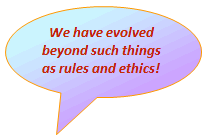 |
- Just as individual not-doing is
supposed to rise to whatever the occasion, so does actual spontaneous
collaboration as observed arising organically, within whatever limits of
application. -Very much unlike the radical anarchist ideological lifestyle of
spontaneous
collaboration, really little more than profound
alienation in deep
denial,
bush-league anarchism, in
reality nothing more than trendy pseudo-sociological rationalization for age old
decidophobic paralytic radical anarcho-holism,
frequently snatching defeat from the jaws of victory, especially when likewise to the exclusion of intentive planning and action by
appeal to crank ideologies of the diligent cultivation of memetic
influence upon the sublime and nigh magical confluence of appropriate conditions for whatever
particular desirable and foreseeable outcomes, firmly eschewing any such abhorrent crassness as of
consciously and overtly purposeful interaction or individual direct action seeking to guide
events in any crude linear progression.
-
-
-
Indeed.
perhaps worst of all, under
hypocritical
nigh Mooninite pretensions of being so much more highly evolved, such
impoverished and two dimensional ideology practiced only unilaterally,
is the ever
manipulative
habit and
moral
vacuum (because agreements are an imperfect ssocial technology!)
of making promises with no intention of keeping them unless one feels like
it later on, in order
dishonestly and
exploitatively to incur any likewise unilateral sense of obligation or
contractual reliance from the rest of us poor squares!
-
|
| |
 |
 |
| |
|
-
- Zen
brainwash?
"I just don't know how...to think less. If you know how, then teach
me...” — Aishah Madadiy, Velvet di Durham
All
cooperation in baffling and perplexing cult initiation persists upon
suspended judgment and the hopes that things will begin to make sense later on.
-A
futile hope to be dashed in Zen
Surrealism.
All other revelation is deemed fraudulent. For the Zen rejects the escapism
afforded by the unique features of the idle human mind, being: insight,
imagination and
cooperation, as burdensome self-consciousness. Have you found
The Root
Cause of Unhappiness?
Spoiler: it's ego of course, consciousness, the mind itself
intrinsically, thought at all. Happiness is just spacing out! Or so we are
assured.
According to Freud, the conscious and aware ego exists for the sake of
impulse formation into the execution of strategy, serving the drives of the id
within constraint of conscience which is an aspect of superego. But Zen is the paradoxical cultivation of non-cultivation and striving to
non-striving, for a return to a romanticized natural state which will be empty
of artifice, prior conditioning, premeditation and premediation whatsoever, and
release from all thereof, in recognition that only the illusion of
non-enlightenment, ego, self consciousness born of inner
reflection brought
about by life in society, all trivialized and demonized and believed to obscure
becoming enlightened naturally.
And ever the function of
propaganda is to lighten conscience in savagery against
whatever is demonized or trivialized in the first place. And from whatever core
values,
typical cult conditioning reinforces the pivotal rationalizations of a shared
worldview rarified of empathic common sense. But in the struggle against abuse,
Zen in particular, does not merely contend with inevitable distortion. Rather,
Zen is forced to confront problems and
contradictions inherent to any such
radical optimistic Nihilism.
And Not-Doing, to live in accordance with the way is
for one’s hand to be guided thereby, becoming perfect in action only when one no
longer consciously considers what one is doing.
Not-Doing
means letting actions control the doer rather than the other way around. But
whence all said action? Motive,
as any other truth, does not actually go away simply by being ignored instead of
being considered.
Indeed, one may quest for whatever sort of inner
knowledge from the
unconscious, or to trigger operations and response thought howsoever healing. Or
else, one may seek to add to, change, control, overwhelm or seduce the
unconscious by whatever content of behavioral conditioning or suggestion. And the slight of
hand comes in blurring the distinction, in bait and switch of the latter instead
of the former. Yes, there's the rub!
Indeed, either way, superficially, there may be a similar result in
unselfconscious action. But precisely because each is harmoniously adaptive to
completely different
situation, likewise the core
motivations
remain irreconcilably distinct.
Much thus, one way or another, Fascism of whatever stripe, typically contrives to
actually fob
off conformist and dutiful blind obedience as rugged
Individualism. Much as with
the Hindu adaptation of Buddhism to Arian domination, in the particular Feudal
Japanese appropriation of the Zen, the crucial slight of hand is in the
conniving reversal of inward soul searching for whatever the innate inner
knowledge from the
unconscious, into conformist Behavioral conditioning and fatalism via
deceptively superficially similar striving towards No-Mind, the unconscious
reservoir of dissociative automatic behavior without regard or
attachment. For
dissociation is a
denial process
of separating shameful unwanted impulses, desires, and needs enacted, from
cognition of ego and more importantly, superego, conscience, thus shielding
self-system.
But Freud condemns all such abuse as violation of his famous injunction against
suggestion, the crucial distinction being between the open endedness of what Sapir Handelman
categorizes as expanding manipulation as often seen in
psychotherapy, consisting of whatever
indirect oblique approach, with emotional incentives and even diversionary
tactics, yet, similarly to
Socratic
Method as applied to open questions, all scrupulously directed toward liberation via the inculcation of
doubt towards various beliefs, complexes and double binds, by which individual action of the person,
willing
choice, and well
being is effectively constrained and imprisoned, as entirely district from limiting
manipulations designed only to narrow, constrain and specifically direct the
range of belief, conviction, behavior and action taken by the target thereof, objectification and exploitation all in
accordance with the aims of the
manipulators.
Alas, the core ethic of Zen is often perverited and abused.
Ah, but is that merely mischief and misfortune? Indeed, are not the perverting
contradictions inherent and the abuse therefore
imminent and innate? Then again, are not all proverbial swords two edged? After all,
there is always far darker negation. Indeed, any tool
of liberation, be it the Nihilistic Zen bludgeon or
whatever
incisive Zen scalpel of inspired thinking, may
also all to easily and suddenly be turned about to degrade, enslave and destroy.
Indeed, a quest for something ineffable may readily engender servitude to an
unquestioned master renowned as exalted beyond mere mortal rational mentality
and mere intellectual defenses such as question or
criticism.
For all such is typical of devious
coercion and
consensus
manipulation towards exploitation until the collapse into
disillusionment or, if not, then long term cult brainwashing into the eager and
highly capable sycophancy and career advancement of the true believer.
And it is the
realization of such uncomfortable truths that must always inform our most difficult
meditations. For example, no uncompromising quest for human truth
can ever simply ignore the Second World War! But an historical account alone, no
matter how detailed and unflinching, runs the risk of simply dismissing
brutality as pure aberration rather than delving any deeper, let alone Zenning
the matter.
Indeed, if abasing and humiliating
oneself is ever truly so fruitful in vanquishing ego and achieving the bliss of
humility, then why do Masochists so often tend
all the more towards the most morbid and chronic egocentric obsession?
in the ardent cultivation of
immediacy and awakening to mindful heightened awareness of experience, and thence the rejection of
conceptualization as burdensome self-conscious encumbrance and suffering, Zen
quests for the complete abandonment of understanding as such. And this next quotation, however Didactic,
fairly strikes to the heart of the tragic Orwellian
doublethink and antirational
Wittgensteinean paralysis of Feudal Zen Fascism in the eager and
ambitious service of fanatical ancestor-worship and war crime atrocity:
- "Mental paralysis in the face of
contradiction -the failure, even, to perceive contradiction -allows the
unhindered exercise of power by the privileged over the non-privileged. The
mechanics of submission and domination in the typical Japanese setting are
intimately bound up with the possibility of being unreasonable and seeming
reasonable at the same time. This reaches its ultimate manifestation in the
manner in which the Zen master frustrates his pupil by unintelligible answers,
until the pupil ceases all intellectual defense and submits to the master's
purely arbitrary authority."
- 'The Enigma of
Japanese Power' by Karl Van Wolferen, page 300.
New York, Vintage
Books, 1990, 504 pgs.; ISBN 0-679-72802-3.
Inductivism:
Science without
attachment. Or: Not-Doing
your homework.
The Zen rejects the escapism afforded by the unique
features of the idle human mind, being: insight, imagination and
cooperation.
And
Inductivism
is the futile quest premised
upon a long refuted doctrine of science as an invariant systematic process
without personal emotional attachment.
Induction is an invalid inference wherein conclusions of generality (all swans
are white) may not contradict observations of specific instance (particular
white swans) taken as
premise.
But many allowable possible conclusions may still contradict one another.
Nevertheless, that the
premise
and conclusion may not contradict already narrows possible conclusions, perhaps
even closing upon truth, which is correspondence to
objective
reality. And the more
varied the particular instances taken as
premise,
the more narrow the range of conclusions that won’t contradict with
premise
from
subjective
observation. But can the possibilities ever be narrowed all the way to truth
before perception; entailing even tentative hypothesis and opinion, must
inevitably arise?
The core falsehood of
Inductivism
is the notion that hypothesis, opinion and therefore
attachment to pet theories
in jeopardy from trial and error, conjecture and refutation, with pursuant
controversy and strife, are avoided simply by the patience to gather
sufficient instances open-mindedly. Thus again the myth of infallibility in
innocence, assuming induction to be natural and therefore glamorized and
hypothesis and deduction civilized and therefore demonized. Indeed, numbering
among the most needlessly misleading of
attachments and suffering is
anti-argumentative
anti-critical
bias, the angry, emotionally injured and hypersensitive
Anti-Socratic
fixation that strife must ever attend upon
controversy, destructively and unproductively.
Inductivism
never really forestalls
controversy
nor eliminates doubt and hence even the most entirely intellectual of responsibilities
entailed in
free
choice at all.
-
Tantra:
the next best thing
to necrophilia!
- Who eats chocolate simply in order to transcend and overcome the
pleasing flavor?
-
-
""A good rider has balance, judgment,
and good timing. So does a good lover." — Unknown
-
-
Though tantra is juxtaposed to Vedic traditions
as a heterodox, life-affirming tradition, which is both ancient and basic to
Hindu interpretations of being, its hedonistic contents have been purposely
neglected or suppressed, partly because of the continuing hold of Victorian
morality (imbibed from the British missionaries and colonial rulers), and
partly because the erotic route to
mystical achievement has always been a
secret, minority path."
-
— Prem Saran,
Tantra -
Hedonism
in Indian Culture
At minimum, much as the famous Buddhist Shaolin
warrior monks renounce aggression, even practicing their renowned martial arts
without aggression, Tantra aims at non-thrusting
sex likewise all without the passion of aggression. Thus do the
disciplines of Tantric sex promise
such benefits as
slow, prolonged and even entranced love making in
tranquil Yogic positions, relaxation and greater heights of ecstasy, and some
would say, enhanced intimacy as well. Or are they actually expressly seeking to
avoid it? That rather depends whom one asks, and it should come as no surprise
that once again the question typically comes
subject to much
qualification.
 Indeed, what exactly is meant even by the common
parlance: casual
sex? (What, as opposed to formal attire
debauchery?)
Indeed, what exactly is meant even by the common
parlance: casual
sex? (What, as opposed to formal attire
debauchery?)
Why must it ever be so hard just to be easy?
That vibrant lust momentarily fulfilled still escalates unsatiated, seems little
tragedy. By contrast, the sex in
sexual addiction must be pretty damn
awful just miserably bad
sex to be so depressingly joyless! What are called addictive
behaviors such as gambling, never mind actual substance abuse, are the most
Existentially
Absurd,
Ecclesiastically
futile,unfulfilling of so-called
recreations, indeed
leaving no afterglow no speak of.
Casual
sex so-called, is often anything
but! -rather instead, excruciatingly awkward and actually uncomfortable, all the more so
for the cultivation of disassociated
sexuality, cavalier attitudes of the same antique Zen quest for
indifference in struggle of
denial in order
to cope with deep seated shame and disgust engendered by the no less archaic and ugly bigotry that so demonizes
Eros as the enemy of Agape and, more to the point: vice versa; either way, as
often expressed
poetically: that
love demands the sacrifice of love. Is casual
sex like casual conversation,
interminable delusory small talk, a snare of doom into an oblivion of unfulfilled
superficiality?
Answer: Only insofar as anything howsoever more substantial is
actually howsoever deliberately ruled out as actually impolite as typically in
the name of willful
positivity. And the same goes for
sex. typically, it is actually the onus and dire presumption or outright
premeditation of
attachment
disorder that truly raises any such neurotic dire
conflict between
Eros and Agape, in such dire self fulfilling prophesy. Nothing endangers or destroys deep feeling the way that
pressure under demand thereof as any sort of prerequisite does. Freedom from precisely such
common place ideological demands, freedom to
grow, is
always precious. Whereas, under conditions of
distress,
such as school, emotional support seems more of a
determinant of success than
sexual activity or not.
Indeed, it is so often the anhedonic that are so
unsympathetic and Moralistic. Nevertheless, it is the
pleasure
centered who are so often maligned as therefore callous and indifferent,
attachment
disordered. And yet, in truth, many close
relationships
grow from sharing
pleasures. Why should it be any different with the
intimate gratification of lust? Answer: Compartmentalization that is, indeed,
repressed and
attachment
disordered. Compartmentalization as a defense or
denial, a coping
strategy for dealing with overwhelming
ambivalence,
as from the equally intense craving and terror at any prospect of intimacy of
any kind at all. Agape can be as painfully suppressed as
Eros. And as we shall
see, some actually recommend it!
Declares
Laura Wood,
The Thinking Housewife: “The
well-educated slut has been fed a pack
of lies. Let’s face it. For all her credentials and impressive grades, she is
stupid!
Promiscuity
plunders a woman’s soul and wrecks her ability to love.” Indeed, along
the slutty Tantric path upon the sadly
misguided Zen quest of futility
and non attachment, such
precisely, is actually the deliberate
goal
put forth!
“It keeps many from ever marrying at
all or from having children. It is ultimately unappealing to men.”
But are any of the
three preceding claims scientific? What would be the
Empirical standards
of refutation? Under what conditions, particularly of culture and especially
self fulfilling prophesy, might any of the
assertions
in question, tired traditional
truisms as they may be,
nevertheless ever tend to be true (correspondent to
reality)?
What would be the controls? And
are there pertinent statistics?
Actually, it turns out that initial
sexual interaction and encounters as readily leads to longer term
relationship as anything the more at least ostensibly Platonic. Although
differing expectations can lead to misunderstanding and disappointment. if only by the expression: "casual
sex" nothing more was ever meant than that everyone involved in
entitled to be comfortable with all that they do together, at their ease and
free. Alas, the very expression: "casual
sex" is loaded euphemism, instead signifying nothing more or less
than morbid detachment, yes: those Zen ideals of non
attachment, and
cynical compartmentalization. But there is even worse in the implication of all
such as the natural human disposition, indeed remedied only by repressive
indoctrination into controlling jealously, possessiveness and fear based
relationship. But in any better alternative, surely any coherent quest for
individual wholeness, must value the genuine and
natural integration of self, integrity and principle, often at the vulnerable
danger ever of openness, approachability, and even heart worn on sleeve.
For the searing
ambivalent
inner
conflict between desire and
inhibition is untenable and irreconcilable, save either that lust be quelled or
insecure jealousy, fear, guilt and
aversion overcome. But as Thomas Szass observes, either such profound change
is easier lip service than accomplishment, and so it is more common for anyone
simply to go through the motions either of liberated
sexuality on the one hand or of chastity on the other, than truly to
conquer either desire on the one hand or inhibition on the other, at all.
-
"I'm just a Westside lover, I leave females in my sheets
and all my feelings in a rubber." — Big Sean
Indeed, to what lengths should one be willing to strive
for pure, innocent precious freedom at long last, from the falsehood and
suffering brought about by the entire range of frustrated needs obstructed by
all manner of confusing, painful and debilitating anxious, guilty and
self-conscious sex hang-ups? Everyone is one way or another
familiar with the grand stereotypical societal myth of how the quest for acceptance into the
Sixties, with the ideals of peace, love and understanding, and practice of
flamboyant free expression, somehow collapsed into such now hilarious
self-involved Narcissistic Disco era self caricature into the Seventies.
Behind enshrouding
Mysticism, Tantra can be perverse and
prudish all at once. Consistently to every other context of life, Tantric
sex is the ancient and venerable application of Yogic contortions and
sublime Zen apathy and transport of utter detachment even to
such weird and dissociated
sexuality. For dissociation is a
denial process
of separating shameful unwanted impulses, desires, and needs enacted, from
cognition of ego and more importantly, superego, conscience, thus shielding
self-system. And during the Seventies, porn icon Emmanuelle as most
famously portrayed by Sylvia Kristel, was the skinny blond catatonic
shiksa goddess
slut and traveling guru, the ideological cheerleader and
rôle
modelfor
entranced and detached dissociated sublime apathetic carnality, attended upon by robust and
lustful male performers doing all of the work for their limp, entranced and passive pretty ragdoll!
So, are such truly The Joys of a Woman and aught anyone
actually to envy Emmanuelle and aspire to become more like her? Indeed, can
complete introversion truly be the key to
sexual liberation? Answer: Obviously, not for natural extroversion
and curiosity. For once again, the pangs of loneliness and
sexual
boredom are portrayed as anything to be quelled
introveritedly and Narcissistically by regaining taste only for
one's own company, because extroverited Hedonistic passion actually reaching out for human connection
even for the sheer gratification let alone actually ever in order so much howsoever
as to alleviate any suffering of loneliness, is
once again cynically and prudishly dismissed as Quixotic, Ecclesiastical vanity,
Zen
futile.
Have you found
The Root
Cause of Unhappiness?
Spoiler: it's ego of course, consciousness, the mind itself
intrinsically, thought at all. Happiness is just spacing out! Or so we are
assured. And hence the dysfunctionally misguided appeal, also, of all such
disassociated sexuality in
quest of radical disengagement.
- "The main
motive for ''nonattachment'' is a
desire to escape from the pain of living, and above all from love, which,
sexual
or non-sexual is
hard work.”
— George Orwell,
-
Debunking
The Zen Master Dog-Poop
Story
Again, in the cutting prose of
Kathleen Norris:
"When you are unhappy, is there anything more maddening
than to be told that you should be contented with your lot?"
Indeed, it is said that
happiness is not having what you want but wanting
what you have. And indeed, what annoying sanctimony! For is that truly
happiness, or merely indifference precisely as cultivated by the Zen?
If so, then far best to let the tired homily be afforded a quite
death, with no further
torturous rephrase to sidestep and omit the now
invalidated very concept of
happiness. Alas,
however, such peace was never to be! So let the games begin:
"To manifest a stated intention you must begin by intending what's happening
to be happening, to choose what’s so to be so." What utter linguistically
meaningless pseudo-profound sophistry! As a transitive verb, to manifest means
to show or demonstrate plainly or to reveal. And to show, demonstrate or reveal
an intention, stated or otherwise, does not first require to
willingly
choose what is so to be
so. Intention and apathy are mutually exclusive, after all. Indeed, nor, tautologically, can one
willingly
choose what is so to be
so, because in order to
willingly
choose, tautologically,
there must be alternatives. And obviously,
motivated
decision alone, however arrived at, seems precious little efficacious causality
so long as passive rather than active or at least at all however harmoniously
reactive.
Hence, the only
willing
choice, as such, here,
so extolled, is acquiescence, of course. Not-doing.
And so-called intention thereafter, is actually anticipation. Because intention
is actually purpose of action. Non
causal manifestation of intention is an
ideation of action at a distance in magical power of positive or wishful
thinking. And so, the notion of manifestation of intention only provided
intention of what already occurs, is ironic and Zen
futile.
-Like unto the crowing rooster, taking
credit for the dawn!
And to actually encourage quest thereafter, can only be yet another harsh
practical joke of Zen tough love under what amounts to careful suicide watch
provided within the Zen Dojo, in order to wear down the disciple
into eventually nervous collapse, breaking their spirit into the utterly complacent abandon of all hope and
sublime apathy and untroubled docile adaptive resignation
to convention, inducing Bodgictta/ PTSD.
All nevertheless hopefully no
more than a humorous anecdote rather than any serious recommendation or
prescription, all perhaps best taken as another cautionary jibe against
Malignant Narcissistic Zen Masters or celebrities and their determinedly naive sycophantic
disciples. Not unlike unto the fabled deranged foolish Wise Men of Gotham or Chelm.
"To create something you first must know how to create nothing." But that
is demonstrably quite false! "Until you know how to create nothing, the space
in which something is created, you can't be certain you are creating anything."
But so what if one cannot be absolutely certain? Must uncertainty regarding
inevitable preconceptions whatsoever necessarily provoke such unmanageable
responsibility anxiety or:
heteronymous
decidophobia in the first place? Why?
Nor, for that matter, is sheer vacuum actually the requisite medium for
creativity. There is no emptiness, no fresh start, nor ever need thereof: "All is fire!"
proclaimed Heraclitus, a sea of glorious clutter and ever
roiling bricolage therefrom. Indeed, the new is always created out of the old, by inventive readaptation or else simply by change over time and
engagement rather than
apathetic Zen cessation of all
attachment, that purported great truth of
pointless
futility and Ecclesiastical vanity by
persuasive practical demonstration which is no more or less than, in terms of
Behavioral Modification, merely repeated
elicitation, frustration and extinction actually of all impulse globally, in
general, wholesale and in total at all, rather than
whatever specific targeted impulse or range of impulses. Indeed, though the solitary Zen may
spurn the joy of creative exchange and
collaboration,
nevertheless,
Empirically, such is
known to occur. Indeed, observably, every
thing, event or idea today, is contingent upon some antecedent, natural or
artifice. Even
satori,
the flash of new connections, inspiration, insight and
Gestalt,
cannot spontaneously occur in a vacuum!
Verily, there can be nothing so purely private
and internal as in the loftiest ideal of Zen. Again, utter freedom from preconception
is neither feasible nor actually desirable.
Moreover, nothingness as an entity
is oxymoron. Nothing is absence of all, void, the contents of the empty set. Hence, to create
nothing, if not actually to annihilate, only means simply not to create. Nor need one
know first how not
to create, in order at all to create. Hence, is there anything more here beyond
poor and transparent rationalization and sophistry for creative
block and sheer Zen
paralysis? After all, in truth, not
knowing how not to create, would only mean not
knowing how to stop being constantly
imaginative and creative,
creating quite naturally, even unbidden!
Indeed,
one can be creative at any time and in any place! And while there are, indeed,
people just too full of themselves to contain any new impression that otherwise
might enter or occur, there are others who positively drink in surprising new
information every day, even without first emptying their minds or else
somehow or other overflowing like a cup of tea. For even the weightiest of ideas
are not actually imbued with such spatial limitations as of physical volume like
unto the tyranny of numbers in engineering!
Nevertheless, as a poetical notion, perhaps one might bring delight to conceive, notwithstanding, of some Zen paradoxical concept of
Not-Creativity in application of Not-Doing: For Zen
Aesthetics ever extol simplicity, subtlety and elegance in the suggestive rather
than the descriptive or obvious, with naturalness barring all strain of
artifice, even at play, achieved often by the use of empty or negative
space, literally or fugitively as in the Haiku or the
vignette, all
by the elimination of all that is non-essential, in the cultivation of stillness
and tranquility.
 Stories of
Zen
Stories of
Zen
 What Is a Zen
Garden?
Japanese
Aesthetics
and the Garden
The Book
of Tea
Buddhatronics!
Cryo-Zen
Zen arts
Capturing
the haiku
TangoZen
TarotZen? (How
Existentially
Absurd! For
did
not the Buddha explicitly advise Buddhist monks not to use their psychic powers for
divination?)
What Is a Zen
Garden?
Japanese
Aesthetics
and the Garden
The Book
of Tea
Buddhatronics!
Cryo-Zen
Zen arts
Capturing
the haiku
TangoZen
TarotZen? (How
Existentially
Absurd! For
did
not the Buddha explicitly advise Buddhist monks not to use their psychic powers for
divination?)
Zen
hogwash!!
- "Never fear what will become of you, depend on no one. Only the moment you
reject all help are you freed.” — Gautama
Siddhartha
In the ardent cultivation of
immediacy and awakening to
mindful heightened awareness of experience, and thence the rejection of
conceptualization and the escapism afforded by the unique
features of the idle human mind, being: insight, imagination and
cooperation,
all as burdensome self-conscious encumbrance and suffering, Zen
quests for the complete abandonment of understanding as such. Perhaps the real end
motivating
goal
put forth of Zen,
much as with most any other body of faith, remains no more or less than any hoped for
tranquility in some anticipated state of acceptance and surrender. After all,
remember that even for all of the high hopes inevitably raised by the fervid
illusions of positive transference, Freud was perhaps even less ambitious when it comes to
the benefits of whatever arrival at closure, only seeking to midwife the
transformation of acutely debilitating suffering and disturbance, particularly
hysteria, into ordinary unhappiness.
There is a view of Zen not merely as esoteric secret
wisdom, but actually as something of a great inside joke, a colossal put-on, if not, indeed,
something of an exceedingly shaggy dog: The secret is that
there is no secret! Indeed, are we not extolled that all we struggle for in
our confusion, is actually well within easy reach? Many people secretly and
desperately hope to get all that they shamefully yearn for, simply by pretending not to. Some even pull it off! Except
for the absurdist tag about the monkey, the title of the Beatles song 'Everybody's Got Something to Hide Except Me and My Monkey'
notoriously
derives from a remark by the Maharishi Mahesh Yogi, the celebrity "gigging guru"
in such frantic demand for his purportedly crucial secret transcendental wisdom
as to become effortlessly privileged and wanting for nothing in this life. Thus,
it seems, had the Maharishi Mahesh Yogi found his vaunted blissful non
attachment. Such
much, the great Zen in-joke. What a puerile put-on! A true and more considerate Buddha would have long
departed in order to spare all others any further injury of wasted time and
passion that comes of devoted service -Nietzschean snares of altruism and
selfishness alike, veneration and rapturous goggling at
another's sublime focus and apathy. It's like feasting in view of the starving,
or striptease before the unloved. Worship frequently obscures the message. Even
retreat into contemplation becomes needless distraction, unless inspiring to
action and self care.
Perhaps also the derivation of
koan #36, Goso's No Words, No Silence, Línjì Yìxuán famously cautioned
against all
misleading worldly entanglements and recommended cutting free thereof (incidentally,
a
goal
as ever
put forth,
shared also but approached very differently, by
Transactional Analysis). Indeed, the
shortened proverb: "if you meet the
Buddha on the road, kill him" is often interpreted as an admonition to
Zen for oneself, and, like Siddhartha, to
reject any possibility of external sources of
meaning
or enlightenment and any teacher save for oneself, denounce and fend off any sort
of cult of personality, of any Buddha that can be met, named, externalized and
described discretely from selfhood or apart from
the totality of being, but rather,
"Seek out your own salvation with diligence!" Indeed, the Zen
test of faith ever demands the breaking of the spirit first, promising
exaltation only thereafter. For in order to learn everything, one must first
forget everything, and in order to gain anything, first one must lose
everything. And to kill the Buddha on the road, is to cast aside the last crutch
in order to ascend and attain Buddha nature oneself. The Buddha cannot
be seen. And this is as it should be. For once perceived and distinguished
separately from the totality of being and experience, that which must be
traversed instead becomes an obstruction clung to instead of blessed and
released with due gratitude. And hence, again, the admonition of Yamaoka Tesshu
comparing Zen to soap to be washed with but then washed off again. For winged
truth cannot be possessed.
- But, alas, and what a let down! -all such strained
metaphor is
only the empty verbal residue from lost and bygone inspiration, the fabled Zen
mischief of repetition. Just cornball
clichés from posers! For indeed, disappointed fixation upon the fallibility
of external sources of authority, divinities, gurus and scriptures, yields
to the quest for the inner authority of intuition, as if no one ever
suffered a bad hunch or an ill considered impulse! All the usual impossible
demands and excuses ensue, none the least of which being the conundrums of
spontaneity upon (self) command! All the inner Buddhas on the path within,
are ever remaining likewise to be slain.
-
If You Meet the Buddha in the Road, 2000
by Amir Rosenblatt
- "If you download from the Buddha on Usenet, plonk (killfile)
him!”
— Gyrate
-
- "Should you encounter the Buddha unit onsite maintenance,
deactivate it...”
— Mike Borden
-
- "If you meet the Buddha on the road, have him call my agent.” — waynio
-
- "Ask him how far it is
to the next gas station.” — WaldemarExkul
In fairness, however, the mischief of repetition does come forth in that it's all easer said, understood,
even opined or believed, than done, than embraced, than Zenned, than
apprehended and experienced with such immediacy as may enlighten, transform,
heal and liberate.
Indeed, as Alexander Lowen M.D. put it,
"Conviction lies not in the Ego."
And, in Zen, for all these deficiencies,
Didactic conceptualizations are spurned as Buddhas on the wrong road.
- "'This is my way; where is yours?'--thus I answered those who asked me
'the way.' For the way--that does not exist" Thus Spake Zarathustra —
Nietzsche
For to paraphrase: a king of fools is but a fool himself. Indeed:
- "Once a patient realizes that he has no disease, and so can never be cured,
he might as well terminate his treatment. He may have been put in touch with
good things in himself, and may even still be benefiting from the
relationship with the therapist, but once he realizes that he can continue
as a disciple in psychotherapy forever, only then can he see the
Absurdity
of remaining a patient, only then does he feel free to leave."
- — Sheldon B. Kopp, If You Meet the Buddha on the Road, Kill Him!, page 188.
Of karma
and dharma
Understanding is explanatory abstraction enabling cogitation
upon and employment of concepts effective and pertinent to whatever subject
matter at hand. Explanation is of causation in context and likewise of
consequence. Rational construction comes intermediate between
objective
reality and
subjective perception and experience at all, the
Phenomena, let alone abstract or
practical comprehension.
Different phenomena (lower case) emerge as sufficient causes converge under favorable conditions,
and disintegrate as causes or conditions dissipate. People understand and relate to
the
plot
logic of
polemical
drama and the
linear
causality of stories, even though events in the real world unfold as the
confluence of all manner of even dharmic and karmic cofactors in the outcomes of
complex systems, perhaps even amenable to some common
theme,
similarity or generality, if not any other serviceable
narrative.
Problems and types
of causality are
divided into the categories of dharma and karma, -
in the
polemics
of drama, dharmic
plot,
with "unity
of action,"
Sequence
and logic,
and
situation
plus karmic
character
motivation,
which together
equal
dramatic
destiny, fateful
choice of
free will, because
karma accrues from volitional intentional action
without which worldly happiness is impossible. That is why sublime Zen apathy
promises freedom from karma, ego and responsibility.
Karmic destiny, particularly: as of bad karma, is predictable outcomes
unfolding as inexorably driven by inflexible fixed attitudes, position or
POV,
in short:
dramatic failure of
growth.
inherent meaning as a
poetical figure, actually alludes to
purpose of personal fulfillment,
what matters deeply
growth
towards self-actualization
or at least freedom and autonomy,
relevant
value,
and without which life itself
threatens Zen
futile
Ecclesiastical vanity! and such as
may be expressed, also, in the intention of deeds, including that which is most
broadly signified in communication of message, information content, ideas,
conveying
Phenomenal
subjective
experience or understanding,
TEXT
and
subtext
all in
CONTEXT,
unless, most narrowly,
scientifically,
literally and precisely,
denotatively or referentially, that which is
signified and thus conjectured, is simply and clearly whatever corresponding
objective
reality,
Ontologically,
hence, also, implication, logically
inherent consequence and Deterministic inescapable causal
effect that inspires bleak fatalism but also liberation, hope from
knowledge and
even wisdom, for discovering better
choices,
willfully,
autonomously.
Mythical karma is not actually a system
of the universe at all. Because there actually can be no
Ontological foundation of
morality,
the so called law of karma is
actually mere truism
not really consistent enough to qualify as a physical law of nature. The
principle at all of karma is merely a
fateful tendency however as universal as anything in the soft social sciences or
humanities, stating that, in life's
drama, good results tend to follow from good, skillfully
detached and
responsible causes or
motivations
and bad results, intended, foreseen or otherwise, from bad, malicious or
simply ineptly irresponsible, often impulsive,
reactionary and misguided
causes and motivations. Which, in any momentary
reflection, all seems manifest in human affairs, functionality and dysfunctionality, both privately,
psychologically, and in the wider scheme of events in society. Thus even sans
mythic past lives, one way or another, we remain all nonetheless and
nevertheless the inheritors of past actions, decisions, experience and history
culminating and calumniating in each our own
situation amid the world about us,
karma.
Universal justice, however, is by no means assured. Besides, in the words of
William E. Gladstone: "Justice delayed is justice denied." -Let alone through
eons of mythical reincarnation! What would be the point?
By contrast, dharma, in the many
significations
of the word, may be thought to refer to the more
straightforward material and perhaps even the familiar mechanistic
problems and types
of causality and
effect such as that in the
polemics of
drama, differentiate the "unity
of action,"
Sequence
and
logic as of
plot
distinguished
from sheer
chronological sequence of
narrative. Dharma is constituent from all that simply is,
unmotivated,
morally neutral and devoid of
passionate human
values,
such as is the concern of natural science and particularly physics. Dharma also
refers to the nature and function of any thing or event, as most lucidly as
we may so apprehend, which, of course, is the
motivating
goal
put forth of science. But all too
often, it may be observed that the more transcendent the passion for science, the more detached,
socially inept, graceless and impractical have been many of the most famous and
accomplished scientists in ordinary life!
Dharma in the sense
of
trustworthy
virtuous right action according
to divine law, of
Stoical oikeiosi, also denoting one's
rôle in
life and the challenge to play it well as conduct within
dharma, perhaps connotes a somewhat
jaundiced and detached view of
plot, such as might
fail to be properly acknowledged as the more intimate problem of
growth and
character
development. Drama,
after all, from the same root as the Sanskrit dharma but in Late Latin drma,
drmat-, via the Greek drn, to do or perform, is
conflict
inherent to
situation;
conflict on
every
level
within
and
without, being,
as it is, more than merely an event, but like unto karma itself, a
condition, a relationship.
Indeed beware! for in true life no less than
in the equivocal representation thereof, poor staging or presentation
of
any
level
of conflict is
effectively misdirection dissipating
inherent
drama,
reducing promise to
catastrophe by losing sight of
what matters
deeply. Where, then, does that leave the ideal and
motivating
goal
put forth of
sheer detachment?
Is Zen itself, then, no more
than the hamartia and even cowardice of
turning one's back on life?
Which brings us
to
conduct within
dharma:
- "A good rider has balance, judgment, and good timing. So does a good lover."
— Unknown
Dharma remains at once both eternal
universal order and also duty or law governing one’s life. Fulfilling dharma
goes beyond mere purpose in life, but endures as the path for transcendence of
suffering and the cycle of birth and death called: Samsāra. Now, there can be a Zen of any solitary
art, archery, motorcycle maintenance, or anything else, even perhaps including
the conduct of science, even the Chivalric Kama Sutra
Tantric
sexual
etiquette extolling adroit arts of love. But can there be a Zen of graceful interactions, especially
such as by which people are ever thought to relate to one another? Indeed, is
the cultivation of skilled conduct within dharma in order to become good
at life, and much such a quest for the
same insight of spontaneous authenticity and
good faith is striven for in
Transactional Analysis between individuals?
Is
Transactional Analysis
then
a properly dharmic liberation from karma?
Or is the cultivation of virtuous right action or Stoical
oikeiosi, conduct within dharma, rather a questing
for sublime unmotivated
impersonally cold-blooded perfection in dealing with others? And what would that
amount to, but
manipulation
without
attachment? Indeed, must
Zen prize or reject the same insight of spontaneous authenticity and
good faith striven for in
Transactional Analysis between individuals?
Indeed, strictly speaking, can Zen ever even recognize
as possible any insight of spontaneous authenticity and
good faith striven for in
Transactional Analysis between individuals?
After all,
bypassing, exchange which is not genuine communication because it lacks
sufficient intersubjectivity and does not carry at all the same
meanings or even
purpose, intention or point at all between
the participants, is all there really is, according to the Zen, traditionally.
According to Zen, individuals may be perfectly genuine, but
dialogue, never mind the
attachment snare of
relationship, never can be genuine or true. Hence, Zen must regard
Transactional Analysis
as quixotically futile. For only the masterful Zen
liberated superhuman quelled
into conduct within dharma can conceivably ever be however cold-bloodedly receptive
to the challenge of effectively dealing with others in order to feed them the
correct stimuli in order to steer them along the most benign causality, according to
Stoicism and Zen alike.
In the most Heraclitian Buddhist thinking more current than ever in modern
physics, all objects, phenomena or other events are deemed empty of self
sufficient inherency which is illusory. Such, however, is relationship, indeed, in
a strictly dharmic view. Whereas under Zen
Wittgensteinean paralysis, any
meaningful
conversation, dialogue,
literally from dia- "across" + legein "speak,"
let alone human relationship, remains all quite oxymoronic,
being after all, inescapably doomed to human imperfection. And that is why
Jews do not Zen. Zen and Judaism are
intrinsically irreconcilable because, after all, the
attachment and belonging of
human relationship, a
value
so Nihilistically rejected by the solitary Zen, is,
indeed, the very central focus and very cornerstone of Judaism.
The sublime sagacity and skill promised
of conduct within dharma mythologizes and romanticizes the irresponsibly
indifferent proto-Behaviorist
heteronomy to
situation much as extolled by such
doctrines as the Zen. Conduct within dharma
refers to Not-Doing without
attachment or self
conscious contemplation, thus immediate, harmonious and perhaps even
somewhat superficial, individual conduct in even nigh
fundamentalist conformity with the dharmic principle of
universal order, behavior that arises from a sense of connection to others and
to one's environment or
situation and the experience of
unity, balanced, unselfconscious, adaptive, detached and karmically neutral. A lofty ideal of
sagacity, contemplative Gestalt
comprehension accruing the skill to act beneficially for oneself and others, a
more scientific caution towards moment to moment human
transaction, the lesson
of exaggerated responsibility in hindsight as the quest for perfect compassion must demand, once the
deceptive illusion and snare of
attachment, regard, desire and unhappy frustration is
overcome and the transitory nature of things can be accepted and embraced.
Hence, arguably, the
transgression of
hamartia, after all,
more often so unwitting, is only figurative, because, literally, the only
transgression in question is against dharma in the sense of the laws of nature. But the
laws of nature, literally, are inviolable! After all, who needs to enforce
the law of gravity or thermodynamics? Hence, the only conceivable violation can be
against prudence, soundness of judgment. Hence,
hamartia is only poor unskilled dharma,
error indeed, often quite innocent and impulsive.
Whereas
science, no matter how exacting, remains volitional intentional action, deliberate exercise in trial and
error bound to anticipate and forever accept imperfection. Hence, like unto
science, is Zen likewise sanguine or not? And if not, why should the surrender
to futility be deemed more commendable than commitment to
scientific rigor? The Zen rejects the escapism afforded by the unique features
of the idle human mind, being: insight, imagination and
cooperation. Indeed,
Philosophy is typically
belittled in Zen because every solution only tends to fresh
contradiction.
But then, what of Zen paradox? nevertheless, as the sages admonish,
Philosophy is not Zen. And perhaps the real
practical and practicable limits of any Zen practice are
somewhat overdue to be at all established in clinical trials. For tragic and
damaging attachment to the same old myth and pursuit of transcendent perfection
remains, tantalizing and tormenting, especially when and as abused and exploited
by the infamous domineering controlling Zen
celebrities, authorities, fakirs, tricksters, the paradoxical
Buddha on the road and hence, with any luck, ego crushing
barrier to the gateless gate to Nirvana in this life.
-Or so we are assured...

Why Jews do not
Zen
Who is a Jew? Indeed, what is
a Jew? -let alone an
Israeli... The answer is that the Jew, much as the Hobbit, is a mythical
creature of mythical extraction and legend. -Just like everybody else!
And so, then what are, if not differentiating factors, then key
values, as in
being a
mensch?
Be
a mensch!
For Menschlichkeit or creditable
trustworthy
humaneness and integrity, is the art of being a
mensch,
upfront,
honest,
autonomous, responsible and accountable, yet gentle, with benevolence,
empathy and sympathy. Indeed, a synthesis of single minded convergent thinking with nuanced
situational
Gestalt may be achievable in the intellectual
cultural
Jewish
trait or aptitude of justice, proportion, perspective and whole integrity,
especially as refined in prewar Germany, by Einstein, Freud and Marx, Relativistically,
via the integrative synthesis of divergent frames of reference or
POV, everything from time dilation and inner life to a larger view of
economics, overviews and special cases. - All factors that may play into differing
values
and
levels, priority and
autonomous coping in
case of
inner
conflict
between responsibilities and/or interests,
honestly
true to oneself and straight with others.
- "We are all prone to the malady
of the introvert who, with the manifold spectacle of the world spread out
before him, turns away and gazes only upon the emptiness within. But let us
not imagine there is anything grand about the introvert's unhappiness.”
- — Bertrand Russell
We all tend to become
attached to
places or settings, social
milieu, to
objects and even ideas, but most especially
bonds of affection
to other individuals as according to
Attachment Theory
of the
first core strengths
attained in childhood towards
individual
adult
attachment in
relationships
with
autonomy and
respect, risk taken in
friendship and
vested in talent rather than social advantage, with
trust placed in content of
character,
indeed also particularly such as
for couples.
Whereas an attachment injury is the hurt from close quarters, so to speak,
therefore
that festers and engenders
attachment disorder
severely enough to adversely affect future interactions and close relationship
throughout life.
Anti-Critical Bias let alone
Fundamental
Attribution Error exacerbated into
Hostile Attribution Bias are all mistrustfully
attachment
injured and disordered, let alone the controlling possessiveness of
bullying.
To quote Gian Vincenzo Gravina: "A
bore is a man who deprives you of solitude without providing you with company."
But insensitive or just unreceptive intrusion is the very least failure of
intimacy. Intimacy risks far greater disappointment and betrayals. Therefore,
even the most pleasant anticipation or prospect of intimacy is often marked by
even sometimes threatening sensations of shyness, much as good
sex is often preceded by the
churning of proverbial butterflies in the stomach.
So, can Zen non
attachment really be
the answer, the release into perfect Buddhist compassion as promised? -Or just
more of the metaphorical baby out with the proverbial bath water...
For
genuine love, compassion and friendship are all distinctly marked by such
features as patience and kindness rather than envy, rude and boastful pride,
ever self-seeking and quick to wrath and grudge collecting, by forthright
honesty
rather than hollow deceit, by protection and
trust with every hope for the
others' best interests, with perseverance through
conflict,
wanting for another all that they want for themselves.
In the most Heraclitian Buddhist
thinking more current than ever in modern physics, all objects, phenomena or
other events are deemed empty of self sufficient inherency which illusory. Such,
however, is relationship in a strictly
dharmic view.
Whereas for Zen, dialogue, literally from dia- "across" + legein "speak,"
let alone human relationship, remains all quite oxymoronic.
And that is why Jews
do not Zen.
Mysticism at all, even Jewish
Mysticism let alone Zen, are, in truth, all intrinsically
irreconcilable with Judaism, because, after all, the worldly
attachment and belonging of human
relationship, a
value
so Nihilistically rejected by the jaded and solitary Zen, is,
indeed, the very central focus of Judaism. Zen inertia, futility
and inner peace from complete surrender are irreconcilable with the Jewish
value of persistent hope even amid life's most crushing tragedy.
in the ardent cultivation of
immediacy and awakening to mindful heightened awareness of experience, and thence the rejection of
conceptualization as burdensome self-conscious encumbrance and suffering, Zen
quests for the complete abandonment of understanding as such.
Indeed, in the Zen, whole and directly intuitive apprehension is extolled as superior to
dichotomous logic. But:
How so?
The very question provides Zen persuasive practical demonstration, in it's manifestly
daunting complexity. And seeking an answer in simplicity, simply cannot make simple,
whatever, indeed, is not actually simple to begin with. After all, Occam's Razor seeks for the simplest
workable explanation for whatever available observations. Indeed, in the words
of Antoine de Saint-Exupéry, "Perfection is reached, not when there is
nothing more to add, but when there is nothing more to take away." But
when distortion finally arises in further pressing the quest for simplicity, in
heedlessly continuing to subtract even what turns out to be essential after all,
this is rightly called: oversimplification. Indeed, oversimplification is often a
grave drawback of all Radical Holism and one dimensional thinking!
For such, precisely, is the poverty of the Zen, in that though Zen claims to transcend words, actually, direct apprehension can be
limited and limiting. For example, the numbers one, two and three, may ever be
known at a glance, but who can understand even the number six, except by
imagining twice three? And is merely grasping principles at all, even by
whatever agency of howsoever dichotomous reasoning,
truly anything over which to feel guilty and inadequate? Do suffering innocent
cherubs actually bleed from every hair split by
philosophers?
Despite the ancientness of the golden
rule, to do unto others as one would have them do unto you, nevertheless,
only via intellectual Humanism is embraced the real great truth that only an
Individualist can be altruistic, because, after all, how can one care for
another without first recognizing and endorsing their individuality? In the
biting irony of W. H. Auden, "We are all here on earth to help others; what on
earth the others are here for I don't know."
At this point, to escape the Zen
moral
vacuum, even
Buddhist compassion must invoke
relationship in
order to support oneness, because, putting aside all dangers of whatever twisted horrors as
ever may arise to fill the moral vacuum,
amoral
Zen makes by far the more consistent sense than Zen altruism, because even
assuming as given, all due moderation, nevertheless, sublime apathy in prudish
Zen cessation (in terms of Behavioral Modification,
merely repeated elicitation, frustration and extinction, but actually impulse at
all globally, in general, wholesale and in total at all, rather than merely
any specific targeted impulse or range of impulses, especially
including those of desire, relation and
attachment, all as the royal path to altruism, is
far more problematic; because, as the famous biologist and developmental
psychologist Piaget understood, sympathy as requisite to service to others can not
be even possible without selfishness that can in turn be projected onto others;
because only the individual liberty and open desire of a healthy ego can be
extrapolated into the experience of others so as to engender ones own sympathy.
Indeed, tyrannical self
denial is far
more often seen only undermining exactly that very developmental process of
emotional
growth,
actually accomplished, however reasonably and imperfectly, quite without the
scoundrelously unnecessary and impossible transcendence of the life and
experience to which such development is even
relevant.
And for that matter, by what mitzvah or kindness, how is charitable service to a selfless person even
possible? Indeed, what could ever be the point of, as it where, cooking a meal
for a person forever quelled of appetite? Moreover, tautologically, the
closeness of reciprocity requires both selfish desire and altruistic benevolence
on all sides.
- Hence the focus of Judaism
is not with tearing down distinction of the self, but upon building and
discovering relationship.
- I and Thou not: I Am
Thou. If you meet the
Buddha on the road, talk it over. (What could it hurt?)
Have you found
The Root
Cause of Unhappiness?
Spoiler: it's ego of course, consciousness, the mind itself
intrinsically, thought at all. Happiness is just spacing out! Or so we are
assured. Indeed, Zen seeks cessation, that purported
great truth by persuasive practical demonstration towards the embrace of pointless
futility and Ecclesiastical vanity, being no lore or less than, in terms
of Behavioral Modification, repeated elicitation, frustration and extinction,
but of all impulse globally, in general, wholesale and in total at all, rather than
merely any specific targeted impulse or range of
impulses, and especially of
attachment
or relation and thus of the suffering born thereof, whereas
dialogue actually builds
relation and attachment, seeking thereby any resolution to the troubles and
suffering of isolation. All accord born from true
open dialogue (literally from dia- "across" + legein "speak") still
recognizes the sovereign individuality of one the other. Indeed, exactly thus must such
blatantly obvious dualistic synthesis in particular
nevertheless be reasoned, abstractly from fine distinctions, not Zenned in
compassionate oneness.
And for the Jew, duality is not the
constructed deceptive fracture of whole and singular reality so despised by the
Zen, but rather culture, perspective and harmonizing
depth
perception to be
embraced and valued. And so, for the Jew, there
can be no notion of regret over intellectual categorical thinking. Indeed, even
in meditative traditions, duality has even been regarded in Jewish thought as
the very will of the Creator, rather than any flaw, gnosis of which to overcome.
The Nihilism of
the Zen ever gravitates towards oneness of the Tao, whereas the
exploration of
Judaism ever embraces the duality of Diaspora.
By no accident where the three most
important thinkers of the Twentieth Century all assimilated and cosmopolitan
German Jews, living their lives from the dual perspective of the Jewish
experience on the one hand and the German cultural mainstream on the other, and
each rediscovering the world in fresh dimension from some
innovatively dualistic
perspective and synthesis.
Freud focused upon the workings of the
subjective
inner world of the human mind
in contrast to those of the external
reality, Marx sought to place the
economics of Capitalism and the market into a larger ongoing historical context,
and Einstein fathomed relative frames of reference in space-time.
Psychologically,
morally and socially indispensible
self-conscious emotions include embarrassment, guilt, humiliation, pride, and
shame. The self is apprehended by distinction from other. Therefore, the truly
unselfconscious are indeed untroubled by
reflection, blithely insensate and
irresponsible to the
feelings of others whom they treat utterly without regard and trammel under
foot.
For Judaism, true to itself, hardly need
strive at dichotomy, but one way or another, already abides ever in
dualistic counterpoint to argue
Existential
controversy with the world, hence intrinsic
complication even quite without affectation. Indeed, dialogue
and controversy are intrinsic to the essential
moral Jewish
rôle
of loyal opposition in struggle with God: "Though He slay me, I will hope in
Him. Nevertheless I will argue my ways before Him" (Job 33:15, NASB).
Thus, if the innocent uncomprehending tiger evinces neither guilt nor remorse in
slaying it's dinner in accord with it's own inalienable and harmonious nature,
why then should the thinker be any more vexed simply with the habit of thought?
And what's so awkward about self-consciousness introspective preoccupation
anyhow?
Why is analysis, however abstract, deemed any less true to the self of the
rational being born into this world endowed with cerebral cortex, than quiet
respiration and photosynthesis are to the humble and placid bamboo? To the Jew,
it is not. Therefore the silly Zen equivocation and
blanket Ad Hominem of dismissing all
heterodox opinion as manifestation of ego, remains utterly unconvincing. Only
oppressors admonish the masses not to think! And anyhow, isn't the naivety of innocence so often vastly overrated?
-Let alone as in
amoral
Zen inspired and one dimensional Nazi
sociopathic veneration and emulation of
tigers, wolves and other natural predators!
For despite the ardent exhortations of misanthropic hermits and
heteronymous conformists alike, nonetheless,
never might I conceive that compassion could
move
me to crush another's spirit/ego into utter complacency of nervous collapse
under what rather amounts to careful suicide watch provided within the Zen Dojo. For the peace embraced thereby in
resignation and the abandon
of all hope, nevertheless
inspires more pity than envy.
Indeed, if anything constructive and
uplifting is every truly to be lucidly and incisively salvaged from the Zen for
all time, then compassion demands nothing less than the explicit renunciation of
all such enthusiastic selective self-disavowal (bad faith),
taboo, violence and
Moralistic hate speech against the poor
long suffering and unjustly maligned
ego! Awkward self consciousness results from whatever undermines healthy
self confidence. We all know full well that any healthy ego needs love too! Therefore, to
find clarity, do not meditate in oblivious serenity, but reflect
self-consciously thereupon:
Accepting all things with
undifferentiated equanimity as extolled of the Zen, would mean to accept the
very opposite thereof instead of seeking or demanding all acceptance of all
things with undifferentiated equanimity as extolled of the Zen. Of course Zen
means not making effort, but that doesn't resolve the inherent
contradiction.
Accepting all things with undifferentiated equanimity as extolled of the Zen,
means accepting and even embracing also
arousal, discontent, judgment and ego no
less than all else howsoever deemed simpler and more spontaneous. The only
conceivable reconciliation of such paradoxical manifest
contradiction into any
constancy, comes in the admonition of Yamaoka Tesshu comparing Zen to soap to be
washed with but then washed off again. Enough already. Zen isn't clever anymore.
It never was.
Sadly, fewer seek to sell their souls
at any price, than simply to be rid of them at all, relieved thereof and
grateful for it. So, who would actually sally forth in order to have their
spirits broken and discarded as such an
obstacle? Alas that all too
many are so desperate for peace and acceptance on any terms. And there is never
any shortage of ever the same cult snake oil from phony gurus and fakirs, Zen
Masters and
Behaviorists, all ever eager to oblige.
Such is the most vile exploitation. Beware!
Again, does not Zen exhort the
acceptance of things as they are? Why then not acceptance and even appreciation
of the much and unjustly maligned ego, just as it truly is? It is no cowardly
Nihilistic
introversion that overcomes ego, in the first place of no need of being
overcome, violated or crushed. Zen scoundrelously promises the impossible and
the unnecessary in order to evade even minimal accountability. Rather, it is love among all
attachments so
anathema to the Zen, that penetrates and uplifts egotism, altruistically
redirecting any self-centered focus instead upon the emotions and interests of
others, thereby even overcoming bored and
lonely
Ecclesiastical
futility. That
very capacity defines who we really are, or else one truly is nothing, a failure
as a human being. Who knows if love indeed ever conquers all. But love for all
of its chimerical ephemerality and pointless suffering, still handily trumps Zen
cynicism. For as John Donne so famously wrote: "No man is an island." If all of this
is trite, then by that very token, the poverty of all
Mysticism such as the Zen
should be obvious.
Indeed, both the Zen
Mystical disciple and the patient in
Psychodynamic Psychotherapy among others through any range of life experience
and transition or process of maturity, may report a certain particular change, despite sameness
otherwise. - to whit: continued experience
of all the same even hither to vexing cognition and affect, and yet somehow no
longer so troubling or overwhelming. So perhaps non attachment is simple
detachment after all, and enlightenment perhaps even into better
conduct within dharma,
is nothing more than any dawning of what we call perspective or proportion, and
nothing more. After all, what is the unenlightened Cretin, Philistine or
lunatic fool, but one so utterly lacking all perspective and proportion? The adept
bragging of being so
quelled beyond any urgency at all, apathetic and only going through the motions,
can always be thrice denied, dismissed and disowned as an extremist heretic, an aberration or anomaly. But that
can be no less disingenuous than hiding him under the proverbial bushel. As
whatever ancient doctrines
are increasingly qualified and explained away in whatever
apologetics, less and less remains, plain and
profane indeed, unless the apologist strives to metaphorically back peddle by slipping
anything more in via the proverbial back door.
Otherwise, successive qualification consistently reduce wild eyed grandiose claims into into
disappointing trite platitude.
It is only natural and healthy for ego to wax and wane in the transition between
conscious states, even waking and sleeping. Awakening is awakening to ego,
reason and even self knowledge, not out or away from ego. All
value
judgment aside, the escape from ego is in sleep and dreams by any other name,
especially exaltations of transcendental meditation, with or without
drugs. To call any such awakening is to claim lucidity or
insight therein, in other words: inspiration. As if inspiration where ever any
more escapable than ego!
And for that matter, perhaps
satori
is a function not of true oneness, but merely of harmony. Harmony or
Gestalt
is of the whole and may be experienced or apprehended in a multitasking
simultaneous congruence rather than the dichotomous sequence of counterpoint.
Nevertheless, counterpoint remain no less rich and complex even than harmonies.
And harmony or counterpoint howsoever created, recognized and apprehended in the mind may be
transient, precisely because of the effort entailed in the nigh orgasmic mental
complexity that even however pointless, is the lure of the obscurantist
Kabalistic esoteric complexity junkie. However flawless execution, even as however sort of columniation or
fluke outright, like unto consummate ballroom dancing, only promotes the illusion of effortlessness,
albeit unlike ballroom dancing, even however
subjectively.
And the actual totality of being remains exclusive to external
objective
reality,
and we can only reflect thereupon to the best of our
phenomenal faculties of
factitious artifice, which is to say, according to our own natures. And exactly that
dichotomous relationship,
being knowledge, is what makes love possible.
-hence the Biblical usage...
And so sayeth the Bard: "It is better
to have loved and lost, than never to have loved at all." Suffering, then, has
not been Zen-futile. Hope for better has endured.
And that is why Jews do not Zen.
- A rebuttal of sorts:
Zen
and
Accountability
Zen truth...
?
In 'Would
My Zen Master Fail Me For Writing This Article?', Patrick Cox writes:
"The purpose of Zen is to become fully aware at every moment. One is supposed to
become mindful of things in the world or the situation one is in at each
instant: to become fully aware of the tea that one is drinking, for example. “In
short, the whole philosophy of the various methods is to broaden a person’s
vision, sharpen his imaginations, and sensitize his mind so that he can see and
grasp truth instantly any time and anywhere.” (A Source Book in Chinese
Philosophy, p.429)."
But is the above claim
objectively testable? What would be the conditions of
refutation? For that matter, what truth, and in correspondence to what
reality?
"In other words, the goal of Zen is maximum awareness of
reality, unmediated by
false concepts. (Although Zen resists the tendency to define ‘reality’, let me
provide a definition of what I understand to constitute
reality for Zen,
acknowledging my inability to do full justice to the
reality Zen mind can make
known, and which experience verifies. "Reality is everything that can be
perceived by the senses and conceived by the intellect. Zen considers the
non-Zen mind to view reality through concepts and sensory data, which results in
a failure to fully understand it. Zen does not regard this common partial
understanding of reality as completely wrong; rather, our normal conceptions are
regrettably far from the perfect understanding of
reality that Zen mind tries to
help us achieve.)"
But because perception itself, gathered by the sensory apparatus into the mind
for processing, is therefore well
known to be interpretive in
very nature, unmediated perception remains oxymoronic. And because we are all
fallible, there will always be false concepts often undetected. Hence there can
be no totality of perfection or certitude. And calling any claimed mode of apprehension
perfect, or better or even merely different, is still uninformative, most
specifically, Axiologically, as to what about it
may be deemed even desirable, or indeed how and why so. Zen is but another
expression of the cowardly and nostalgic quest for the recovery of lost
innocence.
There is much apologetics of denunciation of
American Zen as heretical from authentic Japanese Zen, or indeed with any
clearer justice, of Japanese Zen and its worst liberties with Buddhism from
India, indeed
historically, literally Zen entranced war crime instead of Buddhist exhortation
to somehow or other no less detached (or: non attached) compassion, But
don't buy in! Briefly, the central bad idea called Nirvana Principle of reducing
ones needs by simply quelling
pleasure
principle, remains ancient, enduring and
international.
Indeed Freud observed: "That which
is not expressed is
acted out,."
And Freud's famous observation well accounts
for the most notorious cult
hypocrisy and abuse, and within Zen particularly.
Yet the answer given to that problem by the various mystics remains no more or
less than exhortation, under what amounts to scrupulously careful suicide watch
provided within the Zen Dojo, to desperate striving unto nervous collapse and the
breaking of the spirit or in more romantic and pleasing euphemism: crushing
of the ego shell.
out,."
And Freud's famous observation well accounts
for the most notorious cult
hypocrisy and abuse, and within Zen particularly.
Yet the answer given to that problem by the various mystics remains no more or
less than exhortation, under what amounts to scrupulously careful suicide watch
provided within the Zen Dojo, to desperate striving unto nervous collapse and the
breaking of the spirit or in more romantic and pleasing euphemism: crushing
of the ego shell.
Again, Zen is but another expression of the
cowardly and nostalgic
quest for the recovery of lost innocence. But leave us face it that innocence may be
vastly overrated. Otherwise, why change at all? What need for
the sacred fool ever to sally forth? Innocence is often extolled particularly
for clarity from preconception and thence certainty or anything of the sort. But sheer naivety is not
infallible after all, whereas uncertainty need never so terrify or paralyze
curiosity and responsible
autonomy.
in the ardent cultivation of
immediacy and awakening to mindful heightened awareness of experience, and thence the rejection of
conceptualization as burdensome self-conscious encumbrance and suffering, Zen
quests for the complete abandonment of understanding
and even curiosity as such.
-
-
"All my life I've been harassed by
questions: Why is something this way and not another? How do you account for
that? This rage to understand, to fill in the blanks, only makes life more
banal. If we could only find the courage to leave our destiny to chance, to
accept the fundamental mystery of our lives, then we might be closer to the
sort of happiness that comes with innocence.”
- —
Luis Buñuel
-
Thus many a disciple must wrestle with the
Zen-futile Salvation Anxiety (so
to speak), attachment to nonattachment, of Zen's unstated implication of, or desperation for,
the numina, of somehow unmediated direct apprehension of essence, in the blithe
ignorance of the constructed subjectivity
of meaning, how even experience, psychologically, culturally and even
neurologically, is, after all, no less
factitious, an artifact, conjecture,
conditioned upon Gestalt relational context and empty of self sufficient
inherency,
than all hearsay, hindsight, preconception and preoccupation which the strict
Empiricism
of Zen so vehemently scorns and deplores, but worse, any regard whatsoever,
distress
and attachment of all
such futility as in any demand to the contrary, for only transcendent
authenticity, even if not deeper
meaning per se. For,
indeed, just
what does all that matter so?
Such patently false conundrums that
have inspired such enthusiastic violence and hate speech against the long
suffering and unjustly maligned ego, emanate from the ill
reputation of meta-cognition, of awareness of self, as an irksome burden to be
spurned at all cost, including as self consciousness so often and consistently
does, time binding and
character
building, rebellion, regret,
worry, ofttimes painful change and
growth,
all emotional baggage of the past and concern with plans of the future to come. The
all to familiar yearning of Zen, then, is for the unperturbed innocence of some sort of pure
spontaneity, or else, in truth, at least to cherish, with
enthusiasm, every delicate illusion thereof.
Hence, Zen takes neither savor nor
solace in the scientific questing and testing for literal truth which is the
correspondence to reality in
assertions, despite the lucid
dharmic neutrality of
any such scientific
agenda, because, after all, it is people who yearn for truth, not statements,
and therefore the process of the mind, experience and
reflection that together
comprise the Phenomena, which must somehow ever arrive, even however briefly, at
some clarity, validity and true accord with
reality that constitute such
transitory insight,
satori,
as constitutes the only kind of knowledge
valued
and exalted by Zen
beyond whatever sheer practical utility.
-
- For those who have Awareness,
a hint is quite enough.
For the multitudes of heedless
mere
knowledge is useless.
— Haji Bektash Veli
-
Zen is often likened unto the '60's. For, as the
saying goes, If you remember it, then you where never there! For Zen is also the
appreciation of the elusive, the cultivation of the experiential and intuitive,
of immediacy, especially where definition may fail. The intellect of Zen in
pursuit of
satori, does
not seek to grasp
Dialectically, but only to point, to indicate
what must be caught, not taught, and often seeks
to fall back upon such common sense as that will be apprehensible
experientially, even reliably, repeatedly and at will.
For example, the
Zen Master will not state for us a definition of self. But if one responds to
one's own name, then, momentarily, it must be presumed that one does apprehend
what is self! So, why struggle with difficult definition and explanation of self
awareness, when the experience thereof is always simple and imminent?
For the skilled Zen master helps to bring about the causes and conditions of
insight, which, nevertheless, remains
subjective
and solitary. Indeed, the vantage for such awakening is never far for anyone.
- "Where ever you go, there you are!” — Buckaroo Banzai
Indeed, all else is distraction. Static
in the attic! Especially, of course, the needlessly complicated construct of the
ego shell. We are all Buddha. Further more, Buddha is not this, and Buddha is
not that, and so on, elimination ad infinitum, questing for emptiness, oneness and,
seeking there in, but quite literally, "the peace that surpaseth understanding".
- "Zen is like looking for the
spectacles that are sitting on your nose.” — Ella
For this is all there is. And there is no
hidden meaning. The only secret,
and an open secret at that, is that there is, indeed, no secret. For
"it is your true self, it has nowhere to hide." and "a dunce once searched
for fire with a lit lantern!" thus writ are the
koans,
plain and profane.
- The Scholar: Whither goes the soul
when the body dies?
- The Master: There is no necessity for it to go anywhere.
- — Jakob Böhme
-
Indeed, as a matter of Zen
practicality, had the poor frantic dunce, or sacred fool, only
known what
was the fire of his lantern, one must imagine that he'd have cooked his rice that much sooner.
After all, we each tend to miss the obvious, one way or another. For, like unto
the quenching and crystalline water drawn for the hungering dunce's cook pot,
where the answers any clearer, they'd only be that much harder to see, transparent and therefore nigh invisible.
Does a dog, then, partake of Buddha
Nature? For cheerful dogs are attentive while desperate men are intentive. A dog, after all, responds to it's own name
without encumbrance or
factitious artifice of fixed meditation, and never complains of
identity
crisis or Nihilistic
Existential angst!
Have you found
The
Root Cause of Unhappiness?
Spoiler: it's ego of course,
consciousness,
the mind itself intrinsically, thought at all. Happiness is just spacing
out! Or so we are assured.
Bah, humbug! Happiness or even tranquility, cannot be owned, possessed, or
transcendentally achieved by the detached (or: "non
attached") adept. The very
relevance
to life at all, of
happiness, is that
happiness
is, indeed, a state
variable in
subjective
response to howsoever favorable circumstances or
situation,
and particularly by doing what you love, indeed, together in
collaboration,
because human interaction is likewise well
known
and understood to be crucial to
happiness. That is what I seek to
discuss, always, indeed, to bring onto the
agenda
for action. That is the
motivation
of this very website,
FoolQuest.com
A prime
distinction of rational falibilism, is the rejection of despair over the
admitted impossibility of perfect certainty or the recovery of
innocence, both so vastly overrated. All struggle for perfection,
innocence and certainty, all thereby become at best superfluous, at
worst pernicious. For that matter,
according to science, happiness cannot so blithely be deemed the same
thing as tranquility, because observably, stress is
dystress when unhappy or displeasing, and
eustress
when happy or pleasant. Suffering is not always the result of anything
intrusively displeasing or injurious. And any objective of the entire
elimination of suffering is impossibly Perfectionist. Worse, as we have
seen, elimination of the very capacity for pain,
valuable no less even simply for being
aversive, would likely be catastrophic. But most saliently, often
dystress is indeed from frustration with
unmet needs and desires, even very much according to Buddhism. Not to
beat about the bush, what is intrusive according to Buddhism, are needs
and desires at all, or at least beyond a modest minimum, according to
different degrees of such extremism. An
Existential
position upon what Zen calls:
futility.
I flatly reject all such
Mysticism,
out of a profound respect for need, desire and even the very struggle so
despised by the
Mystics,
struggle even uplifting and spurred on in the name of compassion, a
struggle inspired by worldly hope because of observable progress and
improvement, or in a word: Humanism.
We are all too
often entirely justified in unhappiness with our circumstances or
situation.
Discontent and ambition have driven humanity to confront and overcome
the challenges we face. Is there any greater good fortune for a human
being, than a position upon what is so disparaged as the Hedonic treadmill?
- at least, only given whatever the correct
personal calibration... Therefore, the rejection of reactive unhappiness
is nothing more than a
manipulative
exhortation to compliant docility. The
conscious
and
aware ego so demonized by the Zen, exists, at least according to
Freud, for the sake of impulse
formation into the execution of strategy towards implementation catering
to
the drives of the id, but within constraint of conscience which is an aspect
of superego, all exactly the point of
FoolQuest.com:
Rational
agenda of problem statement and strategy towards
implementation, all towards fulfillment of unmet needs by improving
adverse circumstances via
engagement in
meaningful
and
pleasurable activity and interaction.
The Zen test of
faith demands the breaking of the spirit first, promising exaltation
only thereafter. But that is nothing more than the typical ruse of a
charlatan, the Buddha on the road, for there is
nothing simply to quell, and just as any other needs addressed
alleviate their painful deprivation, the gnawing ennui such as of
loneliness
and boredom finds catharsis in expression
as anger and sorrow, relief accruing first of all, in the attentive
exchange genuine interest, even sheer humane curiosity, then lastly in
understanding and compassion.
Loneliness
and boredom fade before conviviality in
joyful passions of
pleasurable and
meaningful
engagement and
fulfillment
. -all,
indeed, transitory but ever renewable. For such is the dignity of
risk in
good faith, learning by trial and error
necessarily rejecting the
futility
of impossible Perfectionism
and heteronomy ever inspiring only
Nihilistic
value-destruction
in scorn of inevitable worldly imperfection.
In defense of the Hedonic treadmill:
From
consciousness accrues the capacity for
intentional activity,
known key to the flow of
intrinsic reactive happiness.
Far from non
attachment,
happy people are
known to involve themselves reaching out and exerting
every effort in order to actively
make things happen, pursue new understandings, seek new achievements,
and thereby uplift their own thoughts and emotions and even improve
their circumstances. -To celebrate fulfillment precisely because
it awakens fresh desire and vitality of
eustress. Not to extol
lonely
boredom
for the morbid peace it brings!
-repugnant Zen Nihilism ever
extolling noninvolvement and the
virtues of inertia, mired in the salvation anxiety of
desperate
Zen
attachment to mythic non attachment questing
for the emptiness of holier than thou stagnation, and standing in
denial and
value-destruction
not only of material wellbeing, improvement of
situation and
circumstance and intrinsic reactive happiness
in response thereto, naturally engenders inward turning
futility. Indeed,
intrinsic
reactive happiness stands perhaps as no less
than the prime target of alienated
Nihilistic
value-destruction
against any enticement whatsoever howsoever of involving
engagement within the
external world at all.
Hence, if Zen is
indeed like unto soap, in turn to be rinsed away along with the day's
soil, grime and strife, then then washing off the
long proverbially scabby encrusted and mildewed soap of the Zen is long
overdue. And good
riddance!
For I shall speak my egotistical Western mind:
Truth to tell,
futility isn't clever or romantic,
but merely
futile.
The standard
flavors of passive-aggressive cyanide Kool-Aid being: Zen, motivational
positive
thinking, touchy-feely
bogus support
group marshmallow throwing,
Behavior Modification and adherence all such to, have been
sucking up all the air in the room, especially now online, for far too
long!
In the immortal words of
Protagoras "Man is the measure of all things"
because there is no intrinsic
meaning;
for
meaning
at all, let alone value,
is an aspect of human experience and comprehension that the Zen mystics
strive so quixotically to transcend as unjustified. Just as
Socrates
points out, how can the nonexistence after
death be any more
distressing than the nonexistence before birth? Indeed, desirable values
even as far as sheer necessities of life at all, let alone any further
amenities or loftier concerns, are not
logically reducible, but simply a
matter of human nature, ultimately
as innately
biological and therefore arbitrary as survival instinct to begin with, let alone
Pleasure
Principle
or
meaningful
engagement.
And I am, among other things, biological as are we all. So that latter is self knowledge
and self acceptance and sign of life coming of no particular moral
distress, nor should it.
"Man is the measure of all things"
because there is no intrinsic
meaning;
for
meaning
at all, let alone value,
is an aspect of human experience and comprehension that the Zen mystics
strive so quixotically to transcend as unjustified. Just as
Socrates
points out, how can the nonexistence after
death be any more
distressing than the nonexistence before birth? Indeed, desirable values
even as far as sheer necessities of life at all, let alone any further
amenities or loftier concerns, are not
logically reducible, but simply a
matter of human nature, ultimately
as innately
biological and therefore arbitrary as survival instinct to begin with, let alone
Pleasure
Principle
or
meaningful
engagement.
And I am, among other things, biological as are we all. So that latter is self knowledge
and self acceptance and sign of life coming of no particular moral
distress, nor should it.
Indeed there
have always been many reasons why it may even be deemed a mistake to
strive for ultimately boring inner harmony
or tranquility: Heraclites said: "All is fire!" Nature is of
clashing forces, and human nature likewise, is of
inner
conflict and
passion. Therefore, true insight is likewise thereof,
honestly.
And so is
engaged creativity that makes even ones own company at all the more
interesting and congenial, particularly as in the
eustress
of. scientific curiosity.
Thus, no, I am Humanist, finicky, and find no particular
temptation into the embrace of any crusade
of self abnegation for to quell desire and
annihilate value.
Indeed, to be
honest,
the very notion is quite repugnant! The
true meaning
of life is that
happiness is neither: a trait cultivated
via intrapsychic discipline, nor merely circumstantial let alone simply
material, but an individually reactive state variable to howsoever
favorable circumstances, hence
achievable only in living life not in turning away into Zen
detachment any more than by compulsive substitution, joyless workaholic material
success or prestige.
And so the quest for
happiness
and the challenge of
meaningful
existence and
relevance
as ever rejecting the embrace of sheer futility,
and any hope for resolution whatsoever of the
boredom and
loneliness that human beings suffer,
raises no less than the true burning question: What sort of interaction is one
wonting, and how best
to initiate and sustain whatever such interaction?
And this very website,
FoolQuest.com,
striving at any viable approach, serves as
your
invitation
to that very struggle.
|
it's
private by ChangeDetection