|
“The truly great advances of this generation will be made by those who can make outrageous connections, and only a mind which knows how to play can do that.”
—
“If I had asked people what they wanted, they would have said ‘faster horses.”
“Fashion is something barbarous, for it produces innovation without reason and imitation without benefit.” — George Santayana
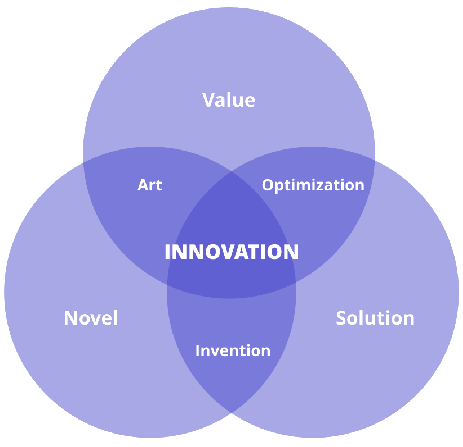
A. In the words of Theodore Levitt: “Creativity is thinking up new things. Innovation is doing new things.” Indeed Digintent.com defines innovation in terms of creative solution finding: “Innovation is the process of creating value by applying novel solutions to meaningful problems.” And creativity remains, to quote Albert Einstein: “intelligence having fun.“ as epitomized in the best Science Fiction. Moreover, Creativity can and Should be Social. Indeed, creativity is found most productively to flourish by continual alternation flowing between creativity in lone contemplative solitude and vibrant expressive creative interaction together. So let's each bring our own considered ideas to share, explore and modify together. Creativity is the very germ at the heart of innovation and true entrepreneurship poised upon innovative new venture creation. In the words of John Emmerling: “Innovation is creativity with a job to do.” As Arthur Porter put it: “The innovation point is the pivotal moment when talented and motivated people seek the opportunity to act on their ideas and dreams.” Innovation remains crucial to all progress. Indeed, in the words of Michael Porter: “Innovation is the central issue in economic prosperity.” Indeed, to amplify in the words of Christopher Freeman: “Not to innovate is to die.” For in the words of Gary Hamel: “We've reached the end of incrementalism. Only those companies that are capable of creating industry revolutions will prosper in the new economy.” But as George Santayana observed: “Fashion is something barbarous, for it produces innovation without reason and imitation without benefit.“ The aphorism illuminates how even innovation is not necessarily always intrinsically relevant or helpful. Consider the noxious polished turds of shameless chicanery, the big lie of criminal innovation in the financial sector, innovation only in wholesale embezzlement, ever blazing new trails into the same old larceny, and all under the ruinous legalized corruption so epitomized in perpetual lobbying for deregulation. So yes, word definition can be important.
Digintent.com: What is innovation: why almost everyone defines it wrong
Q.
What is Brainstorming?A.
Succinctly...
Does anyone know if Alex F. Osborn the Advertising Executive who developed the procedures of Brainstorming, was aware of the work of Sir Karl Popper?
Because Brainstorming translates easily into Popperian terms.After all, Popper not only embraces
Sturgeon's Law (descriptively stating that 95% of everything [and not just Pulp Science Fiction] is shit), but goes further, prescriptively contending that the diamonds will never be there to be found, save amid the freely effluent dung pile. Alex F. Osborn's Brainstorming Methodology of a'posteriori deferred judgment/evaluation, putting into practice Popper's defense of free expression of unfounded conjecture, likewise stressing quantity in order to achieve quality, is now experimentally vindicated. Or is it?Even though, for example, a finished plot must generally be linear, in the activity of creative fiction writing the process of plotting probably should not be. Rather, it may be is best to arrange and rearrange the story components one has or can get, in order to then understand the implications and fill in the blanks, an ideal challenge for brainstorming.
Creativity in any application, in measured steps or "intuitive" leaps, unpredictably dazzlingly brilliant, even peak experience or "merely" clever, is that common and natural cognitive function which, by the Heuristics of Cybernetics particularly, is recognized to be, in part, an investigation, largely a function of flexibility, meaning the ability
and willingness to reflect upon and modify ones own gestalt/frameworks and criteria (for example, as in TRIZ, to cross disciplines, inventively), by which known elements are rearranged into new forms, recognizing similarities and differences, making connections and questioning convention; even though, paradoxically, genius often depends upon not only the greater range afforded, but no less crucially, the further constraint of extensive background knowledge, whereas madness, fanaticism, dogmatism and stupidity, by contrast, are comparatively lacking in the restrictions even of reality checking.Creativity may even offer a constructive and uplifting outlet for pain and confusion.

“
Contents
1. beginning from unfounded conjecture
 3. wild and exaggerated
exploration
3. wild and exaggerated
exploration
b. Ideation and the Applied Imagination Question Summary
c. Techniques for working from Random Stimuli
e. mind mapping
4. quantity first, then quality
 5.
building upon the ideas of others:
modification
5.
building upon the ideas of others:
modification
 6.
Solution Finding:
experimentation
guidelines
6.
Solution Finding:
experimentation
guidelines
 Pareto Analysis
Extras:
The FICTION BRAINSTORMING Toolkit
TRIZ theory of Inventive Problem Solving



Minimal ground rules are covered under conduct and moderation.
Optionally, warm up with an easy, perhaps fun question for a short, practice brainstorming session. It can be anything and doesn't have to be related to whatever matter at hand.
Brainstorming may also be more productive preceded by an analysis of some sort, discussion allowing exchange of interpretations and definition of problems, root causes, the barriers to change, the specifics of the present situation, a vision of the ideal situation, the different aspects or segments whatever problem, and even an inventory of the resources available to help solve such a problem.
 Indeed, Brainstorming
may often benefit from preliminary and even ongoing
research.
Indeed, Brainstorming
may often benefit from preliminary and even ongoing
research.
Radicalism, the attempt to start from a clean slate, is a distortion which will undermine the creativity of Brainstorming. Rather, Alex F. Osborn, much like Sir Karl Popper, follows the Dialectic of Socrates in challenging assumptions as they arise.
Indeed, far from avoiding all assumptions, on the contrary, it may even be crucial to begin with such discourse as to make certain that the participants each understand and are satisfied with the central question before opening the floor to ideas.
The Non Justificationist Methodology of Brainstorming begins with the simple maxim of deferred criticism during the initial creative process of idea generation and collection. Because, as Popper points out, critical preference and reality testing come a'posteriori.
In practice, behaviorally, this means, be curious first, critical next. To explore possibilities before filtering.
However, this has been outrageously distorted by some into sheer Anti-Critical Bias, the standpoint that criticism is bad, intrinsically hurtful and dangerous.
But Popper explicitly holds argument/debate/polemic and controversy to be most important and productive. And Alex F. Osborn, no fool, likewise brings critical preference and reality testing into play, all in due course.
Indeed, the one paradigm in which criticism truly has proven most inhibitive to creativity is known as Verificationsm, the doctrine that Science is the accumulation of verified knowledge. And history is replete with similar cultural doctrines as applied to the arts, as well. Thus creative speculation is actively discouraged, flittered a'priori, before hand and from the very start.
But Non Justificationism, by contrast, holds that Science begins from unfounded conjecture which is to be encouraged, then subjected to critical preference and reality testing. In that order! In other words, that brainstorming is the first stage of the Hypothetico Deductive Method which is Dialectic, in which criticism and objectivity at all come a'posteriori, afterwards, frank, honest but sans recrimination. After all, we learn by making mistakes, creatively, and then detecting them. And that is the way we grow from practice of the arts, as well. Including creative writing, where, likewise, editing afterwards, as one goes, is crucial, but censoring oneself in advance is deadly.
But where as critical preference consists of such criteria as logical internal consistency (that a likely hypothesis ought not to selfcontradic ) and elegance (meaning that the simpler explanation that accounts for all the observations is likeliest to be true defined as correspondent to objective reality), successful Brainstorming employs it's own particular preference, the interesting over the uninteresting, dull or boring, where 'interesting' is defined as offering, at the time, more creative points of departure, and 'uninteresting' pertains to ideas that just don't seem to go anywhere, failing to spark creative points of departure, so that folks loose interest in them, and move on. (But not because of squeamish self censorship or covert peer pressure.)
• Anticonventional Thinking (ACT) is a creative thinking methodology that, unlike many others, actively encourages, rather than discouraging,
criticism. Because criticism Feeds Creativity.
After sufficient experience in imitation, individual preference emerges to begin shaping distinct style, creatively. Explore whatever spontaneous inspirations, one's own prior work or other existing sources entirely, and especially the creative reapplication and improvisation of one known elegant solution towards an entirely different problem.
Discuss the question or issue for the brainstorming session before hand.
Then, feel
free either to jump right in, or else to take time as desired to think about and
"sleep on it"
in order to stimulate the process of "(pre-)incubation".
Discuss any
relevant information concerning the
theme or central question, which will provide additional fuel for the imagination.
And always remember that honesty is the best policy!
 2:
Visioning- Sharpen the focus
2:
Visioning- Sharpen the focus
Visioning is ongoing and concurrent with Exploration looking for Ideas. Because, to begin with, Exploration is shaped by Visioning no less than definitive Visioning must be Exploratory of whatever boundaries, and beyond. Even problem solving, in and of itself, may limit the Socratic discourse of the questions rather than the answers and undermine the quest for personal meaning and new horizons. For, in the words of George Bernanos, "there is no worse lie than a problem poorly stated."
Although, if so be, then an answer in search of a question or a solution seeking a problem, must come as close second. Seek, therefore, the Best Problem Definition.
Consider these questions using these checklists.
There are three crucial categories of questions.
Clearly define the problem and/or opportunity and put forth the motivating goal or ideal outcome, as applicable, not limited by perception of possibility or feasibility and compile lists of statements thereof into Affinity Diagrams according to the Kawakita Jiro method. List All Possible Alternatives and All Factors Involved.
Consider: What is the problem and/or opportunity? Why is it indeed a problem and/or opportunity? For whom is it a problem and/or opportunity? When did it first become a problem and/or opportunity? What are the roots of the problem and/or opportunity?
It is particularly important to clearly identify and put forth motivating goals in order to distinguish problems from solutions and assumptions to begin with.
For example, how to get a message to appear on screen, might not be a well defined problem, but only one solution in the first place. A better stated problem might be, how to be informed in the event of whatever particular occurence, such as the arrival of a guest or indeed, an intruder. A chime and/or blinking light would be another possibility, and a phone call, perhaps automated, might be better still. But the greatest hazard remains sheer irrelevant Malagenda.
Therefore a promising alternative is ANTICONVENTIONAL THINKING (ACT 2.0) turning upon The 5 Whys
Identify interests and POV:
 Force Field Analysis - Understanding
The Pressures For and Against Change
(origin)
Force Field Analysis - Understanding
The Pressures For and Against Change
(origin)

Repeat with more problem statements.
Revise the responses into updated or better defined problem statements.
Then list the real, hypothetical or dramatic obstacles, as applicable, of whatever sort. What and what else prevents or forestalls progress? Revise and redefine problem statements yet again.
For the above point defines growth character development from adversity for oneself or anyone else in
reality no less than for imaginary characters in fiction.Alas, a common anti-critically biased mediocre minded failure of collective thinking is when the very questions are arbitrary and pointless, and the suggestions unimaginative, putting the proverbial cart far before the metaphorical horse. But even, however rarely, when dealing with choices of
creative / dramatic tension that might conceivably make an effective difference somehow, nevertheless even discussion at all to the point still tends to reduce to pointless expression of position and preference that remain genially arbitrary for wont of Critical Thinking about the real situation and whatever principles apply thereto.In other words, even majority decisions may be rendered meaningless, sans any focus upon whatever real issues, and in terms of whatever such issues (such as any pertinent question of what might be more dramatic and why in fiction, or salient questions of what it takes to influence government or make business viable) so crucial to informing any more meaningful discourse.
All classic problems of any system eclipsing it's own purpose, internal agenda instead of putting forth external motivating goals. Such is all that comes from the consensus of people who are not challenging to one another, stop caring and never grow.
Two possible consequences of external conflict are dominance or annihilation, the outcome determining the victor and the defeated. But other possibilities include stalemate or compromise. Indeed, as Mary Parker Follett anticipated so well ahead of her time, conflict on many levels is to be found at the root of both deadlock and accomplishment in social reality and work, even exactly as in by now standard dramatic formulae.
Likewise, and sometimes in parallel or counterpoint with just such outer conflict, there are also a number of possible developmental outcomes of crisis, growth from inner conflict, even proportionally.
 Indeed,
So, in King's view, real life progress actually depends very much upon true real life drama, the struggle for meaningful values in action that matters, to which motivated conflict on every level, of course, is likewise central for meaningful social controversy!
And in brainstorming, specifically in Visioning, the sharpening of focus, by contrast, definition of problems is a part of creativity. And the cultivation of creative tension may even show promise in ameliorating a common drawback of group decisions, that of arbitrarily wishy-washy compromise simply for amicability's sake. Indeed, Focused Listing not only facilitates creativity and problem solving, but enhances people skills in Acceptance Finding.
In all things, the dynamic and flexible piecemiel social engineering principles, personal autonomy, good sportsmanship and responsible values of rational democratic progress are systematic doubt, hope in the honest embrace of fallibility and tolerance for uncertainty, substantive discourse, debate of disputes, criticism without punishment and no insult taken, free inquiry into problems openly and publicly without fear of punishment, indeed, imagination, open unfounded speculation about different case scenarios pursuant to any number of varied and different proposed measures, without need of conforming or in any way limiting said speculations to any accepted quasi-official position.
The very values and aptitudes ever fostered in brainstorming and fiction writing!
And all pursuant to experiment, trial and error, the vital opportunity for all manner of ongoing reevaluation and revision, open ended correction of mistakes and improvement at all levels, piecemeal, without bloodshed, violence or even strife as such.
Democracy is the social system of process seeking to guarantee these rights, to encourage, protect and foster all such interaction.
The following steps in brainstorming may be applied just to the visioning alone no less than to the rest of the brainstorming process, afterwards.
 Any source must be
allowable for points of departure.
Any source must be
allowable for points of departure.
It's much easier to tame a wild idea later on, than it is to think of an immediately valid, viable, founded or Justified one in the first place. Heck, the 'wilder' the idea the better! By all means, pop out bizarre and unworkable ideas to see what they might spark off. No idea is too ridiculous. Humor is also creative, after all. For, not only truth but inspiration does come forth in jest or from Stream of Consciousness free association and permutations.
Optionally, practice close and detailed observation and description of pertinent objects, phenomena and even visual "deep thought" fantasies, until novel and even insightful details and/or connections and associations arise.
So, allow, state any ideas, however outlandish or downright silly, deferring judgment or evaluation, suspending disbelief, conscience and even good taste, however momentarily.
Exaggerating ideas to such extremes even as of the unfettered speculation in Science Fiction as a vehicle of satire, is often helpful in opening up thinking from fresh direction or POV. And one can always put forward ideas, thoughts purely as creative points of departure, to spark off other people and not just as a solution to any problem in particular.
Exploration, looking for Ideas, is ongoing and concurrent with Visioning. Because, just as Exploration is guided and defined by Visioning, so too is definitive Visioning Exploratory of and beyond the boundaries it seeks. In the words of George Bernanos, "there is no worse lie than a problem poorly stated." Hence, even problem solving, in and of itself, may limit the Socratic discourse of the questions rather than the answers and undermine the quest for personal meaning and new horizons.
"Bullshit!" Hungarian Brainstorming, 'A steady stream of wild ideas, punctuated by logical and scientific reasoning'. Memetic mutation subject to selection (elimination) for fitness. The general idea of these forums, except without the score keeping of the party game...
3a: The Seven Creativity Tools
Click the link above to browse variant brainstorming exercises for making new variations and finding different correlations. Also see the creativity tools list.
 3b:
Ideation
3b:
Ideation
Click the link above for an exhaustive list and explanation of different problem solving methods and approaches, the emphasis being on engineering. Also browse the Applied Imagination Question Summary and see: TRIZ.
 3c: Techniques for working from Random Stimuli
Because the human brain is a self-organizing pattern creation system, always making connections, almost any random word will stimulate ideas on a given subject. Simply follow the associations and functions of whatever stimuli and also aspects thereof as a metaphor or even Forced Relationships/Analogy.

|
|
Exterminate All Rational Thought
with:
DadaDodo
and
WebCollage
Plato held that patient reflection upon the whys and wherefores any instance or experience of subjective beauty can reveal some meaningful truth in an idea. "When I was a boy I felt that the rôle of rhyme in poetry was to compel one to find the unobvious because of the necessity of finding a word which rhymes. This forces novel associations and almost guarantees deviations from routine chains or trains of thought. It becomes paradoxically a sort of automatic mechanism of originality ..."
|
|||||||
| Stimulation Toolbox | |
| Job Force | Takes inspiration from occupations. |
| Ricliché | Uses playfully distorted proverbs as prompts. |
| Sloganeeze | Draws inspiration from advertising slogans. |
| Web Economy Bullshit Generator | Very clever, but the verbs are often real verbs. |
| Star Force | Asks how famous people might solve your problem. |
 |
Follow a chain of quotations to inspiration. |
|
Creates new words to inspire you. |
|
|
Generates random corporate memos. |
|
|
Combines word parts and rhymes with your entry. |
|
|
Suggests 100 ways to think about naming. |
|
|
Over 700 free ideas and growing. |
|
|
|
|
|
|
Free web-based anagram server from your input. |
|
|
"All the life's wisdom can be found in anagrams. Anagrams never lie." |
|
|
Words of a chosen text are replaced with their dictionary definitions. |
|
Multibabel lost in translation |
Any phrase translated by computer back and forth between 5 different languages. |
|
|
|
| Haiku Writer |
Confines itself to Just seventeen syllables. Procrustean, right? |
| Press Release Writer |
|
|
A companion tool box to this one, First Aid for writer's block in fiction writing. |
|
Q. Is Surrealism truly "as beautiful as the chance encounter of a sewing machine and an umbrella on a dissecting table"?
A.
"The surrealist use of games, like that of art and literature, is primarily focused on the subversion of premeditation and rational constraints, but in addition it is also a subversion of the artist's ego with the potential for revealing the Marvelous heavily relying on the release of collective creativity."thesis-synthesis-antithesis, also Peripeteia
What
philosophical import unfolds from serious collaborative fiction writing and brainstorming here on FoolQuest.com? Just what is the point? What can it mean? Where does it lead? By what method? In case of unresolved artistic difference among friends, the worst that can result will be prolific multiple variant versions, different stories. But out from the dramatization of controversy, presented from differing POV, Point Of View or perspective in character conflict (whether of internal ambivalence and/or as in external action adventure), new heights of collaborative creativity in plotting and meaning, are discovered via synthesis of any two conflicting ideas, called: thesis and antithesis, together reconciled in synthesis, to form anything unprecedented, richer, more engagingly complex and surprising. And this same very principle of fertile conjecture transcends mere drama into any range of creative solution finding and collaboration among equals, bridging abstract (generally why) and concrete (specifically how), even into the real world along the Backwards Ladder of Abstraction, the steady retreat from fantasy and willing suspension of disbelief, gradually into ever more defensible bastion of real purpose and barest possibility: Innovative new venture creation (various business startup). Power, capability, autonomy, real liberation, freedom in an unfree world. To quote Sir Francis Bacon: “Truth is so hard to tell, it sometimes needs fiction to make it plausible.”Premise with Antithesis or Counter Premise, in the richness and, as in the Zen dualistic opposition of Yin and Yang, the clash of paradoxical reconciliation and balanced accommodation of contradictions, and ambiguity, as a means of creative modification. "In a good play, everyone is right." Even the emptiest verbal abuse outright may be salvaged via the techniques of topic reclamation.
Evocative drama may turn upon social estrangement or other Peripeteia, and may also incorporate an opposing or contradictory Counter Premise or Antithesis. For better and more dramatic and engaging conflict on myriad levels in fiction, even diametrically opposing views and tendencies, indeed if not represented in the agenda of an antagonist or villain outright, may even be embodied by the foil and related character.
Antitheses, opposites, may also be synthesized (combined), because concrete solutions to problems, indeed truth itself (correspondence to reality) are often found in Dialectic synthesis of somewhat abstract extremes. But in consensus manipulation, just such Dialectic synthesis of antitheses is perverted and subverted into a means of peer pressuring consent in order to collectively conceal and suppress controversy.
Consider every POV, no matter how outrageous.
"The nature of a novel is that it has no opinions, only the dialectic of contrary views, some of which, all of which, may be untenable and even silly."
For sheer creative Provocation, modify problem statements outrageously! -Even to the point of the ridiculous, totally far-fetched, backwards, impossible, or humorous, even downright wacky. Indeed, for story plotting, inspiration may even be derived from free association via the experimental introduction of entirely inappropriate elements and characters.
Deploying the Paramount Idea tool, define and put forth the primary motivating goals, and then (hypothetically) abandon it! For example, instead of increased sales, imagine bankruptcy and consider resource redeployment thereafter. Then readapt the new ideas either toward the primary the primary motivating goals initially put forth or possible sidelines that have been discovered.
Indeed, among the CRUTCHES FOR A GENIUS is Thinking in opposites, Problem Reversal, actually brainstorming ways to do things opposite or even dead wrong so as to accomplish or change nothing, criticism, fault finding for gaps in strategy, such as in how, where, to whom and in what way, and whatever measures under consideration would have no desired effect or virtually no effect at all, or even how to actually make things worse (such as, for example, how to waste water rather than how to save it, or to alienate one's object d'amore rather than ever winning hearts and minds, or even the Six Surefire Ways to Kill a Brainstorm (rather than fostering creativity) so as to suggest solutions by defining problems, indeed, much as in plot oriented story lines. Just so, Fanfic Rebellion serves as an opportune demonstration of some of the creative and investigative possibilities.
"Bullshit!" Hungarian Brainstorming, 'A steady stream of wild ideas, punctuated by logical and scientific reasoning'. Memetic mutation subject to selection (elimination) for fitness. The general idea of these forums, except without the score keeping of the party game...

 An
entirely optional visual tool with your choice of FREEWARE!!
An
entirely optional visual tool with your choice of FREEWARE!!
Open the FoolQuest.com folder in the IHMC Public Cmaps (2) Place
 in the center.

Video: How to Mind-Map with Tony Buzan
History:
Mind Mapping, also
known as
'Radiant Thinking',
is a technique that was developed in the 1970s by Tony Buzan. A Mind Map
consists of a central word or concept, with 5 to 10 main ideas radiating out
from that central concept.
Mind Mapping can be effective in taking inventory of current knowledge and also
to make associations because each Basic Ordering Idea can become the center of
another Mind Map. And a Mind Map is capable of producing endless associations.
Indeed, the very structure of a Mind Map keeps giving rise to fertile new
associations. Mind Mapping also helps organize information hierarchically,
in a way that is not possible with lists. The tree-like structure of a Mind Map
is a hierarchy and the non-linear nature of mind maps makes it easy to link and
cross-reference different elements, hence the process of arranging information
along the 'branches' and 'twigs' of a Mind Map facilitates superior grasp of the
information.
Uses: Mind Mapping is used, individually or in concert, to help in sorting out and making choices, organizing ideas (one's own or those of others), memory, creativity, Self-Analysis, problem-solving, diaries, Genealogy, learning, teaching, note taking, presentations and more.
And in case of writer's block, Writing flash fiction using bubble diagrams is an application of Mind Mapping to creative writing. For this purpose, the Random Story Starter can be supplemented with the Random Character Maker and Random Character Namer or DADA's Little Baby Namer.
And for an impressive,
elaborate, robust, but at least initially somewhat daunting series of
forms, all flowcharted together, be sure to check out

“The best way to have a good idea is to have lots of ideas.” — Linus Pauling
As many ideas, POV, variations and synthesis as possible!
Get each idea noted, noticed, and seek response as per item 5, next.
The more creative ideas a person or a group has to choose from, the better. If the number of ideas at the end of the session is very large, then there will be that much more to sift through and work with for the best ideas in due course.
Brainstorming should not stop until ideas become sparse, allowing for late-coming ideas.
In brainstorming, it may help to keep each idea succinct rather than elaborating in excessive detail - just capture its essence. Brief clarifications can be requested. Think freely, and reflect in due course.
After all, can there really ever be such a thing as excessive participation?
4a:
Knowledge-driven
Epistemology
proceeds from the
Empirically
derived hypothesis, the
observation that often one typically strives to understand otherwise often quite
baffling new information at all in context of existing
knowledge.
This proposition emphasizes the structure and accessibility of
relevant
knowledge
as a crux of problem solving, deduction and even
prognosis. Efficiently stored
knowledge
is structured into networked schema of information interconnected by links of
rational association. It is just such richly interconnected structures of
knowledge
that constitute
comprehension, hence new
knowledge
(knowledge
being the recognition of truth, truth being correspondence to
reality), and
enable the recognition, in turn, of the relevance whatsoever of whatever
appropriate schema. And so, for better or worse,
knowledge
actually tends to
limit sheer experimental creativity of
correlations.
Indeed, an expert is one well able to access by recall from memory such
networked
knowledge structures readily, and rapidly decide which information is
important, which cues are significant and how to integrate these data to draw
sound conclusions and derive appropriate decisions.
But improperly indexed knowledge is called inert, tending toward simply going overlooked in solving problems. If judgments/evaluations are made without coherent convergence of the diverging thoughts, creativity will tend to be lost! And that would be purpose defeating and pointless! Therefore, eliminate, combine or group duplicate and then similar ideas and emergent themes. Otherwise, exhaustion may often motivate a precipitously poor and arbitrary choice from an unwieldy and disorganized list. Sort the ideas into groups and subgroups in preparation of the Affinity Diagram according to the Kawakita Jiro method of grouping observations into clusters and combining and making sense of like ideas to better create opportunity, then to build upon them and spark new ideas for any clearer picture of the problem to emerge and hence to structure more productive discussion.
An Affinity Diagram can be
expressed in the form of a written list or by sorting
pocket reference cards or as a chart with Microsoft Excel or even using of
the free template for Microsoft Word
Word
Everyone can and should participate in sorting. But do not name or categorize groups or subgroups, at least until they take shape.
Then Clarify each idea. Identify and explain different understandings thereof, as this can only better facilitate collaborative filtering from the Affinity Diagram later on.
Build and expand on the ideas of others through out. Add and combine extra thoughts to each idea or and/or change or improve them. Likewise, use other people's ideas as inspiration for your own. Creative people, after all, are also sharp listeners. Synthesize (combine) several of the suggested ideas, even contradicting ones (Antithesis), to explore new possibilities.
It may prove just as valuable to be able to adapt and improve other people's ideas as it is to generate the initial idea that sets off new trains of thought.
It was in just such fashion, that the Beatles would regularly modify and improve one another's lyrics, back and forth, to such brilliant result. Hence so obvious why they where never as good separately. Indeed, Monty Python did much the same so innovatively for offbeat humor. And FoolQuest.com invites YOU, likewise, to peruse content, weigh in, and partake of collaborative brilliance, online!
Seek to find and explain new connections and relationships between the different ideas already put forth, and with other things, even all chosen at random.
Or to maximize the challenge if Combination Creativity, find and list similarities even between the most unrelated and dissimilar problem statements.
Optionally, also try
Mind
Mapping or make use
of the free template for Microsoft
Word 2000+
pocket reference cards for
sorting
the entries into groups and
subgroups in preparation of the Affinity Diagram according to the Kawakita Jiro method.
For the full benefit of meaningful controversy, competing ideas can and should be argued/debated against one another, attacked and defended, adversarially. After all, one can and should always be free to express each one's own differing opinions, preferences or tastes.
After all, the deferred judgment/evaluation of Brainstorming in the Hypothetico Deductive Method should not and does not mean the permanent surrender of all personal reasoning and conscience!
So, by all means, beyond simply emphasizing different priorities or POV, one after another, as in the Six Thinking Hats Technique, just as a creative challenge and logical test, one can also extend the best individual or collaborative Parallel Thinking effort by actually attacking and defending different positions in turn, the way law students do.
Indeed, the Six Thinking Hats Technique may also prove excellent in redeployment to fiction writing, because unique and original well rounded characters in opposition each need plausible rationalizations consistent with differing motivation, for all of exactly the very sort of dramatic conflict on every level that Edward de Bono so deplores in real life!
As Paul Raven observes: “Science Fiction isn’t dying at all; it’s metastasizing!”
|
|
Hence the idea finding of Brainstorming must flow into the next aspect of the Hypothetico Deductive Method, which is examination for critical evaluation.
FoolQuest.com is YOUR invitation, likewise, to peruse content, weigh in, and partake of collaborative brilliance, online!
 Collaborative
Filtering:
Collaborative
Filtering:
 Do
not
rank by preference. Neither rush to
judgment/evaluation
nor seek the single answer.
Do
not
rank by preference. Neither rush to
judgment/evaluation
nor seek the single answer.
Choice by elimination is a last resort! Do not choose until first sorting for common themes or similarities. They are always there!
In the Problem Census procedure, problems, questions and difficulties are compiled and then voted on to be sorted by priority and then dealt with in turn. Then, in the Rational Management Technique decisions are guided by explicit criteria (if not established before hand then compiled by the participants), some criteria identified as crucial and even indispensable while others merely preferable or desirable, for possible solutions to then be identified and compiled and next perhaps rated on degree to which each solution fulfils the criteria, identifying the optimum choices among imperfect options.
Disagreement is indispensable to creativity. But if ever consensus in choosing decisions to make truly becomes an indispensable priority, and all else fails, then, eventually, as a very last resort, and even then subject to ongoing honest reevaluation, votes can be taken as to rating solutions and/or what to cross off, in turn, from the Affinity Diagrams, in Collaborative Filtering during Solution-Finding.
6b:Pareto Analysis -
Selecting the Most Important Changes To Make
The Pareto Principle, as so named by J.M. Juran, based upon Vilfredo Pareto's 80/20 rule, is the idea that by doing 20% of work you can generate 80% of the advantage of doing the entire job by "Separating the Significant Few from the Trivial Many" under the premise that an estimated 80% of problems are actually due to only 20% of all whatever myriad and multifarious conceivable and possible causes.
Pareto Analysis can be of use when one encounters multiple related problems, or a common problem with multiple causes. Especially if one might be able to collect metrics on how many times each problem or cause occurs in order to observe whatever problems and determine their frequency of occurrence. This, in turn, derives the information needed for prioritization of effort to ensure expenditure of time and resources to maximize positive impact.
But where statistical data is short, or not quite applicable, some informal prioritization must suffice. (And that is where Brainstorming generally and Visioning in particular may come into it, to Explore whatever issues entailed.) For example, each type of defect or failure observable or anticipated in a process under consideration may be "weighted", if desired, according to its severity, adverse impact and/or cost to repair.
Pareto Analysis is a formal technique for finding the changes that will give the biggest benefits, useful where many possible courses of action are competing for attention.
What Is A Pareto
Chart?
"A pareto chart is used to graphically summarize and
display the relative importance of the differences between groups of data. Learn
when it's appropriate to use a pareto chart, histogram and bar chart, and what
the differences are." From iSixSigma.
Use Pareto Analysis as applicable, to practical considerations of problem solving.
But what about Pareto Analysis somehow reapplied for more pure creativity exercises? Now that, as a topic, might make for an engaging Brainstorming Exploration and/or Reverse Brainstorm!
Indeed, to pad a good Hard Boiled Murder
Mystery with adventure in the pursuit of endless
 red
herrings let the
protagonist waste time on the Trivial Many shady
characters and
situations,
by being diverited away from upstanding Significant Few with too much at
stake
and too much to hide!
red
herrings let the
protagonist waste time on the Trivial Many shady
characters and
situations,
by being diverited away from upstanding Significant Few with too much at
stake
and too much to hide!
At least will you ever even pause back up your metaphorical nose from the proverbial grindstone in order, as it where, simply first to sharpen the grindstone the better and more productively to work thereafter?
The Pareto Zen: Will you you intelligently prioritize what is most crucially urgent, important, productive or otherwise desirable, or will you only Behaviorally react to the most immediately presenting stimuli, situational forces and the sensation of urgency from whatever or whoever gets in your face first?
6c: Acceptance Finding / Building Acceptance & Agenda Definition
Acceptance Finding or Building Acceptance, means reaching collective consent after Solution Finding in order to prepare for action. But what does that entail? When writers brainstorm together, sometimes they complete works in collaboration, and other times they create entirely separate works off on their own. Or one can do both! And the same principle may or may not apply to individual and collective priorities, strategies and agendas to real action.
For Professor Joseph Agassi, agenda is of clear practical necessity: "The problem of the choice of problems or the critical consideration of agenda enables us to coordinate and be critical - on our view, to be rational - about the selection of problems [and] [...] thus increase the scope of rationality" - 'Rationality, Problems, Choice' with John R. Wettersten, PhUosophica 22, 1978 (2), pp. 5-22. But the FoolQuest.com agenda challenge advances and explores more surprising considerations.
Indeed, one feature of serious conversation is agenda. Moving from the abstract and generally why, to the concrete and particular of specifically hows, characteristics of agenda are questioning open endedness, the practice of criticism and controversy, strategic planning into expanding collaborative action. Agenda is therefore taboo. In any bureaucracy, especially as in any way influenced by or affiliated to what passes for education, if calls to agenda cannot simply be ignored or condemned, they will typically be countered with call for compromise in the name of convention and sensitivity, all amounting to the heteronymous annihilation of all the aforementioned responsible and liberating characteristics of agenda.
In fiction or in reality, putting aside irrational psychology and devious manipulation even at the expense of more dramatic conflict, rational and straightforward agenda instead entails assuming good will and rationality and together coming to decisions so that action can be taken, even persuasive "selling" and persuaded "buying into" ideas, proposals and whatever productive compromise, then arriving at a clear plan of action. And all this should be the focus of an agenda:
An agenda may be defined as a list of questions/inquiries or objectives to be considered and pursued or tasks to be accomplished. When an agenda item is an objective, the implicit questions are to the wisdom and desirability of such an objective, and then if the objective is ratified, strategically how best to achieve said objective. If the agenda item is already any specific task, then the implicit question is logistical, deciding how best to go about and accomplish said task. And crucially, this this brings us to what is called an Action agenda . But more later.
Individuals, traditions or institutions all alike, may covertly harbor ulterior motive and howsoever ambivalent or duplicitously undisclosed hidden agendas all their own. Daylight is the best sanitation for hidden agendas, and the best nourishment for honesty in best agenda setting.
In formal parliamentary procedure, an agenda is put on the floor and seconded, then put before the assembly for acceptance or rejection by a voice vote. In this way it assures that the topics to be discussed and acted upon will be those topics of common interest to the majority of the assembly. Once an agenda is accepted by the assembly by vote the only topics to be discussed and acted upon are those that appear on the agenda. Anything else is out of order.
Less formally, an agenda may either be set ahead of time or proposed by a participant in discussion from the beginning. An agenda purposefully and transparently gathers and structures focus upon topics of inquiry, discourse or planning, including issues, priorities and projects for consideration, all bearing in mind motivations and priorities of participants in deliberation and even for preparation as prior to a scheduled meeting or discussion. What goals are set forth? How is discussion relevant thereto? And as to ones own part, in the immortal words of James Stockdale: Who am I, and why am I here? What purpose is served by ones own involvement? All thereby, an agenda be rendered clearly explicit rather than implicit or actually unclear. Whereas an ulterior agenda in subtext, seeks to smuggle into action, just as taboo exists to obstruct, any such as above, unstated and unexamined. Indeed, for example, Mass Media is noted for its power to set public policy agenda by raising profile of some problems and proposals, while ignoring and banishing other information and ideas into the veritable oblivion and limbo of collective unconscious that is public dismissal and forgetfulness. Thus is established the Media Political Frame which is the very proverbial box, the confinement whereof creative thinking, investigation and problem solving so strives to escape. For autonomy, open ended deliberation upon agenda explores direction in defining voluntary collaboration and participation, thereby filling the gap left in the rejection of heteronymous leadership or convention.
For happiness, Epicurus espoused freedom, friendship and thought. Indeed: Happy people talk more seriously together, freely, and with less small talk. Because otherwise, to quote Olmstead: “After all is said and done, much is said and little is done.” And to quote Benjamin Disraeli: "Action may not always bring happiness, but there is no happiness without action.” Indeed, one feature of serious conversation is agenda. Moving from the abstract and general, to the concrete and particular, characteristics of agenda are questioning open endedness, the practice of criticism and controversy, strategic planning into expanding collaborative action. Agenda is therefore taboo. In any bureaucracy, especially as in any way influenced by or affiliated to what passes for education, if calls to agenda cannot simply be ignored or condemned, they will typically be countered with call for compromise in the name of convention and sensitivity, all amounting to the heteronymous annihilation of all the aforementioned responsible and liberating characteristics of agenda.
Certain constraints of time structure may be relaxed given asynchronous text communication instead of meetings in real time. All the same, raising good questions in setting or revising agenda organizes and itemizes relevant objectives, whatever goals put forth, values, procedures and priorities, even step by step, framing clearly and transparently, into an order or schedule of whatever business to be done or considered, again, unless, as in the subtext of dramatic dialogue (never well written "on the nose" ), the inner dramatic of unresolved hidden or ulterior agenda actually serving to shield expression of true intent.
Agenda frames topic of discussion, sets forth goals and defines needs to be fulfilled in the crafting of strategy culminating in effective action; listing all that must be done for implementation as applicable in order to make the idea happen, certainly if in actual reality, or even dramatically or in whatever hypothetical scenario or fictional context, as ever the case may be.
An effective agenda will direct and support whatever purpose at hand, setting the expectations for participants thereof, informing participants of any helpful or required prior preparation, all permitting adequate time and attention to cover each item and allowing ready adjustment as needed.
Is there or should there even be any deadline? In reality, deadlines as any other goals sets forth, are best neither to be neglected nor simply assumed and then imposed arbitrarily, even if whatever impending threat and the race against time does number among the time honored dramatic Techniques of Suspense plotting. However, in life as in drama, task interdependency is often what is actually crucial: What must be accomplished and within what time frame, in order for other tasks to even become possible in turn.
What materials and resources are required?
What
obstacles or
complications can be
anticipated, and how are they best to be dealt with?
with?
Who else must be involved? Consider and anticipate any known egos and existing agendas, in order to brainstorm how all said might be dealt with. Identify and reconcile interests, an aspect of people skills throughout Visioning and Focused Listing in particular.
 Who should be consulted and
included before hand? What
strategic alliances might be
advantageous, and what
committees, if any, need to be
formed?
Who should be consulted and
included before hand? What
strategic alliances might be
advantageous, and what
committees, if any, need to be
formed?
How are desired results to be arrived at? List the steps and sub-steps needed to be performed in sequence, starting from now, until the problem is entirely solved in a WHO-WHAT-WHEN format. Also, how is progress to be monitored?
Of course, all plans, of however much foresight and detail, are still only hypotheses, prognoses, fictional plotlines that will need, likewise, be flexible to re-adaptation to the inevitably unforeseen, in reality no less than in any gripping fiction. And in reality no less than in drama, task/outcome interdependency translates into crucial trust issues of reciprocity, conflict and resolution.
Including the tools of Attribute Listing and Morphological Analysis, most succinctly, TRIZ, The Theory of Inventive Problem Solving, the method of Semyon D. Savransky, is a discipline of solving complex problems systematically and how existing solutions can be reapplied to different but similar problems.
In 'TRIZ made simple,' Graham Rawlinson exposes the common misconception in practice of how incorporation of various TRIZ activities into whatever process of arriving at solutions, often blithely looses sight of the over all TRIZ process as a whole.
Breakthrough Thinking is a sequencing of a subset of TRIZ tools included, into relevant steps of a solution procedure, removing their tendency to overlap and hence any ambiguity of which to apply appropriately in any given application.
There are forty TRIZ principles most often applied to inventive problem solving, even in the widest variety of patents. TRIZ Contradiction Analysis identifies the particulars of how most inventions, like unto fairytales, must strive at the resolution of contradiction, conflicts inherent to situation. The difference is in Reverse Planning, retreating from sheer Fantasy, imaginatively, step by step, via Science Fiction speculation, into practicality, rather than flirting with normatively Surreal self deception as in fairytales.
For innovative solution finding, Look for the Solution within the Problem:
Advanced Systematic Inventive Thinking (ASIT), SUSTAINABILITY & INNOVATION
Q. Want more?
 ycotted
creativity techniques
ycotted
creativity techniques
Creativity techniques of fiction writing
Copyright 2001 - 2024 by
Aaron Agassi

OR
 if
its private
if
its private