
|
The Tarot or similar superstitions may ever and so |
|
|
|
|
|
And the Tarot, dealing with the formative past, the issues of the moment, and prognostication of future outcomes, or at least goals ever put forth, is both motivated and time-bound.
Indeed, that old fortune telling scam appeals to the mark's keen love of
melodrama! The yearning to discern passionately involving adventure and symbolic allegory in even the most ill advised and pedestrian of personal foibles. For the Tarot system deals in the universals of human nature and experience, with easy interpretive application to the individual particulars.A popular and capable fortune teller, however, is not one who is accurate in prediction, but rather one who is incisive in telling the mark exactly all they yearn to hear. For even though ministration to the soul of one sort or another has long predated inclusion into medicine as psychotherapy, alas the fortune teller specifically, is but a living tool of denial and self-harm, validating irresponsible fatalistic passivity.
Indeed, all too often, a fortune teller yielding to an attack of conscience and seeking to actually help a client, truthfully, will frequently loose customers very quickly and learns better by conditioning from the experience.
And so, beware, as it will be good advice if any one may heed it, to eschew the vicissitudes of melodrama and not to attempt prediction or divination of the actions or feelings of others as however off stage from ones own rôle, completely out of ones own control, and hence entirely disconnected from ones own responsible interactions. Instead, to remain flexible and seek better insight, ask the cards all what you may already know full well deep down or at least begin to suspect, all of the dramatic and karmic questions as to what you may expect in your dealings and relationships with particular individuals, and what may be called upon of you in turn.
 querant in the reading by
simply coming out and asking what the cards suggest, to illicit even
projected free association response much as with the standard
Rorschach
inkblot test (cheat
sheet!).
Hence, inevitably, the Tarot has,
similarly, even found it's way into
application towards psychotherapeutic soul-searching and clinical treatment.
querant in the reading by
simply coming out and asking what the cards suggest, to illicit even
projected free association response much as with the standard
Rorschach
inkblot test (cheat
sheet!).
Hence, inevitably, the Tarot has,
similarly, even found it's way into
application towards psychotherapeutic soul-searching and clinical treatment.
Nevertheless, surely there can be no malice or falsehood in laying the Tarot, say, for story
plotting or Improvisational scenework with entirely fictional characters, or, indeed, in their creation, purely as a fiction writing aid, without any exploitative misrepresentation or salutary claims whatsoever. Divination rituals or
mimesis such
as
the
Tarot
symbolically
reflect
the
unpremeditation
of
Fairytale magical
realism
wherein ideations of even unbidden thought and
motivation
all by themselves influencing events and circumstances.
The Laws of Sympathetic Magic
by which rituals are thought to influence that which they represent, are but
projections of the
Laws of Association pertaining to learning and memory. Within the
collective unconscious abide also
logical
fallacies of argument by
analogy, that
are all
anti-rationally projected in
fairytale magical thinking
uncritically and at face value, hence without distinction from the truest
external reality.
Divination rituals or
mimesis such
as
the
Tarot
symbolically
reflect
the
unpremeditation
of
Fairytale magical
realism
wherein ideations of even unbidden thought and
motivation
all by themselves influencing events and circumstances.
The Laws of Sympathetic Magic
by which rituals are thought to influence that which they represent, are but
projections of the
Laws of Association pertaining to learning and memory. Within the
collective unconscious abide also
logical
fallacies of argument by
analogy, that
are all
anti-rationally projected in
fairytale magical thinking
uncritically and at face value, hence without distinction from the truest
external reality.
Indeed, the esoteric law of correspondence as exposited,
along with that of contiguity, in
the often plagiarized
 'The
Golden Bough'
A Study in Magic and
Religion by the noted Anthropologist Sir James George
Frazer in 1922, and as applied spatially in the laying of the cards — as
above so below — correlates also temporally, in sheer predictability,
allegedly by way of sympathetic magic and the esoteric law of similarity, as in the future unto
the past. Because certain
symbolic arrangements in the laying of the Tarot are intended to
signify the dimension of
time frame. In the material embodiment of the Tarot, the
mythic coexistence of past, present and future, are spatially represented and
distributed in the spread of the cards.
'The
Golden Bough'
A Study in Magic and
Religion by the noted Anthropologist Sir James George
Frazer in 1922, and as applied spatially in the laying of the cards — as
above so below — correlates also temporally, in sheer predictability,
allegedly by way of sympathetic magic and the esoteric law of similarity, as in the future unto
the past. Because certain
symbolic arrangements in the laying of the Tarot are intended to
signify the dimension of
time frame. In the material embodiment of the Tarot, the
mythic coexistence of past, present and future, are spatially represented and
distributed in the spread of the cards.
The future as well as the past, is even conceived of as belonging to an eternal now, beyond transience and duration, wherein space-time abides as a seamless whole. The concept originates in
a certain Mystically expansive sense of the timeless, of Eternity being an enduring theme of divination with origins in Mystical and religious experience often as achieved in meditation and prayer by the inwardly focused suppression of spatiotemporal coordination in the superior parietal lobe, an innate terror management strategy, a neurological denial and coping mechanism evolved in defense from the dreadful eventuality of death and consciousness irreversibly extinguished. Indeed, it was the ambient preconscious timelessness of the mythic Astral Plane that gave rise in the fertile mind of Science Fiction pioneer HG Wells, instead, to the revolutionary and socially constructed Ontology of time frame as an actual fourth physical dimension, for Einstein later to build upon the paradoxical Lorenz Equations, and even, though not to digress, the very concept of time travel.For the evocative imminence of the readings conjure up
the Phenomenal time-bound present state of the highly evolved human social intelligence, which nevertheless recollects the past and anticipates possible future events, in hope or in dread, even constructing possible or likely scenarios, indeed, as howsoever mysteriously suggested by to the position of the cards. Hence, in the semiotics of the Tarot, said sequencing, signifying the future aspect of time frame, correspond to the specific synthesis of time, or the mythical memory of the future that is the celebrated poetical gift of the Muse, inspiration.
Each different card in the Tarot deck communicates its own unique significance, and their arrangement discovering meaningful connections, may even be thought to help distinguish the range of willful choice from the restrictions of fate that define situation.
 The
Tell Me a Story
Spread provides, in
sequential order, the basic elements of simple
linear
plotting,
and there is
also a
spread designed just
for
character generation.
The
Tell Me a Story
Spread provides, in
sequential order, the basic elements of simple
linear
plotting,
and there is
also a
spread designed just
for
character generation.
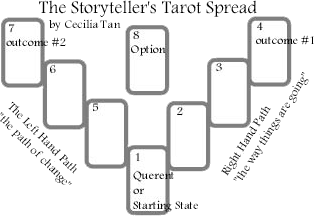
Whereas, in the Story Teller's Spread, the branching right hand path of three cards in succession at positions 2, 3 and 4, represent the expected plot scenario or dramatic situation, either of chronological events, past background ("act zero"), dramatic obstacles or challenge to overcome, then the future or climax, or else some other progression of states of being, all branching from and disrupted by the inciting or precipitating incident or event in the opening scene for the querant or protagonist as represented by a single first card at position 1. While the left hand branching path of another three cards at positions 5, 6 and 7, represent change, complications, the new progression or plot scenario, either of events, dramatic obstacles to overcome, or of states of being, unfolding. Lastly, a final center card at position 8 represents some third option, resolution, themes, moral or worldview.
|
|
|
||
|
|
||
|
|
||
|
|
||
|
|
||
Then pair or group any adjacent cards, seeking balance or imbalance of tendencies or relating the themes of one image to another, to creatively imagine story conditions more broadly.
 For example, perhaps the figure depicted in the 4 of Pentacles sitting fast in
the Tower basement even as lightening shatters the battlements above, deadly
debris falling all about him, yet he guards his treasure, even to the last.
For example, perhaps the figure depicted in the 4 of Pentacles sitting fast in
the Tower basement even as lightening shatters the battlements above, deadly
debris falling all about him, yet he guards his treasure, even to the last.
Or seek for themes in common, and yea shall find, for they are always there to be found!
And the associative system of reciprocal influence among categorized Elemental Dignities may also be utilized for gleaning further inspiration in relating paired or grouped cards, narratively.
 F
F
Above and beneath position one, which is the location of the center card, come the base and the crown, respectively. The base or root is thought to represent deeper, truer causes or reasons for whatever problem situation at hand, and is purported to derive from the past in issuance of the the querant's core motivation to his or her central question, whereas the crown purportedly reveals whatever the best possible outcome, alternative or achievement.
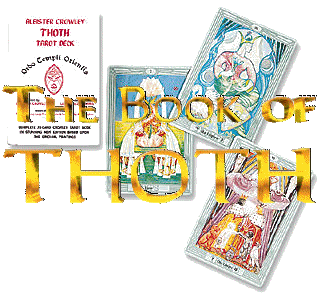
Indeed, the tarot figures of the base and crown along the y axis, no less than the chronological elements along the x axis, conjure up any range of archetypes personifying different motivations as friendly guides or malevolent misleading tricksters and in turn suggesting people coming into ones life or handy fictional supporting characters, friends and allies advancing the plot or malevolent or dysfunctional deceivers restraining the plot.
And all such archetypical characters making their entrances into ones life just as revealed in the cards. For, after all, no less than real people, characters are defined not only introspectively or in motivated action and free choice, but by their particular relationships and by their unique rôle or karma, the operant nature of their associations and influence within setting and milieu.
“People's level of motivation, affective states, and actions are based more on what they believe than on what is objectively the case.” -
Albert BandurRich and complex fiction often turns upon
complications, Peripeteia as in the estrangement of the bullied idealistic whistle blower. And likewise, in the Yin/Yang of the Tarot, if one pays attention, traditionally the reversed or upside down card caries special mythic significance, perhaps diminished or simply opposite to that card's standard significance, or all too easy to DIS-MIS, with 12 ways that cards reversed may be reinterpreted, plus a clever 13th, in the ways the direction the characters are gazing or pointing etc., will be different with the card inverited, signifying, thereby, a different other card position affected, related to or modified than when upright.Hence, indeed, the automated pnTarot™ even takes into account which way the figure in the card you choose as the Significator is facing, and adjusts the spread accordingly. And there are complex and novel special card combinations, no less than in any of the currently popular fad card combat games, all with bearing upon the more standard interpretations. Or there are variants more ominous and darker negation.

|
 Though
the graphics for the
Sacred Texts card reading are all somewhat stark black and white line
drawings, as befitting to such a bare bones automated Tarot, with hyperlink
click reference bookmark tags to the significance of each card and it's
position in the spread, some of which even seem redundant, and leaving
whatever
plot
or narrative entirely to one's own devising, as best appropriate for story
tellers compelled to shun all computerized assistance, desirous of no
prompting whatsoever! Indeed, no supporting
characters
or interactions are evidenced, but only various abiding personal
motivations
and static situational influences are at all suggested.
Though
the graphics for the
Sacred Texts card reading are all somewhat stark black and white line
drawings, as befitting to such a bare bones automated Tarot, with hyperlink
click reference bookmark tags to the significance of each card and it's
position in the spread, some of which even seem redundant, and leaving
whatever
plot
or narrative entirely to one's own devising, as best appropriate for story
tellers compelled to shun all computerized assistance, desirous of no
prompting whatsoever! Indeed, no supporting
characters
or interactions are evidenced, but only various abiding personal
motivations
and static situational influences are at all suggested.

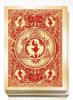
And then there is
the Dreampower Tarot and original spread.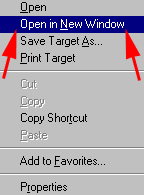 The
positions of the cards are explicitly and specifically significant
as to the rôle of the
themes,
motivation or
character
and the
nature of their relationships and
persuasive
influence, represented or read into the
card randomly occupied thereby, however the cards themselves may prove
enigmatic enough to challenge the writer's imagination.
The
positions of the cards are explicitly and specifically significant
as to the rôle of the
themes,
motivation or
character
and the
nature of their relationships and
persuasive
influence, represented or read into the
card randomly occupied thereby, however the cards themselves may prove
enigmatic enough to challenge the writer's imagination.
But beware
always to employ your context sensitive
right-click menu to
highlight,
select and then click
the "Open
in New Window"
selection in order to read more about each card, or else when the browser
back
button is deployed to
return to the cards as they have been laid out,
the page reloads an entirely new spread!

 For
all
For
all
 ,
no
less comprehensive than the offerings of the
,
no
less comprehensive than the offerings of the
 NewAgeStore,
the sheer range and scope of the
NewAgeStore,
the sheer range and scope of the

 offer splendid background resources in the fraudulent occult lore of
the Tarot,
all
roundly debunked
in an extensive,
accurately truthful
and serious history:
offer splendid background resources in the fraudulent occult lore of
the Tarot,
all
roundly debunked
in an extensive,
accurately truthful
and serious history:
Copyright 2001 - 2023 by
Aaron Agassi