

Q. What is the purpose of this section in a nutshell ?
Less is more: "Leave out the bits that people just skip ahead.” — Elmore Leonard
all them big four dollar words you been a'spoutin' all a time?
What, dost not all who span this spinning sphere, ever hath thus spake?
“Big words” are only “big” because other's curiosity, intellect, or hunger for knowledge is small. — Quant
- So long as you remain squeamish of heightened language, then you become part of the problem.
|
.jpg) |
And if one ever doesn't understand, one may always ask. As useful as it is correcting one another's mistakes (actually indicating a good grasp of the intent), what actually facilitates best communication is to simply indicate, specifically, whatever is indistinct or confusing.
And that is why, on occasion, it will often be worth the simple effort of interjecting comment, point by point, parsing and annotating another's phrases for any linguistic ambiguity. At least in conversation with anyone so forthright as to respond adequately with the requested clarifications, welcoming without fear such process of fault finding and error checking.
And this is how new understanding dawns from incomprehension, unless one lives only by re-warming over all that is already deathly familiar and unchallenging.
Vague and non specific complaints, however, remain as decidedly unhelpful in the reformulation and improvement of prose as in any other undertaking. And worst of all are those irate anti-intellectual whiners who act out by kicking up as much dust as possible, and then find the sheer temerity complain and blame others when discourse chokes on said dust! ("See? Now look how you've made me flame, thou pompous troll!")
But a good clear and polished final product will only result from continual rewrites, with proper feedback and civility. A Dialectic process conducted according to the standard Usenet posting conventions, building up or boiling down the ideas, as desired.
And so, with all due respect to the currently fashionable literary authoritative champions of the "Keep it Simple, Stupid" school of thought among other ubiquitous
Bad Creative Writing Advice, and, indeed, in all fidelity to the ongoing struggle against the evils of obscurantism, nevertheless, there remain other thinkers still, who yet do not quail or waver, enduring steadfast in the considered opinion that one ought not to be too easily intimidated by clever word play, big words or elaborated linguistic formulations any more than their complex ideas and whatever deeper meaning, unless one seriously expects and presumes, as only fair, reasonable and even one's due! to be actually talked down to.For indeed, as for what passes for critique, many there are that with blithe conviction denounce culture as pretension, call education effete, exploration Ecclesiastical futility, analysis ungainly, the truth unpatriotic and bemoan any vestige of vitality as plumb antisocial.
Woe unto us all! Because intelligence is largely a habit of appetite and interest, the simple custom of a second thought. And there are none so stupid as those who will not think! Not merely should they take criticism badly, rather that it sails right over their desiccated heads.
Ah, but they do fit in, don't they? That's why you ought to see things their way, especially when they refuse to really explain. After all, they feel so deeply! It's not that they are actually lost for expressive short words.
Regardless that Herman Melville may not be of free choice to every modern taste or just anyone's cup'a tea, nevertheless, 'Moby Dick' should actually remain within reach for any functional adult literacy. And while few of us may dare aspire to the heights of a William Blake, anyone ought to appreciate his deathless prose without waiting for the Reader Digest condensed version to dumb it down. For writing is many things, but always, writing is still the love of language. And vocabulary has always been prominent in the writer's tool kit, as well it should be.
Indeed, Patrick Stewart, no less, the actor who plays Captain Jean-Luc Picard of the Starship Enterprise in 'Star Trek: The Next Generation', has described the dialogue of 'Star Trek' in particular, as "heightened language", a nigh superheroic blend of Shakespeare and tech-talk.
Indeed, even the lengthiest and most elaborate of sprawling sentence structures will flow forth ever powerful with clarity, but beginning with subjects and verbs and only then with subordinate elements to follow or branch to the right.
A
nd consult the FoolQuest.com Terms of Use rants on short attention-span semi-literacy.
Why must you be so mean and nasty all of the time?
A. Actually,
I am kind and sensitive, and therefore, brutally honest.What is key to masterful and resonant prose?
Rhetorical schemes describe the arrangement of individual sounds (phonological schemes), the arrangement of words (morphological schemes), and sentence structure (syntactical schemes). Rhetorical tropes are devices of figurative language. They represent a deviation from the common or main significance of a word or phrase (semantic figures) or include specific appeals to the audience (pragmatic figures).
A.
For the uncontroverited fundamentals of prose usage The Elements of Style by William Strunk, Jr. is considered the classic, but take a word of advice and make better use of the impressive, clear and comprehensive Online Writing Lab Handouts Complete Index by Topic. And here is
A Dialog Lesson in
punctuation. Shucks, learn ya'
How to write good ! And then let's
evaluate
clarity.
Online Writing Lab Handouts Complete Index by Topic. And here is
A Dialog Lesson in
punctuation. Shucks, learn ya'
How to write good ! And then let's
evaluate
clarity.
Polemical styles of persuasion employed in plot logic...
Because, although the essential components of
plot structure for the writer to artfully balance remain fairly constant, a great deal of effort may often go into detecting and reworking all manner of pitfalls, in polishing a work to make it read easily, in every aspect of content, structure and prose, Stellar Sentence Structures in Painless Paragraphs, reworking every awkward turn of phrase, such as the begin fallacy, editing out redundant passages, Using Short Words Effectively, retrofitting and filling plot holes in coherent detail, and other gaps. After all, the secret to any good writing is good editing.A good writer often dwells upon these tasks, and still may need to come back to the work again later, taking satisfaction in the effort. Whether such will be a lone effort or in joint authorship.
So, test your writing IQ and learn the simple secret to good writing that is soul more than syntax [Wayback mirror] , both statement and feeling. And here's food for thought, guidance on The 12 Step fanfic Program.
Less is more: "Leave out the bits that people just skip ahead." — Elmore Leonard
Beyond all the above, if one must, there is one most basic maxim of writing style, choice of
narrative modes, that may help keep the narrative prose readable and make a more compelling word picture to direct the mind's eye:
The passive "there was an affliction of debilitating arthritis in his aging body" is weak, "he had severe arthritis" is that much plainer, but "he reached forward, slowly and painfully, to turn the door knob. And, after actually wresting the door open, he stopped a while to catch his breath. Shaken and rasping from the sheer fatigue, he clenched his teeth bitterly and tried to rub the stiff and tender joints in his swollen fingers" is active, immediate and most descriptive.
One may even chose details for adding lots of physical action! Not "She ran really fast and slid into second" but "She stretched out her legs, pounding hard and as far apart as they could reach into the soil, then dropped onto her side and slid through the rising clouds of dirt on her right hip, skinning her elbow sharply. . .
Even without "writing on the nose," important exceptions to the "show don't tell" maxim include, on the one hand, whatever such events from which the author for whatever reason elects to spare the audience explicit description, the eyeball kick, or on the other hand, hinted suggestion which may even be the more powerful, or else simply focus upon some other more important events, so as not to unduly precipitate, retard or completely interrupt the flow of the story.
All else in the logic of plotting scenes readily follows from pertinent decisions what need be shown regarding motivated characterization and conflict on many levels with dramatic obstacles.
Indeed, whereas journalism and history generally rely upon expository summary, the narrative of fiction can be rendered from sources and inspiration in reality by details of action and dialogue.
How to Show Instead of Tell:
Descriptions are often intended to reveal moral or psychological aspects of character. Motivated characterization is shown by external description of physical appearance including even physical characteristics that constitute symbolic elements along with meaningful names, Setting The scene and more, and also via relationships and contrast between characters (foil), with development or not, and any better hidden revelation and understanding gleaned from the reactions of others, dialogue and action.
Describing Your Characters Through Their Actions who then all the more come to life when they speak and are revealed with dialogue that shows, even sans adverb tags. Motivation unfolds suspenseful, in cycles of stimulus response, Motivation Reaction Units.
The reader needn't believe whatever one's told, unless it rings true and evokes pathos. To state plainly, that young man is touchingly awkward may easily seem more like awkward narrative. Instead, let the reader have their own emotions. Only show the awkward behavior to play upon our sympathies, and let evidence supplied move the desired verdict from the audience.
Indeed, perhaps most important to "show don't tell," is character motivation, for just such salient coherence and consistency in deeds, behavior and response, is indispensable and key to effective drama, the many levels of conflict inherent to situation.
Of course revelations of any character's own thoughts and feelings may be conveyed via straight exposition or rhetorical discourse directly providing needed background information from the authorial POV. Likewise introspection of any character's private inner most thoughts and feelings from the POV of inner life. Or, instead, interior monologue may attempt to convey in words the process of consciousness or thought as a means of narrating a story. But stream-of-consciousness or otherwise Representation of consciousness may even endeavor to show, convey or portray in thoughts, experience, the entire subjective Phenomena, as it passes by, often quite at random.
While, indeed, there are important exceptions to the rule of "show don't tell," and frequently the need for backfill narrative, even black box scene analysis and also hybrids such as the half-scene, nevertheless, more often there may be many better techniques by which events even foreshadowed by anticipatory imagery, can unfold in scenes or even by creative stagecraft, rather than actually being explained. Indeed, editing film has been likened unto writing with images, and viewers will actually tend to form context on their own, even from sequences of unrelated shots, however random. Never remind readers they're reading. Allow the reader/viewer/audience to figure things out. Indeed, for that matter, whereas in pornography the sex is always good but all the reader remembers is the intensity of the orgasm, to quote John Casey, in Romance Fiction, show and bring to life “…the swoon, the delicious palpitations of one’s heart is the real eroticism.” -which is to say, feather soft core.
Favor the specific over the generic. Although an actual story can effectively and evocatively reinforce and return to a central theme, essential understanding or recurring concept, often conveyed via some symbolic Objective Correlative motif or topos, but even then, with variation.
Fictional characters like unto real unto the people they generally represent, are wont to associate emotionally to setting via meaningful key "objects," not only real physical props, decor, senses, smell, mood, ambiance, light and sound, but also triggers of memory and motivation perhaps focused thereupon, sentimentality after a prolonged absence, or to heighten or show any range of affect and motivation from tragic loss to pleasant anticipation.
Good writing is akin to good reporting, conveying the level of intensity and other evocative qualities of any scene, or, for example, in the vital details of group scenes.
And so, no matter the tone or attitude, atmosphere or ambiance, as evoked by the perfect setting, by Writing from the Senses,
SUBTLE AND sensuously, with some reference to sensory perception in every paragraph, describing not only what a character sees, but hears, smells, tastes; the wind on his or her skin, the drone of insects, whatever, for richness of texture the senses remain key to Techniques of Suspense plotting and particularly to building onstage sexual tension and even aversion. Therefore, details of reflection, perception and experience must be chosen to draw out the moment that the reader may in turn be drawn into whatever the ambiance or other qualities of the passage or sequence, whichever point in the narrative.The gap in Behaviorism was never cognitive, but Psychodynamic all along. Behavior, including action and expression or dialogue, is often actually less mediated by cognitive events than by Psychodynamic events, feelings and motivations to be specific, often with inner conflict, in an observable (show: don't tell) cycles of Motivational Reaction Units. Cognition is a rational function of the ego, Phenomenologically manifest in reflection.
“Thoughts are the shadows of our feelings - always darker, emptier and simpler.” — Friedrich Nietzsche
Aptitude with nuanced nonverbal communication, is sometimes named: covert social skill. But isn't such, rather, a function of Emotional Intelligence rather than social intelligence or social skill? Perhaps that depend upon application thereof, to what extent whatever subtext transacted be genuine, individual and autonomous, or social and disingenuously heteronymous. Other functional subtleties are the proverbial grain of salt, context, moderation, proportion and even the saving grace of social hypocrisy mitigating otherwise barbaric custom, all typically lacking in comically over parented heteronomy.
Action, great or small, serves many functions, from evocation of characterization to punctuation of dialogue even a simple gesture such as a shrug or a nervous laugh, an action or task, lending context, in turn, all likewise, key in showing characterization, wherein motivation should be apparent no less than in a reaction shot, even as specific as, for example, what sort of frown, confused, troubled, or disapproving, and even through thoughts, however expository. And in all that is spoken and unspoken, unique, original and rounded and multifaceted characters must be concrete with their own unique behavior and responses including dialogue with tone, subtext and believable details of body language, that are consistent with their own perceptible background and outward signs, in Describing Your Characters Through Their Actions. And the logic of deconstruction expands and unfurls consistent story elements and variations out from one another. In the rewrites, details reexamined serve as clues to a better sdeveloped tory.
Or instead of telling, explaining or else showing cinematically or sensorially, in the novel there has long also been refined the literate elaboration and demonstration by dimensioned anecdote, even sheer gossip.
Identity is often associated with habit, and yet, the public persona seldom matches the Phenomenal reflection of inner life, POV, 'spin,' interpretive frame of reference, so much of which, in turn, us filtered through our meager and misguided self-understanding. Indeed, beware, the personal constructs of social cognition often arise from various learned or innate naturally flawed Epistemological Methodology.
Indeed, do we consider our options and consciously take action, or do our actions simply come upon us as we react to situation, and only then rationalize afterward? Frequently, the self conscious illusion of individual will is only the burden of responsibility in hindsight after misdirection (whether error circumstantially and honestly, by deliberate manipulation or even hamartia and self-deception) has already been key in moving from promise to catastrophe. -An artifact of the personal narrative facilitating growth and the unfolding process of tragic discovery and self recognition called Anagnorisis. Indeed, beyond direct action, our influence upon others may often be even the more misguided and deluded.
Some say that one becomes addicted to shame when another's heart is closed to one, because, however excruciating, the sheer megalomania of taking the blame protects one from the ugly truth that we really have no control over others and the universe or God. We can't make either love us or, ultimately, even protect those who do. Put more simply, then, and in complete good faith, powerlessness, the impotent helplessness of the human condition is terminally demeaning.
Drama is conflict on many levels, or contradiction, more than mere crisis, that is inherent to situation, conflict being more than merely an event, but like unto karma, a condition, a relationship. Alas, however, beware! poor staging or presentation of conflict is effectively misdirection that dissipates inherent drama.
Moreover, well rounded fictional characters
like unto the real people they generally represent, wont as we all are to attachment, are often prone to associate emotionally to setting via meaningful key "objects" or personal symbols, not only real physical props, decor, senses, smell, mood, ambiance, light and sound, but also triggers of memory and motivation perhaps focused thereupon, sentimentality after a prolonged absence, or to heighten or show any range of affect and motivation from tragic loss to pleasant anticipation.“People's level of motivation, affective states, and actions are based more on what they believe than on what is objectively the case.” -
Albert Bandura red
herrings,
innate naturally flawed
Epistemological
Methodology
and
elements of narrative even including
Pathetic
Fallacy, each with it's own distinct
advantages and disadvantages
and often conveying, beyond
plot
frame and sequence, perception,
sense,
time
frame
or
structures,
duration, and
pacing,
and
into the thematic
significance
of the setting or
milieu
as a
vehicle of
reasonable description in
character and plausible to the
situation,
organized description either in any spatial order, vertically,
horizontally or depth perspective, as and that might draw the eye or stressing
that which whatever such an individual would likely prioritize, uniquely react to and
notice first under whatever particular circumstances, will help to avoid an
unlikely artificial seeming separation of
character from place, again, bearing in mind,
who's voice?
red
herrings,
innate naturally flawed
Epistemological
Methodology
and
elements of narrative even including
Pathetic
Fallacy, each with it's own distinct
advantages and disadvantages
and often conveying, beyond
plot
frame and sequence, perception,
sense,
time
frame
or
structures,
duration, and
pacing,
and
into the thematic
significance
of the setting or
milieu
as a
vehicle of
reasonable description in
character and plausible to the
situation,
organized description either in any spatial order, vertically,
horizontally or depth perspective, as and that might draw the eye or stressing
that which whatever such an individual would likely prioritize, uniquely react to and
notice first under whatever particular circumstances, will help to avoid an
unlikely artificial seeming separation of
character from place, again, bearing in mind,
who's voice?
Hence, to pique curiosity, the physical realism of Science Fiction may introduce one to whatever world or situation, sans cumbersome instruction manuals telling too much too soon, instead showing from the verisimilitudinous Edge of Ideas like unto the historical subtext of an invented and often far future or otherwise distant world or setting, abruptly, yet unfolding bit by bit, or even in some entirely novel and surprising manner, baiting the all important hook or grabber and more, actually central and unique to whatever the work's special appeal and invitation to the thrill of shared disorientation. For avid readers of Science Fiction are alert to seek out and make note of seeming incoherencies as tantalizing clues to the mysterious and fabulous world beyond the narrative, even somewhat likewise as the true lover of poetry must seize upon narratively inexplicable visual disruptions or conjunctions of sound.
And as for showing elements and information the importance of which may only become clear later on, Don't Drop Clues -- Place Them Carefully! and clearly for the audience. Even
red
herrings let alone crucially important clues, particularly such
as raise doubt as to the outcome,
tension
raised by
Techniques
of
Suspense
plotting, by going overlooked within the story and especially
by
foreshadowing, clues or otherwise suggestions as
to later events unfolding in the
plot, even the
content and outcome of the
story.
Exposition, even however naturally and incidental in dialogue, may reveal information, plot points however crucial, that is, among the characters of the story, known to all or else only to some, hence yet to be discovered by others.
Creating,
choosing and
describing the perfect
setting
Character and
setting
INTERACTIONS
include the
red
herrings
innate naturally flawed
Epistemological
Methodology and
elements of narrative even including
Pathetic
Fallacy, all redolent with
theme.
Q. What is paqoz?
A. "Delicately edged" or more narrowly, Pathos is the feeling aroused or that quality, as of an experience or a work of art, motivation of your audience and Getting Under Their Skin, that arouses feelings of pity, sympathy, tenderness, or sorrow, or even an an argument based upon emotion, pandering, playing on sympathy, fears, and desires, even as is typical of propaganda, to heighten sympathy and identification with central characters, through a range of emotion or motivation, and most strongly at the climactic lowest point.
- There is no such thing as a “good faith” emotional argument.
It is an exploit not an argument- Only the corrupt engage in pathos and exploitation
- What is on sale is never the actual pay load.
There can be no excuse. Indeed, with the possible exception of all the more damaging and melodramatic innuendo, "BE" IS FOR "BORING." In order best to show don't tell, use action verbs instead of Be verbs, as in these evocative figures of pathos or even the symbolic imagery of Pathetic Fallacy.
To show means either to display in action or else, otherwise, object demonstration, persuasion, even pandering propaganda or a moral, a lesson enfolded, when abstract knowledge alone fails to make an impression.
Q. Where is to be found the deeper meaning in fiction?
A. Such depth is there to be plumbed and discovered
in sophisticated Literary thematic subtext...
A.
Tone varies
to express the full range of
human feeling and thought,
text and
subtext,
spoken and unspoken
body language, likewise
to inform and influence audience reaction or perception. The
term is usually used to refer to the tone of language in narrative or
drama,
or the tone of a narrative, lyric
persona or
POV,
filtered perceptions and
Interpretive Turn. Tone is the manner of
expression in speech or writing, the attitude adopted by the speaker to the
listener, likewise the author's attitude toward the work, events,
characters,
or audience, even
subtext
gathered and understood from the
tone
of syntax and vocabulary used, while mood is atmosphere or frame of mind. No
less than as with the literal intonation of
voice
in speech,
the quality of sound, like unto musical tones, produced by the
voice
in
uttering words, likewise in writing tone conveys the author’s attitude, stated
or implied, toward whatever subject and which may help convey the
theme.
Such an attitude might be no less immediately apparent then as in a strident
tone of voice, or, on the other hand might be in a complex and subtle a manner
which takes time to establish in an extended written work.
Layers of
subtext
and
ambiguity are richer and thought provoking.
Choose and vary wording and phrasing. Beware repetition,
Micro
Repetition,
Macro
Repetition,
Mega
Repetition.
An author’s tone emerges through choice of words and details. But mood is the
climate of prevailing feeling in a literary work. The choice of
setting,
objects, details, images,
symbols
and words all contribute towards creating a specific
mood.
For example, an author may build up a certain mood around a
character
or
setting,
and even while treating such a
character
or
setting
in in quite a different tone. Indeed, such a contrast may be
ironic,
implied
meaning differing from whatever that is stated overtly. Thereby, mood
remains distinct from tone. For example, the mood in a Halloween children's
special may be deliberately ominous, dark and spooky, while, by
ironic
contrast, the tone emerges as light hearted, wacky and comedic fare. Tone may
be formal or informal,
trusting, even to the point of naivety, or deeply
suspicious (whether or not the mood is brooding and paranoid), passionate
(excited, sorrowful, loving, angry) or calmly meditative, outright
bored and
jaded, detached or intimate, serious, straight forward, even pompous or else
light-hearted, even
witty
or out and out sarcastic.
Whereas, mood may shift and change from
scene to
scene to mirror the emotion
of the point of view
character
through whose experience that scene is filtered. Indeed, while stark contrast
creates impact, otherwise the external mood in
situation and
setting
should mirror the internal mood that is an aspect of
POV,
filtered perceptions and
Interpretive Turn, as perhaps express though
persona or
character
attitude, to more subtly incite the audience to react as intended to
events than more blatant
propaganda.
 Writing
Great
Dialogue?
Writing
Great
Dialogue?|
A talented conversationalist never monopolizes the conversation but strives to engage others. A conversation is like unto a volleyball to be kept in the air: Set up others to take their shot. With skill, the flow of conversation may be gently guided and directed. Build a repertoire of topics at your fingertips, Ask open-ended questions that cannot be readily answered with a simple "yes" or "no". Find new ways to phrase typical standard questions and prompt more interesting replies. |
 A.
There
are
six
core
polemically
purposeful
and
dramatic
motivations for
dialogue
salient towards
literate
understanding
or
modeling
of
the
rhetorical
situation[ism]
analysis.
A.
There
are
six
core
polemically
purposeful
and
dramatic
motivations for
dialogue
salient towards
literate
understanding
or
modeling
of
the
rhetorical
situation[ism]
analysis.
Tone as well as body language, are also important in delivering dialogue, even the punctuation of a simple gesture such as a shrug or a nervous laugh, let alone an action or task, lending context. People speak in each their own realistic variations, individual rhythms, language, voice and style, all crucial to purposeful effective dialogue. Action or dialogue with tone and subtext may be key to show or evoke characterization, spoken and unspoken, wherein motivation should be apparent, and even through thoughts, however expository.
Six key functions of imagined interactions are: relational maintenance, conflict management and resolution, rehearsal for future interaction, insight, catharsis and compensatory fantasy.
Characters are revealed and come to life with dialogue that shows, even sans adverb tags.
Keep it short, snappy, interactive, dynamic, subtle, meaningful but simple.
“People's level of motivation, affective states, and actions are based more on what they believe than on what is objectively the case.” -
Albert BanduraThe clues to answer such dramatic questions may lie beneath the surface TEXT and CONTEXT in subtext, What Lurks Beneath, shown by way of each of the senses in setting, action and atmospheric tone, along with the Subtle and Delicate Art of Doublespeak dialogue, that may either harmonize with text, or in true Method subtext, even disagree with text, subtly, so as to draw attention into a deeper vein or level of conflict by being subtly wrong, to show or evoke characterization, wherein motivation should be apparent, even through thoughts, however expository. Layers of subtext and ambiguity are richer and thought provoking.
Even however little action may reveal more than any volumes of dialogue from the same character, or even contradict one another, raising tension. Indeed, cognitive dissonance, the inner conflict of dishonest hypocrisy, manifests in dialogue as Antiprocess. Well rounded characters manifest conscious and even false goals often in both inner turmoil as well as practical outer conflict with radically different unconscious motivation quite unawares yet nevertheless betrayed, demonstrated, shown, by their actions and growth into entirely new goals. However, no less than characters need motivation over all, more, the plot chain of cause and effect very much includes stimulus and response. Thoughts and reactions must be revealed and shown, for the story to remain coherent.
In the end, it can't look like acting. "Writing on the nose" is an old Hollywood pejorative expression denoting dialog lacking the subtlety of subtext. After all, in real life, people rarely just come out and say what they really think. Therefore, motivated characters shouldn't either. Without being blatant, context comes to light in the way that people talk to others consistently with how they take measure and relate to whomever they are talking to, and revealing as to how they feel about that person and perhaps as well, whatever the topic of conversation.
Each event in sequence that follows from motivated character action consistent with background, must in turn initiate from observable proximate stimulus unless entirely emerging from inner life, and, either way, rather than simply remaining mysterious, known only the mind of the character, must one way or another be shown intelligibly to the audience, even if none of any other characters; either way, in turn, quite probably another vitally important plot point. Whenever the cause and effect chain ever omits such links, expect plot holes stumbling amid succession of unrelated events.
The dramatic efficacy of revealing and motivated subtext is in desire, giving rise to need and ingenuity. Drama is the gripping and engaging tension-laden presentation of conflict on many levels, whether or not the storyline is even believable. Drama is conflict on many levels that is inherent to situation, conflict being more than merely an event, but a condition, a relationship. Alas, however, beware! poor staging or presentation of conflict dissipates inherent drama.
No matter how plausible, better fictional dialogue with all if it's hazards greatly differs from ordinary real life conversation in that fictional dialogue generally is and usually must be edited. Among the many uses of dialogue are setting the hook or injecting humor. Among the pitfalls of bad dialogue are unnatural sounding stilted language, especially during exposition of plot, imparting whatever information, recap or back-story, or generally repeating information for the benefit of the audience or filler that does little to advance the scene nor deepen characterization. Only used car salesman actually say peoples' names back to them!
So,
in summation, be mindful of the simple
rules
and guideline of prose for formatting dialogue, and always make
Dazzling
dynamic Successful
Dialogue
Work
Harder.



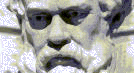 The
Dialectic of Socrates
or: Socratic Method
is a technique of cooperative argumentative dialogue
between individuals, by asking and answering questions. Socratic method
endures as an ancient, renowned and highly efficacious polemical and
Epistemological
Methodological
reasoning and error checking tool and method of investigating problems
through
controversy,
dialogue discussions,
definition, observation, analysis and abstract discovery of generalization, embracing
valuable
Intellectual Traits
and
dimensions of
critical thinking,
an open exchange, preferably among frank
and
trusting equals.
Socratic Method proceeds and unfolds in a step by step
cross-examination technique/procedure,
of imminent
critique (the
legitimate modified form
of Ad Hominem) checking for validity
of internal consistency,
of
questioning
assertions or inviting question, in order thereby to draw
out inherent
contradictions or
inconsistencies and
midwife, bring to
light, self
knowledge,
starting with Geometry or anything else, but
principally in matters of
moral principle
and
character
growth,
to recognize
contradictions between
values
one avows and the
choices
one
freely
makes and perhaps empowerment to improve. - In short, an ongoing systematic
questioning of beliefs, traditions and authority. In a word:
Philosophy. And the
productive discomfort of Socratic Method serves well in the writing of
dramatic dialogue, much as in it's own true to life
drama.
The
Dialectic of Socrates
or: Socratic Method
is a technique of cooperative argumentative dialogue
between individuals, by asking and answering questions. Socratic method
endures as an ancient, renowned and highly efficacious polemical and
Epistemological
Methodological
reasoning and error checking tool and method of investigating problems
through
controversy,
dialogue discussions,
definition, observation, analysis and abstract discovery of generalization, embracing
valuable
Intellectual Traits
and
dimensions of
critical thinking,
an open exchange, preferably among frank
and
trusting equals.
Socratic Method proceeds and unfolds in a step by step
cross-examination technique/procedure,
of imminent
critique (the
legitimate modified form
of Ad Hominem) checking for validity
of internal consistency,
of
questioning
assertions or inviting question, in order thereby to draw
out inherent
contradictions or
inconsistencies and
midwife, bring to
light, self
knowledge,
starting with Geometry or anything else, but
principally in matters of
moral principle
and
character
growth,
to recognize
contradictions between
values
one avows and the
choices
one
freely
makes and perhaps empowerment to improve. - In short, an ongoing systematic
questioning of beliefs, traditions and authority. In a word:
Philosophy. And the
productive discomfort of Socratic Method serves well in the writing of
dramatic dialogue, much as in it's own true to life
drama.
Do not simply state, declare or assert that such or other is so, but challenge and question: Would you agree that such is so? By precisely such closed and deliberately narrowed Dialectical process, Socrates promised to call in his very antagonist as supporting witness, in any reasoning so plain and inescapable of whatever solid argument. Whereas open ended dialectical questioning proceeds without any predetermined script, by raising any question, and then further questioning each answer or response in turn, in order to expose just how much we take for granted and how little we actually know. Moreover, any unexpected response may send closed dialectic veering off script into open dialectic. Such is the pursuit of enlightenment by refutation for those of friendly and intellectually honest disposition to value such a thing, and tolerable to those Athenians who enjoyed humoring the eccentricities of Socrates, but all to often, a shabby trick of public humiliation in the estimation of the vain, fragile, prideful, spiteful and powerful, their ignorance and vanity exposed by the gadfly Socrates.
Modern Scientific Method of experimentation remains predicated upon Socratic enlightenment by refutation in a process of elimination setting aside unviable hypotheses, thereby clearing the field of all but any handful of remaining viable hypotheses, ever less wrong. In true to life practice or merely in fiction wring, the Dialectic readily brings to light meaningful conflict in dramatization of controversy and values and intriguing problem to solve. Socrates hailed drama as most philosophical among the arts. In skillful fiction wring much as in reality, the Dialectic facilitates high dramatization, beyond mere plausible contrivance, of exposition with controversy through dialogue raising conflict on many levels and tension motivated by the relentless pursuit of truth through unceasing questions even perhaps to the point of tragic hamartia or blind error of maladaptive improportion, so-called Socratic irony, a stated ignorance and probing willingness to learn from others by adroit questioning to reveal the inescapable truth and expose the errors of the answers received, by progressions of seemingly innocent questions ultimately leading the respondent to a logical conclusion incompatible with whatever that person's originally stated belief, indeed, exactly such that attempts to evade and back out all deteriorate and fail, just as in any fine drama. But perhaps most dramatically of all, whereas even perfectly honest and straight forward rhetoric or any story or fable with a moral, let alone slippery Sophistry or devious propaganda or any fraudulent manufacture of consensus, indeed, leading questions dishonest and manipulative or honestly transparent, all aim to convince and persuade, in response, the Dialectic of Socrates may often be more akin to a more Literate meaningful thematic exploration, indeed falling short of pat answers, and instead, enlightenment by refutation, the elimination of unviable hypotheses. By his method of challenging the claims of participants in his dialogues, Socrates would expose ignorance in others by first admitting his own ignorance, Socratic irony, to elicit honest answers to pointed obvious question in detail, centering the discussion and evidentiary burden upon the beliefs of those he this cross-questioned.
It has been observed that one never learns anything so well as when one is coaxed forth to teach it! As we discover in the Dialogues, the Socratic Method of exploratory cross questioning with even the broadest and most open questions opening and expanding thinking and discussion, may serve to ferret out and expose weaknesses in an argumentative position, thereby to challenge complacency and achieve enlightenment by refutation. Also, however, framing the logical steps in an argument even as very narrow specific rhetorical questions, draws the focus of the hearer either to acquiesce or to rebut, point by point, rather than endlessly gainsaying and bypassing. But to narrow focus and draw attention in any one direction is often a misleading diversionary tactic away from other possible thoughts. Hence, to press a string of leading questions leading directly to the desired answers to elicit, may as readily serve for systematically chopping from whatever the full range of logic applicable, with selective information as well, thereby even repressively molding ideas rather than to nurture the flower of autonomous thought. Moreover, while logically leading questions require understanding of the concepts and principles involved in order to be answered correctly, psychologically leading questions can be answered by keying in on clues other than the logic of the content at all. -In other words, by approval seeking. And all this much too, may already be gleaned at all, even from the Dialogues of Socrates, even if somewhat unacknowledged therein.
Aside from exploratory open ended questions, a crucial technique of Socratic Method is indeed the intellectually leading question simply to double check and get any point across clearly, step by step, so that all understand exactly what they agree to, and not circuitously to confuse ones opponent as recommended by Schopenhauer, nor otherwise to the point of distorted logic chopping with selective information, nor emotionally leading questions and pressures of approval and disapproval, and certainly not tawdry and blatantly dishonest and abusive are the ambiguous linguistic or semantically leading loaded question, wherein, one way or another, answer to one possible interpretation is then deliberately taken out of context into the other. -For notorious Vaudevillian example: "Have you stopped beating your wife?"
For the Dialectic of Socrates remains an intrinsically two edged sword to wield. For plainly, some of the Dialogues remain livelier than others. Some are more skeptical and contentious, and others more propagandistic going largely unchallenged. Of course the former are often deemed more genuine, while the latter considered more the invention of Plato towards his own agendas. Whereas the candor of honest controversy proffers the benefit of the doubt, because the tool of argument serves alike in sporting debate, honest unapologetic discourse among trusted friends, sly caution among knaves and liars, or sorting out who is which. And, make no mistake, here is the real reason why cowards, reactionaries, liars and bullies so resent and vilify controversy. Hence, in drama as in life, it may often be the more instructive to engage in Socratic irony by playing stupid with an indignant liar in order to trip him up by lending him enough rope by which to hang himself, than to play into his hands by entering into an immature pointless shouting match. Devious as tactics of Socratic irony may seem, nevertheless what is worse, cowardly and irresponsible, is to demure and accept bad faith as good.
Arguments remain difficult getting anywhere without first clearly identifying whatever disagreement. Therefore the Dialectic of Socrates legitimately follows two modes, either logically leading questions in sequence, arguing and double-checking to discover error or disagreement, point by point, in rational polemical persuasion towards an intended conclusion, or else open ended questioning with no preset destination, in free exploration bringing all into question as ever may arise. Leading question may veer off into open ended question at any time, because of an unexpected answer or counter question. The scrutiny by leading question begins by taking any coherent step by step argument, and questioning each point, indeed rephrasing each point is sequence of an argument, as an even rhetorical question to gain ascent and agreement.
""An unexamined life is not fit to be lived by a human being." (Apology, 38a) For the capacity for reflection is uniquely human, and there is wisdom simply in even knowing that one does not know, gauging and understanding the scope of one's own ignorance, the limits of ones own knowledge. Hence, in Plato's Dialogues, Socrates constantly asks questions in order to come to an understanding of something or other (e.g., piety, knowledge, courage, temperance, justice, etc.). Upon receiving an answer to a question, Socrates usually commends his interlocutor (ironically), and then asks for clarification of a few points (almost the way Detective Colombo voices nagging after thoughts during a typically infuriating false exit); that is to say, Socrates asks further questions that arise from the answer to the previous question. This process continues until Socrates' interlocutor (if enlightened or entertained thereby, or just reasonably emotionally secure to begin with) either finally admits his ignorance of the subject contrary to his original claim or else (otherwise) simply becomes extremely annoyed with Socrates.
This method of inquiry is renowned as the dialectical method: the asking of a series of interlocking and progressive questions. Step by step, by framing every each reasoned argumentative point not as an assertion, but in the form of a question seeking assent, then from forthcoming reply it will be possible for the interlocutor better to discern if the other party clearly follows or agrees. Error detection is also served along with ongoing miscommunication repair and clarification of disagreement. Also, by every inevitable deviation from script, open ended exploration ensues.
Thus did the gadfly Socrates in his investigations gain the reputation for impractical, esoteric speculation about the cosmos, which not every Athenian appreciated, not liking to be made to feel foolish, especially the most unteachable unreachable envious grudge-collecting dullards in town, often glorified experts in their own narrow fields, discounting all other disciplines and presuming thereby to know everything or at least everything important.
Unskilled and Unaware: The more one knows, the more one might come to realize all that one doesn't know. Such is growth in the sagacity of Socratic Wisdom. When Socrates was hailed as the widest man in Athens, he retorted that this could only be because and in so far as he, Socrates, knew that he knew nothing! Socrates valued honest ignorance. Therefore Socrates never resorted to such derision as 'Dismissive Incomprehension,: A Use of Purported Ignorance to Undermine Others.' Modern research corroborates that the ignorant often think themselves knowledgeable and the unskilled often believe themselves to be capable; lacking as they do, all knowledgeable referents by which to asses circumstances and self evaluate. They fail at metacognition. Such is unaware incompetence, so bereft of Socratic Wisdom. Others learn or become Behaviorally Conditioned only how to garner approval and fit in, but at the expense of all responsible decision and action. Such operant behavior in society, nevertheless externally irrelevant, is called: skilled incompetence, prime example of the unexamined unworthy of the living for any human being.
The truth will out! To thine own self be true! Argue your point. Criticize. And encourage others, likewise. And you too, like Socrates, may come to stand castigated and condemned by bitter old farts for corrupting youth!
But beware the insidious support group exchange of extrinsic motivational conditioning and Constructivist Listening rather than any techniques of Active Reading or Effective Active Listening, Constructivist listening being a process of passively allowing a person to talk without being interrupted, with nary ever a care regarding Miscommunication Competence or Conversational Adequacy, indeed wherein listeners neither overtly respond nor interpret at all, neither to paraphrase, analyze, proffer advice nor seek to relate via personal stories, all because people are simply held to be capable of solving their own problems by thinking aloud. -All very much in accord with Nihilistic value destruction as implicit to the Solipsistic Zen position upon dialogue.
A.
Is the very beginning adequate to pique and to hold the reader's interest? After all, just as the old saying goes, first impressions are everything!The "mini-crisis" is the setup at the beginning of the story in which the dilemma is established, comes to pass or is discovered by the protagonist or just the audience, if it turns out the protagonist knows all along. Also the characters' reactions thereto.
The Point of Attack is that first thing the audience will see or hear as a play begins or in the first short segment to pique inrterst before the credits in a TV show, called: the teaser.
anything that comes early on to help pique curiosity and even pathos in order to involve the reader. Indeed, anything puzzling enough to demand explanation, certainly including the unfolding of whatever the anomalous Speculative Element of Science Fiction, may hold the audience as ever any such revelation unfolds. Woo, beguile, slap or tickle. Anything provocative. The teaser is the first scene in a teleplay, just before the opening credits, that sets the scene with an exciting situation and even a cliff-hanger.Or it can all be more understated: How to Open Without a Bang
Indeed, every vital element to compelling story may already be introduced in a dynamic beginning to foreshadow that which will have impact to come, unless it's only bait and switch.
Or else, for a a better hook or grabber, the story may start from a big scene in the middle or in media res, even plot inversion, so that the beginning must retrieved, later on, in flashbacks. Also, for the scene to be established from various points of view, the position in sequence of each item may be shifted about or actually shuffled together. Yet the essential components remain the fairly constant.
Meeting new friends, getting hot dates, or making more money; success, commercial, political, social or romantic, is after all, a matter of sales, of selling yourself, of creative writing, of telling a story, finding and baiting the hook. Naturally, the most prevalent hook online will be that of whatever success or writing guru, offering the secret of finding your own unique hook and baiting it just so! Ah, but what if I turn all of that on its head? Gentle reader, here's my hook, then, about the agenda of FoolQuest.com: If anyone else were, then why would I bother? And the bait, something that everyone wants: That your opinion will be valued.
Q. What is key to effective pacing and rhythm?
A. In fiction, there are various conceits for imparting whatever information crucial to the story. Otherwise, there is nothing wrong with the economy of a fast paced adventure yarn which is confident, careful and concise, for The Art is in the Revision. In so far as fiction must be life-like, nevertheless the dull bits are best excised, not spelled out in excruciating detail or padded. Whatever details should be salient and revealing. Use it or loose it! Observe dramatic economy and eliminate needless redundancy.
Indeed, whatever motivation establishing conflict on many levels and even pathos in fight scenes needs must come before hand and even such crucial exposition and background information as the terrain is best established immediately before a chase sequence, usually lacking dialogue unless it's short and clipped.
Psychogeography is the art that endeavors to record and to understand the influence of the outer environment upon the human mind, including, no less than plot frame and sequence, sense, time frame or structures, duration, and pacing, as well as, reciprocally, the Phenomenal creative mental emotional process of meaningful association to locale and environment which is so key to the most evocative use of setting in fiction.
A good descriptive passage shows in specific, well-observed detail, revelation of the character's inner life and driving motivation. Eliminating needless redundancy presses the writer to show in more and better developed detail to guide the reader through character focalization, filtered perceptions from prior experience, context, bias, Phenomenal and interpretive frame of reference, 'spin', propaganda, or the scarce resource that is Point Of View, superficial or deep Viewpoint, and elements of narrative, each with it's own distinct advantages and disadvantages and often conveying perception, sense, time frame, pacing or duration, not merely plot frame and sequence, and into the setting. -A reasonable description in character and plausible to the situation, stressing that which whatever such an individual would likely prioritize, react to and notice first under whatever particular circumstances, will help to avoid an unlikely artificial seeming separation of character from place, again, bearing in mind, who's voice?
Your Story at Your Speed. Filler, details filled in just for the sake of completion without even so much as local dexterity, even if not excessively belabored, may tend to be both awkward and dull, fails to effectively control pacing so as to build and sustain tension and pathos by Techniques of suspense plotting, anticipation, even aversion, to help achieve immediacy in The Rhetoric of Action. Indeed, a good rhythm of repeatedly building tension, even discomfort and aversion, spoken and unspoken, followed by comedic relief, or charm and alarm, generally helps in holding the attention of an audience. Likewise, in any Horror screenplay, effective timing may be derived from an understanding the physiology of boredom.
However, all such tricks aside, beyond simply being drawn out, lest only into sheer irrelevance, boredom, aggravation and disappointment, what is also required for suspense is anything to raise anticipation by heightening the moment extended. For, just as any plot requires some dramatic obstacle, even for any story at all, just as eustress will often become a function of Creative Tension, likewise building tension by Techniques of mounting suspense requires an immediate obstacle to raise conflict on many levels and put the outcome of Emotional decision making in doubt. -Even sheer momentary hesitation, diversion or distraction, and some internal or external trigger or motivation thereto, even as the character begins to take action, also with something more to spur them on, then perhaps to some element of surprise. For in the words of Friedrich Nietzsche : “Thoughts are the shadows of our feelings - always darker, emptier and simpler.” Drama is suspense drawn out over the long term of the story arc, whereas suspense is the immediacy of drama in the short term.
To show don't tell, details of reflection, perception and experience must be chosen to draw out the tension of the moment that the reader may be drawn into whatever the ambiance or other qualities, including suspense, of the passage or sequence, whichever point in the narrative.
Q. Any additional more specific and over all follow up advice about fiction writing?
A. After a quick review of the fundamental elements of fiction, follow The 39 Steps: A Primer on Story Writing and be sure to drop by Writers Studio 2 and take the Strange New Worlds Hints, then ponder the Aphorisms for Writing Science Fiction and consult A checklist for critiquing Science Fiction while ordering in fluent Literary and Rhetorical Terms from the Pure Fiction writing menu, and consider the Hardcore Critique Guidelines about How to Critique Fiction when Reading Fiction and then Writing about Fiction.
Beginning with the outline for introductory six part mini-series
also serving as series "bible" for Star Trek: The Ship of Fool, no effort has been spared by glossing over that which is merely perfunctory and dull. Nothing should be included unless it is interesting, provocative or dramatic. To provide new and colorful motivated and even unique and original well rounded and multifaceted characters, and to speculatively advance the ramifications, or at least take over the top rather than simply rehash or further trivialize, the most appealing STAR TREK tropes.And that Star Trek: The Ship of Fools outlines and drafts are truly unfinished, with much to be added and changed, rich with points of creative departure for anyone to join right in a real ongoing online writer's bull session. Not just dullardly anal formulaic filling in of the blanks with the obvious simply for the sake of completion in immersive detail, even however arbitrarily.
Q.
Why
the
title?
A.
The
Ship of Fools,
sacred fools, is a classical allegory of the human condition, blind and
impulsive in hopes of salvation. And
Star Trek: The Ship of Fools is a tale of encounter with the unknown from Rashuman-like
multiple perspective, and corresponding
dramatic
conflict on
many
levels from
clashing motivation.
Hieronymus Bosch • Annotated • schooled fools • yellowdog
Copyright 2001 - 2023 by
Aaron Agassi